The Kreutzer Sonata (Bernard Rose, 2008, USA)

Mostly famous for having made effectively creepy slasher Candyman (1992), British director Bernard Rose’s career since has seen him tackle the life of Beethoven in Immortal Beloved (1994), as well as twice adapt Tolstoy for the screen – a lavish Anna Karenina (1997) followed by the contrastingly low-key Ivansxtc (2000) – so it seems only logical that he eventually turn his attention to The Kreutzer Sonata, the Russian’s famously notorious tribute to the eponymous work by the German composer. Artistic notoriety, though, seldom lasts long, and though one can argue that many of the overriding themes of the novella happily abide, if there is a major flaw with Rose’s film then it is that at its foundations the original story simply fails to shock today in the same way it did on its publication over a century ago.

As with Ivansxtc, which transposed The Death of Ivan Ilych from Tsarist Russia to modern-day Los Angeles, we are once again situated in affluent Beverly Hills, this time around in the spacious mansion of Edgar Hudson, director of his family’s charitable foundation and whose life is divided somewhere between apparently pious philanthropy and schmoozing with the city’s socialite set. As the film opens, though, he lies distraught on his bed having committed an as-yet unspecified act, apparently inspired by a performance of the Beethoven sonata, and which has caused him to recollect the history of his relationship with pianist Abby, who also just happens to be his wife.

Through flashbacks we see how their relationship came about: they meet at a cocktail party: he single and on the prowl, she attached but unmistakeably interested. He succeeds in seducing her away from her then-partner, and the two become involved romantically, leading to her eventually falling pregnant. The demands of childbearing force her to abandon her burgeoning career as a concert pianist for which she begins to harbour resentments, straining the couple’s relationship and leading to Edgar proposing hosting of a charity piano recital to appease her. Beethoven’s Kreutzer Sonata is chosen, a duet with which she begins to rehearse with violinist Aiden, who an increasingly paranoid and frantic Edgar suspects she is conducting an extra-marital affair with.

This exposition offers, stripped of the setting and more minor details of Tolstoy’s novella , offers up one its main themes: the apparent incompatibility between monogamy and long-term sexual fulfillment. Through a series of increasingly bizarre internal monologues, we hear Edgar’s obsessive commentary on the rise and fall of the couple’s relationship: from their early lust-filled encounters – shown in surprisingly graphic detail – through to his more-and-more paranoid ruminations on her perceived dissatisfaction and possible infidelities. Given the circumstances of their initial coming together, these thoughts are understandable, and in one of the film’s more perceptive moments, we see Edgar appear to observe his wife giving Aiden the very same look of desire that she gave him all those years before. No sign, though, of the theme of sexual abstinence, central to Tolstoy’s writing of the novella, but apparently incompatible with Rose’s story. Its absence is noticeable, and renders hollow much of what remains.

As with adapting, say, a Kafka or a Nabokov, the key issue with Tolstoy is in trying to evoke the original tone, and Rose’s film seems torn between this demand and that of telling the story, to the point where it at times feels like two separate films. The first is the more straightforward passive observational film charting the couple’s courtship, played at a steady pace and naturalistically acted, which takes us through the essential storyline. Like Ivansxtc, the eschewing of film for use of DV cameras does an effective job of capturing the intimacies and details in almost fly-on-the-wall documentary fashion, though the overly shaky handheld work suggests a rather excitable fly. The easy charm of Danny Huston, who excels is this kind of role, and the coy sexiness of Elisabeth Röhm create a very watchable pairing.

Interleaved between these more laidback scenes, though, are moments of light farce, first-person narration placing us somewhere inside Edgar’s frayed mind through which echo the notes of that damned sonata, apparently sending him off somewhere near David Helfgott territory. Their presence successfully convey the sense of an unreliable narrator and provide both both oddly comic moments reminiscent of Curb Your Enthusiasm as well as darker insights into Edgar’s soul, or absence thereof. However, though on the whole blending into the storyline well, the dichotomy between these scenes and the more observational ones makes the film feel tonally uneven; funny in places, but not satisfying in its entirety.

Given the slew of films emerging from American independent cinema featuring highly superficial and almost wholly dislikeable characters whom we are apparently supposed to identify with – prime among them the characters in Jonathan Demme’s painfully irritating Rachel Getting Married (2008) – it is pleasing at least to see a film where repulsion is the desired reaction to the protagonist. Sure, Danny Huston’s Edgar is charming, but so too is he shown to be philistine and ultimately solipsistic, a man who sees in a worthy charity event only an opportunity to set a trap for his wife. Viewed by Los Angeles society as a benevolent do-gooder, as we penetrate his psyche he comes across increasingly as a selfish, misogynistic sleaze. This, though, is as much comment the film has to make about its character, who ends up just a little too two-dimensional.

In placing the film in modern-day USA, the film goes some of the way to replacing the mores of nineteenth century Russian society with twenty-first century American ones, but it does have the effect of making the denouement seem unnecessary – surely quickie divorce would be the simpler outcome in L.A.? Ultimately there isn’t enough in Rose’s film to replace what has been jettisoned from Tolstoy; in removing the thesis of sexual abstinence from this story of the unknowability of women, this tale of the fall of a charming misogynist falls a little flat.
Shutter Island (Martin Scorsese, 2010, USA)

Those a little perplexed by the sheer pulpy excess of Shutter Island, Martin Scorsese’s follow-up to his Oscar-winning The Departed (2006), should remember that, like Quentin Tarantino after him, the director’s famously encyclopaedic knowledge of cinema has long placed on equal par the genre picture and the art-house classic, a democracy in which Gun Crazy (1950) is as important an influence as Ossessione (1943). One ought not to forget either that Scorsese was a graduate of the Roger Corman film school, an early brush with exploitation which can be betrayed to varying extents in his output ever since Boxcar Bertha (1972) gave rise to Mean Streets (1973). The problem is, running to an overlong 138 minutes Shutter Island if anything needed to be a little more Corman and less Cimino.

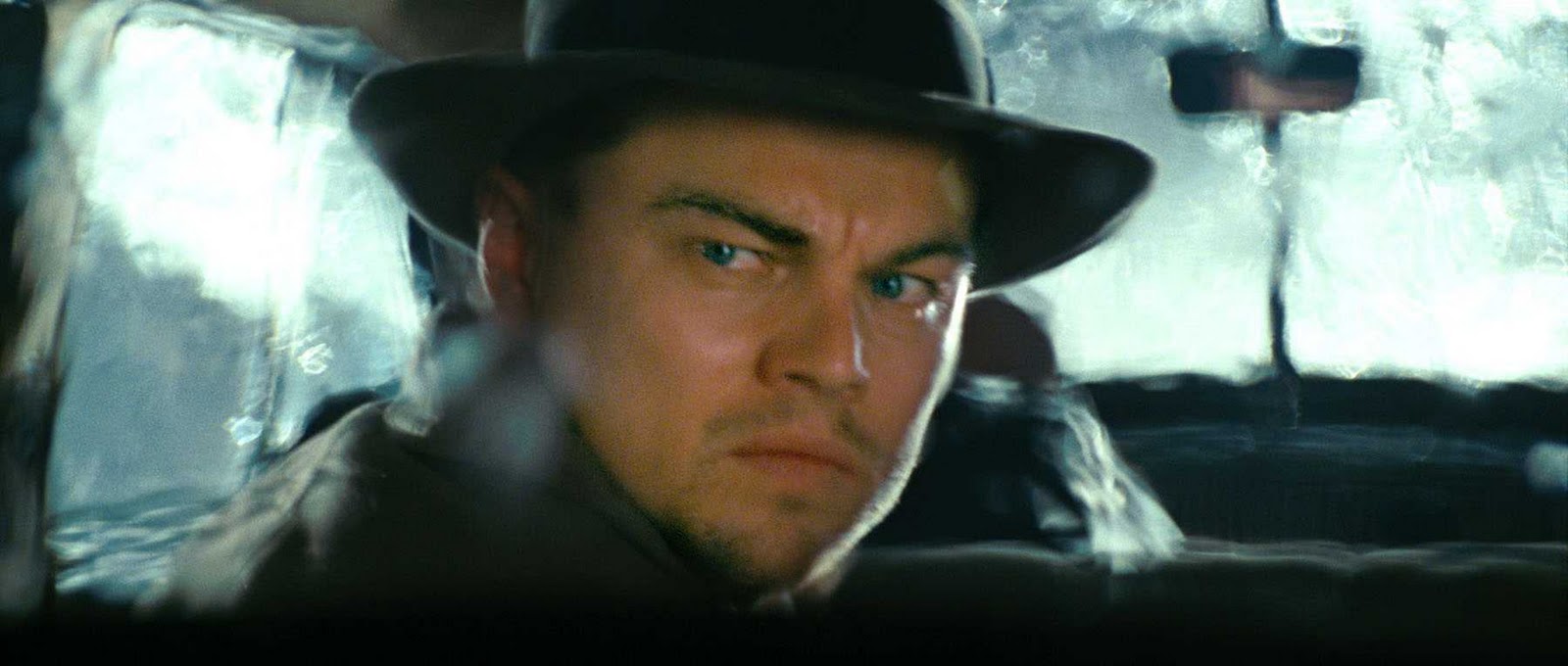
The year is 1953, and we begin aboard a ferry carrying US Marshal Teddy Daniels and his newly-appointed investigative partner Chuck Aule, who together have been sent to the small titular island, home to the Ashecliff Hospital for the criminally insane, a forbidding place established from these early shots aboard the boat – the hold all clanking chains and handcuffs – to their arrival through the high-security electric-fenced perimeter of the hospital. On arrival, the hospital’s head psychiatrist, the charming, smooth-talking Dr. John Cawley, explains that it is his liberal-minded philosophy that these dangerous prisoners may be ‘cured’ of their mental traumas by allowing them to act out their anxieties rather than by punishing and medicating them; this awakens hostility from Teddy, who in a series of dreamlike flashbacks recalls not only his wife’s death in an arson house fire but also his presence as a soldier at the liberation of the Dachau concentration camp, dually haunted by the ghosts of a loved one and strangers he was unable to save from mechanised slaughter.


Ostensibly Teddy and Chuck’s mission is to investigate the mysterious disappearance of one of Ashecliff’s patients/inmates, Rachel Solando, who had been locked up for the brutal drowning of her three young children. But just how did she manage to escape from her locked cell, barred at the windows? Within the opening reels, this is the apparent central mystery, but slowly the detective story mutates as it transpires that Teddy has other, hidden reasons for coming to the island: not only has he reason to believe that his wife’s killer has been sent there, but he also suspects that the facility has been conducting mind experiments on its inmates. Thus, he is conflicted between two motivations: on the one hand avenging his wife’s death, and on the other crusading against what he sees as the appropriation of the Nazi thought experiments he fought against during the war.


This is only the piano terra of what quickly becomes a complicated Memento-like (2000) house of cards representing the fractured psychology of Marshal Daniels. Communicating to the ghost of his dead wife, who seems to be urging him on in his investigations, albeit then decaying into a pile of ash, he begins to question the trustworthiness of all around him – inmates, staff, even his own partner. Most of all, he is suspicious of Dr. Jeremiah Naehring, the German ex-pat colleague of Cawley’s who seems to suggest a link to the wartime experiences he is unable to forget. But can he believe even himself, led by ghosts of his own memories?


Based on the novel by Dennis Lehane, whose comparably more sober Mystic River (2003) and Gone, Baby, Gone (2007) have also been filmed, Shutter Island is the kind of story which translates very well to the visual medium, and Scorsese employs a full gamut of camera techniques in order to send us hurtling around the menacing prison’s corridors and its surrounding windswept island in a whirlwind fashion. Hitchcock seems the key reference point in terms of storytelling, reflected most obviously in the Bernard Herrmann-esque score as well as visual nods to Vertigo (1957) and Psycho (1960), but one can’t help but think that Hitch might have trimmed the running time down by a reel or so; the drawn-out ending in particular makes the full 138 minutes feel just too long, and the sheer obviousness of the big plot twist makes it seem as if Scorsese is showing his cards more than a little too early.


The length issue is reflective of the film’s essence as a hybrid of detective story and psychological autopsy, and the film ends up feeling a strangely schizophrenic mish-mash of visual styles. The opening reels feel strangely old-fashioned, an homage to the classic post-war film noir tradition right down to the apparent use of very retro-looking back-projection placing the island ferry atop the ocean waves, and veteran DP Robert Richardson’s camera and lighting take ecstatic delight in showing the period mise en scene. And yet despite the hokey, over-expositionary dialogue, there is an unease about those early scenes, largely thanks to some odd jump-cut editing and subtle use of minor temporal discontinuities to set the viewer on alert that all is certainly not what it seems. The dream sequences, though, are pure Tarkovsky, undercranked and littered with symbols and associative elemental imagery, with a feeling of po-faced unease that occasionally threatens to turn into slapstick.


The pastiche of film noir tropes is unsurprising for the director whose films always seem so enamoured with cinema history, but the evocation of the Holocaust seems flippant, almost frivolous, to what is ultimately an insubstantial story, if an entertaining one. Of course, noir owed its existence to World War Two, not only as a reaction to its horrors but as a product of its resultant immigration to Hollywood of the likes of Fritz Lang and Billy Wilder, and it is certainly possible to use experience of it to great achieve great empathic effect – see how Nabokov subverted the apparent comedy of Pnin with the haunting tragedy of Buchenwald – yet here it feels like Scorsese is unable convincingly to work it in to the story, at least with the unresponsive DiCaprio as lead. Not that DiCaprio is bad – in fact he seems well suited to this period hokum – but for a film which about interior psychology his performance is simply too opaque.


For its problems, Shutter Island remains enjoyably entertaining, and a film unashamedly soaked in love for the history and traditions of cinema, and for the sheer craft of old-fashioned thriller filmcraft. Still, it is an obtuse, awkward work, and will surely baffle many more than it will delight, but this seems to be where its charm lies; file under ‘personal projects’ alongside The Aviator (2004) and Kundun (1997). Maybe this is where the true value of his work has resided all along.

Män som hatar kvinnor [aka The Girl with the Dragon Tattoo] (Niels Arden Oplev, 2009, Sweden/Denmark /Germany)

The massive global popularity of Stieg Larsson’s Millennium trilogy of novels owes not as much to their innovation or any authorial distinctiveness as to just how successfully they stick to the classic rules of thriller storytelling – establish memorable characters while placing them up the proverbial creek and then show how they manage to wriggle out of the sticky situation while solving the plot’s central mystery. It should come as little surprise, then, that Niels Arden Oplev’s rigorously effective and entertaining screen adaptation plays to this strong suit; yes, on the whole it plays to the standard genre rules, but in exploiting these to their full potential what emerges is one of the more memorable – and unashamedly thrilling – thrillers of recent times.

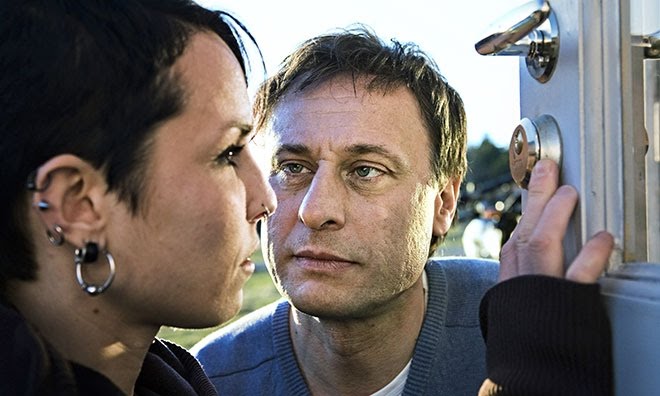
The title The Girl With the Dragon Tattoo places the focus of the film on character, choosing to eschew both the unappealing if more interesting original Swedish title Men Who Hate Women as well as the rather more forgettable Millenium tag which it was carrying at last year’s Frightfest. A basic description of said titular Lisbeth Salander as a high-kicking, bisexual computer hacker does make her sound like the kind of mess of cliches one might expect to see in an early 90s straight-to-video erotic thriller, but between Larsson, Oplev and striking lead actress Noomi Rapace she somehow seems to transcend this and emerge as a likeable character, just within the realms of the believable as half unapologetic outsider, half fantastic super heroine.

When compared to the preposterousness of comparable Hollywood leading females – stand up, Keira Knightley’s Domino – she carries a much more believably tough persona, both mentally and physically, illustrated nowhere better than in the unsettling early scenes showing her abuse by her unmistakeably evil legal guardian Nils Bjurman. He, a respectable lawyer and apparent pillar of society, behind closed doors turns out to be a violent sadist towards his ward, yet as he explains to Lisbeth his position of power allows him to be able to get away with his violent fetishes unquestioned. A recurring undercurrent in the film will be not merely the misogyny of individuals, but its virtual enshrinement in the power structures of seemingly placid, progressive Swedish society.

A pleasing amount of time is spent carefully establishing Lisbeth’s past history – naturally as means of setting up not just one film but the three of the projected trilogy – but perhaps a little too much at the expense of introducing the main thrust of the story. So too, the significance of her screen partner and yang to her yin, Mikael Blomkvist, editor of the tenacious and controversial investigative magazine Millennium – presumably a Swedish equivalent of the British Private Eye, though this unfortunately produces an unwelcome parallel with Ian Hislop. Licking his wounds following losing a high-profile libel case after the publication of a particular article, Mikael finds himself not only facing a jail sentence but also his being tailed electronically by the hacker-stalker Sander and courted by wealthy industrialist Henrik Vanger who wants to enlist his investigatory skills to investigate the disappearance of his niece, who went missing more than forty years previously.

Cue the mystery plot and, predictably, the coming together of unlikely pairing Salander and Blomkvist. Some kind of chemistry between the two, both professional and personal, inevitably begins to arise – he is obviously flattered by the interest shown in him and his work by his newly-found ingénue, she drawn to him in varying degrees as both a crusading truth-seeking hero and a surrogate father-figure. As the mystery plot begins to pick up pace and the pair spend ever-increasing amounts of time together alternately staring at their laptop screens, flitting between legwork at significant locations and bookwork at archives, and occasionally getting into scrapes with less-than-friendly interested parties, their strange working relationship shows signs of teetering over into something more. Accusations here of middle-aged man wish-fulfilment are perhaps fair, and the lurch towards the heteronormal from the more ambiguous undermines the unconventionality of our heroine, but these complaints ought to be laid at the door of Larsson himself.

Director Oplev does nothing particularly spectacular, though one might argue it is enough that he manages successfully to balance off this burgeoning if rocky central relationship with the demands of the series of convoluted plot turns that even Raymond Chandler might have balked at. What is a long duration of 152 minutes fly by pretty effortlessly, largely thanks to the numerous alleyways of intrigue the pair take us wandering down, labouring significantly only in the final reel coda, whose presence necessarily sets the audience up for the two films to follow.

Quite extraordinarily – largely indicative of the substantial global following Larsson’s novels have enjoyed – the film earned comparable box-office receipts to Ron Howard’s megabucks behemoth-like Dan Brown pot-boiler Angels and Demons (2009) when both opened at similar times to each other across Europe last year, an unthinkable level of success for a Swedish-language film. I doubt whether many of those fans who saw it could have been disappointed with this entertaining, effective and surprisingly endearing home-grown adaptation of a modern cult classic, not least before the inevitable glossier and sanitised Hollywood remake sits Megan Fox (or suchlike) in front of Lisbeth’s laptop.

Treeless Mountain (So Yong Kim, 2008, USA / Republic of Korea)

For all of the wealth of films produced by middle-aged directors which focus on the coming-of-age of female adolescents – a subject which can take in as great and diverse films as Gigi (1958), Mouchette (1967) and Spirited Away (2001) – the lives of protagonists of a younger age are proportionally under-represented in film. Why should this be? As characters are they are more difficult to delineate convincingly, their personalities emerging but yet to form fully? Is imposing a narrative onto characters who are yet to be able to perceive such a concept is too great an artifice? Maybe it is simply that their lives are viewed as being simply not interesting enough.

Filling this void is Asian-American director So Yong Kim’s Treeless Mountain which places the world of young children at its very centre, observing the rhythms and small triumphs of their lives with a quiet patience. Like her strongly autobiographical début feature In Between Days (2006), her second film takes elements of her own childhood as the inspiration for its storyline, but while it may be looking further back into her own life story, it represents a for her a large career step forward; in asking the viewer not to judge or moralise, her strongly observational style serves to portray elegantly the world as viewed through a child’s eyes.

The story introduces us to six-year old Jin, making her way home from school and picking up her younger sister Bin, who is being looked after in their neighbours’ flat. Their busy working mother is a notable absentee, and who on eventually arriving is evidently too harried to pay her children their due care and attention. On a following day we see her take them on a long bus ride out of the city where she announces that she is going to go away in search of their estranged father, and in the meantime they are to stay in this strange new town with their Big Aunt, whom they are introduced to for the first time. She gives the girls a large piggy bank, promising to return as soon as they manage to fill it with coins.

Life with their Big Aunt in this strange new town proves to be troublesome – far from being a caring foster-parent she pays them scant attention, leaves them undernourished and proves quite happy to use them as a means to blackmail money from another child’s mother in order to fund her alcoholism. The girls learn to take refuge with a generous and kindly neighbour, and discover that if they catch and cook grasshoppers they can make money with which to fill their piggy bank which they continue to believe, heartbreakingly, will guarantee the speedy return of their mother.

These relatively bare bones are as much as the film offers in terms of plotting, and aside from the initial drama of the children’s abandonment, there is little concession to providing narrative impetus – only the sub-narrative of the girls’ quest to fill up their piggy bank offers any sense of direction – and this noticeable absence suggests that the children, whose eyes we are undeniably witnessing events through, are yet either to form or to expect narrative coherence as an overlay to life. This lack of event makes it is possible to come away with an impression that the film is a touch slight, but while there are certainly passages of the film which play slowly, start to peel away at its layers and what begins to emerge is a work of remarkable complexity beneath its seemingly simple surface.

Firstly, it is revealing what director So Yong Kim chooses not to do as much as what she does do with such material. Tonally, we are not in the realms of the lyrically elegiac (The Spirit of the Beehive (1975)), the polemical (The 400 Blows (1959)) or the harshly poetic (Forbidden Games (1952)) but rather strictly observational: the vérité filming style and the hugely naturalistic acting from the two very young leads gives the film an authentic, documentary-like feel, and the regular use of close-ups gives a heightened sense of intimacy with the main characters. Through what we are selectively shown, the film sees the child’s viewpoint not as an essentially simplistic one awash with incomprehension and fear, but instead one with a combined sense of wonder and curiosity. As such, its closest forebear may be Koreeda Hirokazu’s similar Nobody Knows (2004).

If Treeless Mountain shares a kinship with any broader genre then it is mostly Italian neorealism, both in terms of its non-studio location shooting and eye for everyday detail, as well as extensive use of non-professional actors. Though lacking the movement’s tendency for out-and-out melodrama, there is curiously the very De Sica-like subtle background use of fairytale archetypes: the absent parent and quest to ensure her return, the wicked stepmother charged with their keep, and the two princesses exiled in a strange land – the latter point highlighted by the young Bin’s wearing of a princess-like dress in many scenes.

What often goes unnoticed about the classic De Sica films is that they take place over a very carefully-defined period of time, in Treeless Mountain it seems the opposite is true: there are no visual or verbal signposts within the diegesis to indicate whether hours, days or months are passing, events happen episodically but the only indicator of timescale is the girl’s piggy bank gradually filling up – though this too proves no measure as they later discover how to go about filling up quicker. Relocated to a strange new location and no longer subject to the everyday rhythms of their previous lives, time for the girls within the film seems to have stopped.

It is in this stasis that the girls are left to discover this new world on their own terms, and the real drama of the film emerges from the focus on the girls’ interactions with each other: their slow realization of the reality of their situation, their overcoming of certain naiveties, and ultimately their acceptance of their new lives, achieving a kind of Bressonian transcendence. It is this which prevents the tone from being overly morose, and viewing the girls’ lives as somehow quietly triumphant lies in contradiction to the view of the lives of adults as riddled with problems and alienation.

There are other questions which reside in the background, outside of the children’s perception, questions which another film might have sought to answer: what happened to the father? Why is the sister-in-law unmarried? As the film transfers from the city to the town and then on to the countryside, how much of the social dislocation we see can be placed on increasing urbanization in Korea? However, it is only as adult observers that we have been taught to pick up on such matters; for the girls in Treeless Mountain, whose eyes have not yet learned how to perceive them, they have yet to take on any importance. As such, it may be one of the most accurate cinematic accounts of the experience of childhood yet.

Aruitemo aruitemo [Still Walking] (Koreeda Hirokazu, 2008, Japan)

The shomin-geki, a particular type of Japanese family drama, is a long-established genre dating back to the early 1920s, but it is one which is perenially associated with, indeed practically synonymous with, the director Ozu Yasujiro, whose work is currently the subject of a major retrospective at the BFI. There is perhaps no better context within which to view this film by Koreeda Hirokazu, a director who has long been spoken of as his natural heir, given that his films share similar themes and concerns with those of his predecessor. Still Walking sees the parallels between them stronger than ever, and if one were to imagine the ghost of the great director watching with us, he would surely be nodding in silent approval.

A prologue introduces us to Kyohei and his wife Toshiko, an elderly middle-class couple living in a quiet coastal town. We see the old man doggedly struggle up some steps before exchanging kind greetings with a lady, from which exchange we learn that he is the area’s retired former doctor, and later that his house is his former surgery, still full of now disused medical paraphernalia. In contrast to this character, we are then swiftly introduced to his son Ryota who is travelling by bus with his new wife and stepson to visit his parents. In these early exchanges he seems uncaring towards his father and mother, expressing his wish to stay with them for as little time possible; in the meantime his own concerns have blinded him to the nervousness of his new bride at the prospect of meeting her in-laws for the first time.

Such a setup inevitably recalls Tokyo Story (1953), and the expectation is that the story will be about an uncaring son who is woefully neglecting his kindly parents, yet as soon as he arrives this is turned on its head. In truth, it is the father who is the transgressor, and greets his son with cold inhospitability; he holds lingering resentment that Ryota decided not to follow in the family tradition and become a doctor, and shows disdain for his chosen career as an art restorer. Toshiko is little kinder to her son, and confesses to daughter Chinami her disdain for his marrying a widow: after all, at least a divorcee might have chosen to leave her husband.

The film takes its time to reveal important pieces of information, and it is largely relayed through offhand remarks rather than expositionary dialogue. Slowly, we piece together that the family have gathered to mark the anniversary of the death of eldest son Junpei, the apple of his father’s eye who drowned many years ago in saving another man’s life. Kyohei clearly believes that Junpei would have become a doctor himself and carried on his work, and his resentment towards Ryota is based in a belief that the ‘wrong’ son died that day. The mother, too, is unable to let her son go. Later on, the man whom Junpei saved comes to pay his respects, a sweaty, obese, unkempt man who is both embarrassed and ashamed to be present in front of the family; Toshiko confesses that she insists that he return every year in order for him to suffer as she continues to her son’s death

Much of the subject matter makes the film sound depressing, and one suspects in the hands of a Western director such material would make for more of a melodrama, yet Still Walking, in the tradition of Ozu, is anything but morose. For long passages, the tone is light and playful, brightened by lively, colourful cinematography – the camera keen to linger on seemingly insignificant domestic details – a lilting acoustic guitar score, and the dialogue filled with the pleasantries and idioms with which the characters generally interact. Food is the major topic of conversation, and even the cold father softens and is lured out of his den when he smells frying tempura in the kitchen. Most of all, it is through the presence of the younger generation’s children of their own: while the adult dramas are playing out onscreen, there is frequently the accompanying sound of offscreen children at play, their lives so far mostly untouched by these frivolous grown-up concerns

Where Koreeda’s script and direction excel, though, is in how skilfully he manages to weave the tangled web of characters and their inter-relationships so that frequently within the same frame we can see a whole variety of emotions being experienced simultaneously by different characters, usually along generational lines. As well as dramatically underlining the gap between their attitudes, it also lends a huge sense of authenticity to this familial portrait: after all, how many family gatherings see all participants synchronised emotionally? More often the blinkers are on for the duration.

The shooting style – mostly carefully composed medium shots – might suggest observational distance rather than emotional intimacy, and yet film proves to be a bridge between the two; like Ozu’s films we feel like another visiting guest in the household, and when narrative resolution is achieved and the film closes there is a sense of emptiness in having to leave the world we have been living in for the previous two hours. The other director whose work springs to mind as a comparison piece is the late, great Edward Yang, another master of deep, subtle humanism. Koreeda’s beautiful, delicate film deserves such illustrious company.