Great Films: Les Yeux Sans Visage (Franju, 1960)

At once both beautiful and horrifying, Georges Franju’s Eyes Without a Face has deservedly been recognized as one of horror cinema’s great treasures. The premise: a doctor, responsible for disfiguring his daughter’s face in a car accident, strives to find her a ‘new’ one by attempting to graft on ones taken from other women, whom he and his assistant kidnap and kill. However, attempt after attempt fails, and both doctor and patient become increasingly deranged.

What is it that makes the film so great? For a start, it functions so well on a horror level: some scenes, while not especially explicit, are too gruesome for even this hardened viewer to stomach. Secondly, the pacing of the film is night-on perfect; this is no splatter-fest, instead we have an almost Hitchcockian air of tension throughout, as we discover the full horror of what has been happening. It makes me think of Vertigo; the daughter Christiane’s haunted, ghostly quality echoing Kim Novak’s Madeleine/Judy, while Dr. Génessier’s manicly grim determination to succeed whatever the costs remind me of James Stewart’s increasing sense of detatchment from reality.

But surely the greatest aspect of the film, aside from these points, is the haunting imagery, which gives the film an almost fairytale-like feel. As fairytale-like as, for instance, Jean Cocteau’s La Belle et la Bete, another great French film about beauty and loneliness; as with the beast in that film, we sympathise with Christiane’s isolation from society, but we also withdraw in horror at what is being done by others to restore her beauty. This dichotomy is a classic one in horror fiction, and is certainly a tradition which continues today; one thinks of the work of Mexican auteur Guillermo Del Toro, or Lucky McKee’s underrated May (2002).

The film was released in 1960, a landmark time in French cinema history, with the rise of the Nouvelle Vague and the apparent reinventions of the artform. Godard and Truffaut’s backgrounds were from film criticism. Franju was a similarly influential character from the French cinema scene – he was co-founder of the influential Cinémathèque Française – but he was no critic, not coming armed with theory under one arm and iconoclasm under the other; he was simply a man who loved films, and enjoyed the process of their production. That he was separate from the New Wave movement, in a sense isolated from his peers, is evident from the vast difference in styles between he and they. I always get the feeling that Jean Luc Godard loved the idea of being a film director; Georges Franju simply loved making films.

Great Films: 8½ (Fellini, 1963)

Ricordati che è un film comico: ‘remember, this is a comedy film’. So, legend has it, Federico Fellini reminded himself with a note positioned near the camera’s viewfinder during the shooting of , his now legendary ‘film about filmmaking’. It is more than just this, though; it is an examination of the challenge every artist faces in the act of creation, the struggle to articulate a representation of one’s own experiences into a work which communicates to somthing to others.

The film is representative of the situation Fellini himself faced in 1963; he had had the thing that all artists both strive for and dread simultaneously: a hit. Despite his earlier critical acclaim for films such as La Strada and Le Notti Di Cabiria, it was La Dolce Vita, released in 1960, that catapulted the director into the worldwide limelight. In 8½, the main character Guido, played by Marcello Mastroianni, is similarly faced with the task of producing a follow up to a succesful film. The trouble is, he doesn’t know what film to make, and is constantly hampered by the demands of critics, mistresses, actors, producers, fans and hangers on. Of course in the plane of reality, the film Fellini was making was 8½.

The film naturally contains many autobiographical elements, in particular childhood recollections; in one particularly memorable scene, the young Guido experiences his sexual awakening with Saraghina, a rather buxom prostitute, who performs a raunghy rhumba for him and his friends. marks the point in Fellini’s career where autobiography began to become more and more an inspiration for his films: whilst the earlier film I Vitelloni touched on his past in the seaside town of Rimini, it was in later films such as Roma and Amarcord where he would most explicitly deal with his past.

This use of autobiography was not without controversy; Fellini came under domestic critcism for having been seen to have broken with his background with the Neorealist movement of post-war Italy. This accusation was also levelled at a similar time at his filmmaking peers Luchino Visconti and Vittorio De Sica. Of this triumvirate, it is perhaps Fellini against whom the charge seems weakest; even his earlier films, particularly his ‘trilogy of loneliness’ (La Strada, Il Bidone, Le Notti Di Cabiria) never formally adhered to the neorealist structure. Perhaps this was merely jealousy on the part of his critics.

There are so many things to say about how wonderful the film is, and so many scenes that stick vividly in the memory, but one thing i will flag up is the simply wonderful soundtrack. Nino Rota, who would work on all of Fellini’s films until the composer’s death, outdid even his supremely high standards with the score for , the signature passarella wonderfully encapsulating the ‘beautiful confusion’ of the film, and indeed filmmaking. It has been said that the music is the one thing which really binds the film together; certainly the repeating motifs and melodies help to add more of a sense of coherence to what is at times a rather scattergun narrative. In the film’s closing scenes, a small boy with a flute plays the film’s title theme, leading a procession of the film’s characters, characters taken from Fellini’s life, in a large circular dance. The great director is showing us how he sees himself: as that young boy, leading the dance.

Great Films: Rashomon (Kurosawa, 1950)

Famously, Akira Kurosawa’s Rashomon has given its name to any situation where differing perspectives of the same event contradict each other, and this device has since been used in several much lesser films, such as Bryan Singer’s flashy, overrated The Usual Suspects. While this is the most obviously startling and challenging feature of Rashomon, after repeated viewings this is almost forgotten in favour of gawping at Kazuo Miyagawa’s incredible cinematography, certainly ranking the film with the likes of The Third Man, The Seventh Seal and Citizen Kane as one of the greatest monochrome films of all-time.

The film begins with three characters sheltering from a storm in the ruins of a gatehouse, two of whom, a woodcutter and a priest, are recounting to the third, a commoner, the details of a dramatic recent event: the murder of a samurai, and rape of his wife. We then are told the story through four differing viewpoints, each differing significantly in detail with each other. While these varying accounts are being told to the commoner, what the viewer begins to do is piece together a picture of the various motivations, interests and prejudices of the story’s protagonists. However, once we are invited to question these accounts, the viewer naturally then begins to question the woodcutter and the priest: what are their motivations? The extension of this, of course, is to ask the same question the filmmaker.

As mentioned above, while the viewer is considering all of this, it is easy to miss what the camera has been up to during this time. For a start, some of the shots of the forest where the flashbacks take place are breathtaking; hot and sticky compared with the rain-sodden ambience of the gatehouse. Light creeps through the branches onto the actors’ faces seemingly naturalistically, though this effect actual required great ingenuity from cinematographer Miyagawa. Also, witness the use of quick editing; 407 separate shots in the film, according to Kurosawa scholar Donald Richie, ranking it alongside the last Michael Bay film in terms of fast cutting. This miraculously passes the viewer by on first viewing, as perhaps do some of the more complicated and innovative camera movements and pans.

Rashomon sent a shockwave through the film world on its international release in 1951, though it garnered some criticism from the domestic Japanese critics who labelled it ‘too western’. Nevertheless, it can be seen as the film which opened up the world to Japanese cinema, as well as announcing the arrival of what would become one of cinema’s greatest directors onto the global stage. Its stars similarly would go on to greatness; Toshirō Mifune, the bandit, would star in many more of Kurosawa’s films, most famously in Seven Samurai, whilst Takashi Shimura would memorably go on to play the ageing bureaucrat in Ikiru, my personal favourite in the Kurosawa canon. DP Miyagawa would go on become Japan’s preeminent cinematographer, and work with other greats such as Ozu and Mizoguchi.

Rashomon remains a great statement about the potential of cinema as an artform, a meditation on the subjective nature of truth, as well as being one of the most visually dazzling films of all time.

Great Films #810: Love and Death (Allen, 1975)


Woody Allen’s Love and Death is not only his most consistently funny film, but also marks the first key turning point in his career. Before its release in 1975, the films he directed, such as Bananas, Sleeper, and Everything You Always Wanted to Know About Sex, verged on the slapstick, and were more episodic in structure; after Love and Death came a series of three more meditative, mature films, namely Annie Hall, Interiors and Manhattan. Sandwiched in between these is this 85 minute masterpiece, which though rooted in the former aesthetic, points towards the latter.

The film is essentially an homage to proto-existentialist Russian literature, in particular through numerous references to Dostoyevsky and Tolstoy, and the many mock-philosophical debates about existence and death. The prominent use of Prokofiev in the score adds to the Russian flavour. However, the setup allows director Allen to parody many other of his key reference points, most notably nudges to the films of Ingmar Bergman and Eisenstein’s classic Battleship Potemkin.

However, describing the film in these terms is to ignore its main selling-point: the humour. The laughs come thick and fast, by means of slapstick, parody, satire, anachronisms as well as some fantastic one-liners and put-downs. Boris is, like most of Allen’s self-played protagonists, equally cursed and blessed, with his trademark insecurities and completely unbelievable sexual magnetism. Love and Death represents the high-water mark of Allen’s comedy output, and as with all great comedies, it’s best to just let the jokes speak for themselves.

Great Films: La Haine (Kassovitz, 1995)


Matthieu Kassovitz’s portrait of a day in the life of the residents of the Parisian banlieues still feels as fresh and relevant today as when it debuted at Cannes back in 1995. Indeed, it manages to be both of its time and timeless, in a similar way to Scorsese’s Taxi Driver, one of the film’s key influences. In the earlier film, alienation and existential isolation are the key drivers towards the inevitably violent denouement, while La Haine illustrates the same inevitability arising from social, economic and racial unrest. However, while Taxi Driver has often been accused of being nihilistic, a charge which i would refute, La Haine is more of a polemic, a plea to address the inequalities and prejudices which will inevitably lead to tragedy.

This social commentary contained in La Haine has been criticized from various quarters; the police in France were naturally concerned with their portrayal as violent thugs; others questioned Kassovitz’s outsider status, claiming he was portraying a culture he neither came from nor understood. This is, however, too cynical a view of the film’s intentions. Kassovitz is no Tarantino-like dimwit throwing blood around the screen for the audience’s titilation; the consequences of violence, riots and revenge are all considered carefully, and the scenarios are carefully set up so as not to give the viewer easy answers to what are profound questions. Whilst the film’s themes are universal, the setting is unmistakeable; like Spike Lee’s Do the Right Thing, unmistakeably tied to Brooklyn’s Bed-Stuy, La Haine is convincing in its portrayal of the Parisian banlieue. In a similar way to Lee’s film, we are encouraged to appreciate the colour and vibrancy of the setting, and understand a little about why our protagonists act and react to situations like they do.

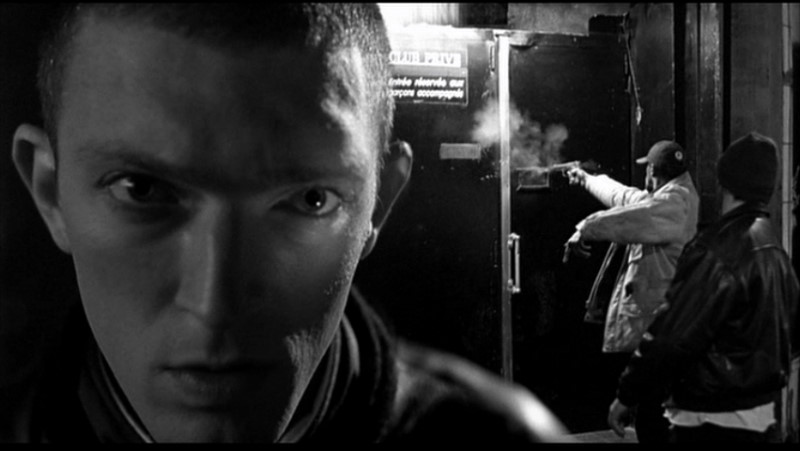
The most obvious visual aspect to the film is the black-and-white photography; this was not the original intention, as it was shot in colour and only converted to monochrome in editing. The effect is to create an unsettling feeling in the viewer, creating a similar atmosphere to Rene Belvaux’s earlier Man Bites Dog, another film concerning the glamourization of violence. This is, perhaps, also a nod to the nouvelle vague, Godard, Truffaut et al, as well as the Cinéma Vérité tradition. Kassovitz’s snappy visual style and sharp edits give the film its breathless (no pun intended) pacing, again betraying the influence of the likes of Scorsese and Spike Lee. The sound design is similarly dynamic, a chiarosuro of blasts and silence. The lead performances are all spot-on; Vincent Cassel gets just the right balance between psychopath, clown and lost child, while Hubert Koundé and co-writer Saïd Taghmaoui both create equally believable characters who we feel we know versions of in our own lives. We come to like these characters, understand where they come from and why they behave as they do, and by the end of the film wonder why they their lives have to be so inevitably doomed.