Great Films: The Red Shoes (Michael Powell & Emeric Pressburger, 1948, UK)

At this year’s Cannes, the renowned director Martin Scorsese announced the completion of a seven year labour of love: the restoration of the classic 1940s British film, The Red Shoes. Scorsese has never been shy about revealing which films have inspired him: in two documentaries he produced in the late 1990s he discussed the importance that both classical Hollywood and post-war Italian cinema played in making him decide to become a film-maker. Through his World Cinema Foundation, launched in 2007, he continues to spearhead efforts to recover and to restore classic forgotten films which otherwise may have been forever lost.

His relationship to The Red Shoes, though, seems to me to be outside of much of this. Indeed, for a director whose work is generally associated with realism, violence and Catholic guilt, it perhaps seems odd that he should hold in such esteem a melodramatic romance about ballet based around a Hans Christian Andersen fairytale. Yet in interviews he has candidly described it as ‘the movie that plays in my heart’; his dedication to its preservation and his fervent championing of both it and the wider canon of films by Michael Powell and Emeric Pressburger show that the film has more than a great significance for him.

The key to an appreciation of the film is to understand that at its core it is about the creation of artistic spectacle, and the sacrifices which must be made in its process. Take away the film’s romance plotline, one that can be found in countless matinee melodramas, and what is left is one of the darkest portraits of obsession put on screen, a clear inspiration for Scorsese’s own maniacal protagonists as well as those of messrs Schrader, Coppola, De Palma et al; a deep plunge into the heart of darkness of all artistic creativity.

The story will revolve around a curious ménage à trois between two younger characters trying to enter the ballet world and an older one who knows no other world, but to begin with they are all, like the cinema audience themselves, spectators. The world famous Ballet Lermontov has come to London, led by the charismatic but enigmatic Boris Lermontov and starring renowned prima ballerina Irina Boronskaja. In the audience, eager to catch the attention of the Russian impresario is Vicki Page, whose influential aunt Lady Neston forcibly tries to arrange an impromptu audition for at the aftershow party. Lermontov is disinterested, but enquires why it is she wants to dance. “Why do you want to live?” Vicki replies somewhat rhetorically; within this exchange it is clear that he sees something of promise, and so invites her to study with his company.

The third main character comes to the fore the following morning; Julian Craster is a young student of Lermontov’s conductor who believes his master has plagiarised his own compositions for use in the last night’s production. Lermontov agrees – quipping “It is much more disheartening to have to steal than to be stolen from” – and promptly hires Craster as his new orchestral coach. Through the eyes of these two inexperienced newcomers we are thrust into the world of ballet behind the stage. A montage of scenes shows use the messy underweave of the tapestry, a beautiful confusion of dancers, stage hands, set dressing and musicians, all under the steely gaze of Lermontov, a solitary seated figure in the shadows of the stalls.

The company moves to Paris, but once there prima ballerina Boronskaja announces she has married. She is congratulated by her colleagues, but when she looks for Lermontov he has disappeared; she observes that he must have no heart. Cut to him alone, smoking in a darkened study, visibly distracted. He calls for Craster and dramatically announces to him that he plans to produce in Monte Carlo a ballet of the Hans Christian Anderson fairytale The Red Shoes, in which a girl is offered some footwear by a demonic shoemaker which cause her to dance uncontrollably, leading to her eventual death. Boronskaja is dismissed, Page is promoted to top billing and Craster is to compose the score.

Until this point, the film has been light in tone, but the introduction of the fairytale interrupts this and announces something very different. Witness the abrupt cut to Lermontov closing the score book to reveal its title, emblazoned in red, and how it sends Craster into a trance, unable to hear what the director is saying. And then see the Russian’s impassioned explanation of the synopsis, clutching a sculpture of a ballet shoe, and then his quick dismissal of the girl’s sad fate.

The loss of Boronskaja to wedlock has lit some form of fire inside of him, but motivated by what? Sexual jealousy? Speaking to Ljubov, his chief choreographer, he pours scorn on those who seek human love, suggesting one who succumbs to it can never be a great dancer. The choice, one which he has clearly made himself, is between love or complete commitment to one’s art. Some readings of the film read Lermontov as being a repressed homosexual, but this makes for a much less interesting character, and in reality there is little on-screen to suggest this; it is his entire repression of all sexuality which is most in evidence, and some are fooled by the fact that both actor Anton Walbrook and the character’s real-life model Sergei Diaghilev were openly gay.

The ballet is a spectacular success, and as Vicky and Julian are thrust together during the preparations for the new production, a romance between them unsurprisingly blossoms. Lermontov is once again furious with what he perceives as his new muse’s betrayal of him. Unlike Boronskaja, though, he presents her with a choice: married life with Julian or become a great dancer under his tutelage. And thus, he has transformed from the charming, inscrutable figure at the start of the film into tragic villain by the end, undone by his own pride and perfectionism, much like Charles Foster Kane in another film.

The Red Shoes was not an immediate success on release, despite the name the Powell and Pressburger had forged for themselves on the back of hits A Matter of Life and Death [aka Stairway to Heaven] (1946) and Black Narcissus (1947). J Arthur Rank saw such little commercial potential in the film that he left its initial screening without saying a word to the directors, and subsequently only supplied one print for the entire US market. That print went on to screen continuously in a small New York cinema for nearly two years before it gained a wider distribution, and eventually went on to win two Oscars, as well as opening up ballet to a younger, much wider audience.

The film’s enduring critical appeal stems from the darkness and ambiguity of the Lermontov character, played with sympathy by Anton Walbrook. His fall is one of the most tragic in screen history, without any doubt up there with the likes of Citizen Kane (1941) and The Godfather (1972), and as an examination of the process and problematic nature of artistic creation, it can also be placed alongside Fellini’s 8 ½ (1963).

And yet, the continuing popular image of the film is not one of tragedy but great joy. This is, of course, thanks in no small part to its lush bombardment of the senses: Brian Easdale’s magnificent Oscar-winning score, the physical splendour of the cast of famed ballet dancers Robert Helpmann, Léonide Massine and Ludmilla Tchérina alongside the ravishingly beautiful Moira Shearer in the lead role, all captured in dazzling Technicolor by cinematographer Jack Cardiff.

Cardiff, who died last month, had already pushed back the boundaries of visual possibilities on Powell and Pressburger’s last two films, but this would become his most loved work. The film’s centrepiece, the seventeen-minute Red Shoes ballet, is quite the most extraordinary montage of dance, motion, light, colour and in-camera wizardry, set on a stage but defying it by every means, transporting the dancer to a nightmarish nether-world where she floats, soars, plummets, and dances to her eventual death. The camera completely eschews objectivity, immersing the viewer in subjective visions. The expressionistic use of colour was unlike anything seen before, and would notably resurface in Scorsese’s own Mean Streets (1973), while the choreography would be an influence on the filming of Raging Bull (1980).

The ballet sequence is clearly marked as artifice, but as the film ends with its tragic repetition, the frame dissolves to a burned-out candle atop a book marked Hans Christian Andersen, the candle which the observant viewer will have remembered as being the very first frame of the film after the title cards. The entire film has, like the ballet, been a kind-of fairytale, typically filled with melodrama, romance and villainy. Post-war, this kind of filmmaking was unfashionable: realism was king, and the fantastical likes of Jean Cocteau’s La belle et la bête (1946) had been criticized for their lack of political commitment.. Looking back at it now, The Red Shoes is such an established classic that it is easy to forget what a gamble it was for Powell and Pressburger, and like the great art contained within the film, how ambitious and ambiguous it all is.

Great Films: Notorious (Alfred Hitchcock, 1946, USA)

There are still some who are in doubt of Alfred Hitchcock’s genius as a director, to whom I address this question: who else in the history of cinema could invest a scene with such an unbearable air of tension simply by showing us a case of champagne slowly being depleted? This occurs two-thirds of the way through Notorious, in the centrepiece party scene which begins with a most elegant, sweeping single shot, crescendos to a frantic race against time before ending with its characters making a series of crucial discoveries: ten extraordinary minutes which amply illustrate the master suspense-maker at the peak of his craft.

Like most of Hitchcock’s best work, Notorious is ostensibly a thriller, but the audience has long-since focused on other more important matters by the time the credits roll. The film opens with an introductory placard giving us the very specific place and time at which events begin to unfold: Miami, Florida, Three-Twenty P.M., April the Twenty-Fourth, Nineteen Hundred and Forty-Six. The use of verbose wording as opposed to more succinct numbering of the date and year call attention to its specificity, the very opposite of the imprecise fairy-tale “Once upon a time”, yet by the end of the film, Prince Charming will be called upon to rescue Sleeping Beauty from her imprisonment.

The opening scene, indeed the very first shot – that of a paparazzo’s camera – highlights the theme of voyeurism, one which is clearly prevalent throughout much of Hitchcock’s oeuvre. For a film about the rights and wrongs of espionage, there is a delightful irony in the way that we then peek into the courtroom, the shot framed by a doorway, to watch Huberman Sr. being convicted of treason, and then to follow his daughter Alicia out of the courtroom past the baying press-pack; if we are at first appalled that she is being personally hounded for her father’s crimes, then we must quickly remember that we too will demand to know more about her during the following 100 minutes of the film.

The following scenes will indeed introduce us to this woman, and the other dimensions to her notoriety: her drinking and apparent sexual promiscuity. Both of these converge at a party at her house where a silhouetted stranger is the latest target of her inebriated advances. We as an audience know that this will turn out to be the debonair Cary Grant, but as Alicia’s drunken charades continue, he is kept in shadow and with his back to the camera, as if he is just another spectator, sitting in the cinema row ahead of us. He will turn out to be Devlin, a CIA agent whose job inherently involves anonymity, and whose lack of a past and emotional coldness will be sharply at odds with Alicia’s vulnerable humanity.

The CIA has a job for Alicia: to travel to Rio and infiltrate the confidence of Alex Sebastian, an old flame of hers now suspected of collaborating with what remains of the Nazis on some form of new weapon. The weapon is the Hitchcockian MacGuffin, a device used to propel the story forwards but itself of little importance, except here it underlines the theme of espionage, allowing the director to utilise an increasingly subjective camera: slow reveals and point-of-view shots placing the viewer too in the role of government spy. Suspense demands a certain degree of empathy, so our increasing identification with Alicia heightens the air of dramatic tension.

This set-up of the film allows the conflict between two sets of competing poles: the stuttering romance of the leads is continually hampered both by the requirement of the mission for Alicia convincingly to seduce Sebastian, as well as the clear personality differences between her and Devlin. As the stakes are gradually ratcheted up we see her desperately try to get him to put his love for her above his job, but his emotional passivity disguised as professionalism repeatedly drives her further away from him.

One of the great strengths of the Notorious screenplay is how the danger to the central romance and the physical danger to the protagonists are both steadily raised in parallel with each other. As Alicia is driven away from Devlin and however reluctantly towards Sebastian, so her deeper immersion into Alex’s world puts her in greater peril: on first viewing, the casual way in which poor Emil Hupka is escorted from the dinner party after creating a scene suspiciously does not appear to signify much, but this is the first signpost towards indicating the very seriousness of the stakes involved – the implication of his demise comes later, as we figure out how far Alex and his cohorts are willing to go to keep whatever is secret, secret. All the while, this seems to be a world away from the CIA operatives in the safety of their comfortable offices.

Notorious could well be argued to be Hitchcock’s most visually rewarding film: if one pays careful attention, all manner of cinematographic trickery is used throughout, but never seems to draw too much attention to itself, or to be affectedly showy. See the brilliant repetition of the use of the combination of silhouette and a Dutch-angle camera, firstly towards the start of the film and then again devastatingly as the film enters its final phase – and note how this so elegantly underscores the dual intoxication motif. And then there are the famous shots: firstly, that famously long ‘kiss’ between Grant and Bergman lasting three minutes, a tracking shot in medium close-up somehow transferring from exterior to interior and seeing the pair exchange screen position twice, something of a dance between the two which cements their intimacy. The aforementioned shot at the cocktail party, which seems to glide us down the Sebastian mansion staircase bannister.

For the cineaste, the film is rich with so many echoes of both Hitchcock’s previous and future films: the presence of his common themes of voyeurism, the control of women, doppelgängers, identity deception, overbearing mothers and the seeming banality of evil render Notorious as allusive as a Joyce or Nabokov novel. Some comparisons deserve more appraisal than others: the use of point-of-view naturally anticipates Rear Window (1954), the famous long kiss will be repeated in Vertigo (1958), while the Sebastian mansion is eerily reminiscent of the De Winter house of Rebecca (1940). Slavoj Žižek famously made the case for Norman Bates’ house in Psycho (1960) to represent the three levels of psychoanalysis, and there is a parallel here: Sebastian’s mother inhabits the upper level, respectable socialising takes place on the ground floor, while the dark truth is eventually located in the wine cellar.

The casting is impeccable, indeed it may be difficult to imagine any other actors taking the place of leads Cary Grant, Ingrid Bergman and Claude Rains. Grant is the apotheosis of his on-screen persona: always much more than the popular caricature of the suave ladies’ man, under Hitchcock he reveals his depths as a character actor: stilted, emotionally repressed, bubbling with internalised rage which he is unable to release. This, along with Casablanca (1942) would be one of the two popularly iconic roles for Ingrid Bergman, before the scandal of her affair with Roberto Rossellini would put her in the spotlight for all the wrong reasons. For me, this performance along with Valli’s in The Third Man (1948) stand as the two greatest female lead performances in 1940s English-language cinema. And spare a thought for Claude Rains, behind the two handsome leads, but somehow his Alex Sebastian holds everything together – like the others a pawn in a greater game, and one whose disposal of at the denouement comes close to being tragic.

Tags:

Great Films: Il Posto (Ermanno Olmi, 1961, Italy)

The bumpy transition from adolescence to adulthood is perhaps the most important defining experience of a person’s life: those first solo steps beyond familial comfort and familiarity, and the slow learning to discover both one’s self and one’s position in the world, seldom a smooth, comfortable or necessarily swift transformation. Coming of age is well-worn cinematic material, but documented nowhere more compassionately as in Ermanno Olmi’s elegant Il Posto, his tender, semi-autobiographical tale of one young man’s emergence into the grown-up world. But look beneath its avuncular, sympathetic surface and one finds a harshly critical denouncement of the modern workplace and the alienating effect it has on its occupants.

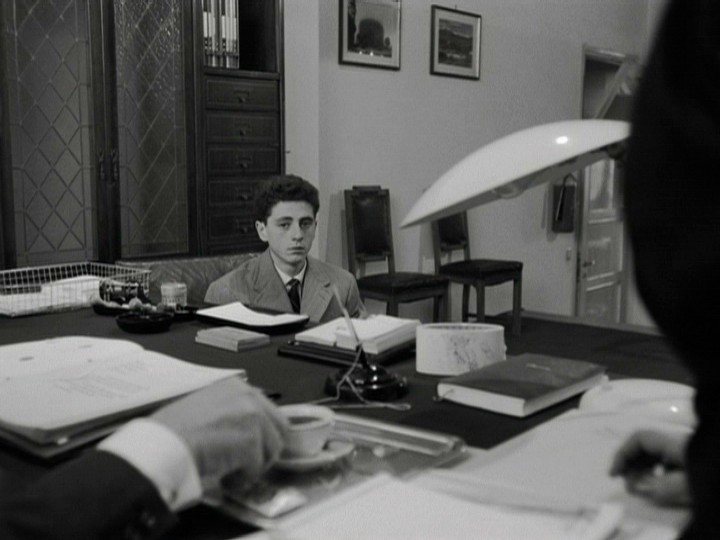
The setting is Milan, which an opening placard informs us is a magnet for workers migrating from the surrounding countryside. One such hopeful is Domenico, fresh out of school and now being somewhat unwillingly guided by his parents towards a career in the big city. Once there, he is subject to scrutiny via a series of comical arbitrary mental and physical tests, though much of the time seems to be spent waiting with other, mostly older and bigger, candidates in waiting rooms. One fellow inductee, the pretty Antonietta, catches our young protagonist’s eye, and the two share a happy afternoon together acting the grown-ups in the city’s streets and coffee houses – perhaps all is not doom and gloom for Domenico in his new surrounds after all?

On a basic level, the story is a warm and largely comical look at this young man’s unease at entering into a very adult world. At the centre of everything is Domenico, played with real pathos by Sandro Panseri: in the neorealist tradition a non-professional actor, but chosen because he was someone who both looked and lived the role. There is every chance that a trained actor may have been too forced in trying to convey the nervousness and hesitancy of the young protagonist, but Panseri makes it look effortless: so many times in the course of the film we see the sweet innocence of his face, more frequently than not trying to hide his nervousness, and cannot help but want to give him a big hug and some encouragement. The humanity of this central performance is magnified when juxtaposed against his cold, sterile surrounds: deep focus camerawork insistently capturing endless corridors and oblique, imposing architecture.

As with Olmi’s next film, I Fidanzati (1963), the context is Italy’s postwar economic miracle; the later film exiles its protagonist to the geographical and culturally opposite end of the country, but while the physical displacement in Il Posto is by comparison over a much smaller distance, it is just as unfamiliar an environment for little Domenico. As the film’s opening scenes make clear, he hails from a poor, rural background, and his juxtaposition to the urban jungle becomes symbolic of his country’s economic transition into a modernity. But there is more: as Millicent Marcus argues, Olmi’s film portrays Domenico’s entry into a world of consumerist luxury and social mobility, as unthinkable to his father as it would be to protagonists of neorealist films but a decade and a half earlier.

If Olmi is giving us a vision of the future, though, it is not a flattering one. Anticipating Terry Gilliam’s Brazil (1985), the film offers a warning of the dehumanizing nature of large-scale bureaucracy. In one scene we are introduced to a rather comical office environment, populated by a variety of eccentric characters with odd tics: one man methodically combs his sideburns, another struggles with a malfunctioning lamp, all the while one employee continues to repeatedly throw balls of paper at another across the office. This all appears to be being played for laughs, until we are given a series shots illustrating the lives of these men outside of work – an aspiring opera singer, a would-be novelist – and realise that their strange habits are actually the result of the workplace’s stifling of their individual personalities. Whilst not as bleak as, say, Akira Kurosawa’s Ikiru (1952), it is nevertheless a damning view of the modern-day work environment.

Another cinematic reference point may well be Billy Wilder’s The Apartment (1960), released a year earlier than Il Posto, and with a similarly cynical view of the bureaucratic machine (coincidentally, both films climax on New Year’s Eve). In Wilder’s film, the absurd object of the office workers’ desires is to move to a higher floor of the building, apparently bringing with it a greater social status; in Il Posto, the hierarchy is represented rather less glamorously – the acquisition of a desk closer to the front of the room; after the death of an elderly employee creates a vacancy at one of the frontmost desks, those sat behind it eagerly shuffle to the one in front of theirs’, a clearly metaphorical step closer to their own deaths. One hopes that Domenico is able to do what C.C. Baxter does and become a mensch, but as the film ends with the repetitive cyclical sound of machinery it is hard to be optimistic this will happen.

Despite what is its bleak outlook, the film is by no means depressing; as previously emphasized, Olmi invests the story with warmth and gentle humour, enough that the casual viewer might not focus on its darker undertones. The lack of narrative resolution curiously leaves both an air of hope as well as melancholy, and reflects the film’s resonance: this is not the melodramatics of bicycle thieves or Umberto Ds, but an everyday tale of small triumphs and disappointments in a largely indifferent world; whether or not we take comfort from this is ultimately up to us.

Great Films: Radio On (Christopher Petit, 1979, UK / West Germany)

When one thinks of a road movie, the images that instantly spring to mind are of endless journeys along long, dusty American highways, man and motor fused together amidst desolate, inhospitable surrounds, of Two Lane Blacktop (1971), Easy Rider (1969) or Vanishing Point (1971). What does not think of is the quiet, two-hour drive west from London to Bristol, but that is exactly what Radio On, the 1979 debut feature by film critic Christopher Petit, offers up instead. A reinvention of the road movie genre for England, it is a film with few precedents and no antecedents, but remains a fascinating portrait of a very particular place and time.

The story, for what it’s worth, concerns the Kafka-esque monickered Robert B, a late-night London DJ who receives news of his brother’s death in Bristol, and ostensibly sets out on a road trip to investigate the circumstances. Along the way, he stops off at a pub, picks up a hitchhiker, meets a man living in a caravan, eventually alighting in Bristol where he encounters and befriends a German lady estranged from her daughter. But what becomes evident early on from the almost entire absence of narrative thrust is that this is not a film about mystery or plot, but a mood piece, a piece of British arthouse cinema not ashamed to wear its European influences on its sleeve.

The most obvious debt, as is clear from as early on as the opening credits, is to Wim Wenders, associate producer of the movie, as well as its clear spiritual forefather. His German road movie trilogy, Alice in the Cities (1974), The Wrong Move (1975), and Kings of the Road (1976) is the obvious stylistic influence here, in particular the monochrome photography (Wenders loaned his own DP Robby Müller to Petit for the making of the film), but also the use of long shot lengths, allowing the camera to linger on scenes much longer than would be conventional, giving a feeling of melancholy reflection.

For a road movie, there is a remarkable lack of a sense of liberty — driving scenes are mostly confined to shots filmed from inside the vehicle, and the framing of the windscreen gives less of the impression of the freedom of the open road a la Easy Rider, but at times more like the trapped Marcello Mastroianni attempting to escape at the start of (1963). In this sense it is different from the Wenders films, and perhaps more reflecting the size of the British Isles — no road journey in one direction can last much longer than a few hours by definition, so how much a sense of freedom can there be?

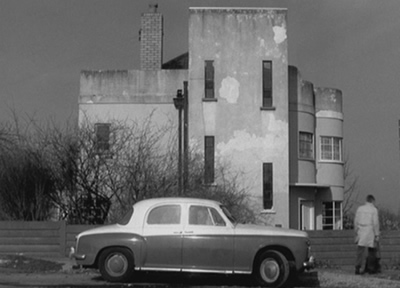
One of the unusual aspects of the film is its unromanticized view of 1970s England. No criticism of the film I have yet read has not mentioned the adjective “Ballardian” to describe the early shots of the capital, a London not of the Ritz and Buckingham Palace, but of ugly industry, dreary tower-blocks, and somehow menacing motorway flyovers. These early shots, coupled with the later similar views of Bristol are oddly reminiscent of the Paris of Godard’s Alphaville (1965), or possibly the corner of Rome in Antonioni’s L’Eclisse (1962) — the use of contemporary architecture to predict a dystopian future.

More in common with the latter of these cinematic references, the film’s somewhat nightmarish urban geography gives us the context of the film’s making, Britain of the late 1970s, as do other cues: the Krautrock soundtrack of Kraftwerk and Berlin-era Bowie, the filtering in of new technologies such as audio cassettes and video games. Snippets of radio news reports offer the further context of ongoing IRA terrorist campaigns, anti-pornography raids, and violence underlying an England far removed from the austerity of the Fifties or the Swinging Sixties. If the film’s title is a reference to Jonathan Richman’s song Roadrunner, then it does not appear to share the singer’s being “in love with the modern world”.

This urban decay is in stark contrast to the pastoral countryside we see on the journey between the two cities, and the difference between these two Englands becomes a further point of interest. In a later scene, we enter an older lady’s very middle-class household, the formality of her matching china teacups the epitome of picture-postcard British bourgeois living, and in direct contrast to the lives of everybody else we have seen in the film so far. Radio On feels a companion piece to post-punk’s musical prediction of the civil unrest to follow under the Thatcher regime in the coming decade, in that it flags up the dichotomy between the vision of a supposed classless social ideal and the unfortunate reality of such a folly.

There is a wider point also here, regarding Britain’s place in the world. On the one hand, there are many references to the closeness with Europe, in particular Germany, not just in the score, the visual aesthetic, and the prominent presence of German actress Lisa Kreuze, but also in more subtle ways, for instance the quiet paralleling of experiences of IRA and Baader-Meinhof terrorism. Even the credits appear bi-lingual in both English and German. And given that this is an existential road movie, is not existentialism itself a strictly European invention? At the time, Britain was seeing rising Euro-scepticism, and perhaps the film was calling on people to move closer rather than pull away from their continental cousins.

Conversely, there are glimpses of America, much like we see in Wenders’ own Alice in the Cities (1974), but these seem strangely alien and forced. B encounters a man, played by none other than Sting, who lives in a caravan close to the spot where Eddie Cochran died in a car crash in 1960. He sings “Three Steps To Heaven,” but the juxtaposition of the song to the setting of a quiet road outside the village of Chippenham reduces it to the absurd. Later on, B admires the lines of a vintage Cadillac and sits in it, only to be told “it doesn’t suit you.” When he drinks – swigging from a can of Guinness at the wheel, a hip flask on a seaside pier, or a solitary pint in a pub – he lacks the cool sheen of Hollywood’s alcoholic anti-heroes.

If B lacks cinematic cool, then he is also lacking in many other respects; his detachment from any kind of emotional response, whether the death of his brother, the affections of a beautiful woman, or being beaten up in a pub position him closer to the Mersault of Camus’ L’Etranger than any of the Kafka protagonists his name would suggest. His very blankness does render him lacking in a certain degree of sympathy, though it does allow him to be a cipher to explore other characters’ behaviors and attitudes. He, like the film, appears to have come from nothing, and does not appear to lead towards anything.

One scene, and in particular one song, lingers more than others. A pub jukebox plays Wreckless Eric’s “Whole Wide Worldalmost in its entirety, while B just sits down and slowly finishes his pint. What does it mean? Seemingly nothing. The song, incidentally, is one of the greatest to emerge from the punk period, a deceptively simple song about being lonely but spurred on by hopes however impossible. Perhaps it offers a key to this film about trying to find something, but not knowing what that thing is or where to go about finding it.

Great Films: Vertigo (Alfred Hitchcock, 1958, USA)

Vertigo is one of those films, along with the likes of George Sluizer’s Spoorloos (1988), Martin Scorsese’s The King of Comedy (1982) and Alfred Hitchcock’s own Rebecca (1940), that at least according to their film certificates may be suitable viewing for all audiences and ages, yet their profound and frankly frightening delineations of the dark depths of their protagonists’ obsessions are as graphic and disturbing as any violence, horror or gore, and should be steered around with a wide berth by the young, over-impressionable or faint of heart. But for those able to stomach it, as well as those who in some way relate to the nature of the characters’ fixations, Vertigo is cinema’s greatest examination of self-destructive desire.

A film about how traumas affect psychologies begins with a fairly simple cause and effect: police detective John “Scotty” Ferguson is involved in a rooftop chase where he witnesses a colleague fall to his death, resulting in his developing acrophobia-induced vertigo. The early plot device not only sets up his retirement from the force, thus allowing him to be in a position to undertake his sunsequent unofficial investigations, but also prepares the audience for the more complex psychological changes which are to follow.

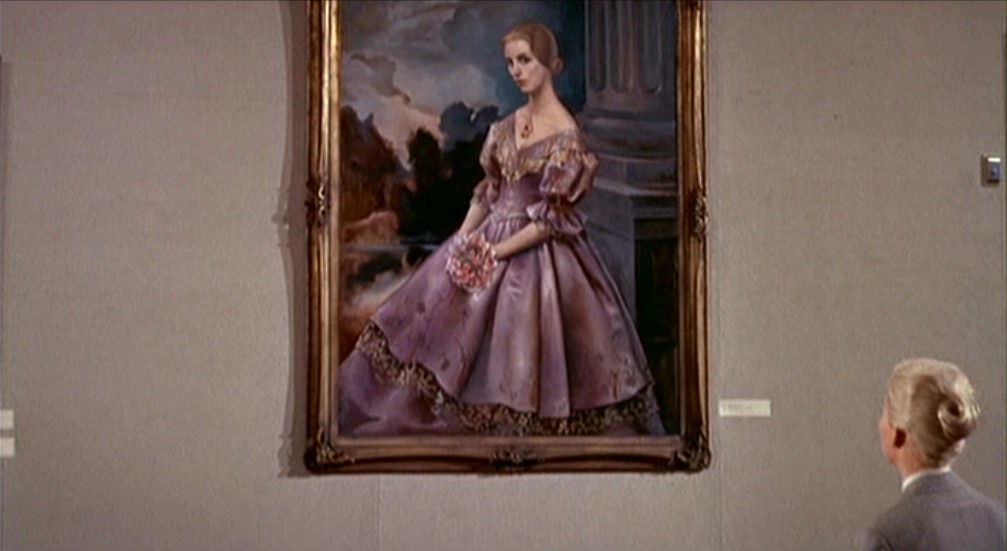
Enter the MacGuffin, that most Hitchcockian device which moves everything along so smoothly yet ultimately has little relevance to the film’s theme. But while in other films it is clear-cut (the $40,000 in Psycho, the government secrets in North By Northwest) here it is less so, and seems to be on shifting sands. Initially, it is precisely defined by the mission Gavin Elster puts Scotty on: solving the mystery of where his wife Madeleine is going. This slowly changes to discovering the relevance of the painting of Carlotta Valdes, the grave, the hotel, and how they are all interlinked, before yet another mystery surfaces, that of what Madeleine’s vision of a Spanish bell tower represents.

The famous surprise that comes halfway through Psycho is unanimously praised as daring, but it could be argued that the surprise that comes two-thirds of the way through Vertigo is just as revolutionary: here is the central mystery, or at least what has been the central mystery so far, solved before our very eyes. Is that the end of the story? Audiences at the time must have thought so, probably not suspecting that there would be at least another 40 minutes of film to come. But this is where the classic mystery thriller format ends and the psychological horror comes to its apex: no longer is a man chasing a doomed woman with whom he is in love, but a woman is now chasing a doomed man whom she loves, but who loves not her but someone who never existed.

In this setup, there is a little philosophical overlap with Andrei Tarkovsky’s Solyaris (1972), in that both films in different ways examine what it means to love someone. In the Russian film, the question is is it the other person in themselves that we love, our own perception and memory of what they mean personally to us, or is it in the forever unbridgeable gap between two existences. Vertigo offers a much more bleak outlook: Scotty falls in love with a charlatan and is unwilling to accept any other ‘Madeleine’, while the very real Judy has fallen in love with a Scotty who is perhaps just as unreal, as invented as her alter-ego.

The main characters, their interlinkings and failures to communicate the truth to each other, as well as their incomplete knowledges of the whole situation are what drive the film towards its inevitably tragic conclusion: lies, tricks, deceptions are everywhere. Even the superficially relaxed relationship between Scotty and Midge, whose early scenes together appear to offer light relief to the thickening mystery plot, have an undercurrent of jealousy and sexual tension, which surface when the latter makes an ill-judged attempt at poking fun at the former’s developing preoccupation, overstepping the mark catastrophically.

It takes an obsessive to analyse obsession; just as there is something of Vladimir Nabokov in Lolita‘s Humbert Humbert, there is much of Hitchcock in John Ferguson. As has been noted by many others, the disquieting scene where an increasingly paranoid Judy is made-over by Scotty to look exactly like Madeleine, right down to the platinum blonde hair and fitted grey suit, in many ways acts as Hitchcock’s confessional to the way he uses the women he casts in his films, meticulously and some would say obsessively controlling their looks and manners. For a director so verbally dismissive of the importance of acting talent and so frequently abusive of his female characters, it is something of an admittance of guilt.

There is so much happening for the viewer both in terms of overt plotting and underlying psychology that it is easy on a cursory viewing to overlook just what a dazzling technical achievement the film is: Bernard Hermann’s magnificent, unsettling score, making even the most trivial detail seem sinister and loaded with danger; the performances of the two leads, both playing against type but delivering career-defining roles; the use of location, San Francisco’s apartments, hills, landmarks, narrow backstreets and surrounding landscape as important a location to Vertigo as Los Angeles was to Philip Marlowe. The virtuosity with which Hitchcock can add a breathtaking effect, yet make it necessary enough to the story for it not to seem overly showy – the ‘vertigo’ shot as famously copied in Jaws, or the bravura scene between Scotty and Judy that Roger Ebert describes as the director’s best.

Note also the colour coding: the bright, passionate reds of the restaurant where Scotty first sees Madeleine, the famous grey suit, the greens of both the car he follows and the doppelganger he later stalks. It may seem like a game of directorial cat-and-mouse, but the later scene in the hotel room, where Scotty finally acquires the woman he has been fixated with, make it clear that this is no foolish joke on the audience: the translucent green of the hotel sign forms a mysterious haze around his desired one, which is later shattered by the very real red of the familiar-looking necklace around her neck. See here for more on the film’s colour coding.

One final odd curio: film censors in certain countries required the film not to end on the dramatic bell-tower ledge, but for there to be a coda explaining how the fleeing fugitive Elster was being captured in Europe, as if audiences in Europe would not be able to handle anyone guilty of murder not being seen to be brought to justice.