Great Films: I Fidanzati (Ermanno Olmi, 1963, Italy)

It comes and goes within a short 77 minutes, and during that time hardly anything dramatic really seems to happen, so why is Ermanno Olmi’s 1963 film I Fidanzati so dearly cherished by those who have seen it? The answer, at least in part, is how it presents the complexities of life, particularly twentieth century life, and the conflict between how people deal with these whilst striving both to maintain a sense of one’s own identity and to keep those that we love close to us.

The background to this, and many another Italian film from this period, is the country’s “miracolo economico” of the 1950s and early 1960s, where a series of agrarian and fiscal reforms led to unprecedented economic growth and industrial expansion, coupled with mass population transfer from the poorer South to the more prosperous North of the country. Filmmakers at this time, particularly Antonioni, sought to try to illustrate the effects that these ongoing demographic shifts were having on individuals and the way that they interacted with each other, usually showing how society was becoming more fractured, and people more isolated in these quasi-dystopian urban landscapes.

Olmi’s film, though, is a little different, and it pays to talk a little about his background. Unlike his contemporaries Rossellini, Antonioni and particularly Visconti, Ermanno Olmi was not from well-to-do stock, nor had any formal filmmaking training. Instead, he learned his craft making documentaries for the Edison-Volta electrical plant that he worked at as a clerk, culminating in his first feature-length film Il Tempo Si E Fermato [Time Stood Still] (1959). His experience of blue-collar work would undoubtedly give him a different take on the industrialization of Italy, say, relative to the more purely intellectual standpoint of an Antonioni or a Pasolini.

If his second film, Il Posto (1961), was somewhat autobiographical in nature, reflecting his own transition from small town comfort to the hustle and bustle of Milan, then there is a little of himself also in Giovanni, the main character in I Fidanzati, again a Milanese but this time older and facing a year-and-a-half-long displacement to Sicily for a work contract, taking him away from his fiancé Liliana, with whom relations seem strained enough already. As the film opens, our couple are at a public dance, he trying to rationalise his move to her, she pessimistic about what it will do to their relationship.

The film’s pacing is rather skewed – the opening dance is intercut with other scenes seemingly from different timeframes, non-linearity clearly influenced by Alain Resnais’ Hiroshima mon Amour (1959). European audiences at the time would have been sure to expect a similarly bleak outcome in Olmi’s film, perhaps also remembering the less-than-happy endings of L’Avventura (1961) La Notte (1961) and L’Eclisse (1962). But after the opening act, the majority of the film is devoted to Giovanni and his slow adjusting to life in Sicily, more in terms of being away from home than being away from Liliana, and it almost plays like a Werner Herzog-like discovery of a new land and peoples. It is only near the very end do we get the expected rush of pathos and emotion that we have been waiting for.

Amidst the story gradually unfolding we glimpse Olmi the documentarist peeping out, his camera catching the small details of everyday Sicilian life, like an over-zealous tourist: the huge white mounds of the salt mines, a small boy in a cafe hurriedly making coffee so he can run off to play with his friends, a masked New Year party where the women wear masks presumably to protect their honour, the final shots of heavy rains sweeping across the plains. It is not just these snapshots he captures, there are also some lovingly shot scenes of industrial work, sparks from welding irons cascading down scaffolding like flourescent waterfalls. Yes – cinematic romanticised welding.

As both Giovanni’s exile and his separation from Liliana wear on, the film once again shifts to non-linearity, as a series of postcards hesitantly exchanged between the couple elicits more snapshot details about their past together, but also begin to make the couple begin to envisage a future time where they are together. This temporal shift into a future not yet happened, whilst not completely out of step with the changing timeframes of the early part of the film, do mark an important turn in events, as we can see that the couple are now at least optimistic about their future, and that there is hope for them where there seemed little. It is such a seemingly simple cinematic device used, but like much of the rest of the film it is its very simplicity that makes it resonate emotionally.

The influence of Italian neorealism hangs large over Olmi’s work, and no more so here: the subject matter is focused on the lives of working people, filming done in genuine locations as opposed to studio sets, a documentary-like shooting style, and most importantly the use of non-professional actors. One of the major triumphs of I Fidanzati is the naturalistic performances of the two main characters: firstly, the quiet reserve of Carlo Cabrini as Giovanni, looking much like one the passively observant leads in a Wim Wenders film, always aimlessly wandering and wondering in his newly found surrounds.

Just as importantly, the wonderfully Anna Canzi as Liliana, whose silent face conveys the depth of emotion that dialogue seldom can. One scene in particular stands out to me, where she has returned to the dancehall where she met Giovanni for a New Year celebration, but sits alone in the corner, unable to join in the festivities. We see her only briefly, yet in that time her solemn expression and slouched posture are enough for any viewer to relate exactly to her postition, clearly somewhere where she wished not to be at all.

I introduced the film by questioning why I Fidanzati is so beloved, yet it feels entirely inadequate merely to sketch out these details and expect to communicate its simple power to someone who has not actually seen the film. This is a film for everyone in love, or who has ever loved: warm, a little sad, tender, humane, cautious but quietly optimistic.
Great Films: El Espíritu de la colmena [The Spirit of the Beehive] (Victor Erice, 1973, Spain)

For those entranced by Guillermo Del Toro’s recent Pan’s Labyrinth (2007), here is that film’s spiritual forefather, and one of the great masterworks of Spanish cinema. Made in the last years of the Franco dictatorship, what is surprising about The Spirit of the Beehive is just how much Victor Erice managed to slip under the censors’ gazes and onto the screen, even if cloaked somewhat in allegory. Beyond this political context lies one of the greatest films, if not the greatest, to examine childhood innocence and its slow surrender to the real world.

“Once upon a time”, the opening titles describe, setting up the mythical, more mystical side of the film’s narrative. A vehicle pulls into a small village in rural Spain, which a group of children excitedly gather around. Its precious cargo is the reels of film containing James Whale’s horror classic Frankenstein (1931), which on projection hold the youngsters spellbound. One girl, the impressionable Ana, is left, mystified by one particular scene: when the monster is taught by Little Maria to throw flowers into the river, only for him to throw her into the waters too. Why did he kill her, Ana enquires of her sister, the older Isabel, who toys with her younger sibling by suggesting the monster lives in a nearby sheepfold, and may be summoned if Ana calls for him.

The year is 1940, and the other side of the film is framed by context of the location: the dusty plains of Castile. By this time, the Spanish Civil War had long been won by Franco’s Nationalists, but beginning were the small-scale Maquis Republican guerilla operations which would last well into the next decade. What becomes more noticeable throughout the screentime is the absence of young men from the town, whether killed in the violent, bloody conflict just ended, or participating in the wider European conflict of the time. The few we do glimpse are on trains, whether bound to or from the lines of battle. One young man will eventually enter the story, though, which will have its own inevitable consequences.

Ana and her sister live with their parents: their father, an older man who silently tends to his beehives, observing and writing about their microcosmic patterns of life, as well as taking the girls on walks in the country explaining to them about the ways of the natural world. Their mother, much younger than he, daydreams and writes long letters to a lost lover who is away fighting, and quite possibly dead. Though both the father and the mother are loving to their children, they are clearly no longer communicative to each other, and their respective preoccupations allow the girls time and room to roam around and play.

The young Ana, given this somewhat free reign, is allowed to be led astray by Isabel, roaming around the countryside and playing on the nearby train tracks. Isabel is older, more worldly-wise than her younger, more impressionable sister, and plays a number of tricks on her; some critics have pointed to their cruelty, yet for me are typical of the type young siblings play on each other. The two sisters illustrate the transition into adulthood: the older sister playing with ‘adult’ things like lipstick and shaving brushes, losing the innocence of childhood, while the younger sister, still learning about the world and life, at the mercy of the limits of her imagination. There is undeniably some subtext here about the loss of Spain’s innocence in the blood soaked years of the late 1930s, which saw brother killing brother, but it is the film’s sense of enigma which allows interpretations to be drawn without being forced.

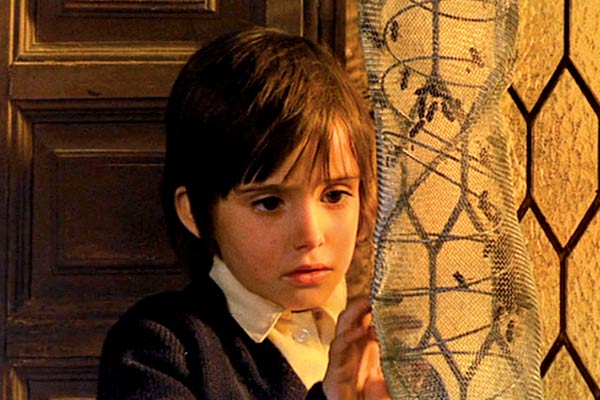
Part of the film’s wistful air can be certainly laid down to the remarkable cinematography; Bergman-like interiors are bathed in light streaming through the hexagonal-patterned (beehive-like) windows, betraying a debt to Vermeer both compositionally and in terms of the rich golden hues. Exterior shots are similarly rich in colour, the Castilian plains as full and golden as anything we would later see, for example, in Terence Malick’s spectacular Days of Heaven (1978). Cinematographer Luis Cuadrado was slowly going blind around the time in which the picture was shot, and it is all the more remarkable that the subtle nuances of chiaroscuro indoors, as well as the more grandiose outdoor shots, are as superbly photographed as they are.

As much as the film is memorable for its visuals, what stands out equally is the central performance of Ana Torrent, later to make an equally memorable impression in Carlos Saura’s Cría cuervos (1976), and who continues to work in Spanish cinema to this day. It is a demanding role for any actor, with most scenes communicating emotion through facial close-ups rather than dialogue, yet her visage – full of wonder and sadness, inquisitiveness and fear – seems to sum up a lot of what childhood is about. The parallel with Pan’s Labyrinth would be that much of what Ana fears in the world is what her imagination creates, yet this allows her to deal with real-world problems with much more ease – much like Del Toro’s protagonist.

The Spirit of the Beehive won its director much acclaim, but Victor Erice has since gone on to make only two subsequent feature films. A little strange, maybe, given Spain’s increasing moves towards liberalization, openness, and artistic freedom. But then again, perhaps he managed to say all he wanted to say in this, one of the great films of European cinema, one of the great meditations on childhood, and a poetic allegory of a beautiful country’s sad recent history.

Great Films: Amarcord (Federico Fellini, 1973, Italy / France)

It hardly seems a criticism, but the problem with much of director Federico Fellini’s output is that it is too entertaining to take it with the seriousness that it deserves. Take Amarcord as a key example; from the outset what we have is a wildly funny look at Italian small town life, replete with bawdy humour, sequences of pure slapstick, and a lightness of tone which fools the viewer into thinking that it is merely a simple pastiche of everyday life beside the Adriatic.

One of the clues to the film’s meaning is in the title; Amarcord is an approximation of ‘I remember’ in the dialect of Fellini’s hometown of Rimini, and what is clearly being portrayed here is the small seaside town of his childhood. Much, but not all, of what we see is filtered through the eyes of a group of pubescent boys: the boring lessons at school, the buxom women whose derrieres populate their gazes, the coming and going of the seasons over the course of the year. But this is not pure bildungsroman, as from the outset there are competing narrative perspectives: the opening sees the town idiot explaining to us the significance of the spring puffballs, and the town’s lawyer regularly intercedes with pieces to the camera detailing facts and fancies about the locale.

Fellini’s later films were frequently criticized for the exaggerations and indulgences which were seen to be the antithesis of the pared-back Italian Neorealist school in which he cut his cinematic teeth. It must be remembered, however, that, like that more recent over-the-top documentor of the grotesque Terry Gilliam, Fellini came from a background of cartoon-making, and this instinct for caricature provides an interesting, if not entirely surprising, insight into his filmmaking mindset. Take the gruesomely comical visage of Mussolini that is paraded before the assembled Fascist parade – the contrast between its ridiculousness and the later scene where a Communist sympathiser is forced to drink castor oil flags up the duality between the absurd and the serious which runs throughout the director’s work.

Another accusation lazily thrown at Fellini is that his films are sexist – the superficiality of the women of La Dolce Vita (1960) and 8 1/2 (1963), coupled with a consistent voyeuristic obsession with the female form has fed into these claims. The fact is, if women don’t come off too well in some of his films, frankly neither do the men. Marcello in La Dolce Vita is equally as shallow as his female counterparts, and the famous harem scene is suitably avenged in his later La Città delle donne (1980). The women of Amarcord present an equally curious mix, representing different aspects of sexuality, both public and private. The promiscuous Volpina is in stark contrast to the class of town beauty Gradisca, as underlined by their colour coded uniforms (Volpina’s green dress the opposite of Gradisca’s bright red coat). Yet the former’s is a more honest sexuality, while the purity of the latter is questioned when she is offered up as bait for a visiting Fascist official.

The undercurrent of Fascism underlines one of the film’s other important strands: that of the disparity between the public and private, the indoor and the outdoor. While the town puts on a face of community and civic pride with its rituals, such as the burning of the witch of winter, or the daily passeggiata through the town square, behaviour inside the town’s buildings is far from harmonious: the arguments, sexual intrigues, political discontents all play out behind closed doors. When Uncle Teo is released from the insane asylum for a day out in the countryside, the worst he does is climb a tree and proclaim “I want a woman!” – an honest cry of frustration, but enough to demand incarceration. All is about appearance and superficial calm – as Fellini embodies with the grand but clearly artificial SS Rex ship passing by the town. It is this unwillingness to publicly admit discontent which allows good people to submit to Fascism.

Amarcord is a dense, thematically complex film, yet it all seems to hang together effortlessly. Of course, this is evidence of a true directorial master at work, but no mention of Il Maestro can go without flagging up the immeasurable contribution that his own maestro, Nino Rota, made to his work. It is often said that Fellini’s films make no sense without Rota’s scores keeping them going, and with Amarcord their collaboration’s synthesis of image and music is at is very peak: the opening theme with its melody which gently falls before soaring again still higher perfectly evokes much of the imagery of the sea, and the puffballs of the opening shots. The theme later recurs in many different forms: a romantic Hollywood-style theme, an upbeat lounge-jazz version, and one absolutely magical slower syncopated variant accompanying the boys’ glide through the snow-covered town square. Along the way, there is also polka, flamenco, accordions and even Arabian-influenced sounds. An astonishing array of sounds, yet entirely coherent, and testament to the true genius of Nino Rota.

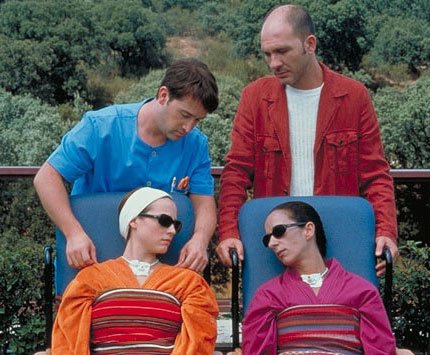
Great Films: Hable con ella [Talk to Her] (Pedro Almodóvar , 2002, Spain)

Coincidence, chance, fate, whatever it is that drives a Pedro Almodóvar pelicula, there always seems to be a guiding force moving proceedings along, whether dealing crushing blows or handing great fortune upon its characters. In Hable con ella it is mixed blessings: two lonely men, both infatuated by two very different women, find themselves united when the objects of their desire suffer accidents which put them in long, deep comas. For Almodóvar this represents a break with his traditional lines of enquiry: so often a great director of women, trying to penetrate their world which he has been denied merely by dint of his gender, this is a film about men, and that eternally unknown mystery to them of the opposite sex.

We begin, as in his previous film Todo sobre mi madre (1999), with a performance, this time a piece of dance, with two women gracefully moving about a stage littered with chairs. A man enters, the women scatter, knocking over the wooden props. In the audience are Marco and Benigno, who do not know each other yet, both entranced by the production. Marco is a journalist, and another day catches sight of a female matador, Lydia, appearing on a trashy talkshow (now there’s an Almodóvar trademark) and storming off when asked about her ex-lover, also a famous bullfighter. Something in seeing this prompts the writer to ask his editor to allow him to write a profile of her, which is agreed to. On meeting, he admits to her that he is drawn to women like her, and a stroke of Almodóvarian fortune thrusts them together.

Flash-forward, and Lydia has a dramatic ‘accident’ with a bull, which puts her in a vegetative coma. At the hospital, Marco meets Benigno again, who is a nurse tending to another girl in a coma, Alicia, a dance student, who it turns out the young man used to watch train from his bedroom window across the road. Benigno, like his name, seems a harmless, unthreatening fellow, lonely after having cared for his sickly mother up until her recent death. The two men are like light and dark – Marco, still haunted from losing a prior love jaded from experience, and Benigno virginal and innocent – so unlike each other, yet they find common ground in their shared predicaments. Benigno, thinking himself more in tune with his female patient offers Marco one piece of advice – hable con ella: ‘talk to her’. If the men are contrasting, then so to are the women: despite the similarities which the director clearly wants to draw between bullfighting and dancing, there are clear differences: the colourful adornments and costumal complexity of Lydia’s matador outfit in stark contrast to the simple white gown which the unconscious Alicia wears in her hospital bed, the blood-soaked bull next to the elegance of the dancer.

Almodóvar’s films are often populated with female dialogue: chit-chat, gossip, and more serious matters which men generally seldom would admit to talking about with their male friends. Yet his films are not aimed strictly at a female audience; i feel that his films are often a means by which men can venture into the cinema and gain a window of insight into what women really talk about to each other, whilst still holding their arthouse heads held high. Here though, this kind of talk is kept to a minimum – save for some idle staff-room gossip about Benigno’s true sexuality, and one woman’s charming description to a friend about her ‘elephant sized’ defecation. What the elegant setup of this film allows is for men to talk to each other about women – in one particularly great moment, Lydia and Alicia have been brought together, and Marco speculates at to if they weren’t comatose, ‘what do you think they would be talking about?’.

If this is a film about loneliness, then it is also about voyeurism and co-dependency. Aside perhaps from the angelic and mostly prone Alicia, the other main characters seem to be living their lives through someone else: Benigno through Alicia and latterly his deceased mother, Lydia through her former amor Niño, and Marco at first for his ex-love, then by Lydia’s bedside, before finally assimilating much of Benigno’s identity. The nurse by definition works for the benefit of others, and Marco too in his capacity as a travel journalist acts as a cipher for other peoples’ experiences. As they conduct their bedside vigils, we have to question how much do we ourselves live our lives through other people – is this not, to an extent, what love is? ‘Love’, of course, is never a simple concept in the Almodóvar world, much like in the real world, and sexuality is ill-defined at best. Benigno pretends to be homosexual in order to get the job tending to Alicia’s bedside, but is he ‘sexual’ at all?

The much celebrated, perhaps over-praised, Todo sobre mi madre wore its artistic influences on its sleeve – John Cassavetes’ Opening Night (1977), Tennessee Williams’ A Streetcar Named Desire, Joseph L. Mankiewicz’s All About Eve (1950) – and here there is a segment which pays tribute to silent films gone past, a bizarre Freudian B-movie the details of which are probably too spoiler-filled and quite frankly bizarre to reveal to any readers who have not seen the film yet. The interlude would seem an amusing exercise in style were it not for the fact that the key turn in the narrative occurs here – what is its significance? There is much to debate here, but once again, not without seeing the film first.

Hable con ella is my most favourite of Almodóvar’s films, though it could be construed as his most least auteurist work. Certainly there are most of his trademark elements present: the driving, mysterious plotting, vibrant use of bright colours, sexual confusion, an emphasis on theatricality over narrative realism. But while most of his films are to one degree or another built from his background in exploitation cinema, Hable con ella feels his most honest: his best statement about what it is to be a man in the world, wanting to be close to women, perhaps even be one, but never being able fully to understand their mysteries, their sheer incomprehensibilities from a male standpoint.

Great Films: Fucking Åmål [Show Me Love] (Lukas Moodysson, 1998, Denmark / Sweden)

The best line in Richard Linklater’s 1993 high school comedy Dazed and Confused is when Randall ‘Pink’ Floyd says “if I ever start referring to these as the best years of my life – remind me to kill myself”. That one line seems to eloquently sum up the wide gap between the idealised notions of blissful adolescence we are frequently spoon-fed and the altogether more grim realities of growing up which we all faced, or are facing, as well as the almost inevitable glossing over of these which seems to occur in our oh-so-tough later years of mortgages, pensions and rising energy bills. Like Linklater’s influential film, Lukas Moodysson’s debut feature Show Me Love reminds us all of the emotional traumas, as well as the fleeting triumphs, of those ever-fading-from-memory days of youthful naivety and boredom.

The setting is Åmål, a small town in the Swedish south-west so unaffectionately described in the film’s original title, but viewers may quickly recognise it as like many a small town elsewhere in the Western world. There is quickly established the sense of there being really nothing for young people to do, aside from going to school, hanging around each others’ houses and the occasional teenage ‘party’. The popular, attractive Elin sums this frustration up wonderfully in an early scene; wanting to go to a ‘rave’ but grounded by her parents for a tantrum, she roots around in the medicine cabinet, finally reasoning that her best chance of getting high will be to take a massive dose of antacid pills – when told the folly of her plan, she can only scream “I want to take drugs!”. For all of her popularity, she seems jaded by the insularity of her small-town existence.

It could be worse for Elin; at least she has friends. Agnes is a girl who attends the same school, but is a loner, depressed and frustrated by her inability to make any real friends. She looks up to her more popular, attractive classmate, and has also developed something of a crush on her, knowing full well that realistically nothing could ever happen between them. Her kindly, well-meaning but rather out-of-touch parents try to do their best to help her, telling her that it is because she is new to the area, and that anyway the popular kids at school always end up as the ones that never amount to anything. How this is supposed to comfort a sixteen year-old girl is anybody’s guess.

Still meaning well, Agnes’ parents arrange a birthday party for her, even going so far as to print out invitations for the others at school, not realising the probable humiliation this would bring on their daughter. Sure enough, when Agnes hands them out, she is treated with scorn, and sure enough, when the time comes for her party, no-one shows up except for a similarly friendless girl, the wheelchair-bound Viktoria. Angry at her humiliation, Agnes screams abuse at her and storms off to her room without eating.

In the meantime, Elin and her sister Jessica, remembering the invitation they received and desparately wanting to get drunk but also to avoid another party elsewhere, decide to go to Agnes’ party, drink as much free booze as they can, and then leave. Rumours have spread around school about their classmate’s supposed sexual preference, and Viktoria dares her sister to kiss Agnes, for the princeley sum of a few kronor. Game for a laugh, she agrees to do it, quickly running off to the other party after having done so. On arriving at the other, more populated party, Elin feels guilty at what she has done, and returns to Agnes’ house to invite her over as well.

Up until this point, the film has been about contrasts, but from here on an affinity develops between the two girls, despite their differences. On the way to the other party, they both begin to talk about how stifled they feel in Åmål, Elin in particular fearful of getting pregnant and winding up as a single mother stuck in the town for the rest of her life. They both have dreams and ambitions, but neither is particularly confident of bringing them to fruition. Stoked up on the booze, they even attempt to hitchhike to Stockholm (a five hour drive away) as at least a tokenistic, temporary escape.

Show Me Love could so easily be many things – exploitative, leering, predictable, whimsical, patronising to its characters – but its real triumph is that it is none of these things, and the ease with which it tells its story and sets up its environment it effortless. Critics of the film have pointed to its lack of character development or depth, but for me this is symptomatic of its strengths. In one scene, Elin is quizzed by her sister about an ‘Italian guy’ she was supposed to be in love with, which she dismisses with a simple “no, that was yesterday”. How can we expect straightforward Hollywood character development from the rapidly changing moods of teenagers? The film’s rapid shifts from light to dark, from comedy to seriousness, are just reflections of the fluctuations of the flyaway teenage mood.

One of the other strengths of the film is the performances of the two leads: Alexandra Dahlström really shines as Elin, a mess of teenage contradictions, somehow both superficial and deep, while Rebecka Liljeberg as Agnes has less of a showy role but invests her character with equally numerous nuances. And it was not until seeing Juno (2007) this year that I have seen such a warmly-drawn parent figure, here in the person of Agnes’ father: he sympathetically tries to do his best for his daughter, but is painfully out of touch and is no comfort. Sometimes there really is nothing a parent can do or say to help matters.

Show Me Love was well received both critically and publicly, even grossing more than Titanic (1997) at the Swedish box-office in 1998. The late Ingmar Bergman even labelled Show Me Love “a young master’s first masterpiece”. Since then, his subsequent films have become increasingly dark in tone and subject matter, such as the bleak Lilya 4-ever (2002) and the highly controversial A Hole in My Heart (2004), which now seem a long long way away from the optimism of this and his second feature, Together (2000). While i appreciate his later work greatly, his debut remains for me his masterpiece, and one of the greatest portrayals of the pains and trivialities of adolescence.