Great Films: La Grande Illusion (Renoir, 1937)


Widely regarded not simply as one of the best films about war, but one of the greatest films in cinema history, Jean Renoir’s La Grande Illusion remains a powerful artistic and moral statement about the consequences of conflict.

The film is set during the First World War, and one of the key themes is one of class conflict; the two aristocratic characters on either side of the war, Boeldieu and Rauffenstein, through their mutual respect and multi-lingual verbal jousts, are shown to have more in common with each other than they do with officers on their own sides. Time is running out for them, though; both are aware that the war will signal the end of the hegemony of the aristocracy in Europe, an overdue death knell for their feudal positions; “For a commoner, dying in a war is a tragedy, but for you and I, it’s a good way out”, Boieldieu utters in one particularly poignant scene. This sense of inevitable change would later be a key theme of a protege of Renoir’s, Luchino Visconti, in particular in Il Gattopardo, his dramatisation of the Risorgimento in nineteenth-century Italy.

Within the film, issues concerning the First World War are addressed, but it must be remembered that it was made in 1937, when Europe was once again on the cusp of bloody conflict. Any doubts that the film was intended to have a contemporary message are dispelled by the inclusion of a Jew as one of the key protagonists, a defiant challenge to political situation in Germany. The fraternity between the Jew Rosenthal, the French Maréchal, and later a German widow, was clearly intended as an illustration that war is merely a means of dividing people and their common humanity.

La Grande Illusion is a war film without any war sequences, though its presence is always palpable. In one memorable scene we see a lingering shot of a German widow’s dining table, now too large for her depleted family, reminding us of the human cost of war. There is an added level of irony, as she describes that her brothers died in “some of our greatest victories”; win or lose, the consequences are still the same, still just as life-alteringly destructive. The bleak picture of the effect of war on ordinary civilians is in stark contrast to life in the POW camps; the scenes here are played with a light, joky tone, and are much echoed in John Sturges’ classic The Great Escape.

Jean Renoir (1894-1979), whom Orson Welles labelled “the greatest of all directors”, is widely regarded as one of the key fathers of cinema. The son of impressionist painter Pierre-Auguste Renoir, he developed an interest in cinema after being severely injured during the First World War. He started making films in 1924, heavily under the influence of both Austrian silent film legend Erich von Stroheim, and Charlie Chaplin. By 1936, he had made two of his enduring classics: Toni, a clear influence on the later Italian neo-realism movement, and Partie de Campagne, on which a young Luchino Visconti worked as an assistant. His two magnum opi, La Grande Illusion and La Règle du Jeu, followed in 1937 and 1939 respectively.
Review: Sunshine (Boyle, 2007)

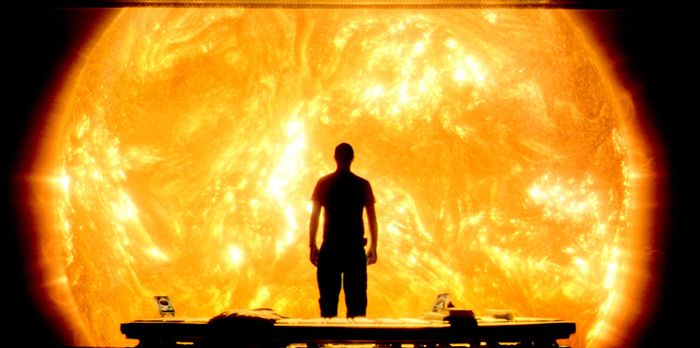
“Directors only go into space once”, said Danny Boyle in the run-up to the release of his contribution to the sci-fi oeuvre. Sunshine is a bold attempt at leaving his mark on the genre, though its flaws perhaps reduce its chances of joining the canon of the truly great space flicks.

The Sun is dying, and a team of astronauts have been sent on a mission to fire a nuclear device into it, which it is hoped will lead to its reignition. We find out that the mission, somewhat morbidly codenamed Icarus 2, is the second such attempt, the first mission having dropped out of contact with Earth several years before. This second attempt will, however, be the last possible chance for saving life on Earth. Things, of course, don’t go according to plan, particularly after the distress beacon of Icarus 1 is detected, an eerie echo of the similar scenario in Alien.

This could easily have been a schlocky sci-fi thriller, but the film’s strength is that, like Tarkovsky’s majestic Solyaris, the plot is used as a device for making the viewer aware of various spiritual and existential questions. There is very little characterisation of the crew – we do not learn about their personalities or lives on Earth – but we get to know them through the decisions, both moral and professional, that they are forced to face. We are immediately placed on board the ship with them, allowing us to feel their sense of detatchment from Earth. However, this also has the effect of distancing us from the magnitude of the importance of their task; the weight of the saving of humankind is rarely felt particularly strongly, which at times renders the characters’ actions questionable. Visually, the film is particularly impressive, with thoughtful set-design creating a very believable Icarus spacecraft. Some critics appear to have questioned the science behind it all, but this is a bit of a red herring, I found myself fully prepared to go along with it.

Intertextually, there are numerous respectful nods to the classics of the genre, namely Alien, Solyaris, 2001, and Dark Star, all done delicately rather than in a Tarantino-like manner (when will he “go into space”, i wonder?) However, its spiritual brother is Paul W.S. Anderson’s underrated Event Horizon, an effectively tense space horror film mauled by the critics who were expecting a subtle sci-fi thriller. Sunshine’s final act in particular seems to resemble Anderson’s film, and it is here that the biggest problem with the film lies: what starts off as a well paced, neatly constructed, patient film, ends up unwisely sliding off into predictable horror about two-thirds in. This unsatistfactory denouement seems in parallel with Boyle’s previous 28 Days Later, which also lost its way at a similar stage after a spectacular beginning. That film’s sequel, 28 Weeks Later, (albeit by a different director and screenwriter) also limped to a close somewhat. Does this mean that Boyle and Alex Garland have a problem finishing films off satisfactorily?

Performances are uniformly good, particularly Cillian Murphy who always appears to breeze through films as if acting was the easiest thing in the world to do (c.f. the likes of Orlando Bloom who make it look amazingly hard). Also nice to see the likes of Chris Evans, Michelle Yeoh and Rose Byrne involved in a British production, showing that Boyle is still a good draw for international talent. Overall, Sunshine is, for the most part, an intelligent, well paced and thought-provoking work, let down only by a rather flimsy third act.

Film Reviews

Men, Women and Hand-Scythes: Urbanoia and Gender in Yang Chul-soo’s Bedevilled (Yang Chul-soo, 2010, South Korea)

The Social Network (David Fincher, 2010, USA)

Madeo [Mother] (Bong Joon-ho, 2009, South Korea)

Frightfest 2010 Roundup

Predators (Nimród Antal, 2010, USA)

Vincere (Marco Bellocchio, 2009, Italy / France)

The Bad Lieutenant: Port of Call – New Orleans (Werner Herzog, 2009, USA)

Four Lions (Christopher Morris, 2010, UK)

Io sono l’amore [I Am Love] (Luca Guadagnino, 2009, Italy)

Kick-Ass (Matthew Vaughan, 2009, USA/ UK)

Double Take (Johan Grimonprez, 2009, Belgium/Germany/Netherlands)

Le père de mes enfants [Father of My Children] (Mia Hansen-Løve, 2009, Germany/France)

The Kreutzer Sonata (Bernard Rose, 2008, USA)

Shutter Island (Martin Scorsese, 2010, USA)

Män som hatar kvinnor [aka The Girl with the Dragon Tattoo] (Niels Arden Oplev, 2009, Sweden/Denmark /Germany)

Treeless Mountain (So Yong Kim, 2008, USA / Republic of Korea)

Aruitemo aruitemo [Still Walking] (Koreeda Hirokazu, 2008, Japan)

The Road (John Hillcoat, 2009, USA)

Where the Wild Things Are (Spike Jonze, 2009, USA)

Das weisse Band – Eine deutsche Kindergeschichte [The White Ribbon] (Michael Haneke, 2009, Austria / Germany / France / Italy)

Jennifer’s Body (Karyn Kusama, 2009, USA)

Zombieland (Ruben Fleischer, 2009, USA)

District 9 (Neill Blomkamp, 2009, USA /New Zealand)

Inglourious Basterds (Quentin Tarantino, 2009, USA/Germany/France)

L’instinct de mort [Mesrine: Killer Instinct] (Jean-François Richet, 2008, France/Canada/Italy)

Orphan (Jaume Collet-Serra, 2009, USA /Canada/Germany/France)

Antichrist (Lars von Trier, 2009, Denmark/Germany/France/Sweden/Italy/Poland)

Moon (Duncan Jones, 2009, UK)

Sunshine Cleaning (Christine Jeffs, 2008, USA)

Katyń (Andrzej Wajda, 2007, Poland)

Anvil! The Story of Anvil (Sacha Gervasi, 2008, USA)

The Damned United (Tom Hooper, 2009, UK)

Drag Me To Hell (Sam Raimi, 2009, USA)

Synecdoche, New York (Charlie Kaufman, 2008, USA)

Låt den rätte komma in [Let the Right One In] (Tomas Alfredson, 2008, Sweden)

Martyrs (Pascal Laugier, 2008, France/Canada)

Il Divo (Paolo Sorrentino, 2008, Italy/France)