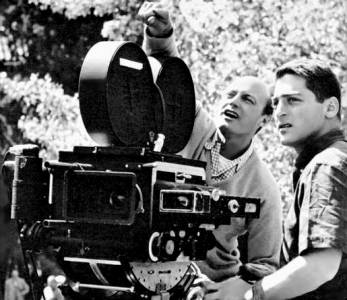
Jack Cardiff, 1914-2009

Sight and Sound recently ran a feature in praise of cinematographers, and suggesting that few could really be called household names. One name which might spring more readily to mind than others is Jack Cardiff, and for good reason.

Several good reasons in fact, most significantly a trio of films which he shot for Michael Powell and Emeric Pressburger starting with the startling kaleidoscopic visions (in colour and black and white) of A Matter Of Life and Death (1946), continuing with the stunning (false) Himalayan sweep of Black Narcissus (1947), and finishing with the ravishing colourful flourish of The Red Shoes (1948).

These three films not only sealed Powell and Pressburger’s reputations but so too Cardiff’s, who then became cinematographer to the stars, shooting subsequently for the likes of Alfred Hitchcock, John Huston and Laurence Olivier, as well as intermittently turning his hand to direction himself.

The Powell/Pressburger films stand as his testament. All three remarkable for their use of Technicolour, but also in very different ways from each other: the fluid dynamism of The Red Shoes, the stately elegance and breathtaking scale of Black Narcissus, and the sheer visual wizardry of the range of visual tricks in Life and Death show a visual artist with an incomparably complete mastery of the camera. Marilyn Monroe described him as ‘the best in the world’. It is hard to argue against this.
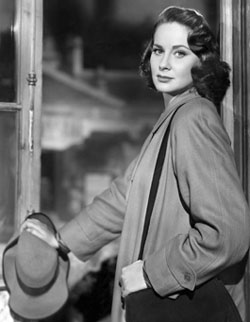
Italian Film Festival 2009

The Italian Film Festival kicks off tonight in London’s Riverside Studios with Ferzan Özpetek’s Un Giorno Perfetto (2008) and visits venues across the UK and Ireland between now and 27 May. Highlights include various screenings in tribute to screen siren Alida Valli, most notably the bizarre double-bill of Carol Reed’s classic thriller The Third Man (1949) alongside Dario Argento’s ballet school splatterfest Suspiria (1976). Details of venues and screenings here:

http://www.italianfilmfestival.org.uk/

Max Von Sydow at 80

His is one of the most extraordinary acting careers of the century of cinema. According to IMDB, Max Von Sydow has no less than 137 film credits to his name, beginning with Alf Sjöberg’s Only a Mother (1949) some sixty years ago. Since then, the iconic roles speak for themselves: the aged Father Merrin in The Exorcist (1973), chess-playing knight Antonius Block in The Seventh Seal (1957), Töre the vengeful father in The Virgin Spring (1960), and a memorably villainous Ming the Merciless in Flash Gordon (1980).

It is, of course, the collaborations with Ingmar Bergman that are best remembered, on stage as well as on screen, but it is the richness, variety and force of his many other roles which for me are demostrative of his extraordinary gift for character acting. He continues to work to the present day, recent highlights being a touching recent appearance in The Diving Bell and the Butterfly (2007), starring opposite Tom Cruise in Minority Report (2002), starring in Dario Argento’s neo-giallo Non ho Sonno (2001), and has just signed up for a recurring role in television drama The Tudors as well as the new Martin Scorsese picture Shutter Island.

It seems extraordinary that a figure who found his most famous role more than fifty years ago, in a film which is such an iconic cornerstone not just of European cinema but of art cinema worldwide, still finds himself today doing important work, seemingly with a minimum of fuss. Grattis på födelsdagen, Max.

Maurice Jarre, 1924-2009

Composer Maurice Jarre will almost certainly be remembered for his more epic compositions, most notably David Lean’s Lawrence of Arabia (1962), Dr. Zhivago (1965) and A Passage to India (1984), but two eminently creepy scores stick in my mind the most. Firstly, Georges Franju’s Eyes Without a Face (1959), where the sinisterly jaunty, fairground-like main theme underscores the carnival-of-the-grotesque air that permeates one side of the action; this is counterpoint to his sympathetic, melancholy theme for Christiane, always matched with Franju’s Cocteau-like eye for painterly cinematographic beauty, to create a deliriously schizophrenic mix which flags up many of the dualities at play in the film. Secondly, and many years later, there is Jacob’s Ladder (1990), Adrian Lyne’s dizzyingly frightening thriller, the mood being set with Jarre’s extraordinarily creepy dissonant accompaniments, a maelstrom of Vangelis-like synths, tender piano solos and hellish choirs. Not a CD to get out for a dinner party.

Obituary