Unrelated (Joanna Hogg, 2007, UK)

If there is one thing more cringeworthy than Brits abroad then surely it is pompous, middle-class Brits abroad, so the fact that Unrelated, which centres on a group of such horrors holidaying in Chiantishire, is in any way engaging is very little short of a miracle; what emerges is a sensitive and touching examination of what it means to be ‘middle-aged’ in these times, and flags up first-time feature director Joanna Hogg as a possible auteur of the future.

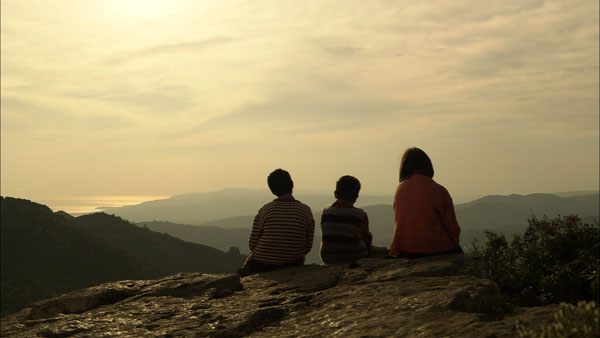
The setting is the Tuscan countryside near Siena, and a picturesque villa in which a group of well-to-do British families are summering. We are given very little in the way of exposition, which allows the dynamics between the main characters to emerge naturally through their interactions: the newly-arrived Anna has turned up without her husband, and there is implication that something disastrous has happened between them to explain his absence. Her old friend Verena seems in charge of most matters, and is enjoying her vacation with her new-ish husband, a family friend, and an assortment of adolescent offspring.

What follows is Anna’s speedy assimilation into the ‘youngs’ group, given relatively free reign in their Italian holiday home by the ‘olds’ who want to kick back and relax in their Mediterranean surrounds. In particular, Anna takes a shine to the confident, teetering into cocky, young Oakley, who appears to reciprocate her admiring glances. A few carefully placed anecdotes with the ‘olds’ place Anna a little at odds with her similarly-aged companions, and she clearly thrives on reliving her youth with the obnoxious, over-confident younglings. But as things progress, it becomes clear that the age difference, as much as it is irrelevant in so many circumstances, becomes too much in many ways.

Other critics have been keen to point to the fact that there is a dearth of films about the British middle-classes as opposed to, say, the great French tradition of such films. So it is quite refreshing, despite the obvious horrors of seeing such horrendously over-confident brats and their parents indulging in middle-class decadence, to see such a situation portrayed on-screen. Anyone who comes into contact with such people will instantly identify the archetypes we see: the busybody mother, the hypertense careerist father, the alpha-male lecherous twat of a son and the namby-pamby daughter, all viewed through the lens of Anna, who we presume is similarly bourgeois, but whose unnamed life crisis is causing her to rethink her preconceptions and expectations of life.

As few films there are about the British bourgeoisie, there are perhaps fewer about women of what would be euphemistically described as being ‘of a certain age’, and once again it is great to see a British director, especially one making their first feature, to look at this issue head on. The film offers no simple answers, no Richard Curtis-like easy options, and in summation (despite an ending which is perhaps a little too neat and tidy for my liking) gives a well-argued perspective on what it sets out to portray. There is also much to applaud in its overall visual style: there is always the danger of this type of film turning into a glorified travelogue, but the camera never strays too far from the characters’ faces, frequently focusing in on their reactions to dialogue as opposed to those who are speaking, giving much more of an insight into character than straightforward shot/reverse shot would.

Joanna Hogg cut her directorial teeth with television dramas such as London Bridge and Casualty, but here she has demonstrated a very fine eye for well-observed, character-driven drama which makes for fine cinematic viewing, and with enough style and eye for detail which suggests there is much to come from her; let us hope her talent is given the chance to shine in the future.
Hunger (Steve McQueen, 2008, UK/Ireland)

From the standpoint of a UK mainlander, it is quite easy to forget the dark days of The Troubles in Northern Ireland, so this first feature film by renowned visual artist Steve McQueen is an opportunity to remember recent history, as well as to reconsider it in the light of the present political climate and the current treatment of ‘political’ prisoners.

Bobby Sands was a member of the Provisional IRA who, in 1977, was sentenced to 14 years in jail for firearm possession. Housed in the newly opened prison in Maze, he rose to prominence through his eloquent writings and rhetoric, eventually becoming not only leader of the prisoners in Long Kesh, but also winning a seat in the House of Commons following his victory in a by-election. In his role as leader he became the spearhead of a series of protests against the treatment of those held in the prison, beginning with the infamous ‘blanket’ and ‘dirty’ protests, and subsequently leading the 1981 hunger strike which would lead to his slow physical degradation and painful death.

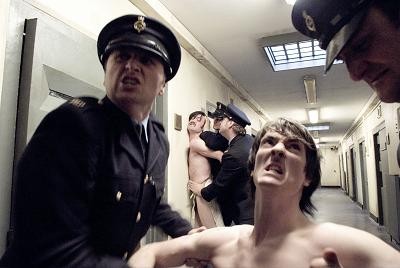
The first surprise about McQueen’s film is that it takes a long time for the main character to arrive, a bit like the wait for Orson Welles to turn up in The Third Man; instead of Sands, we start the film seeing through the eyes of a newly arrived inmate. We are spared little of the horrors of what conditions were like inside the Maze at the time of the protests of the inmates – excrement covered walls, maggot-infested piles of food rotting in corners, urine soaked corridors – and the director’s frequent use of slow, drawn-out takes allows the full horror to sink in. Beatings by the prison staff are frequent and bloody, but the director is careful to show the human side of some of the guards, unable to shut themselves off from the pain they are inflicting on their fellow men, but helpless to stop it. Political fence-sitting, maybe, but wise given the still delicate subject matter.

Is its only well into the running time that we are introduced to the ragged-looking Sands, played in hypnotically charismatic fashion by Michael Fassbender. He first explodes onto the screen being violently shorn of his hair and beard by a group of prison officers, such brutal treatment one suspects he was regularly subject to. But whilst other prisoners naturally react with pain from their beatings, there is an element of resignation and almost perverse pleasure about how he takes them. The film’s key theme, particularly in its second half, is the extent to which a man can put himself in through intense physical agony in order to make a political or personal point. Later on, we see the decay of Sands’ body as a result of the hunger strike, physical debilitation which is hard to describe in words in anywhere near enough graphic detail, but an extraordinary transformation from a well-built man to a frail shell.

Sands is celebrated by many Republicans as a hero, a martyr who died for his beliefs, and whose death inspired a new wave of volunteers to the IRA’s cause. Though McQueen denies any intention of this in interviews, there is an undeniable Christ-like presence in this screen portrayal of the man: despite his blasphemous ‘smoking’ of pages of the Bible, his stoic acceptance of torture, and the stigmata-like markings on his flesh towards the end of his life indicate otherwise. Perhaps to underplay this, the film is keen to stress that the man who Sands identified his actions with was actually his younger self, who put an injured young foal out of its misery to spare it of its pain, regardless of the consequences for himself.

Steve McQueen won the prestigious Turner Prize in 1999, and presumably this has given him much more artisitic freedom than other directors might expect to have, but this is where Hunger runs into difficulties. As much as it is hard to criticize a director for taking risks and straying from the conventions of the filmmaking rulebook, there are moments in the film where storytelling appears to play second fiddle to technique. One scene, where a porter slowly disinfects and sweeps the prison corridor of urine, lasts far too long to the point of becoming boring, whilst offering nothing to the story or mood. Other moments are stretched out for all they are worth, often feeling like filmmaking experiments rather than necessary elements to the story.

In the film’s most bravura scene, Sands and his priest conduct a twenty-minute conversation almost entirely framed in one shot and in one take. Whilst this can be applauded on a technical level, it adds virtually nothing to the scene, and actually has the effect of slightly distancing the viewer from what is being said, as well as highlighting the rather clunky, over-expository dialogue. Some of the film’s risks do pay off: for instance, the lack of dialogue for much of the film’s opening, suddenly punctuated by the chatter of inmates gathered at Mass, works extremely effectively.

Hunger will no doubt cause controversy on its release, if only for its subject matter rather than what it is trying to add to the debate: Sands remains the most divisive figure in the Republican-Unionist clash, and the film is bound to open old wounds. One has somewhat to question the motives of the filmmaker in choosing to make this film at this point in time – far enough away from the actual event, but still in a time when the partisan likes of Gerry Adams, Martin McGuinness and Ian Paisley are still on the political scene. While undeniably a hard-hitting document of a terrible period of history in a particular place, there is not enough outside information about the context to inform a viewer with no knowledge of the Troubles, nor is there a central argument to please either side of the debate, ultimately pleasing no-one. Maybe this is the point – to show that there are no winners or losers in a situation as horrific as this. Powerful, if unfocused, filmmaking.

Gomorra (Matteo Garrone, 2008, Italy)

The subject of organized crime in Italy is nothing new to the cinema, and there is much in Matteo Garrone’s film of Roberto Saviano’s bestselling expose of the Neapolitan Camorra that feels like ground which has been firmly trodden on previously. The film’s real strength, however, lies in its real sense of location: the urban buildings, beaches and countryside of Campania, and the colourful dialect of Naples, placing it in the even grander tradition of neorealism.

Firstly, let me say that this film is not, and should not be, entertaining. For two-and-a-quarter hours we are thrust into the squalid side of Naples, seemingly a universe away from the beautiful city Ingrid Bergman and George Sanders were having such a tough time in in Viaggio in Italia (1954). Instead, there are grim Antonionian apartment blocks, sweatshops, seedy strip clubs, the side of Italy seldom seen in the tour books or holiday guides. The film somewhat disjointedly weaves together several different stories, all involving the mafia-like Camorra crime syndicate on some level, however, subtle: from more ‘legitimate’ operations such as waste disposal all the way down to drug-running and murder.

There is little in the way of glamour, or even an insight into a Cosa Nostra-like controlling hierachy; instead, life (and death) appears arbitrary, ad hoc, at the whims of small-time hoods rather than smartly dressed calculating godfathers. If the consequences of messing up in this world are all-too familiar to us, then it is the sheer splintered disorganization of the Camorra which is new. The multiple stories all show reasonably likeable characters – a tailor who copies couture dresses, two kids who find a stash of guns and want to play Tony Montana, an ageing Camorrista accountant – and how these people find it impossible to either maintain their independence or escape from their urban trap.

The stories are not all successfully executed: the two gun-toting young men are so obviously doomed from the outset that their story becomes rather tiresome and played-out, while the strand involving a young man lured by the prospect of money and travel into helping the illegal dumping of toxic waste feels a little flabby and simplistic. But for all of its weaker moments, there are some tremendously effective ones too – the young Totò’s initiation into gang life, donning a bulletproof vest and being shot in the chest, whilst other boys queue as if waiting at the doctor’s surgery; he later proudly examines the bruise on his chest, a near-literal badge of honour.

For me, the most interesting segment was that of the tailor making copies of couture dresses, who is courted by Chinese immigrants into teaching them his craft, inevitably putting the backs up of the local mafiosi who are reliant on their own trade in knock-off frocks and are less than happy with the prospect of cheap competition. The introduction of new immigrant communities is an indication of cinema increasingly showing the new, economically and culturally diverse Italy.

The film’s greater cultural significance lies with its use of a largely non-professional cast, drawn from the very areas it is trying to portray. The Neapolitan dialect is sufficiently removed from Italian for domestic audiences to have required subtitles in order to understand the dialogue, and this feeling for local flavour recalls some of the best postwar Italian films, in particular Luchino Visconti’s Sicilian La Terra Trema (1948). The actors, most of whom new to the screen, deliver superbly naturalistic performances, perhaps having lived the lives of their characters off-screen – see Vittorio De Sica’s use of Lamberto Maggiorani in Ladri di Biciclette (1948).

Critics of the film have pointed its lack of a wider context of Camorra operations: in a piece in Sight and Sound, Silvia Angrisani notes that the organization penetrates widely into official Naples life, and its permeation into everyday existence is much more profoundly disturbing than the petty criminals elsewhere. The film does end with a series of statistics showing how deadly they have been over the years – 4,000 attributed murders, making them the most ‘successful’ crime organization in the world. There is also the small matter of its 150 billion Euro turnover. But the addition of these stats at the end merely seek to flag up the preceeding 135 minutes’ inability to frame this context; why tell us this?

As a piece of cinema, Gomorra is a little lacking in cohesiveness – lacking either the narrative thrust (however artificial) of City of God (2002), or the vibrancy and punch of something like La Haine (1995). As a series of interconnected stories, there is nothing like the innovation of early Alejandro González Iñárritu, or even Robert Altman. But it is still a solid piece of work, largely down to its insights into the city of Naples, far beyond the Castel Nuovo and the Piazza Plebiscito – a city of people living beneath a dirty, inescapable system of organized crime.

Beş Vakit [Times and Winds] (Reha Erdem, 2006, Turkey)

Reha Erdem’s film Times and Winds seems to have taken an age to reach the UK since its win at the Istanbul International Film Festival back in 2006, but it has been well worth the wait: I doubt there will be a more elegant, subtle, quietly moving film released this year.

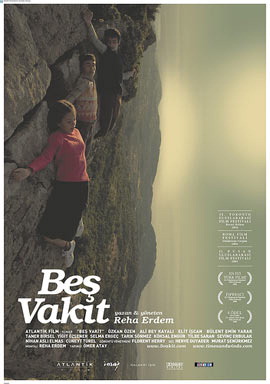
The setting or time is not explicitly defined, but we are clearly in a small Turkish village on the mountainous terrain overlooking the vast expanse of sea, a vista given the full widescreen treatment beautifully by cinematographer Florent Herry. The people are simple farming folk, and as such their lives are governed by the rhythm of the natural elements: the weather, and the coming of night and day. The film is structured with another rhythm at its core: the five calls to Islamic prayer during the day (as the original Turkish title, Beş Vakit, describes). As the film opens, the local muezzin is unable to make the call, so his son Ömer is called upon to rouse another man to climb the town’s central minaret instead.

It is through the eyes of the village’s children that we see most of what goes on, and it is one of the film’s great strengths that is is neither overly sentimental nor melodramatic in showing the joys and agonies of their lives. Ömer intensely dislikes his abusive father, whose frequent beatings lead him secretly to wish to kill him. Ömer’s friend Yakup is a little happier, and has a rather infantile crush on their pretty teacher at school, whom he is constantly attending to. A girl, Yildiz, is quiet and studious, but has to contend with looking after her small brother.

Through these three, still with everything to learn about life, we too learn much about their location and its way of life there. Though there are brief glimpses of the modern world beginning to seep in – a man brings an electronic camera, whose flash makes a young boy think he’s seeing ‘angels’, the minaret has been equipped with PA speakers, whose wires snake up one of its sides – their lives are still primarily agrarian, and inevitably there is the expectation on their parents’ parts that they will learn the skills to carry this on. But being young, they are inevitably rebellious, and curious as to what else there is out there, beyond the sea which seems to stretch away for eternity.

Amidst the quiet dramas of the children’s lives, we see life going on around them: human births and deaths, animals born, slaughtered and occasionally procreating – much to the amusement of the young kids – and the sun and the rain attending to the lush scenery surrounding the village. A great sense of place develops very quickly, in large part thanks to Erdem’s long, flowing tracking shots, following people around the uneven streets, and up and down the rocky peaks outside of the village. There is a very interesting use of orchestration in the score – for such an austere piece, one would expect a more languid use of music, but composer Arvo Pärt opts for a more dramatic tone, lending a sense of urgency and drama to proceedings. At times it seemed counter-intuitive, but go with it: it works.

For all of the film’s realism, there is also a mystery element, one that it is difficult to decipher. At times the narrative stops, pauses, and slowly lingers over an overhead shot of one or more of the child protagonists lying prone on the ground. Are they asleep, resting in the hot Turkish afternoon? Or something more metaphorical or even catastrophic? This certainly adds a mysterious air to the tone of the film, perhaps also allowing a little breathing-space from the main stories.

One point of fascination for me was not in the non-diegetic sounds, but in the copious number of songs and poems being recited by the children; nationalistic ones at school, pledging allegiance to Turkey, as well as more naturalistic ones, reflecting the theme of nature and season; an interesting contrast to the Muslim prayers and calls also peppered througout. While at times nature seems in harmony with religion, there are times when they seem grossly incompatible – in particular underlined by the prayer lines uttered about the sanctity of the paternal figure, in stark contrast to the unsympathetic, unworthy fathers portrayed onscreen.

A blend of East and West, secularism and Islamism, Turkey is a country of contrasts, which its increasingly high-profile cinema output is continuing to address. Reha Erdem has made a great film about his country, with all of its contradictions and joys, and also a film full of the simple joys and pains of all of our childhoods. Simply wonderful, and quite probably the best film of the year.

Be Kind Rewind (Michel Gondry, 2008, USA)

There’s many reasons to find fault with Be Kind Rewind. Let’s start with the sheer ludicrousness of the plot; Mr Fletcher (Danny Glover) is the elderly owner of a failing small video (yes, VHS) rental store in Passaic, NJ, threatened with closure by some cliched evil property developers. For one week he entrusts the store to his clerk Mike (Mos Def) so he can go away to a Fats Waller convention, but also in order to go and check out the methods of the store’s more successful local competition, the large Blockbuster-like West Coast Video.

Plot point: Jerry (Jack Black), who works at a garage nearby, and more frequently than not comes into the video store to bother its staff, somehow manages to magnetise himself while breaking into a power station, with the consequence of his erasing all of the shop’s magnetic tapes on his next entry into the shop. Faced with piles of blank cassettes and some angry, impatient customers, most notably Miss Falewicz (Mia Farrow), Jack and Mike elect quickly to whip up a home-made, ‘sweded’, version of her requested film, Ghostbusters.

This is all a rather silly, laboured device to set up what follows: Mos Def and Jack Black remaking classic films on a zero-budget. The idea is a good one, and is ultimately the films’ saving grace; who could not find funny the idea of Roger Corman-esque productions of the likes of Robocop, Driving Miss Daisy or even The Umbrellas of Cherbourg? This ‘sweding’ of films has become something of an internet phenomenon, with hundreds of would-be amateur directors having a stab at their own imitations/tributes to classic films. See here.

If the recreations are funny, then the rest of the film is decidedly not. Outside of the sweded world, the characters are ill-drawn and under-performed by what is a talented cast; Jack Black is only just reined in from his annoying worst, i’m never convinced by Mos Def, and Danny Glover and Mia Farrow are left to chew on the scenery. The whimsical plot – involving the threatened demolition of the shop – is weak and unengaging: it is as if the filmmakers put more thought and effort into their micro-Rush Hour 2 then they did with the rest of the script. Unfortunately, this has the effect of rather spoiling what could have been a more thoroughly enjoyable 97 minutes.

Michel Gondry, to me, seems to have become a victim of his own success, in that expectations of the quality of his output are still at the level of his masterpiece, Eternal Sunshine of the Spotless Mind (2004). Since then, both this film and The Science of Sleep (2006) have demonstrated his undeniable visual flair and playfulness, but also have lacked the narrative coherence of his earlier film’s watertight Charlie Kaufman script, and so have felt ultimately disappointing. Whether this is fair is questionable; it is certainly not like the case of Wes Anderson, whose films since Rushmore (1998) have shown a director increasingly coasting on autopilot. What Gondry has is imagination and creativity in abundance, what he needs is someone who can focus it constantly in the right direction.