El Baño del Papa (César Charlone & Enrique Fernandez, 2007, Uruguay / Brazil / France)

The Pope is coming to the small Uruguayan town of Melo, close to the Brazilian border, which naturally arouses the excitement of the locals, both in terms of religious fervour and entrepreneurial endeavour. Stoked up by the media reports predicting massed numbers of pilgrims from all around the continent, the townsfolk prepare to cash in, making souvenir flags and all manner of chorizo-based foods for the throngs of visitors, in the hope of lifting themselves out of the all-prevalent poverty of the area. Among them is Beto, who makes his small living running goods for 40 miles across the Brazilian border on his rickety boneshaker of a bicycle, either through the manned border post or by way of the rough treacherous terrain surrounding it, guarded by the crooked mobile patrolman Meleyo. He is not guided by greed, but a simple desire to make a semi-honest living for himself and his family, his wife Carmen and daughter Silvia. However, the money he makes from these border runs only seem earn him enough for a few extra drinks at the local watering-hole.

Then there comes his Archimedes moment – if throngs are expected to line the streets of Melo for the papal visit, then at least some are going to need to relieve themselves, so why not build a toilet and charge for its use? That could pay for the motorbike which would make his border crossings easier on his weary body, and leave enough to put aside to put his young daughter through a decent education. Of course, this will involve construction materials, and therefore more money, but surely these costs will eventually lead to the reaping of a healthy dividend for the him and his family?

If this all sounds rather whimsical, then it is to directors Chalone’s and Fernandez’s credit that El Baño del Papa emerges as an engaging story, ultimately presenting a satire of the false hopes which organised religion, coupled with mass-media hystericism, can create in simple, ordinary folk. The film’s realist aesthetic, coupled with Beto’s mode of transport, invites comparisons with De Sica’s Ladri Di Biciclette (1948), and there are other parallels: the position of the father as fallible role model, the entirely believably-rendered relationship between husband and wife, the focus on the poor, working classes. A lofty comparison maybe, but one which this low-key, big-hearted film at least partially deserves.

The Dark Knight (Christopher Nolan, 2008, USA)

Lack of ambition is certainly something to be criticized in filmmaking, but is it equally fair to bash too much ambition? It is clear from the outset of The Dark Knight that director Christopher Nolan is out to raise the bar with this film, not just for the Batman franchise which he resurrected so well with Batman Begins (2005), but for comic-book superhero films in general. If I do take issue with the structure, content and pacing of this epic blockbuster, then it is that it tries to do too much rather than too little; ultimately, I would rather films attempt to raise their sights high rather than settle for mediocrity, so it really is to Nolan’s credit that The Dark Knight is so ambitious, even if it falls just short of the mark.

Batman Begins was in many ways an easier film to assess, as it was a wholesale redrawing of what had become a tiresome, lumbering film franchise. It was a real success; a fine cast, gripping story, striking visuals, and enough subtext to keep both the comic purists and the critics happy. It was also a box-office hit, and one which naturally invited a sequel. Three years later, in which time Nolan gave us the labyrinthine The Prestige (2006), we return to Gotham City, where Batman has now become a rather more familiar figure in the public eye. Impersonators have begun to spring up, reflecting his symbolic status as someone who could bring hope to the metropolis’ crime-ridden streets. But now there is another source for optimism in the person of new District Attorney Harvey Dent, elected on the promise of eradicating the Mob, only by legal means.

The story neatly intertwines with that set up in the earlier film; Bruce Wayne is a reluctant hero, and is all to pleased to see that the new DA could see him able to hang up his batsuit for good, and make good on his promise to his beloved Rachel. Unfortunately, Rachel happens to be both assistant to and romantically involved with said Mr Dent, and so a complex love triangle inevitably ensues. Meanwhile, we are introduced to the Joker, who seems just like an ordinary petty criminal, except with a rather macabre taste in make-up strategies – face as white as Michael Jackson’s, green hair and a blood-red-smeared Chelsea smile. Swiftly we begin to sense that there is something unconventional about his intentions: money is no object for him, instead a rather macabre sense of humour which seems to thrive on pain, torture and random violence.

This much is well poised for a rollicking action-packed rollercoaster-ride, and throw in some police corruption, car chases, races against ticking clocks and moral dilemmas and surely you have a recipe for success? Well, yes, but with reservations. Firstly the good: and the goods are really good. DP Wally Pfister’s Gotham City is amazing, and the urban cinematography throughout is absolutely top-notch, creating the moody backdrop necessary for the story to play itself on top of. The idea of a coherent, living city, is also fleshed out with the characters which populate it: those already mentioned, as well as police lieutenant James Gordon and his not entirely trustworthy force, the various mobsters, hoodlums and gangsters who control sections of the city, the more ‘respectable’ businessmen with whom they co-operate, and of course the television reporters and commentators – see Robocop (1987) for how important these are for creating a believable fictional world.

And then there is the impeccable cast: another extraordinarily nuanced, subtle performance by Gary Oldman as Lieutenant Gordon, Maggie Gyllenhaal outdoes Katie Holmes as Rachel Dawes, Aaron Eckhart is entirely believable as Harvey Dent, and who else but Morgan Freeman and Michael Caine could be Bruce Wayne’s technical staff? If anything, Christian Bale has the least to do, save for be shown a few blueprints and new gadgets, and mumble in that emphysemic voice whilst under the bat mask. But of course, the performance which has drawn most attention is that of Heath Ledger as the Joker, and not without reason: the brooding pinup completely throws himself into the role of a psychopath, replete with odd mannerisms, explosions of violence, and a strange demonic voice just the wrong side of Al Pacino. Quite unlike anything we’ve come to expect from him before, and what a shame that we will not be able to see any more of his many talents.

With such talent at his disposal, Nolan is able to explore themes which other films might shy from. The psychopathic Joker presents most of these for us on a plate: the questionable nature of insanity, the role of chance in our lives (see No Country for Old Men), the idea that both he and Batman are ‘freaks’ and outcasts from society. The situations that he invents for Batman, and Lt Gordon, to agonise their way out of ensure as great a degree of soul-searching and moral questioning in the audience as in the characters we are watching. Harvey Dent, too, is forced to confront things he would not wish to face, one of which causes a profound change in his outlook on life that cannot be revealed here, but needless to say it is caused by more clever scheming by the criminal Joker.

So, much to recommend of the film. So why my aforementioned reservations? For one thing, it is too long. At 152 minutes, it is only 12 minutes longer than its predecessor, but that had the job of recasting the whole franchise; here, all we need is a story on top of that. There is a definite sense of what i would term cliffhanger fatigue – one too many ticking clocks for the hero to stop from counting down to zero for its own good. It is also a little confusing at times, by sheer volume of plotting; early on I felt more than a little lost amidst all of the intrigues and strands of storyline which it was setting up, and was more than happy to see a more familiar, simple structure begin to emerge as the running time went on. Again, there is just too much going on at times, which is fine for a slow, thoughtful arthouse film, but for a giganto-blockbuster it is just too much.

So what, overall, to make of such an epic work? As a blockbuster film, it is so much more thematically profound, visually impressive and better performed than nearly everything else out there that is seems a little unnecessarily negative to start to pick holes in it. But the high standard of Christopher Nolan’s previous work demands that such rigours be placed on his output, and I do have to say that this feels like one of his least tightly-controlled films. As much as the likes of Memento (2000) and The Prestige (2006) were ambitious in what they set out to achieve, they both succeeded on their own terms. The Dark Knight reaches just that bit too far for its own good, but at least it tries, and goes most of the way, to the greatness to which it aspires.

Man on Wire (James Marsh, 2008, UK / USA)

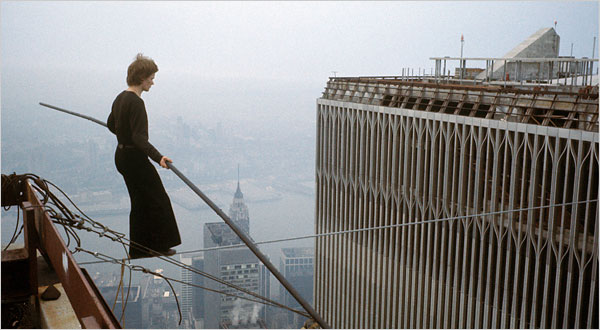
Phillipe Petit comes across as fairly barking, but then you would have to be in order even to consider breaking into the World Trade Center, climbing to the summit, and then erecting and walking across a high wire nearly 1,400 feet above New York. Yet this is exactly what he managed to achieve on the morning of August 7 1974, an event chronicled in this entertaining documentary feature from director James Marsh. What comes through from it all is the idea that a feat which is so visually simple, technically complex, and utterly absurd can still hold so much meaning to one man, his friends, and also the wider world.

It is a little difficult to take everything that Petit says entirely seriously; his constant describing of things as ‘beautiful’ and his playing down of the dangers involved in his escapades suggest a highly romanticized, and dare I say French, view on life and his craft. So we have to go on trust with his claim that it was as a young boy sitting in a dentist’s waiting room reading a newspaper article about the proposed construction of the world’s tallest building that he first developed the idea of doing this high-wire stunt to end all stunts. In one of several staged reconstructions we see the young Petit scribble a line between the two towers’ peaks, at once a simple piece of defacing and a signal of serious intent.

Following a series of smaller walks at Sydney Harbour Bridge and Notre Dame Cathedral, he slowly began to plan the impossible. Director Marsh chooses to intercut the events of the day of the walk with actual footage and reconstructions detailing the meticulous preparations in the months leading up to the big day. It is bizarrely comic at times; his rag-tag bunch of cohorts are a shambolic lot, somewhat ironically introduced to us one-by-one with dramatic spotlit facial close-ups. The film plays events like a classic heist movie, the ‘crime’ of course an artistic rather than financial one, and his conspirators less Ocean’s Eleven (1960/2001), more I Soliti Ignoti (1958).

At the centre of it all is Petit himself: hyper-animated, hyper-eccentric, clearly a man who enjoys the limelight, yet always engaging and aware of the quixotic nature of his great dream; someone less endearingly charming would almost certainly come across as dangerously obsessive. What is incredible is his own self-belief; he appears to have had no doubts that he would be able to pull it all off without meeting a messy end on the sidewalk below. The peripheral players – his girlfriend, Annie, and his long-standing team of Jean-Francois and Jean-Louis – are genial about things until asked to reflect on the longer-term effects of the act: the celebrity status that it brought Petit did not extend to them, and we learn that it marked a painful end to their friendships, one moment of real sadness in the film.

The build-up to the main show is a little lacking in drama – which appears to be why the film is structured in the intercut fashion that it is – but there is enough anecdote to keep things moving along at a reasonable pace. When the main attraction comes, there is an understandable lack of actual footage – we are, of course, in the days before camera phones and YouTube – but the sense of spectacle is enough. What tickled me especially was the official reaction to what was happening – policemen unable to apprehend him whilst on the wire, and afterwards the inability to specify any real serious ‘crime’ that he had committed.

The title Man on Wire comes from the police report of the incident, and deserves to go alongside “Houston, we have a problem” as a great understatements of official reporting. Yet the simplicity of this decscription seems to capture the essence of what Petit is about. The story made the front pages of most of the major newspapers all around the world. In one truly extraordinary act, he was, albeit temporarily, able to stop the world and make it collectively look up at what simple beauty one man with a dream can achieve. Watch, and be inspired.

Savage Grace (Tom Kalin, 2007, Spain / USA / France)

The story of the demise of Barbara Daly Baekeland is one that seems filled with the kind of intrigue and scandal that would be ripe for a juicy film exposé: money, glamour, betrayal, lust, murder and, most notoriously, incest. While Savage Grace dodges sufficiently the temptation to go for all-out sleaze, the shallow characters we are introduced to render the film rather cold – just why should we care about such a dislikeable group of wealthy bored socialites?

This would make a good companion-piece to P.T. Anderson’s There Will Be Blood (2007); if Daniel Plainview is a turned into a monster by his relentless pursuit of wealth, then the characters in Savage Grace are ruined by wealth they are born or married into. Brooks Baekeland is the multi-millionaire inheritor of the Bakelite fortune, wanting for nothing financially, living a playboy’s life seeking adventure around the world. However, he seems to live very much in the shadow of his illustrious grandfather, jaded of his life of much wealth but little achievement.

The centre of the film is not he, but his wife Barbara and their son Antony, and the unusual relationship that slowly develops between them. As the film opens, we immediately get the measure of her: unstable, heartless, lapping up the rotten decadence of the social scene she inhabits, ready to provoke scandal at any moment. Unable to hold her own in the cultural stakes of the gliterati, her inferiority complex results in a less-than-charming combination of vengeful rudeness and arbitrary promiscuity.

The couple are too wrapped up in their own issues to really care about their offspring; even Barbara’s coddling of her son feels unnatural, a pose. The film covers the span of thirty years, but while the infant Antony emerges into teendom and eventual young manhood, and the setting changes decades and continents, the two adults are oddly static, locked in their respective emotional stases. Antony, meanwhile, has become increasingly withdrawn, whether as a result of his itinerant lifestyle, burgeoning bisexuality or the continued sexual philandering of his parents.

Matters take a turn for the worse when Brooks abruptly takes off with Blanca, the beautiful young Spanish girl Antony had recently rather awkwardly lost his virginity to – this is just the kind of thing that’s going to mess a young man’s head up, isn’t it? This inevitably forces him closer to Barbara, now employing a ‘walker’ to encourage her to get her face back on the social scene, as well as getting her to paint more of her hideous portraits. But as time wears on their relationship becomes increasingly co-dependent and frankly rather weird. If ever there was the sense that a film was not going to end happily…

Julianne Moore gives a routinely strong performance as the monstrous Barbara – is there any other actress that can come close to her on form? If this can form a loose trilogy of similar roles with The Hours (2002) and Far From Heaven (2002), then this does feel the most two-dimensional; though it is the material that is in question, not her acting talent. Stephen Dillane’s Brooks is suitably angst-ridden, and the extraordinary face of Eddie Redmayne – Tadzio from Death in Venice (1971) with Cillian Murphy’s cheekbones – provides ample enigma to the much confused Antony.

Director Kalin, whose previous feature Swoon (1992) centred on a similarly scandal-filled true story, the infamous Leopold and Loeb murder case, shows real restraint in what could easily descend into shock-and-awe s-exploitation. A fine eye for both period and locational detail make for a visually sumptuous watch. The problem is the material: while an intriguing and somewhat shocking story, one cannot help but feel an icy detatchment from proceedings as the central characters are all so wretchedly pathetic. I knew nothing of the real-life case before watching the film, so the surprise turns that events took were enough to keep me interested. Those familiar with the story looking for insights into these messed-up peoples lives are likely to leave empty-handed. But then again, perhaps they are not worthy of such scrutiny.

In Bruges (Martin McDonagh, 2008, UK / Belgium)

Outrageously rude. At times massively offensive. Utterly hilarious. This should adequately describe the script of Martin McDonagh’s debut feature, whose snappy quotable dialogue and dark humour will inevitably draw comparisons to the work of David Mamet. But where Mamet’s frequent artificiality draws him as many detractors as acolytes, In Bruges utilizes McDonagh’s considerable stage experience to forge a comedy-drama refreshingly driven by deep characterization rather than high concept.

We are, of course, in Bruges, the picture-postcard Belgian city enthusiastically described in the guidebook as “the best-preserved medieval city in Belgium”, for what that’s worth. Enter our two main men: Ken, the wisened face and portly presence of Brendon Gleeson, is keen to immerse himself in the city’s sights and sounds; his younger travelling partner Ray, a baffled-looking Colin Farrell, is mortified at the prospect of spending any time at all in what he cheerily describes as a ‘shithole’. If our sense of location is firm, just why these two men are here is decidedly less clear. The opening monologue tells us a little: Ray is a hitman whose last whacking went decidedly awry, so he has been told to hole up in his present location. But as he questions – why Bruges? It is entirely possible to hide in Croydon, after all.

Comparisons to Harold Pinter’s drama The Dumb Waiter are inevitable; in that play, two hitmen have to fulfill seemingly arbitrary orders emerging from the titular dumbwaiter, responding to them via a strange speaking-tube. Here, they use the rather more conventional means of a telephone to their mysterious paymaster Harry, Ralph Fiennes in full-on cockney gangster mode, who seems comically keen on them enjoying their newly-found surroundings. Ray tries his best, not only scoring a date with a beautiful local, but also befriending a ketamine-taking dwarf. As one does on holiday.

Needless to say, the full extent of Harry’s plan for the two men becomes apparent, forcing difficult decisions to be made, and loyalties to be tested. What keeps the film constantly engaging is how it chooses to reveal the answers to its mysteries slowly. McDonagh controls the narrative with a tight precision that would put many another screenwriter to shame; there is no over-loading of exposition, allowing character and plot to slowly unfurl naturally, and for situations to emerge and resolve themselves believably. If the hitman film is one loaded with genre traditions, this is one inventive enough to keep the audience guessing at every turn.

Given his theatre background, it is little surprise McDonagh coaxes two superb performances from his leads. Gleeson is, as always, able to inject real pathos into his Ken – the kind of outstanding character acting we have come to expect from him. If there is a surprise, then it is in the depth Colin Farrell demonstrates he is capable of: charming, aloof, menacing, witty – but beneath it all frightened, unable to reconcile himself with what he has done. Not only do the two stand as great characters individually, the interaction between them is priceless. Their comical banter, enhanced by the clashing of their clear personality differences, places their unlikely partnership as one of the funniest in recent years – the De Niro / Grodin axis of Midnight Run (1988) the closest comparison I can come up with. There is also real tenderness underneath it all; that neither man has any close family to speak of means they really only seem to have each other.

The humour of the film is decidedly dark, as would fit a story about paid killers. The easily-shocked or offended would do well to stay away – not only are there liberal uses of all available profanities, there are also some decidedly un-PC comments by our two straight-talking assassins, as well as their similarly unrestrained boss. Violence is frequent – in Sopranos fashion it is sometimes comic and sometimes certainly not – you have been warned.

The difficulty of moving from a stage career to directing films is ensuring the resulting work is sufficiently cinematic. In Bruges wholly succeeds in this respect by making its location an integral part of the whole: much like the Vienna of The Third Man (1949) and Before Sunrise (1995), or the Venice of Don’t Look Now (1973), the location almost becomes a character in itself. That the latter film is an explicit reference in the diegesis is no stray piece of homage. Martin McDonagh has made the transition to the screen from the stage with considerable panache, creating a fine character-driven piece that has no trouble standing up as a piece of cinema. It he can continue to craft films as good as this, we are in for some considerable treats in the future.