Review: Die Fälscher (Ruzowitzky, 2007)

The Counterfeiters, to give the film its Anglicized title, is an intelligent, if a little too underplayed, drama based on one of the most audacious attempts at financial sabotage ever undertaken. The plan: for Nazi Germany to flood the British and American markets with fake currency, thus precipitating economic collapse in the Allied countries. The workforce carrying out this particular task comprised prisoners-of-war in the Sachsenhausen camp, one of whom, our protagonist Salomon Sorowitsch, a Jewish master counterfeiter, was rescued from certain death from the concentration camps. In Sachsenhausen they are kept in much better conditions than other prisoners-of-war as reward for their efforts to help the regime, though this puts them in a morally questionable position.

The film nicely presents us with Salomon’s dilemma, a somewhat Catch-22-like situation: successfully complete the forgery, and end up rendering his position redundant, which would inevitably result in his execution, or fail to complete the task, which would ultimately lead to a similar fate. Salomon is not the only one facing this ‘choice’: another of the counterfeiting team, Adolf Burger, has made his choice and repeatedly sabotages the operation in order to hinder the Nazi plan, much to Salomon’s distress. But does his motivation to succeed derive from a desire for self-preservation, or a blinkered desire to prove to himself that he can perform one of the greatest forgeries of all-time? We must remember that these men are still alive only because of the usefulness of their talents, yet application of these talents ultimately perpetuates the war machine which captured them in the first place.

The position of Salomon is paralleled with his one of his captors, SS Officer Friedrich Herzog, who shares a similar philosophy with him; that ultimately we are confined to act in our own self-interest, no matter what the consequences for others. In a dramatic sense, we are made to feel little sympathy for Sal, and idealistically side with Burger. Yet the film makes us aware that, while this is the choice the viewer has no heistation to make in the comfort of the cinema, in the real world many of us would take the easy option and appease our captors if it led to an easier, more comfortable life; this, the film argues, is precisely the kind of resignation to apparent inevitabilty that allowed the Nazi regime to maintain power over Germany in the 1930s and 40s.

The film handles its subject in a very unflashy non-melodramatic way, and it is not sentimental about the war as so often these sorts of films can be. This does, however, have the effect of making the film seem a little flat and unengaging; while the story is an interesting one, sometimes there is not enough there to sink one’s teeth into properly, and I felt a little underwhelmed by the end. However, this is nitpicking, and I would much rather a serious film like this was handled understatedly, rather than in the sickly over-sentimental way of films like The Shawshank Redemption. Die Fälscher is a film that succeeds in telling its story in an admirable and genuinely thought-provoking way.

Review: The Heartbreak Kid (Farrelly and Farrelly, 2007)

While opinions may differ concerning the merits of Farrelly brothers films, at the end of the day, they have proved to be one of the most successful producing, directing and writing partnerships of comedies in recent years. They have, in the past, proved to be box-office gold; There’s Something About Mary, for instance, grossed (no pun intended) $176 million in the US alone, froma budget of $23 million. Similarly Dumb and Dumber, from a budget of $16 million, went on to take $246 million worldwide. These kind of figures give the brothers significant clout in Hollywood, and allows them a relative freedom to pick and choose what projects they like.

They have, however, only enjoyed moderate success in recent years; Shallow Hal and Me, Myself and Irene took some money, but Stuck on You and Fever Pitch have both struggled since their respective releases. In need of a hit, then, they have turned to remaking a 1972 classic comedy, originally starring Charles Grodin and Cybill Shepherd. Here lies one of the first problems; Charles Grodin in one of the great underrated comedy performers: one needs only to think of his wonderful turn opposite Robert DeNiro in Midnight Run to remember this. Ben Stiller’s comedy style is different; he is at his best playing rather creepy characters, such as Derek Zoolander, or Dodgeball’s White Goodman, characters you are not supposed to empathise with. In The Heartbreak Kid, his role is of a 40-year old loser in love who we are meant to feel sorry for; however, both the script and Stiller’s performance erase any sympathy the audience might have for the character within the first 20 minutes. He is extremely shallow and self-centred, and we are supposed to believe that he has met his soul mate simply because they have a chat together that lasts longer than 30 seconds. This can work as a nice setup for comedy situations; for instance, i am always intensely irritated by Andie MacDowell’s character in Groundhog Day, yet am prepared to go along with Bill Murray’s obsession with her simply because it is a device for his situation to be exploited. Here, however, it falls more than a little flat.

Of course, this being a Farrelly brothers movie, there are the standard gross-out parts, but even these feel rather subdued, given what we’ve come to expect from them, though as the BBFC website points out there are ‘sado masochistic acts and bestiality’. Elsewhere, the laughs are few and far between, though there is the odd chuckle here and there; not enough for a comedy film though, which, let’s face it, is there to make you laugh. For such a seemingly simple setup, the narrative is surprisingly muddled, which doesn’t help the viewer have any coherent sense of what the film’s intent is. Nice bit of Bowie on the soundtrack, though. It does appear, though, that this is not the film to relaunch the Farrelly brothers’ careers; grossing only $14 million in its first weekend, it will probably struggle to recoup its budget. Next up for them is a film of The Three Stooges, maybe this will be an appropriate vehicle for their talents.

Review: Control (Corbijn, 2007)

Roughly two-thirds of the way through Anton Korbijn’s excellent debut feature Control, the double meaning of the film’s one-word title is made apparent; though an obvious reference to one of Joy Division’s more well-known songs, She’s Lost Control, what we see is the opposite: a portrait of a young man as an artist, who cannot cope with both the world he has created for himself, and the world that has been thrust upon him.

As with other rock biopics such as The Buddy Holly Story, the film’s denouement will come as no surprise, even to the viewer with only a passing aquaintance with the singer. There are also dramatic ironies for the more die-hard fans, for instance Curtis’ insistence that he will be on the plane taking the band on their tour of the USA; and once Iggy Pop’s The Idiot makes an appearance, well, we know the rest. However, what is a rather pleasant surprise is the film’s occasionally richly comic tone; this is not Gus Van Sant’s dreary Last Days, in which a quasi-Kurt Cobain mopes around Seattle for a while before topping himself; at times we are back watching 24 Hour Party People, Michael Winterbottom’s raucous biopic of another Manchester legend, the late Anthony H. Wilson. He makes regular appearances in Control, played brilliantly by Craig Ferguson, and almost all of them are sidesplittingly funny. Even more so with Toby Kebbell’s portrayal of manager Rob Gretton, whose constant volley of obscenities gets funnier as it gets progressively ruder. Surely no portrait of Manchester cannot omit this aspect of its culture?

As for the narrative, it initially follows the standard rock biopic formula: obliquely introducing the key players, wives, girlfriends, bosses, jobs, neighbourhoods, and so on. This, of course is standard practice, neccessary for those who are unaware of the factual background but also neatly framing the film’s exposition. What follows is a tender portrayal of different aspects of Ian Curtis’ life, and an attempt to understand what drove him to write such heartbreakingly beautiful but bleak words. Perhaps more than this, it is an attempt to understand his failed relationships; the screenplay borrows largely from Curtis’s wife Deborah’s memoir Touching From a Distance. Here she is played by Samantha Morton, who is seemingly mopping up all of the doomed women roles these days, though her portrayal here satisfactorily combines a combination of toughness and fragility.

And then we come on to Sam Riley’s performance; after watching Sean Harris as Curtis in 24 Hour Party People I thought his mimicry couldn’t be bettered, but Riley here provides a more complete character, fleshed out, warts and all. For the most of the later parts of the film he often comes across like a frightened young boy (a look that Pete Doherty seems to have hegemony over these days) compared to the confident, if detatched, Velvet Goldmine-esque glam rocker at the start. Onstage, he performs the same miracle that Joaquin Phoenix achieved as Johnny Cash in Walk the Line, in that he makes the viewer forget they are watching an actor, instead completely inhabiting the role. Curtis’ distinctive dancing is replicated to a tee, similarly messrs Sumner, Hook and Morris are accurately aped; it is this attention to detail which gives the film its feeling of authenticity.

At this stage, it must be emphasised how good Corbijn’s photography of the band’s live performances is; clearly this is a man who has been to a few gigs in his time, and understands the dynamic between the performers and the crowd. In this sense I was reminded of how Wim Wenders demonstrated a similar knack in Wings of Desire, in which the ambience of a typically frenzied Nick Cave live performance is captured wonderfully. When these things are done well, it is as good as being there seeing the real thing; when done badly it creates distance between the viewer and the performances. Great to see that the band are clearly playing their instruments, and that Riley performs the songs himself, as this gives the live performances an organic feel to them, replicating that magical feeling when a band recreates live what one has heard a thousand times on record. Only twice do we hear the actual Ian Curtis singing, both times at key moments in the film, and both times with their two most ‘untouchable’ songs, Love Will Tear Us Apart and Atmosphere. Corbijn’s reverence for these is too great for them to be touched.

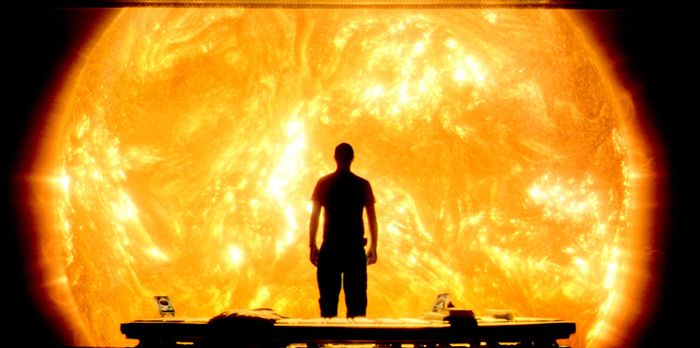
Review: Sunshine (Boyle, 2007)

“Directors only go into space once”, said Danny Boyle in the run-up to the release of his contribution to the sci-fi oeuvre. Sunshine is a bold attempt at leaving his mark on the genre, though its flaws perhaps reduce its chances of joining the canon of the truly great space flicks.

The Sun is dying, and a team of astronauts have been sent on a mission to fire a nuclear device into it, which it is hoped will lead to its reignition. We find out that the mission, somewhat morbidly codenamed Icarus 2, is the second such attempt, the first mission having dropped out of contact with Earth several years before. This second attempt will, however, be the last possible chance for saving life on Earth. Things, of course, don’t go according to plan, particularly after the distress beacon of Icarus 1 is detected, an eerie echo of the similar scenario in Alien.

This could easily have been a schlocky sci-fi thriller, but the film’s strength is that, like Tarkovsky’s majestic Solyaris, the plot is used as a device for making the viewer aware of various spiritual and existential questions. There is very little characterisation of the crew – we do not learn about their personalities or lives on Earth – but we get to know them through the decisions, both moral and professional, that they are forced to face. We are immediately placed on board the ship with them, allowing us to feel their sense of detatchment from Earth. However, this also has the effect of distancing us from the magnitude of the importance of their task; the weight of the saving of humankind is rarely felt particularly strongly, which at times renders the characters’ actions questionable. Visually, the film is particularly impressive, with thoughtful set-design creating a very believable Icarus spacecraft. Some critics appear to have questioned the science behind it all, but this is a bit of a red herring, I found myself fully prepared to go along with it.

Intertextually, there are numerous respectful nods to the classics of the genre, namely Alien, Solyaris, 2001, and Dark Star, all done delicately rather than in a Tarantino-like manner (when will he “go into space”, i wonder?) However, its spiritual brother is Paul W.S. Anderson’s underrated Event Horizon, an effectively tense space horror film mauled by the critics who were expecting a subtle sci-fi thriller. Sunshine’s final act in particular seems to resemble Anderson’s film, and it is here that the biggest problem with the film lies: what starts off as a well paced, neatly constructed, patient film, ends up unwisely sliding off into predictable horror about two-thirds in. This unsatistfactory denouement seems in parallel with Boyle’s previous 28 Days Later, which also lost its way at a similar stage after a spectacular beginning. That film’s sequel, 28 Weeks Later, (albeit by a different director and screenwriter) also limped to a close somewhat. Does this mean that Boyle and Alex Garland have a problem finishing films off satisfactorily?

Performances are uniformly good, particularly Cillian Murphy who always appears to breeze through films as if acting was the easiest thing in the world to do (c.f. the likes of Orlando Bloom who make it look amazingly hard). Also nice to see the likes of Chris Evans, Michelle Yeoh and Rose Byrne involved in a British production, showing that Boyle is still a good draw for international talent. Overall, Sunshine is, for the most part, an intelligent, well paced and thought-provoking work, let down only by a rather flimsy third act.