Io sono l’amore [I Am Love] (Luca Guadagnino, 2009, Italy)

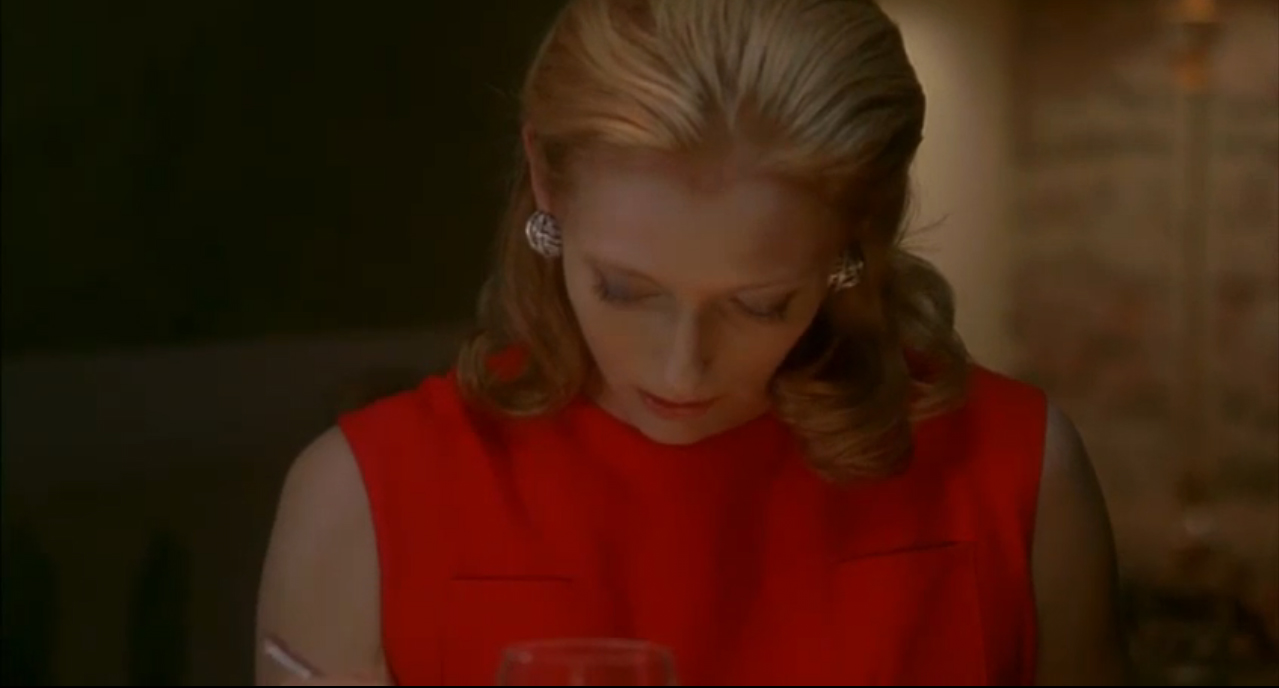
Though flattering, it is also more than a little unfair that I Am Love has been spoken of in relation to the work of Luchino Visconti, given that what is most remarkable about the film is how distinctly idiosyncratic the visual language used by director Luca Guadagnino is. DP Yorick Le Saux, who also lensed François Ozon’s Swimming Pool (2003), has an eye for grand compositions and creates a sometimes-stunning tableau of imagery, from the opening scenes of a wintry Milan, suddenly thrusting into taking in the exquisitely composed details of the opulent Recchi family household, and later out into the sun-drenched countryside, and the cosmopolitan bustle of Sanremo. Established is a clear dichotomy between the liberty of the exterior compared with the stifling rigidity of the interior; as if to underline this, in a later scene set inside a cathedral, a bird flaps around the inside of the domed roof, surrounded by beautiful decor, but trapped nevertheless.

Though ostensibly a family epic, the main focus of the film is in reality focused on one individual, Emma Recchi, a Russian expatriate trapped in a loveless marriage to the heir apparent of the family’s successful clothing factory. Her isolation and inner turmoil is not conveyed through dialogue but through small gestures: in one scene, nervous about a gift her daughter is going to give to the strict patriarch of the family, the camera falls on Emma unconsciously tightly winding the gift’s decorative ribbon around her fingers. Elsewhere, a pan focuses the frame on hands tightly drawing her curtains shut to the outside world, locking her in to this hermetically-sealed world of cold order.

The unemotive world of the Recchi household explains the film’s sudden lurch into colourful expressionism as Emma rediscovers her capacity for passion, first for the food which her son’s chef friend Antonio serves her, and then eventually for Antonio himself. Some scenes work better than others: her rapture on eating a prawn dish sees her spotlit as if she were alone onstage delivering a soliloquy perfectly capturing the solipsism of sensory delight; by contrast, the hazily-shot, soft focus bout of alfresco lovemaking  the pair enjoy soon afterwards feels like the stuff of a cheesy erotic thriller.

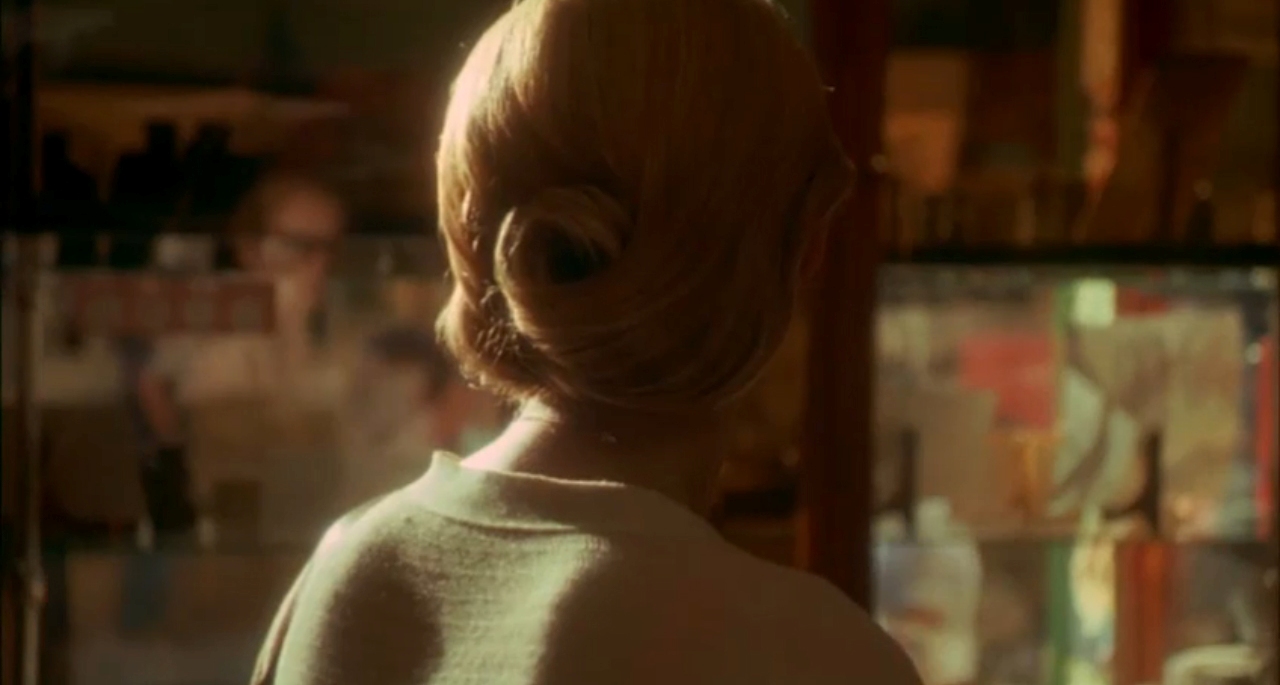
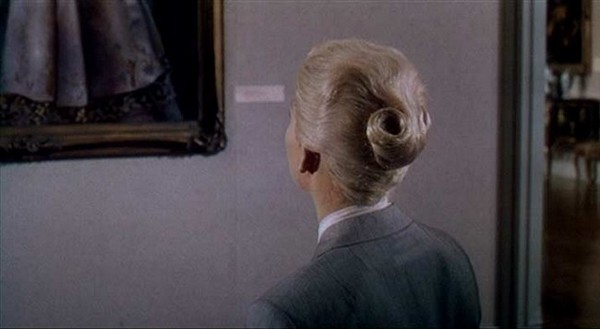
The barebones of the story – unloved middle-aged wife learns to once again be consumed by desire – seems in an old-fashioned Douglas Sirk mold, and Guadagnino does nothing to match the edgy daring of, say, Rainer Werner Fassbinder’s Angst essen Seele auf (1974) or Todd Haynes’ Far from Heaven (2002). But as a piece of visual cinema it is hugely accomplished, and a strange, sometimes counter-intuitive approach to scoring creates unsettling moments, sometimes even pulse-quickeningly suspenseful ones: a ‘chase’ through the streets of Sanremo suggests a gender-reversed version of a scene from Hitchcock’s Vertigo (1958), particularly with Emma’s striking Carlotta Valdes-like curl in her hair, and the final scenes brim with a surprisingly large degree of tension, some compensation for the film’s rather lacklustre lurch into tragedy in its final third. With this kind of ability, perhaps Guadagnino ought to turn to making thrillers?

Kick-Ass (Matthew Vaughan, 2009, USA/ UK)

“With no power comes no responsibility” seems to encapsulate pretty well the irreverence of this sometimes-gleefully entertaining adaptation of Mark Millar’s graphic novel deconstruction of the superhero genre. Aaron Johnson is likeably naive as Dave, a shy high school geek who creates an alter-ego of a would-be crime-fighter Kick Ass, kitted out in a garish green and yellow spandex bodysuit and much too optimistic about his chances of taking on New York’s criminal fraternity. He also didn’t count on encountering Big Daddy (an extraordinarily morose Nicolas Cage) and Hit Girl, a father-daughter vigilante duo armed to the teeth and seeking revenge on major crime lord Frank D’Amico, nor very modern problem of becoming an overnight Youtube celebrity.

Matthew Vaughan keeps everything within the realms of the cartoon-like, with bad, bad villains meeting their comeuppance and good guys striving to get the girl, although the occasionally Miike Takashi-like levels of ultra-violence and the inappropriately foul utterances of the pre-pubescent Hit Girl suggest this films precedents are more in exploitation cinema rather than Marvel adaptations. The old difficulty of adapting from a graphic novel source resurfaces: in trying to recreate the source’s feeling of a fully-formed world, the first half has to set up three different story strands, and switching between these leaves the narrative initially a little stop-start. However, they converge come the eventual denouement, resulting in a more coherent and satisfying watch than Zack Snyder’s muddled Watchmen (2009). A bigger-budget sequel inevitably beckons, but it will lose this film’s easy lo-fi charm.

Double Take (Johan Grimonprez, 2009, Belgium/Germany/Netherlands)

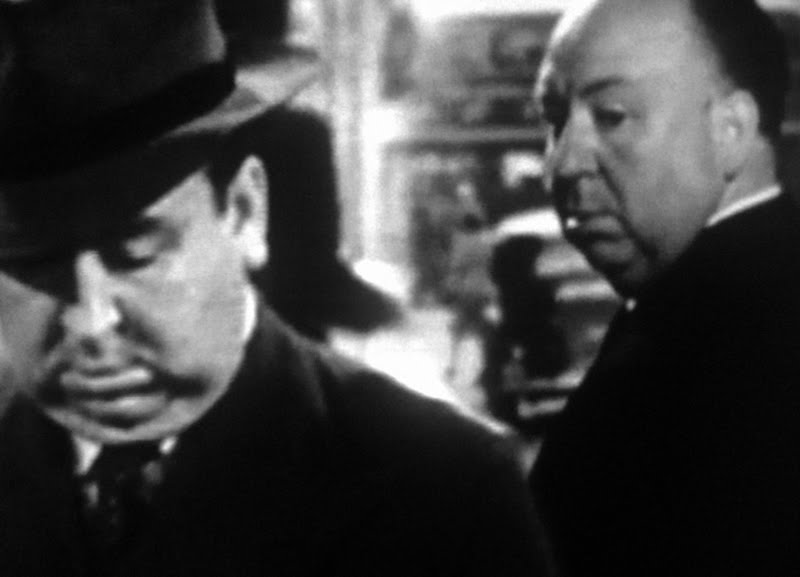
The music used at the start of every episode of the television series Alfred Hitchcock Presents which is now inextricably linked to the director’s image is entitled Funeral March of a Marionette, apt for a man famous for his puppeteer-like manipulation of the actors he used (famously likened to ‘cattle’) as well as his control in fraying the nerves of the audiences who flocked to see the latest film from the master of suspense. The launching point of Double Take, though, is another kind of manipulation: Hitchcock’s fastidious cultivation of a public persona which was half macabre circus ringmaster, half self-deprecating but sinister uncle; all of those television programme introductions, egotistical public pronouncements and famous cameo appearances in his films had the cumulative effect of making his on-screen ‘performances’ just as compelling as his work behind the camera.

Hitchcock, of course, has been the object of copious academic and revisionist attention ever since Andre Bazin declared to the critical world that it really ought to take his films very seriously, a familiarity which tends to make new considerations of his work feel like ground which has been trodden many times too often, like hearing My Way sung at karaoke, or seeing yet another History Channel documentary about the Nazis. Johan Grimonprez’s film, however, is different, and though Hitchcock appears to be the glue which binds it all together, the film is in fact a tangle of many different subjects of consideration, all juxtaposed together to suggest a network of interconnected mutual associations. It should hardly be surprising given its labyrinthine nature that it is in part inspired by a story by Jorge Luis Borges, namely The Other.

The film’s anchor, or as close as there comes to one, is Hitchcock’s 1963 film The Birds, and an apocryphal tale of the director meeting his future self from 1980 whilst roaming the studio set. “If you meet your double you must kill him… or he will kill you” comes the Dostoyevskian warning from Borges; the story seems to carry little significance, yet will come to define the entire contents of the film. Meanwhile, we are also introduced to two real-life ‘doubles’: a voice impersonator learning to mimic a sentence the director recorded many years before, and a physical impersonator who talks about people’s reaction to seeing his likeness, while we are also treated to some of the director’s introductions to Alfred Hitchcock Presents, many significantly involving some form of ‘doubling’ motif.

These strands are those which have the most obvious kinship with each other, but also present in the film are a wide variety of pieces of archival footage: now-hilarious coffee advertisements from the 1950s, reeking of the kind of attitude towards women’s role as domestic slave now so successfully exploited in Mad Men, as well as material illustrating the concurrent rise of television as the dominant entertainment medium, at cinema’s expense. So too is there a wealth of material detailing the escalation of the Cold War following the USSR’s early lead in the Space Race – Sputnik, Laika, Gagarin et al – a lurch into politics which seems at least at first merely to be a riff on the likeness of Soviet Premier Nikita Khrushchev to Hitchcock, apparently yet another ‘double’ of his.

It is initially not especially obvious what connects these more general social and political elements with the general theme of Hitchcock, but as in the mode of a thriller they start to converge on each other, and their motifs begin increasingly to overlap, to the point where they all become inextricably interlinked. Satellite television, for example, is clearly shown to be a product of NASA’s space programme, which in turn was funded by the US government as an issue of national technological prestige against Soviet technological advances. The Cold War begins to assume the form of a squabble between two twins with competing ideologies, while the resulting nuclear arms race created the climate of fear which Hitchcock himself would readily tap into in films such as The Birds.

And then there is television itself, so significant a cultural phenomenon as to have effectively decided the 1960 Presidential Election in favour of John Kennedy, but a subject Hitchcock as presenter of his own programme would repeatedly make disdainful remarks about. In one clip, he sarcastically comments on how the function of commercial breaks was to ensure viewers did not get too engrossed in what they were watching; one of the coffee adverts shown even features a woman who is told by her husband that her inferior brand is like ‘poison’, invariably recalling its use on Ingrid Bergman in the director’s own Notorious (1946).

Naturally, such apparent distaste for the televisual medium leads one to question just why the director was apparently so happy to attach his name and image to his own programme on it. Was it a product of the decline of his own career after The Birds, reflective of the wider decline of the cinema after 1960, with the young upstart medium of television evidently victorious over its older, more cumbersome forefather? Here is where Grimonprez finds a unity, one which lies entirely within his film and which brings its themes together, blurring its seemingly disparate pieces into a unified whole, as if to unfurl a Mobius strip to reveal its unseen simplicity. Television won the Cold War, we are told, and, at least in this fictional realm, Hitchcock had been mysteriously warned of it in advance.

Double Take clearly shares an affinity with the associative film-essays of Chris Marker, and represents an attempt to thrust a wide variety of different ideas together, not to form one simple thesis but in order to capture a sense of the interconnectedness of political, social, technological and cultural events and shifts. It sounds on paper like a dry exercise in experimental cinema, and its scalene structure suggests a difficult watch. In fact, in its weaving of a web of interconnected intrigues which slowly begin to unravel into each other, it is a grand mystery story perhaps worthy of the great director himself.

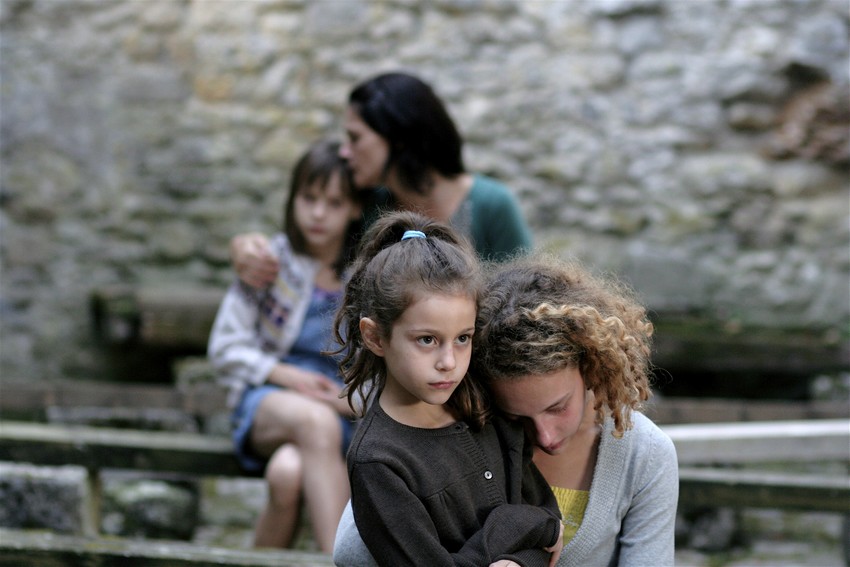
Le père de mes enfants [Father of My Children] (Mia Hansen-Løve, 2009, Germany/France)

Like Nanni Moretti’s Palme d’Or winning La stanza del figlio (2001), it is nigh-on impossible to come to Father of My Children without some prior knowledge of the key event which is to shape the film’s trajectory, nor is it possible to address its themes without revealing this piece of information; readers wishing to attempt to come to the film with completely fresh eyes are therefore encouraged to stop reading here. What is surprising about Mia Hansen-Løve’s film, though, is just how being in possession of the knowledge that the main character is to kill themselves matters so little to the enjoyment of, and startlement at, what is an extraordinarily confident work from this precociously gifted young writer/director.


At the film’s centre is a true-life tragedy: the suicide in 2005 of French movie producer Humbert Balsan, a man who had worked with the esteemed likes of Béla Tarr and Youssef Chahine, as well as Hansen-Løve herself in getting her first film Tout est pardonné (2007) off the ground. The inevitable question arising after such a tragedy is, simply, why? Perhaps with emotional distance it could be explained more logically as a product of Balsan’s financial and personal failures, but while Hansen-Løve’s film is inspired by these events and records such details it does not seek to arrive at any conclusions; instead her film is clearly a very personal reaction to the tragedy, seeking not to adhere to cold hard facts and the quantifiable but instead exploring the its themes and the emotional responses of those closest to him.


In the film Balsen is replaced with the analogous figure of Grégoire Canvel, who from the outset is portrayed as hardly a saintly figure. We are shown a man welded to his mobile phone, utterly engrossed in the wheelings and dealings for his various film projects, but to the apparent cost of those around him. Continuing to natter away even whilst dangerously negotiating narrow Paris streets in his car – at one stage even wielding two phones, Malcolm Tucker style – he is eventually, and not for the first time, hauled over and reprimanded by the police. Spending the weekend with his family at a countryside retreat, his wife despairs at the amount of time he spends away from them; all the while, we are presented with a measured, believably flawed character rather a simplistic Hollywood Bad-Dad: he is a good humoured, loving father to his three girls, even though when with them he still appears uncontrollably to be keeping one eye on his work telephone.


If his personal life is not in an ideal state, then neither is that of his production company, Moon Productions, owing millions in unpaid lab fees and interest on bank loans, manned with a loyal but disgruntled and overworked staff, and with its main creative project – an arthouse film by a renowned ‘difficult’ Swedish director – decidedly hitting the skids and not looking like recouping its spiralling production costs. Grégoire’s insistence on focusing on artistic merit rather than marketability is evidently praiseworthy, yet his continued damn-the-torpedoes attitude seems informed by a combination of Panglossian optimism and extreme denial, his head firmly buried in the sand in the face of the tides of debt washing over him.


Grégoire’s life is far from perfect, but then neither is it massively troubled, at least in melodramatic terms. So far too, the tone has been light and breezy, filled with moments of humour and observations of the small everyday joys of bringing up young children. The soundtrack, largely filled with upbeat, jaunty Jonathan Richman numbers, has thusfar been light and frivolous, hardly foretelling any darkness to come. So when, at almost exactly the film’s halfway point, the anticipated moment comes – suddenly, with little warning, even less fanfare and taking place in a single brief shot utterly devoid of glamour – the audience is in shock as much as his screen family at the relative disparity between his dramatic action and the relative inconsequentiality of his problems.


This point bisects the story into two clear halves, the latter refocusing the story to examine primarily the effect of his death on his wife Sylvia and eldest daughter Clémence. Inevitably the initial emotion after Grégoire’s death is one of intense grief, but the in its aftermath the narrative proceeds to take a series of unusual ellipses – we see no funeral and very little of the immediate aftermath – and instead the focus is placed on the longer-term: Sylvia resolves to finish the outstanding work at Moon Productions, seeing it as a fitting tribute to his memory, while Clémence begins to shadow her father’s former footsteps: visiting the same coffee houses and cinemas, taking an interest in the side of him she was never to know.


Given the film’s tragic subject matter, the emphasis on the family’s longer-term coming to terms with Grégoire’s death rather than their immediate sorrow prevents it from feeling emotionally didactic, certainly in comparison to the expectation that this will be a much more straightforwardly grief-sodden film. The focus is on dealing with mortality rather than transcending it, and by downplaying the dramatics of the situation, the film is allowed to explore much more complex and subtle emotional responses to death, owing a little to the latter half of Kurosawa Akira’s Ikiru (1952). In particular Clémence, something of a disaffected and peripheral figure in the film’s first half, suddenly comes into her own, learning about how her father lived his life, the passions he had and the flaws which he kept hidden; in doing so we see her change from a bored adolescent to the beginnings of a confident young woman.


In a film which is so clearly divided into two, it is inevitable to compare the differences in the halves. The score noticeably takes a turn towards the melancholy, though the use of Doris Day’s Que Sera Sera over the end credits suggests a the film is intended to be taken positively: Hansen-Løve is not suggesting a carefree, Mersault-like indifference to death but neither a triumph over it either – it is simply a fact existence and life must of course go on afterwards. Ultimately, then, this is a film about life rather than death, and by removing many of the expected melodramatic elements, the film touches on a realism, albeit a bourgeois one, more in keeping with the everyday than the hard-edged Bressonian poetic-tragedies of the Dardennes.


There are two brief moments of non-narrative exception, almost as if the film is taking a pause for breath. In the first half, the family embarks on a holiday to Italy, and while there one of the daughters swims in a secluded rock pool, immersing her head in the milky water before coming up for air again. In the second half, a power-cut plunges the family home into darkness, and they light candles and head out into the darkened street to see if the neighbours are similarly afflicted. In both instances time seems to stop; for their non-sequitur positioning within what is otherwise a fast-paced narrative, their presence suggests a kind-of poetry, a capturing of those unexpected moments of beauty which touch the sublime, and for which life must surely be worth living.

The film marks a watershed for director Hansen-Løve, a work of great maturity from this young writer/director of only one previous feature. The confident, subtle use of ellipsis to powerful effect only begins to slip into tell-tale youthful indiscretion in the film’s latter half where a sequence of narrative-advancing coincidences feels a little too fortuitous, but this is forgiveable when there is so much elsewhere to admire: a rich, controlled mise-en-scene, and a delicate script where small details accumulate slowly to take on greater significance. Above all, it is in the naturalism of the performances that she manages to elicit, in particular those of the young daughters, whose vibrant personalities importantly breathe sheer joie de vivre into the story, making the puzzle of their father’s death ever more poignant.

The title of the film, Father of My Children, seems initially to be viewed from the perspective of Sylvia, and yet she is by and large a passive figure for much of the story, at least one who hardly deserves to be the focus of the title. Perhaps it is to be taken less literally? In reality, Humbert Balsan was a kind-of ‘father’ to Hansen-Løve‘s first film, and in this capacity enabled her to become the filmmaker she is today. His passion for cinema encouraged and nurtured many another young filmmaker’s career, making him the father of many cinematic offspring, of which this beautiful picture is just one.

The Kreutzer Sonata (Bernard Rose, 2008, USA)

Mostly famous for having made effectively creepy slasher Candyman (1992), British director Bernard Rose’s career since has seen him tackle the life of Beethoven in Immortal Beloved (1994), as well as twice adapt Tolstoy for the screen – a lavish Anna Karenina (1997) followed by the contrastingly low-key Ivansxtc (2000) – so it seems only logical that he eventually turn his attention to The Kreutzer Sonata, the Russian’s famously notorious tribute to the eponymous work by the German composer. Artistic notoriety, though, seldom lasts long, and though one can argue that many of the overriding themes of the novella happily abide, if there is a major flaw with Rose’s film then it is that at its foundations the original story simply fails to shock today in the same way it did on its publication over a century ago.

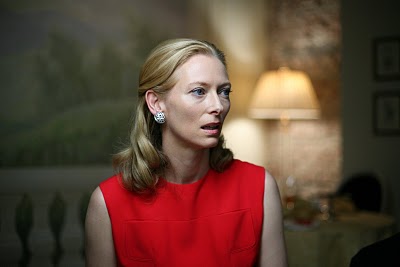
As with Ivansxtc, which transposed The Death of Ivan Ilych from Tsarist Russia to modern-day Los Angeles, we are once again situated in affluent Beverly Hills, this time around in the spacious mansion of Edgar Hudson, director of his family’s charitable foundation and whose life is divided somewhere between apparently pious philanthropy and schmoozing with the city’s socialite set. As the film opens, though, he lies distraught on his bed having committed an as-yet unspecified act, apparently inspired by a performance of the Beethoven sonata, and which has caused him to recollect the history of his relationship with pianist Abby, who also just happens to be his wife.

Through flashbacks we see how their relationship came about: they meet at a cocktail party: he single and on the prowl, she attached but unmistakeably interested. He succeeds in seducing her away from her then-partner, and the two become involved romantically, leading to her eventually falling pregnant. The demands of childbearing force her to abandon her burgeoning career as a concert pianist for which she begins to harbour resentments, straining the couple’s relationship and leading to Edgar proposing hosting of a charity piano recital to appease her. Beethoven’s Kreutzer Sonata is chosen, a duet with which she begins to rehearse with violinist Aiden, who an increasingly paranoid and frantic Edgar suspects she is conducting an extra-marital affair with.

This exposition offers, stripped of the setting and more minor details of Tolstoy’s novella , offers up one its main themes: the apparent incompatibility between monogamy and long-term sexual fulfillment. Through a series of increasingly bizarre internal monologues, we hear Edgar’s obsessive commentary on the rise and fall of the couple’s relationship: from their early lust-filled encounters – shown in surprisingly graphic detail – through to his more-and-more paranoid ruminations on her perceived dissatisfaction and possible infidelities. Given the circumstances of their initial coming together, these thoughts are understandable, and in one of the film’s more perceptive moments, we see Edgar appear to observe his wife giving Aiden the very same look of desire that she gave him all those years before. No sign, though, of the theme of sexual abstinence, central to Tolstoy’s writing of the novella, but apparently incompatible with Rose’s story. Its absence is noticeable, and renders hollow much of what remains.

As with adapting, say, a Kafka or a Nabokov, the key issue with Tolstoy is in trying to evoke the original tone, and Rose’s film seems torn between this demand and that of telling the story, to the point where it at times feels like two separate films. The first is the more straightforward passive observational film charting the couple’s courtship, played at a steady pace and naturalistically acted, which takes us through the essential storyline. Like Ivansxtc, the eschewing of film for use of DV cameras does an effective job of capturing the intimacies and details in almost fly-on-the-wall documentary fashion, though the overly shaky handheld work suggests a rather excitable fly. The easy charm of Danny Huston, who excels is this kind of role, and the coy sexiness of Elisabeth Röhm create a very watchable pairing.

Interleaved between these more laidback scenes, though, are moments of light farce, first-person narration placing us somewhere inside Edgar’s frayed mind through which echo the notes of that damned sonata, apparently sending him off somewhere near David Helfgott territory. Their presence successfully convey the sense of an unreliable narrator and provide both both oddly comic moments reminiscent of Curb Your Enthusiasm as well as darker insights into Edgar’s soul, or absence thereof. However, though on the whole blending into the storyline well, the dichotomy between these scenes and the more observational ones makes the film feel tonally uneven; funny in places, but not satisfying in its entirety.

Given the slew of films emerging from American independent cinema featuring highly superficial and almost wholly dislikeable characters whom we are apparently supposed to identify with – prime among them the characters in Jonathan Demme’s painfully irritating Rachel Getting Married (2008) – it is pleasing at least to see a film where repulsion is the desired reaction to the protagonist. Sure, Danny Huston’s Edgar is charming, but so too is he shown to be philistine and ultimately solipsistic, a man who sees in a worthy charity event only an opportunity to set a trap for his wife. Viewed by Los Angeles society as a benevolent do-gooder, as we penetrate his psyche he comes across increasingly as a selfish, misogynistic sleaze. This, though, is as much comment the film has to make about its character, who ends up just a little too two-dimensional.

In placing the film in modern-day USA, the film goes some of the way to replacing the mores of nineteenth century Russian society with twenty-first century American ones, but it does have the effect of making the denouement seem unnecessary – surely quickie divorce would be the simpler outcome in L.A.? Ultimately there isn’t enough in Rose’s film to replace what has been jettisoned from Tolstoy; in removing the thesis of sexual abstinence from this story of the unknowability of women, this tale of the fall of a charming misogynist falls a little flat.