Moon (Duncan Jones, 2009, UK)

The late, great novelist J.G. Ballard explained that he moved into the realm of science fiction since it was the only literary genre which seemed equipped to explain the psychopathologies of the present day – increasingly fractured societies, the sinister omnipresence of visual media such as television and advertising, and the effects on the human psyche both of rampant consumerism and the ongoing underlying spectre of nuclear annihilation. Dystopian visions of the near and far-future have long been an established literary device for projecting and exploring the human condition in the present day.

The cinematic tradition of looking to the heavens goes back as far as Georges Méliès’ A Trip to the Moon (1902), but the genre only acquired serious critical appraisal with the clutch of films coming in the wake of Stanley Kubrick’s 2001: A Space Odyssey (1968) exploring similar terrain trodden in the best sci-fi literature. This tradition, exemplified by the likes of Solyaris (1972), Dark Star (1974) and Silent Running (1972), is what Moon, the debut feature from British director Duncan Jones (née Zowie Bowie), aspires to and ultimately must be judged against.

An introductory faux-advert economically sets the scene: we are in a near-future in which the company Lunar Industries is harvesting helium-3 from the Moon’s surface for use as a clean power source back on Earth. The mining process is fully automated except for solitary Lunar employee Sam Bell who has the lonely job of extracting and despatching the valuable element whilst also ensuring the moon base’s smooth operation. He intermittently receives transmissions from his wife and baby daughter back home, but aside from these brief communications his sole company moon-side is his robot assistant GERTY, essentially a kind of HAL 9000 with IM-style emoticon faces.

As we join the action, Sam is two weeks from the end of his three-year contract and is naturally looking forward to returning home to his family. There are, however, signs that the extreme isolation has taken its toll, both in terms of his physical deterioration and, most worryingly, his increasing tendency to have hallucinatory visions of a strange woman on the base with him. When on a routine rover-bound excursion he once again sees a vision of a woman on the lunar surface, causing him to crash his vehicle into one of the large harvesters, knocking him unconscious.

Sam awakes in the infirmary to be told by GERTY that he has had an accident and that he must rest up and that a rescue team has been dispatched to bring him home. Yet overhearing a communication between his robotic helper and Lunar Industries management makes him suspicious of what is actually happening, prompting him to fool GERTY into thinking a meteor storm has damaged the outside of the moon base, and so allowing him outside to investigate the rover crash site. Once there, he finds the unthinkable: the injured, unconscious figure of Sam Bell.

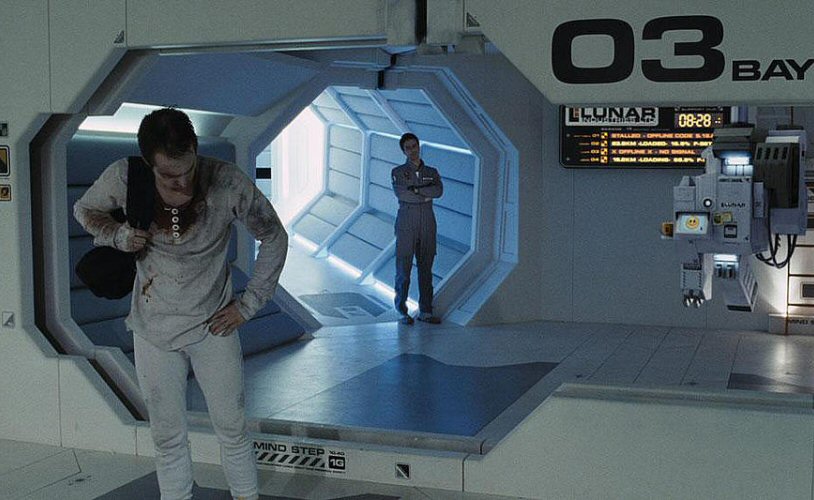
Such a plot point might in another film come as the big reveal, yet here it is really only the device through which the film allows itself to open up and explore its metaphysical philosophical themes. Once reawakened, the injured Sam and the other Sam are inevitably hostile to the other’s presence: who is the ‘real’ Sam Bell? Though practically identical, there are some clear differences between them: the ‘new’ Sam is fitter but more temperamental, compared with the more slovenly but humourous and wise ‘old’ Sam. Despite their antipathy to each other, the two Sams must together try to figure out why the other exists, and what exactly is going on at Lunar Industries.

It should be emphasised that Moon is not on the grand scale of spectacle of either 2001 or many another science fiction film but this is not to the film’s discredit; director Jones has made as visually satisfying a film one could expect for the meagre $5 million budget at his disposal, never trying to reach beyond his limited resources or distracting with visual trickery away from what is a cerebral rather than visceral piece of work. His restraint in generally eschewing visual and sonic crash bang wallop is something to be admired, as is the thoughtful production design which makes the clean lines and brilliant whites of the moon base ragged around the edges and lived-in, nicely highlighting the theme of the clash between humanity and technological sterility, as well as serving as visual homages to a multitude of cinematic forefathers. But for a slight mis-step at the very end, it should also be praised that while the story clearly throws up political and moral issues of contemporary relevance, it seeks not to supply these questions with simplistic, easy-to-swallow answers.

Interactions between the two Sams would be rather unclear were it not for the masterful central dual lead performance from actor Sam Rockwell, carefully delineating between the two to provide enough ambiguity as to whether they are the same person or different people entirely, and giving emotional depth and insight to the at-times flat dialogue. It inevitably recalls Jeremy Irons’ similarly brilliant solo double-act in Dead Ringers (1989), Nicholas Cage’s Kaufman twins in Adaptation (2002), but also Rockwell’s earlier rotating Jekyll and Hyde show in the under-appreciated Confessions of a Dangerous Mind (2002).

There are many positives about Moon, and aside from a few gaping plot holes there is a level of internal consistency which makes it a more coherent and satisfying watch than Sunshine (2007), the other recent British entry into the space film canon, and a film which for all of its genuine brilliance, came horribly unstuck in its third act. Yet for all of the things that it does achieve, Moon doesn’t entirely satisfy. While its sober tone certainly allows for space for contemplation, the story itself lacks the metaphysical profundity of Solyaris, and the ultimate feeling one derives from the film is not nearly as overwhelming; despite the thought-provoking themes, there is a certain flatness to proceedings. So too, by dint of the nature of the story itself, is there not enough chance to identify with the central character, thereby necessarily creating a feeling of emotional detachment. These are ultimately problems inherent to the story, for which Jones can be criticized; but as a director, there is enough in this thoughtful, odd, low-key film to suggest good things to come.
Sunshine Cleaning (Christine Jeffs, 2008, USA)

There should be a lot to like about Sunshine Cleaning: a promising set-up, very watchable leads in Amy Adams and Emily Blunt, along with the ever-affable Alan Arkin, and a snappy 90-minute running time sounds like it should add up to solidly diverting fare, and at least for its first few reels the film hums along quite nicely. Yet despite these positives, the film never convincingly satisfies, not falling into that typical Sundance trap of over-quirkification, but simply not delivering enough of either story or genuine characterisation to be of much interest.

One of the main problems is the onscreen presence of too many tired archetypes: amiable and well-meaning single mother Rose Lorkoski is a former high school princess whose life has not panned out as successfully as she or her peers might have expected, and now juggles cleaning houses for a living and taking care of her loveable but at times troublesome young son Oscar. Mac the school quarterback she used to date she is now having an affair with behind his wife’s back. Her sister Norah is something of a layabout and still living at home with their father Joe, himself jovial but deluded into pursuing countless Quixotic get-rich-quick schemes.

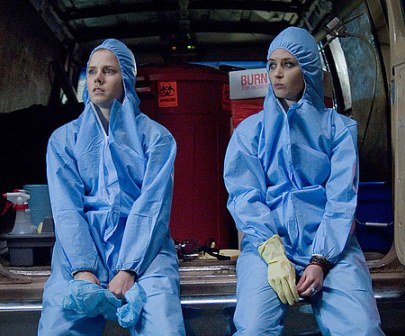
This could be the backcloth for many an unambitious indie flick, but then comes that interesting premise: Mac, now a police officer, informs Rose that he has heard of the disproportionately high fees paid to companies who come in to clean up crime scenes, and suggests she enter this lucrative market herself. Faced with the prospect of having to fund her son’s apparent need for special schooling as well as financially supporting the other members of her dysfunctional family, Rose embarks on this new venture, enlisting her newly unemployed sister to help her out.

There is fun to be had here with the two sisters learning the ropes of their new trade. Adams and Blunt are both fine actresses, and their chalk and cheese act is the highlight of the film; Amy Adams does her nice-girl-out-of-her-depth schtick with aplomb, her bushy-tailed optimistic disposition severely tested at the sight of blood-splattered shower stalls in maggot-infested hovels. Playing off this, Blunt’s charmingly dry Rose counterpoints with sarcasm and ironic humour, her performance filling out her rather badly-written and ill-conceived character.

The problems, though, begin to pile up. Firstly, while the setup offers much promise, the ideas quickly run out, leaving things to be padded out with numerous unnecessary asides, in particular the scenes with Joe and Oscar whose irrelevance and whimsy highlight the script’s shortcomings. As the ideas dry up, we then skirt dangerously close to Sundance clichés: ‘inspiring’ moments of apparent realisation and transcendence, underscored by noodly acoustic indie music, undoing all of the good work the exposition had done to establish some sort feeling of identity and authenticity.

Other characters and details are then thrown in to advance things – we are, for instance, given the information that the sisters’ mother commited suicide, but it is introduced messily and lacking in the required emotional heft. Elsewhere, Norah’s befriending of a suicide victim’s daughter once again sets up what could be an interesting relationship, but as all to often happens in this film, their interactions swiftly descend into triteness. And like much elsewhere, these are suggestions that Sunshine Cleaning could have been an interesting and entertaining film, but for a little more care and attention to detail.

Great Films: Tystnaden [The Silence] (Ingmar Bergman, 1963, Sweden)

Of all of the dozen or so Ingmar Bergman films I have seen, The Silence is the one which I have revisited the most often, but not for the reasons one might expect. I certainly don’t consider it his most accomplished work, nor even his most thought-provoking or philosophically rewarding, usually the hallmarks of his finest films. Indeed, some 45 years after its initial release, some of the film’s psychoanalytical insight appears more than a little outmoded. Yet despite these apparent shortcomings, it stands out in the director’s canon as one of his most intriguing and mysterious, a sinister enigma whose chiaroscuro of contemplation and ferocious intensity renders it as something approaching a masterpiece of psychological horror.

The first lens through which to examine The Silence is seeing it as the final part of a wider cycle of works. The films of the so-called ‘Faith Trilogy’, also consisting of the earlier Through a Glass Darkly (1961) and Winter Light (1962), all consider in different ways their characters’ reactions to the apparent silence of God in the face of suffering and doubt. In the first film, a daughter’s descent into madness prompts a reconciliation between father and brother, and strengthens the father’s hitherto waning religious faith. In the second, a priest suffering even greater doubts appears to find some solace in the presence of his parishioners rather than through God himself.

Silence was the key to the prior two films, but that the third film in the triptych makes direct reference to this is something of a misnomer, since it is marked not by characters entering into a one-way dialogue with their mute God, but by their entire lack of religious engagement – an absent God rather than a silent one. Yet silence manifests itself in different ways here. Firstly, it is an emotional one, the film populated with characters unable to speak their true feelings and desires for each other. Secondly, there is a linguistic silence, brought on by the film’s curious setting – displaced from the familiar surrounds of rural Sweden, Bergman and his characters inhabit an city in an unnamed country with an unfamiliar tongue.

Bergman, at this time heavily influenced by the minimalist economy of chamber music, had begun in his films to pare down his own artform to become something akin to a ‘chamber film’; both Through a Glass Darkly and Winter Light featured only four central characters apiece, and focused on the interplay between their personalities and their unspoken repressed feelings. The Silence sees this stripped back to three – two sisters Anna and Ester, and Anna’s young son Jonas – but with a clear implication to a fourth, the sisters’ dead father. From the outset, the two women quarrel, and use the absent father as a weapon against each other, but as we shall see elsewhere in the film the exact nature of their relationships to him are never made abundantly clear.

From the very first scene, inside an oppressively hot train carriage, the differences between the two sisters are immediately apparent. Anna sits uncomfortably in the heat, sweating profusely, limbs spread wide apart, while by contrast Ester in the same conditions appears aloof to them, sitting deep in thought neatly across the carriage from her sister. As the film progresses the gap between their personalities will become more clearly defined. Anna is impulsive, sexually promiscuous and constantly fussing over her appearance; Ester, clearly disapproving of her sister’s behaviour prefers drinking and smoking in solitude, deeply engaged in the more cerebral activity of her job of literary translation. The voluptuousness and apparent rude health of Anna is contrasted in Ester’s increasing ill health; while the former fulfils her carnal desires, the latter struggles for life itself.

Of his many Bergman tributes, Woody Allen in Love and Death (1975) concludes that “human beings are divided into mind and body”, surely a direct reference to The Silence, since Ester and Anna are clearly somewhat artificially representative of these two sides of the metaphysical divide. Whether this is literal or metaphorical within the confines of the film is certainly debatable, particularly when considering how far Bergman will subsequently go to meld two personalities together in Persona (1966). There are cryptic visual and verbal clues to suggest alternative readings: sometimes the sisters are framed as distant to each other, yet other times their faces almost coincide. If they are the same person, what is the significance of Ester’s apparent lesbian attachment to her sister, often manifesting itself in physical jealousy and masturbation?

The Persona comparison, though, is not helpful, since it positions the women at the core of the film; as in Through a Glass Darkly, which is also frequently misread, it is in fact the son who acts as the fulcrum upon which the film tilts between its competing poles. The several times that Jonas can be seen to wind his watch during the film will remind us of the sound of ticking heard over the opening credits; this and the fact that the film opens and closes with the young boy aboard a moving train are clearly temporal and spatial signifiers of the moral journey he is undertaking here, torn between choosing to live his life according to his mother, and the Dionysian body, and his aunt, the Apollonian rational mind. The strange figure of the troupe of dwarves midway through the film highlight the boy’s apparent pre-sexual nature, yet the unmistakably Oedipal relation to his mother suggests approaching pubescent conflict.

The Silence was released in 1963, and Bergman must inevitably have been aware of recent developments in European cinema. Fellini’s La Dolce Vita (1960), for example, appears to share certain thematic concerns: the death of God, and the consequent resort to either hedonism or rationalist intellectualism as means to fill the ideological void left behind. And just as Fellini’s film operates under the spectre of nuclear annihilation, so too does Bergman’s: the presence in key moments of tanks and air-raid sirens imply some significant unseen or impending armed conflict. The Silence operates in the same weary post-war landscape of many a film of the previous decade, if not explicitly than tonally, a landscape later viewed in Andrei Tarkovsky’s Stalker (1979), which operated its own post-apocalyptic dialectic between its intellectual Professor and artisan Writer.

These central concerns are at the core of the film intellectually, and a certain degree of its beguiling mystery is derived from this, yet more important to the tone of the piece is its oddly jarring visual style. Bergman had resumed his collaboration with cinematographer Sven Nykvist when commencing work on the Faith Trilogy, and it is in The Silence where the partnership became more experimental in terms of composition and framing. As a man equally of the theatre as of celluloid, there are times elsewhere in the trilogy where the director appears to be doing little more than effectively filming a stage.

Though outwardly dismissive of some of his contemporaries like Michelangelo Antonioni, there is a sense from this film onwards that the new dimensions of visual language being explored by other European directors had begun to rub off on him. The range of shots noticeably increases, making extensive use of both close-up and deep-focus. For an example of the former, see how he draws attention to Ester’s drinking and smoking as she fiddles with the radio she is listening to: the camera tracks her hand movements, and the scene becomes intensely subjectively hers, penetrating her psychological state. By contrast, other scenes frame the sisters in separate rooms, one glimpsing the other caught in deep-focus through the doorway, physically representing the mental distance between them. If Bergman is conducting a chamber quartet, then Nykvist is using the full orchestra. The use of diegetic music, sparing and always in some way interacting with the characters, also seems to be penetrating their psyches further.

I began by saying that The Silence is the most intriguing of Bergman’s films, and I think that the reason why lies somewhere between its psychological concerns and its strange aesthetic. The film seems to inhabit the same hellish outer/inner world that would be seen in much of horror cinema: the crazed post-traumatic mind of Herk Harvey’s Carnival of Souls (1962), the Freudian infernos of Polanski’s Repulsion (1965) and Rosemary’s Baby (1968), and through to its mainstream apotheosis in The Shining (1980). And going back to The Silence, as the young Jonas wanders the corridors of the strange hotel where his mother and aunt have disembarked, is it so hard to imagine them as the same corridors the young Danny Torrance explores in his pedal car in Kubrick’s seventeen years later?

Katyń (Andrzej Wajda, 2007, Poland)

I have to admit a certain degree of scepticism when it comes to watching new films made by ageing auteurs. Though it is of course pleasing to see the septuagenarian, or older, likes of Godard, Rohmer and Chabrol continuing to be able to find both the finances and audiences for their work, one cannot help questioning how vital or fresh their output can have remained, some half century after first coming to prominence.

Andrzej Wajda might appear at first to be another such case. First coming to prominence as part of the Polish Film School in the middle 1950s, he has spent the last fifty years largely documenting his country’s tragic history, not just its plight during the twentieth century but also in centuries past. Though not entirely confined to political filmmaking, this part of his oeuvre is what he is most clearly identified with, in particular his 1950s ‘War Trilogy’ of A Generation (1954), Kanal (1956) and Ashes and Diamonds (1958).

What makes his career output persistently interesting is that considering his films allows us not only to trace his development as an artist, but also to examine how they reflect the political climate in which they were made. Man Of Iron (1981), for example, was an historical drama with clear parallels to the burgeoning Solidarity movement, made at a time when censorship had been relaxed to such an extent that a clearly propagandist work could pass through the authorities’ gazes unchallenged. This, in a sense, is what has made his work of continuing relevance and freshness despite his advancing years.

His latest, Katyń, is no exception, focusing on the now infamous massacre of an estimated 22,000 Poles by the Russian Secret Police in 1940, and based on the bestselling book Post mortem by Andrzej Mularczyk. Poland’s unique misfortune in World War Two is introduced to us in an opening scene: it is 1939, and refugees are fleeing the eastbound invading Nazi troops, crossing a bridge only to encounter men running towards them from the other side. The Russians have invaded from the opposite frontier, and the country is now squeezed between the far Right from the west and the far Left from the east. The Molotov–Ribbentrop Pact of non-aggression signed between the two invading powers appears to have consigned Poland to a dire fate.

Initially we view these events through the eyes of Polish Army captain Andrzej, whose wife and daughter Nika have crossed the country to find him and bring him back to safety. The Russians, whilst allowing rank and file soldiers to return home, have incarcerated members of the officer class as well as leading intellectuals as part of their purge of possible insurgents, and Andrzey, unwilling to renounce his vows of allegiance to the Army, is taken into Soviet captivity.

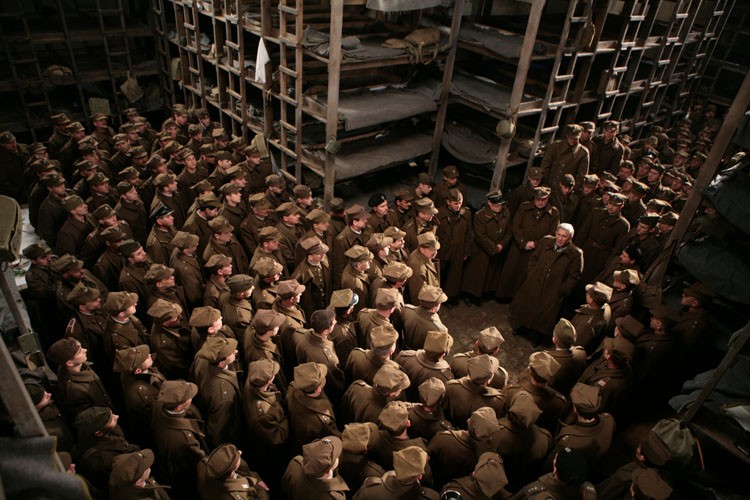
The film then splits into two main narrative strands. Now being held huddled inside a repurposed church and including Andrzej and fellow officer Jerzy, the captives contemplate their collective fate; some anticipate help from the Allies – surely they cannot do without tens of thousands of trained soldiers – while others are far more pessimistic. What fate too for their country? Divided up between the Germans and the Russians, or the bloody battleground when those two ideologically opposed bedfellows almost inevitably turn against each other and come to blows?

The second strand, and more of the film’s focus, settles on the lives of the families of those being held captive. Anna nervously waits for news of her husband’s return. It transpires that in Soviet-occupied areas, wives of officers are swiftly being rounded up too, and she learns that she must escape across the demarcations line to the Nazi-controlled western half of the country in order to survive. Andrzej’s father, a prominent academic, has been captured too, and likely to meet a similar fate to that of his son. Time passes, but Anna refuses to lose hope. News of the Katyn massacre eventually reaches them, gleefully reported through public loudspeakers by their German occupiers, along with newsreel footage showing the mass graves and the method of execution used, apparently typical of the Bolshevik regime.

The war ends, and one might expect the story to end too, yet as with Clint Eastwood’s Flags of Our Fathers (2006), the disappearance of armed conflict from the story merely marks the end of the film’s first act, and the propaganda war has only just begun. The new Communist government of Poland wipes its hands of the massacre, claiming that it took place in 1941, and so at that point in time it had to have been perpetrated by the Nazis. We are shown through several narrative threads how this lie was perpetuated through a multitude of official channels: a woman is not allowed to have the correct date of her brother’s death placed on his gravestone; a university applicant whos father died at Katyn must ‘correct’ his resume in order to be accepted, and Jerzy himself, who survived the POW camp and is now an officer in the new national army, must censor himself in order to keep his job. The very same newsreel footage shown earlier as illustrating the hallmarks of Russian executions has now become illustrative of the SS.

Wajda saves the film’s most harrowing scenes for the coda, a reconstruction of the actual killing processes themselves. Despite all of the portrayals of the horrors of World War Two seen in films previous, there is something uniquely chilling about these final moments. The methodical nature of the killers rendered here with a savage eye for seemingly trivial detail, detail which only heightens the feeling of appalling horror: a dark basement with its blood-soaked floor carelessly rinsed after each victim, and the metal ramp used to slide the prone bodies up to ground level to be dumped on the pile of other corpses. A particularly brave piece of filmmaking for the director, whose own father was one such victim who met this most horrible of fates.

The overall feeling throughout watching Katyń is one of helplessness. By dint of their geographical position, the Poles found themselves at the mercy of not one but two massively armed superpowers, a sacrificial pawn in a much larger game. “Poland will never be free”, one character confides, and even in older Poles today this pessimism is still clearly discernible. Only a few characters are able to articulate what they wish; Agnieszka, the bereaved sister and moral compass of the film, tells one unable to speak the truth, “I choose the world of the murdered, and not of the murderers”. With the pessimism comes a degree of pragmatism, survival over the desire to have the truth be spoken of, and it is this which prevents the film from sliding into sentimentality, something Flags of Our Fathers and the similarly revisionist The Lives of Others (2006) could be accused of. Only Wajda’s sometimes over-the-top visual symbolism and an at-times intrusive overly dramatic score threaten to overwhelm proceedings.

Wajda’s name is synonymous with the cinematic history of his country, and added to this his personal connection to the tragedy of Katyn, it is fitting that he should be one to produce this film in order to do the justice to the story that it deserves. The question would be why now, some twenty years after the lies stopped? Why has it taken so long for him to tell the story so close to his heart? Perhaps it is the contemporary relevance: wars continue to be fought on dubious propaganda, dodgy dossiers and all; there is an important lesson to be learned from history on that count. But also with Poland’s integration into the EU, maybe Katyń comes as a call for the country not to forget her own history; if there is anything positive to be taken from the tragedy of Katyn, it is that we must ensure that the truth is known by future generations, that the horrors of the past are not forgotten, and that ultimately we do side with the murdered and not the murderers.

Anvil! The Story of Anvil (Sacha Gervasi, 2008, USA)

Frankly, there are times when watching Anvil! The Story of Anvil that the whole thing seems like an elaborate joke, and that Christopher Guest will step in at any moment wearing a comedy moustache to announce that the game is up. Yet once one gets over the many obvious parallels the documentary has with This is Spinal Tap (1984), what emerges is not only a hilarious film in its own right, but so too a surprisingly touching one; sometimes a little sad, but also uplifting and genuinely inspiring.

Anvil the band emerged in the early 80s speed/thrash metal explosion alongside the likes of Metallica and Slayer, and as the film opens we see footage of them from this period as they stand on the brink of global superstardom. Talking heads from the likes of Slash and Lars Ulrich tell us what an influence the band were in their bands’ respective formative years, yet flash forward to the present, and who has ever heard of them? It turns out that fame never materialised for the Toronto combo, and now lead singer Steve ‘Lips’ Kudlow is living in suburbia, forging a living out of delivering meals to schools whilst still playing gigs under the same monicker with long-time drummer Robb Reiner.

In the meantime, band members have come and gone (none lost to bizarre gardening accidents, it appears), twelve albums have been released and largely ignored, and instead of filling stadiums like their former peers they play in poky venues populated by mere handfuls of loyal devotees. Lips places the blame on bad management over the years, though a listen to some of their terrible songs reveals that perhaps the quality of their material also played a part in their lack of success.

Lips’ and Reiner’s familes and friends are by turns supportive of them and too a little weary of their continued persistence in chasing their rock n’ roll dreams. Things, though, begin to look up when an email arrives from a lady in Europe telling them she can book the band a multi-date tour of the continent, an offer which they eagerly take her up on. Any thoughts that this could be the band’s big break are, however, brought down to earth pretty quickly; tour manager Tiziana, whilst not lacking in enthusiasm and passion, appears bereft of organizational skills, and after a series of disasters, they limp home having once again failed to make an impact. Will their new album, This is Thirteen, ever get recorded?

All along the way of this journey, the 500lb elephant just out of shot is, inevitably, Spinal Tap. The odd coincidence of the namesake Robb Reiner (note the extra ‘b’) aside, director Sacha Gervasi – and one suspects the band too – is clearly eager to play up the parallels: the childish song lyrics, terrible album covers and names, the artistic pretentions of band members, amplifiers going all the way to 11, even a tongue-in-cheek visit to the full-sized Stonehenge. Perhaps the comparison to the legendary Tap is one which flatters the band themselves? There are countless outrageously funny moments, and the comedic tone is thankfully not mocking; Gervasi, it turns out, was himself a roadie for the band, and it always feels like he is doing no more than administering them a well-intentioned gentle ribbing.

However, that the climb to rock n’ roll stardom is often a torturous, pitfall-laden one will not come as news to anyone; what makes the story of Anvil so engaging is the men themselves, and the strong if sometimes fractious bond between them. Lips, for all of his years, still comes across as a wildly enthusiastic teenager, Reiner the marginally more worldly cynic, Sancho Panza to Lips’ Quixote. As things pile up, the strain on them sometimes boils over, but their fights and eventual reconciliations only illustrate the strength of feeling they have for each other: far beyond a professional relationship, beyond even a fraternal one.

What is stirring is not just the two men’s relationship to each other, but how this unit continues to soldier on regardless of the nearly three decades of rejections and failures. Though they are portrayed largely as comical figures, their steadfast refusal to give up, especially as now old men in a young man’s business, and with near-Panglossian optimism, comes across not as foolhardy but curiously inspirational. For many another musician’s supposed anti-establishment posturing, here are two men delivering a two-fingered salute to their doubters and detractors.

The most poignant section of the film comes when Anvil are booked to play at a Swedish rock festival, where backstage Lips comes face to face with bands he played alongside years before. What is sad is seeing the disparity between the aged, jaded veterans of those multi-million selling bands, and the way their contemporary Lips eagerly runs up to them to shake their hands, like a teenage fan meeting his idols; few though can remember the face from the past. Had things been a little different, had luck fallen on Anvil instead of the Scorpions, perhaps their roles might have been reversed; instead, they have lived the life repeatedly denied to Lips and Reiner.

There are many thematic similarities to Darren Aronofsky’s superb The Wrestler (2008). But while that film was fascinating on a technicial, cerebral and emotional level, there is nothing as comparitively original with what Gervasi does with the material here; he is simply introducing us to his heroes. However, that their story makes for such a genuinely funny, moving and inspiring film speaks volumes about the sheer likeability of its stars and the strength they find in each other to carry on doing what they love, and despite the shortcomings of their music it is impossible not to wish to see Anvil succeed after all those years of trying.