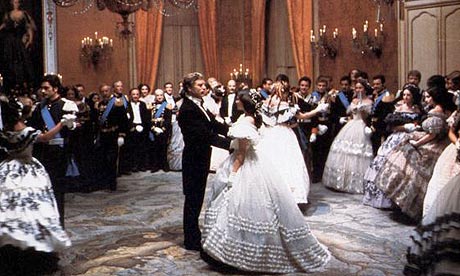
Great Films: Il gattopardo [The Leopard] (Luchino Visconti, 1963, Italy/France)

Luchino Visconti was a director whose career appeared to embrace many contradictions. How did the progenitor of Italian neorealism, with its emphasis on naturalistic mise en scene, eventually turn towards making grand, operatic costume dramas? Salvador Dali described him as “a Communist who only liked luxury”; how could a man who held strongly Marxist beliefs also so fervently defend his own aristocratic stock? And why were his films, whose adaptation from historical and literary sources might appear to be what Truffaut contemptuously labelled cinéma de papa, so praised by André Bazin and the Cahiers du cinéma crowd?

These questions are raised when watching The Leopard, but so too are they answered. In order to more fully understand why, though, we must tell not only the story of the film and its relationship to the director, but also the source novel, its author, and first to the political events which provide its backdrop. The historical period in question is the Risorgimento, the series of conflicts which led to the formation into a single political entity of the Italian peninsula, and specifically within this the events of 1860 which eventually saw Garibaldi’s army, aided by local militias rebelling against the ruling Bourbon monarchy, annex the island of Sicily, allowing them a march on Naples.

Author Giuseppe Tomasi was born in Sicily in 1896 into an aristocratic family, inheriting the title of Prince of Lampedusa on the death of his father some 36 years later. In 1958, a year after his death, what would be his only novel, Il Gattopardo, was published; in the book, a Sicilian prince not unlike the author but living some one hundred years earlier witnesses the profound political upheavals brought about by Garibaldi’s invasion with a mixture of sadness and bemused detachment. The book proved to be divisive: derided by the Left as an apology for imperialism, criticised by conservatives for its portrayal of a corrupt self-serving Church, but loved by just about everyone else for its sensuous, languorous prose, it went on to become an international bestseller.

Who better to adapt the novel for the screen than Luchino Visconti? Like Lampedusa, he had been brought up in a noble household, albeit at the northern end of the country in Milan, but one who could well empathise both with Lampedusa himself and his literary protagonist. True, he had made his cinematic name with the realist likes of Ossessione (1943), La Terra Trema (1950) and Rocco e i suoi fratelli (1960) but so too had he demonstrated his ability to stage opulent historical drama in the spectacular Senso (1954). In fact, in a similar way to how Ingmar Bergman is remembered in Sweden as equally for his theatre work as his film output, in his native country Visconti was just as noted a director of grand operas as man of realist cinema.

Opulent is something of an understatement in describing the film; The Leopard is firstly and most obviously a feast for the eyes. Shot by cinematographer Giuseppe Rotunno, who would later go on to film Fellini’s kaleidoscopic masterpiece Amarcord (1973), the full splendour of the Prince of Salina’s many palazzi is brought dazzlingly to the screen: gold-lined interiors flanked by countless paintings, sculptures and ornate pieces of furniture, and the lavish feasts and ceremonies the populous court he holds partakes in, all rendered with Visconti’s famous visual perfectionism, and underpinned by Nino Rota’s sweeping score. A life of absolute luxury, but one is stark contrast to the brief glimpses of the poverty suffered by ordinary Sicilians, and one now under threat from the bands of revolutionary armies sweeping through the lands.

The threat is not just from below, but from a new estate, personified by the ambitious Don Calogero: nouveaux riches of less-than noble birth whose wealth threaten to eclipse and even to engulf those of the established landed gentry. The Prince seems aware of this decline in his prestige, but remains passive to them; his favourite nephew Tancredi, by contrast, is an active Garibaldini, more aware of which way the political winds are blowing. He and the Prince’s own daughter Concetta are expected to marry, but when Calogero’s beautiful daughter Angelica is introduced to Tancredi, the Leopard must decide whether to sacrifice his familial line and allow old prestige, modern politics and new money to be joined in order for all of them to survive.

While witnessing these profound changes, there is also perceptible an increasing awareness on the Don’s part of his old age and inevitable eventual death. What is so delicately explored is the correlation of his political and physical mortality, seemingly personified by Angelica: he is drawn to her beauty himself, yet while for a man of Tancredi’s generation to marry the daughter of a nouveau riche is a politically astute move, wedding a non-noble for one from the Prince’s previous generation would have been unthinkable. And so, the personal fate of one man is shown to be inextricably influenced by the wider historical circumstances, and even a man of the Don’s considerable power is helpless in such a situation.

The Leopard was released in 1963, at a time when European cinema was once again becoming explicitly politicized; not just the exploits of the nouvelle vague in France, but so too in Poland, Spain, the UK, and most significantly a crop of post-Neorealist Italian films by new directors: Francesco Rosi’s Salvatore Giuliano (1961), Bernardo Bertolucci’s La commare secca (1962) and Pier Paolo Pasolini’s Accattone (1961) and Mamma Roma (1962). In this context, why was professed Marxist director Visconti making an historical epic, what looks to be misty-eyed nostalgia for his feudal ancestry, now something of a relic in the politically divisive scene of 1960s Italy? How does this fit in to his oeuvre of socially-committed films?

The answer is in the source novel as much as it is in the film. In Lampedusa, though significantly not filmed by Visconti, we flash forward in the final chapter fifty years to see the Salina household decades after the Prince’s death. The palace is a relic, haunted by its grandiose past, yet outside of it the ordinary people of Sicily are no better off than they were before. For many, the Risorgimento was a failed, compromised revolution, a triumph of the bourgeoisie, the third estate who would replace the aristocracy as the oppressors of the masses, a theme already explored by the director in Senso.

For dramatic flow, Visconti leaves this final chapter out of his film in order for it to concentrate more on the Prince’s view of his own mortality, but the politics are still there; in many ways the spectacular final ball sequence, lasting some 45 minutes, forms as political a denouement, where the demise of the aristocratic order, personified by the Prince, seems silently to unravel before our very eyes. At times both the novel and the film dare to suggest that the old feudal system was much better for ordinary folk than what followed – a position sure to infuriate professional intellectuals, and one which surely only the likes of Lampedusa and Visconti would try to defend. The over-the-top vulgarity of Don Calogero as played in the film shows that while Lampedusa may have a little respect for such a Machiavellian creature, Visconti has little but scorn.

Visconti, then, is politically engaged like his contemporaries, but so too in his own idiosyncratically contradictory way, much like Pasolini and Bertolucci were in their own ways. With Visconti there is something of a commonality with Jean Renoir, the great French director under whom he served his apprenticeship as directorial assistant on Toni (1935) and Partie de campagne (1936). Renoir’s twin masterpieces, La grande illusion (1937) and La règle du jeu (1939) both examined the mores of the higher classes with a certain degree of sympathy. So too is there an aesthetic debt to Renoir. Those interiors shot in deep-focus, those carefully controlled gliding camera moves, the painstaking attention to spatial arrangement of mises en scène all bear the hallmarks of the French master.

The interiors of the Prince’s world are more obviously lovingly rendered, but it must not be neglected how much the exteriors are too. Two years earlier, cinematographer Gianni Di Venanzo had brought the stifling heat and beautiful if oppressive landscape of Sicily to life in the black and white of Francesco Rosi’s Salvatore Giuliano, and here that is built upon in colour by Rotunno in a series of stunning outdoor scenes. In particular, the morning after the plebiscite on unification we see the island, so much a character in itself in the book, awakening under a literal new dawn, if not a metaphorical one.

That same day, the Prince and the accountant Don Ciccio, discuss the new political situation, all framed by the golden mountainous landscape stretching as far as the eye can see. “That America of antiquity” as Lampedusa describes it – do they not recall cinema’s similar renderings of the barren, hostile American West? Aptly, Sicily will later serve as such for the Andolinis and Corleones when Francis Ford Coppola films it in those greatest of American films, The Godfather (1972) and The Godfather Part II (1974), films not by coincidence scored too by the peerless Nino Rota. Another Italian-American, Martin Scorsese, marvelled at Visconti’s use of colour, borrowing heavily from it for his own The Age of Innocence (1993). But as Peter Bondanella suggests, the lavish visuals are always in danger of overwhelming the film’s politics; perhaps this is why it is not embraced as widely as it should be.

The reason, for me, why The Leopard is so important to understanding Visconti as a director is illustrated by comparing it to his more internationally famous Morte a Venezia (1973). In that film too we have an ageing aristocrat in fin de siècle Italy, obsessed with beauty and his own decay; here Gustav von Aschenbach attempts to transpose this into his music, while Don Fabrizio seeks refuge through the lens of his telescope, observing the celestial motions above him which care not for trivial earthly matters. In the face of death, both men reject traditional religion for something other, a mathematical perfection of sound or light.

Like The Leopard, Morte a Venezia is beautiful to look at. But the later film is overly stylised, and an emotionally cold film, when by contrast, there is a warmth and pleasure in watching The Leopard, even amidst the introspection. Visconti’s class identification with the Prince, I think, is the key to this. The tragedy of Von Aschenbach’s demise when it comes is less than that of Don Fabrizio’s implied death because he is so detached a character, obsessive like the director, but remote from the world around him; Don Fabrizio, though, is aware of his situation but helpless to change it. The Leopard‘s marriage of the epic and the personal is what makes it Visconti’s most affecting work.

The Damned United (Tom Hooper, 2009, UK)

Why has there never been a great film about football? I use the word ‘about’ with caution, since there have been several great films featuring football: Bill Forsyth’s Gregory’s Girl (1981), the excellent Iranian drama Offside (2007), Stephen Chow’s deliciously odd Shaolin Soccer (2001) and a host of documentaries, most notable of them the superlative Once In a Lifetime (2006). What I refer to as the paucity of great football movies is more to do with the surprising inability of cinema to arrive at a satisfying fictional representation of the drama of football itself.

The game is filled with a ready-made cast of heroes and villains, full of moments of intense drama and nailbiting suspense, and with a global following of passionately devout supporters, its international language transcends geography and cultural and linguistic differences. And yet, when one examines its cinematic representations, we have the likes of When Saturday Comes (1996), Fever Pitch (1997) and Goal! (2005), which all fail miserably either to convey or to explain the devotion and obsession of those who take part in and follow the world’s most popular sport. Is there something intrinsic in the game which makes this difficult?

The question is at least partially served in considering The Damned United, Tom Hooper’s adaptation of the bestselling novel by David Peace. The subject of the book, the brilliant and famously outspoken manager Brian Clough, was a divisive character, still loved and loathed in equally great measure by his respective supporters and detractors, and a man whose record of managerial successes hid a life filled with much speculated-about inner demons. Could there be a more compelling subject for a football film?

The film is a fictionalized account of Clough’s famously brief 44-day tenure at Leeds United in 1974, interspersed with flashbacks taking us back to happier and more successful times years earlier at Derby County, where he had taken the then provincial minnows to their first ever League Championship. Though at times the structure is a little inelegant, flitting between these two timeframes allows us to see the differences between his tenures: at Derby commanding fear, respect and admiration in equal measure, yet at Leeds instantly aliented from players, fans and directors alike.

What caused such a change of fortune is at least partially simple. That famous brash cocksure demeanour of his galvanized the smaller club on to great things, but at the more prestigious Yorkshire club, reigning League champions on Clough’s arrival and filled with stars of the England national team, the upstart manager was viewed with suspicion at best, and at worst contempt. The feeling, though, was mutual: Clough despised the club’s reputation as purveyors of violent, ugly football, and appeared to want to change them into a team which entertained rather than bullied their way to the top.

What is central to the book, written as Clough’s internal stream-of-consciousness, is the psychology of the man. Why would he take on this Quixotic task of beautifying an evidently unwilling brute? The answer proves to be complex, but the figure which looms largest in it all is Don Revie. Revie was the Leeds manager from 1961 through to his eventual exit in 1974 in order to take vacant post of England manager. Clough had much in common with him, as he explains in the film: similar working-class upbringing in the industrial North-East, both centre-forwards with brief England careers, and both now experiencing managerial success.

Clough and Revie evidently had much to compare notes on, but as is so often the case it is those who are most similar to each other that end up quarrelling the most. For Clough, the vendetta began when Revie refused to shake his hand after an FA Cup match between their two respective sides, and then jumping back on board the team coach instead of sharing a much anticipated glass of wine with his opposite number. Peace’s Clough seems to have taken this as a major snub, and one which drives his desire for oedipal revenge, in the form of outdoing the achievements of his rival.

All of this is made fairly clear in Tom Hooper’s and screenwriter Peter Morgan’s adaptation of the novel, as it gleefully flits to and fro between timeframes. We can begin to see Clough as one of the first modern managers, in contrast to the older Revie – charming, media savvy, and aware of the importance of psychology and mind-games on the players. Balancing these demands could be tricky: we see his first action as coach is to drive to the television studios to give an interview, even before meeting his new squad, much to their ire. So too do we see a man who was caught between two worlds: born with a working-class desire to prove himself, but working in an increasingly corporate sphere.

What the film misses out though, is the real meat of Peace’s book, which is the urge to self-destruction of its central character: his emotional isolation, his rampant alcoholism, and the internalised demons and fears which seek to drive him to try to undertake the impossible. Instead the film presents a fairly cheery portrait of an avuncular, if misunderstood, genius and one who discovers he needs his footballing muse, assistant Peter Taylor who did not follow him to Leeds, by his side in order to succeed. Their relationship is suggested to be one approaching love, but quite why they were such a winning double act is never really explored.

The film then transforms the more pessimistic and dark tone of the source novel into a more easily digestible piece of middle-of-the-road entertainment. This in itself is not necessarily a bad thing, making for an easier watch, but the question is whether or not it serves to tell the story more effectively. Ultimately for me, the real interest of the book has been sucked out in order to conform more readily to a disappointingly standard sports film narrative. Clough’s fall from grace becomes inconsequential, and as the film ended detailing Clough’s post-Leeds success at Notttingham Forest, I was left wondering why we had focused on what is portrayed as the most unremarkable period of his career.

The film is not without its deft touches: once again, Michael Sheen makes the transformation into a well-recognized public figure with aplomb, both in terms of vocal and physical mannerisms – i would not put it past him to play anyone from history in any upcoming features. There is too a certain joy in these Post-Life On Mars days of seeing 1970s England faithfully reconstructed: the cars, the awful suits, the less-than athletic-looking players and, inevitably, found footage of Jimmy Hill’s absurd chin/facial hair combination.

As a slice of rose-tinted nostalgia The Damned United entertains for its duration, and Sheen’s central performance alone makes it worth watching. But all-in-all this is yet another football film which fails to convey just why it is a sport which continues to be so intensely followed and argued about the world over. In removing the dark roots of Clough’s obsession, how can anyone believe this to be a sport more important than life and death?

Drag Me To Hell (Sam Raimi, 2009, USA)

Many moons ago, director Sam Raimi made a low budget horror film called The Evil Dead (1981). The plot was ridiculous, the dialogue was hokey and the acting was mostly abysmal. It also happened to be brilliant, making an instant cult hero of star Bruce Campbell, and going on to become one the most rented films of all time. What marked the film out was its inventiveness: dynamically jarring camera angles and moves, clever pacing of its jumps and frights, a boldly experimental sound design and score, but along with the terrifying horror a blackly comical tone clearly informed by slapstick. Here was a young new director bursting with fresh ideas about horror filmmaking, and what it could do simultaneously to entertain and to thrill.

Fast-forward 28 years and Raimi, now a big Hollywood player after helming the massively successful Spider-Man film franchise, has returned to the genre which he first made his name. It may seem a curious move for a director now used to making blockbusters to return to low-budget horror, but his bigger films have to me have always seemed like merely upscaled versions of his earlier work, with coincident themes and characters. What is striking about Drag Me To Hell is just how exhilarating his style has remained, all these years later.

The story concerns Christine, an ambitious but good-hearted loan officer at a bank with one eye on the vacant assistant manager desk across the office from her. She is urged by her boss to make tough decisions if she wants to succeed against Stu, her irritating rival for the job, and so when a grotesque and classically ‘sub-prime’ elderly woman comes to her begging for some financial help to stop her being evicted from her house, Christine is reluctantly unforviving.

However, like the hapless Ash before her, she doesn’t know what she’s letting herself in for. The elderly woman, shamed by events in the bank earlier, returns at the end of the day to attack our young protagonist as she tries to drive home from work. After a protracted struggle, the lady mysteriously removes a button from Christine’s coat. Later that evening, confused by the incident, she visits a conveniently placed friendly neighbourhood fortune teller, who informs her of her dire situation: she has been cursed by a dark spirit, which will visit her in physical form over the coming days, and as the film’s prologue has delightfully shown us has happened to others before, she will then be literally dragged through the ground to an eternal fiery inferno.

The film takes its time setting all of this up, probably to the disappointment of those expecting wall-to-wall horror, but in being patient with the story, director Raimi is then allowed to do what he does best: violently assaulting his main character in as many comical different ways as can be imagined. Fans of the abuse meted out to Bruce Campbell will delight in the various ways poor Christine is flung around, tossed up in the air and generally harassed by ghosts both real and imagined, and as she is thrown into ever more of a paranoid frenzy she pictures the elderly Gypsy woman invading her life in increasingly horrible ways.

Christine is played by a radiant (initially, at least) Alison Lohman, apparently a last-minute stand-in for Ellen ‘Juno’ Page, not that you would notice. Similarly baby-faced and playing things entirely straight-faced, she makes for a sympathetic lead, much like Jess Weixler’s little-girl-lost in Teeth (2007). Support comes from her drippy boyfriend Clay, but whose disapproving parents make for a hilariously awkward dinner party scene where Christine, eager to make a good impression, ends up screaming and flinging her chardonnay across the room. Not the way to ingratiate yourself with the future in-laws.

There are possibly some questions which should be asked about the film’s presentation of Gypsies, but tasteless is what Raimi does well, and I feel that there is nothing malicious here, perhaps just a little naïve and childish. There are also curious moral questions raised: if placed with such a curse, what would one do to rid yourself of it? Would an animal-lover be willing to perform a sacrifice? Would a good-natured soul be happy to condemn another to suffer her fate instead? All this is framed by Christine’s initial refusal to help someone else for her own gain, a timely message given the recent messy history of global financial mismanagement.

The laughs are funny, and typically Raimian – gross-out bodily fluids, Three Stooges-esque physical comedy – and the scares when they come are typically well-crafted, but the film never feels quite like a true classic. The artificially metronomic pacing of the jumps, which worked so well in the claustrophobia of the Evil Dead cabin, is not so menacing in the urban environment. The frayed edges of the characterization – that Christine was raised on a farm, that she used to be overweight, and that her mother is an alcoholic – are casually thrown in to advance the story without much care. And at 99 minutes the film is probably about 10 minutes too long, and drags noticeably in places.

All said, this is still the work of a master horror director, albeit a minor work. For its flaws, there are still the unmistakeable hallmarks of Sam Raimi’s genius as a filmmaker is uniquely able to scare and entertain at the same time, and for that it is essential viewing.

*EDIT* There is sadly no Bruce Campbell present, though one character looks like a surrogate for him. Raimi geeks will, however, be reassured that ‘the Classic’ is present, as ever.

Coraline (Henry Selick, 2009, USA)

Since Toy Story (1995), the standard bar for animated features has been set so high by the likes of CGI pioneers Pixar and Dreamworks, as well as the more traditional animations from Studio Ghibli and Aardman, that many new films fail to make much of a lasting impact. In twenty years’ time we will remember The Incredibles (2004) and Princess Mononoke (1997), but will anyone be going back to Bee Movie (2007)?

The proliferation of the requisite technology to make such films has allowed them to be made more quickly and inexpensively, while the leading animation studios attempt to outdo each other with newer flashier effects. Last year’s WALL-E (2008) represents the current high-water mark, but no doubt five years down the line it will look horribly dated compared with the latest releases. What makes the likes of the best of the Ghibli and Pixar films is not how cutting-edge their graphics were at time of release, but the quality of their stories.

Into this market is thrust Coraline, being hailed by some as ‘the best 3D movie of all time’, and heralding a new dawn for the cinemagoing experience. If this is not a reason to get suspicious, I don’t know what is: showcases of new technology, while undeniably technically impressive, seldom make for lastingly great films. Smell-O-vision anyone?

Coraline, though, comes to us from good stock: director Henry Selick previously helmed the superb, if misleadingly titled, stop-motion classic Tim Burton’s The Nightmare Before Christmas (1993), a masterpiece of darkly macabre imagination recently reissued in 3D. Furthermore, the story itself comes from the pen of revered fantasy author Neil Gaiman, creator of the Stardust (2007) universe amongst many others.

The story begins with the young Coraline Jones and her parents moving cross-country from Michigan to Oregon into a house labelled the ‘Pink Palace’. Her mother and father are both gardening writers, both rather drab and both too absorbed in their work to pay much attention to their daughter. Friendless, save for one strange local boy named Whybourne, Coraline spends her time exploring the house’s large garden and many rooms, as well as acquainting herself with her new eccentric neighbours.

On one of her explorations, she finds a small door which has been covered over with wallpaper, but upon opening it, she discovers whatever behind it bricked up. However, awoken one night by a jumping mouse, she is led back to the door to discover that it leads via a tunnel to a replica of the real world, but where everthing is more fantastical and exciting. Replicas of her parents are more loving and dynamic, cooking sumptuous food and playing games with her rather than ignoring her. The ‘Other World’ garden, far from the derelict real world equivalent, is transformed into an enchanted living forest.

All of this wonder is of great excitement to the previously bored Coraline, who soon becomes a nightly visitor to this strange wonderland. However, all is not well there; all of the characters there sport the extremely sinister look of having buttons sewn in where there should be eyes, and the young girl soon learns that if she wants to stay in the Other World that she must have the same done to her. When she refuses, it soon becomes clear that her Other Mother is not as kind and benevolent as she seems, and that Coraline is in big danger.

The first thing to say about Coraline is that there are many moments where it is truly visually breathtaking. Ignoring the 3D element, which though at times is impressive can too be distracting, there is so much to feast the eyes upon in the Other World that it can be overwhelming: troupes of dancing mice, plants and flowers exploding into bloom, and all manner of miscellaneous creatures and gadgets which fire the imagination. The curious neighbours, both in the real world and Other World, are similarly bizarrely grotesque and entertaining.

It is pleasing to note that this visual splendour is not let down by the story. Initially things in the real world are slow to start, perhaps too slow for children raised on Transformers (2007), but once the Other World begins to become more fully formed the narrative pace picks up, particularly as the urgency of Coraline’s situation becomes apparent. Some critics have suggested that the film is in fact too dark for children, and whilst this may be true for much younger viewers, I think that the PG certificate just about gets it right.

My initial fears about Coraline being merely a vehicle for 3D technology proved to be unfounded. Brush aside the gimmicry and here is a vibrant, modern spin on the classic Through the Looking Glass tale with enough darkly visual delight to make children of all ages think twice about turning the light off at bedtime.

Great Films: The Red Shoes (Michael Powell & Emeric Pressburger, 1948, UK)

At this year’s Cannes, the renowned director Martin Scorsese announced the completion of a seven year labour of love: the restoration of the classic 1940s British film, The Red Shoes. Scorsese has never been shy about revealing which films have inspired him: in two documentaries he produced in the late 1990s he discussed the importance that both classical Hollywood and post-war Italian cinema played in making him decide to become a film-maker. Through his World Cinema Foundation, launched in 2007, he continues to spearhead efforts to recover and to restore classic forgotten films which otherwise may have been forever lost.

His relationship to The Red Shoes, though, seems to me to be outside of much of this. Indeed, for a director whose work is generally associated with realism, violence and Catholic guilt, it perhaps seems odd that he should hold in such esteem a melodramatic romance about ballet based around a Hans Christian Andersen fairytale. Yet in interviews he has candidly described it as ‘the movie that plays in my heart’; his dedication to its preservation and his fervent championing of both it and the wider canon of films by Michael Powell and Emeric Pressburger show that the film has more than a great significance for him.

The key to an appreciation of the film is to understand that at its core it is about the creation of artistic spectacle, and the sacrifices which must be made in its process. Take away the film’s romance plotline, one that can be found in countless matinee melodramas, and what is left is one of the darkest portraits of obsession put on screen, a clear inspiration for Scorsese’s own maniacal protagonists as well as those of messrs Schrader, Coppola, De Palma et al; a deep plunge into the heart of darkness of all artistic creativity.

The story will revolve around a curious ménage à trois between two younger characters trying to enter the ballet world and an older one who knows no other world, but to begin with they are all, like the cinema audience themselves, spectators. The world famous Ballet Lermontov has come to London, led by the charismatic but enigmatic Boris Lermontov and starring renowned prima ballerina Irina Boronskaja. In the audience, eager to catch the attention of the Russian impresario is Vicki Page, whose influential aunt Lady Neston forcibly tries to arrange an impromptu audition for at the aftershow party. Lermontov is disinterested, but enquires why it is she wants to dance. “Why do you want to live?” Vicki replies somewhat rhetorically; within this exchange it is clear that he sees something of promise, and so invites her to study with his company.

The third main character comes to the fore the following morning; Julian Craster is a young student of Lermontov’s conductor who believes his master has plagiarised his own compositions for use in the last night’s production. Lermontov agrees – quipping “It is much more disheartening to have to steal than to be stolen from” – and promptly hires Craster as his new orchestral coach. Through the eyes of these two inexperienced newcomers we are thrust into the world of ballet behind the stage. A montage of scenes shows use the messy underweave of the tapestry, a beautiful confusion of dancers, stage hands, set dressing and musicians, all under the steely gaze of Lermontov, a solitary seated figure in the shadows of the stalls.

The company moves to Paris, but once there prima ballerina Boronskaja announces she has married. She is congratulated by her colleagues, but when she looks for Lermontov he has disappeared; she observes that he must have no heart. Cut to him alone, smoking in a darkened study, visibly distracted. He calls for Craster and dramatically announces to him that he plans to produce in Monte Carlo a ballet of the Hans Christian Anderson fairytale The Red Shoes, in which a girl is offered some footwear by a demonic shoemaker which cause her to dance uncontrollably, leading to her eventual death. Boronskaja is dismissed, Page is promoted to top billing and Craster is to compose the score.

Until this point, the film has been light in tone, but the introduction of the fairytale interrupts this and announces something very different. Witness the abrupt cut to Lermontov closing the score book to reveal its title, emblazoned in red, and how it sends Craster into a trance, unable to hear what the director is saying. And then see the Russian’s impassioned explanation of the synopsis, clutching a sculpture of a ballet shoe, and then his quick dismissal of the girl’s sad fate.

The loss of Boronskaja to wedlock has lit some form of fire inside of him, but motivated by what? Sexual jealousy? Speaking to Ljubov, his chief choreographer, he pours scorn on those who seek human love, suggesting one who succumbs to it can never be a great dancer. The choice, one which he has clearly made himself, is between love or complete commitment to one’s art. Some readings of the film read Lermontov as being a repressed homosexual, but this makes for a much less interesting character, and in reality there is little on-screen to suggest this; it is his entire repression of all sexuality which is most in evidence, and some are fooled by the fact that both actor Anton Walbrook and the character’s real-life model Sergei Diaghilev were openly gay.

The ballet is a spectacular success, and as Vicky and Julian are thrust together during the preparations for the new production, a romance between them unsurprisingly blossoms. Lermontov is once again furious with what he perceives as his new muse’s betrayal of him. Unlike Boronskaja, though, he presents her with a choice: married life with Julian or become a great dancer under his tutelage. And thus, he has transformed from the charming, inscrutable figure at the start of the film into tragic villain by the end, undone by his own pride and perfectionism, much like Charles Foster Kane in another film.

The Red Shoes was not an immediate success on release, despite the name the Powell and Pressburger had forged for themselves on the back of hits A Matter of Life and Death [aka Stairway to Heaven] (1946) and Black Narcissus (1947). J Arthur Rank saw such little commercial potential in the film that he left its initial screening without saying a word to the directors, and subsequently only supplied one print for the entire US market. That print went on to screen continuously in a small New York cinema for nearly two years before it gained a wider distribution, and eventually went on to win two Oscars, as well as opening up ballet to a younger, much wider audience.

The film’s enduring critical appeal stems from the darkness and ambiguity of the Lermontov character, played with sympathy by Anton Walbrook. His fall is one of the most tragic in screen history, without any doubt up there with the likes of Citizen Kane (1941) and The Godfather (1972), and as an examination of the process and problematic nature of artistic creation, it can also be placed alongside Fellini’s 8 ½ (1963).

And yet, the continuing popular image of the film is not one of tragedy but great joy. This is, of course, thanks in no small part to its lush bombardment of the senses: Brian Easdale’s magnificent Oscar-winning score, the physical splendour of the cast of famed ballet dancers Robert Helpmann, Léonide Massine and Ludmilla Tchérina alongside the ravishingly beautiful Moira Shearer in the lead role, all captured in dazzling Technicolor by cinematographer Jack Cardiff.

Cardiff, who died last month, had already pushed back the boundaries of visual possibilities on Powell and Pressburger’s last two films, but this would become his most loved work. The film’s centrepiece, the seventeen-minute Red Shoes ballet, is quite the most extraordinary montage of dance, motion, light, colour and in-camera wizardry, set on a stage but defying it by every means, transporting the dancer to a nightmarish nether-world where she floats, soars, plummets, and dances to her eventual death. The camera completely eschews objectivity, immersing the viewer in subjective visions. The expressionistic use of colour was unlike anything seen before, and would notably resurface in Scorsese’s own Mean Streets (1973), while the choreography would be an influence on the filming of Raging Bull (1980).

The ballet sequence is clearly marked as artifice, but as the film ends with its tragic repetition, the frame dissolves to a burned-out candle atop a book marked Hans Christian Andersen, the candle which the observant viewer will have remembered as being the very first frame of the film after the title cards. The entire film has, like the ballet, been a kind-of fairytale, typically filled with melodrama, romance and villainy. Post-war, this kind of filmmaking was unfashionable: realism was king, and the fantastical likes of Jean Cocteau’s La belle et la bête (1946) had been criticized for their lack of political commitment.. Looking back at it now, The Red Shoes is such an established classic that it is easy to forget what a gamble it was for Powell and Pressburger, and like the great art contained within the film, how ambitious and ambiguous it all is.