
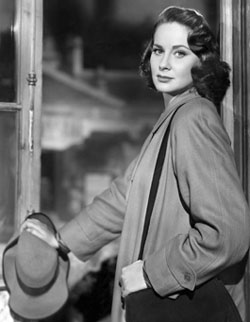
 The Italian Film Festival kicks off tonight in London’s Riverside Studios with Ferzan Özpetek’s Un Giorno Perfetto (2008) and visits venues across the UK and Ireland between now and 27 May. Highlights include various screenings in tribute to screen siren Alida Valli, most notably the bizarre double-bill of Carol Reed’s classic thriller The Third Man (1949) alongside Dario Argento’s ballet school splatterfest Suspiria (1976). Details of venues and screenings here:
The 50 Greatest Films?
 Fellow bloggers 1linereview are conducting a survey of film lovers’ top fifty films, which has now got me sweating over what should and should not be on my own list. Anyone else feeling up to the task can find the details here:
http://1linereview.blogspot.com/2008/09/one-line-review-presents-50-greatest.html
Max Von Sydow at 80
 His is one of the most extraordinary acting careers of the century of cinema. According to IMDB, Max Von Sydow has no less than 137 film credits to his name, beginning with Alf Sjöberg’s Only a Mother (1949) some sixty years ago. Since then, the iconic roles speak for themselves: the aged Father Merrin in The Exorcist (1973), chess-playing knight Antonius Block in The Seventh Seal (1957), Töre the vengeful father in The Virgin Spring (1960), and a memorably villainous Ming the Merciless in Flash Gordon (1980).
It is, of course, the collaborations with Ingmar Bergman that are best remembered, on stage as well as on screen, but it is the richness, variety and force of his many other roles which for me are demostrative of his extraordinary gift for character acting. He continues to work to the present day, recent highlights being a touching recent appearance in The Diving Bell and the Butterfly (2007), starring opposite Tom Cruise in Minority Report (2002), starring in Dario Argento’s neo-giallo Non ho Sonno (2001), and has just signed up for a recurring role in television drama The Tudors as well as the new Martin Scorsese picture Shutter Island.
It seems extraordinary that a figure who found his most famous role more than fifty years ago, in a film which is such an iconic cornerstone not just of European cinema but of art cinema worldwide, still finds himself today doing important work, seemingly with a minimum of fuss. Grattis på födelsdagen, Max.
Låt den rätte komma in [Let the Right One In] (Tomas Alfredson, 2008, Sweden)
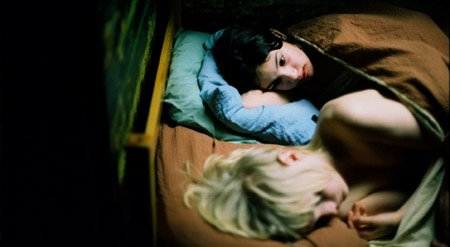 It would be a lot easier not to consider Let the Right One In a ‘vampire film’, as attaching this label has a tendency to conjure up in most people’s minds images of Christopher Lee, crucifixes and garlic braids. Tomas Alfredson’s film is in an entirely different sphere from these, a reclamation of the genre both from high camp and from high-kicking high-school girls into a social-realist world where growing-up and not growing-up are equally as painful.
Strip away some of the film’s layers and there is some similarity with fellow Swede Lukas Moodysson’s growing pains drama Fucking Åmål [Show Me Love] (1998), for this is a film primarily concerned with loneliness, trust and loyalty. Oskar is a shy, spindly 12-year-old growing up in a chilly Stockholm suburb, juggled between his separated parents and frequently picked on by the school bullies. In his room he dreams of exacting revenge on his persecutors, manifesting itself in an unhealthy obsession with knives and newspaper stories of grisly murders.
One night he meets Eli, a reclusive young girl who has recently moved into the same apartment complex as him. She is mysterious, with a haunted demeanour which suggests an inner sadness Oskar can well relate to, and the two tentatively begin to strike up an odd friendship, perhaps even a cautious romance. In the meantime, we have already been introduced to Håkan, an older man whom Eli lives with whose main nocturnal habit appears to be stringing people up and draining them of their blood, though at times failing comically.
The viewer has already worked out what Eli’s big secret is, but then perhaps so too has Oskar. In the traditional vampire film, the revelation to the protagonist of the blood-sucker’s feeding habits comes as a moment of intense drama, yet here by contrast it is a gradual understanding and acceptance. Eli constantly hints at suggesting that she is not ‘a girl’, highlighting the outward sexless androgyny of both youngsters; but an imaginative, lonely twelve-year-old boy is more able to accept this as a mere difference rather than a threat. In fact, the central contradiction is that Oskar is seen as ‘good’ for plotting his unnecessarily violent revenge, while Eli is viewed negatively for the killings which she must do to stay alive.
Those expecting an action-packed thrill ride will be disappointed, as the story unfolds at a measured, stately pace, and aside from a few scenes of blood-letting the visual aesthetic is mostly spare and sombre. The architectural setting, a drab Stockholm apartment complex, not too dissimilar from the humdrum Belgium of the Dardennes or even the Poland of Kieslowski’s Dekalog (1989), is far removed from the glamour and mystery of Nosferatu’s Transylvanian castle. Yet there is just a hint of something magically supernatural in the snowy Swedish chill, in particular the beautifully lit night-time exteriors where Oskar and Eli make their first meetings, and in the spellbinding shots of the young vampire’s piercingly-blue eyes.
It is in this juxtaposition of the mundane and the horrific that the film allows us truly to consider its themes of isolation and despair. The familiar vampire traits – fear of sunlight, a bestial thirst for blood, the sadness and inevitable loneliness of never ageing – all carry a hugely greater emotional punch when placed in a deliberately realist setting and placed in parallel with a character with whom some could relate to and most would sympathise with. Not made explicit, but certainly implied, is that Håkan’s relationship with Eli may have once been like that now developing with Oskar, suggesting that even if their friendship blossoms, there is certain to be no conventionally happy ending.
If we are considering Eli’s immortality, then in straight counterpoint to that is Oskar’s very mortality. If childhood is being painted in an entirely unsentimental way here, then so too is adulthood: whilst not demonised, his parents are hardly role models which he could find himself idolising, neither too his teachers, authority figures nor the pathetic adult residents of his apartment block whose petty squabbling and layabout lifestyles the film openly mocks. Caught at the beginning of awkward pubescence, sandwiched between the twin dystopias of childhood and adulthood, it becomes less surprising that he finds solace with a 200-year-old perpetual adolescent after all. He already knows a little about growing up – about ‘going steady’ for instance – but only about as much as he should for his age. But then Eli, whose life for so long has essentially been one long press of the ‘pause’ button at the same age, knows just as little.
Let the Right One In is a profoundly sad film, yet peppered with moments of black humour. Håkan’s bumbling attempts at securing fresh blood for Eli more than once raise the question of what to do if caught red-handed hanging someone upside down with a jerrycan below their bleeding neck. Elsewhere, one woman’s struggle against a band of CGI cats needs to be seen to be believed, and there is one valedictory scene towards the end which somehow brilliantly combines stunning cinematographic beauty and intense off-screen violence, and on top of that will still have everyone in metaphorical stitches.
Great horror films function by attaching themselves to our fears, sometimes rational, sometimes irrational. Let The Right One In, well deserving of being called a truly great horror film, does this by combining the ordinary with the extraordinary, showing them to be mirror images of the same thing, and by placing them within the confines of the everyday then holds the mirror up to the audience to show what we all are capable of doing if the situation demands it. But beyond this, the film is a work of exquisite beauty, of deep yearning and sadness, but also of the comfort and strength that can be found in kinship and love.
Martyrs (Pascal Laugier, 2008, France/Canada)
 I’m not sure who first coined the phrase ‘torture porn’ as a genre label, but it smacks of the insistence of musical journalese to arrive at names for supposed new musical scenes, like ‘slowcore’ and ‘nu-gaze’, which largely reflect nothing other than a handful of disconnected bands using the same guitar pedals. In the case of ‘torture porn’, it was the arrival of Eli Roth’s Hostel (2005), then retrospectively applied to Saw (2004) and its sequels as well as The Devil’s Rejects (2005) and even bizarrely The Passion of the Christ (2004) that flagged up this apparent new pattern in horror cinema.
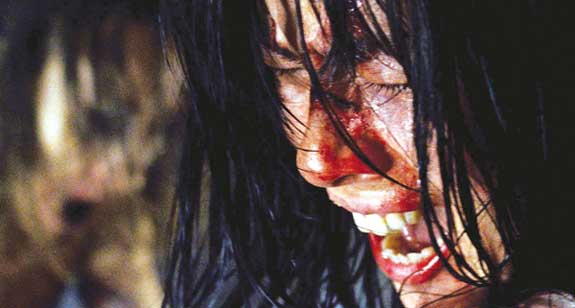
The latest to have this label attached to it is the new film from Pascal Laugier, whose only previous directorial credit was the unspectacular Saint Ange (2004). Here, in Martyrs, we begin with a young girl named Lucie escaping from a mysterious and grisly captivity into the outside world, where she is rescued and subsequently placed into an orphanage. The authorities are mystified by the circumstances of her incarceration: though showing signs of prolonged physical abuse, the expected signs of sexual abuse are absent. Lucie is emotionally withdrawn and inevitably shows signs of deep trauma, but nevertheless is befriended by fellow orphan Anna. Flashfoward several years, and the grown-up Lucie is now out for revenge against her captors, with a somewhat spellbound Anna in tow.
From these opening scenes onwards, it is clear that the comparisons to Hostel and Saw are rather ill-fitting: these opening reels in fact position the film firmly in revenge-thriller territory, much nearer to something like Haute Tension [Switchblade Romance] (2003) or the work of Korean gore-maestro Chan-wook Park. Despite the splatter, of which there is plenty – believe me – there are also some thoughtful psychological considerations posited. Lucie is haunted by some form of demon, but it Laugier carefully leaves ambiguity as to whether this is internalised or an all-too real one. The latter renders her apparent persecution at its hands literal, but the former interpretation throws up a messy tanglement of guilt and self-harm.
There is a clear divide in the film where it diverges completely from where conventional expectations would tell us it was going. From this point on, not only does our focus on a particular character shift dramatically, but so too the tone and thematic concerns, and what follows cresendoes to what is a near-unpalatably bleak and violent third act. It is difficult to go into too much detail without giving away significant amounts of key plot developments, but suffice to say it requires a great deal from the audience, and to my mind is why reviewers have had such polarised opinions about the film as a whole. I consider that where it goes and the philosophical points is raises are enough to justify what are some of the most harrowing scenes I have seen on film; others, I can well understand, will disagree.
It is significant that the closing credits finish with a dedication to Dario Argento, for not only is the Italian’s stylish pouring-on of gore a clear visual reference point for Laugier, but so too the intellect behind the bloodshed. Argento for many years was never taken seriously as a cinematic thinker, but subsequent revisionism has pointed to underlying themes of voyeurism, gender relationships and fetishism in his oeuvre. Martyrs may well suffer a similarly long gestation period before the mainstream takes it to be anything other than exploitation, but for my money it is as necessarily horrifying and vital as the likes of Irréversible (2002) and Salò (1975), and well worth visiting for the open of mind and strong of stomach.
Tags:
 Serene Velocity