
 Composer Maurice Jarre will almost certainly be remembered for his more epic compositions, most notably David Lean’s Lawrence of Arabia (1962), Dr. Zhivago (1965) and A Passage to India (1984), but two eminently creepy scores stick in my mind the most. Firstly, Georges Franju’s Eyes Without a Face (1959), where the sinisterly jaunty, fairground-like main theme underscores the carnival-of-the-grotesque air that permeates one side of the action; this is counterpoint to his sympathetic, melancholy theme for Christiane, always matched with Franju’s Cocteau-like eye for painterly cinematographic beauty, to create a deliriously schizophrenic mix which flags up many of the dualities at play in the film. Secondly, and many years later, there is Jacob’s Ladder (1990), Adrian Lyne’s dizzyingly frightening thriller, the mood being set with Jarre’s extraordinarily creepy dissonant accompaniments, a maelstrom of Vangelis-like synths, tender piano solos and hellish choirs. Not a CD to get out for a dinner party.
Il Divo (Paolo Sorrentino, 2008, Italy/France)

Before addressing the subject of Il Divo, the labyrinthine film about Italian political animal Giulio Andreotti, first a little about his political biography. Andreotti is one of the key members of the Christian Democrat [DC] party which dominated postwar Italian politics for over fifty years, until its spectacular collapse in the mid-1990s. During that time, he held practically every prominent position in government, most notably holding the office of Prime Minister no less than seven times, and oversaw Italy transform itself from a backward peasant country little changed from the days of Garibaldi into one of the world’s leading economies.
His career has been dogged by controversy upon controversy: links to the Cosa Nostra, alleged membership of the sinister P2 Masonic Lodge, and involvement in the tangentopoli corruption scandal that eventually brought down the DC party. Most notoriously, he was Prime Minster during the so-called Anni di Piombo (Years of the Bullet), a period which saw escalating terrorist bloodshed, culminating in hardline left-wing group the Red Brigades’ [BR] kidnap and eventual murder of former Prime Minister and close cohort Aldo Moro. It is widely regarded that Andreotti’s decision not to negotiate with the BR was what led to Moro’s death, but more significantly it is suggested that his uncompromising policies were intended to provoke more extremist factions into violence in order to isolate them politically.
It is necessary to have this knowledge before seeing the Il Divo, since this is no narratively straightforward biopic in the vein of, say, Milk (2008). In fact, its complex construction and bewilderingly large cast of secondary characters make for a somewhat overwhelming first viewing. The film opens with his re-election to the Prime Ministership in 1992 and ends with the opening of his corruption trial, but through a combination of flashbacks, reconstructions, confessions and interviews we see glimpses of the preceding years: suicides, assassinations, and in particular Andreotti’s unshakeable guilt for letting his colleague Moro die so horribly – in one of the few scenes where he lets slip genuine emotion, he questions why it was not he instead who was the one kidnapped and murdered.
If the film is an unconventional portrait in that it is non-linear in structure, then it also must be stressed that it is by no means an entirely realistic character study. Though the script is based largely in fact, from the very beginning it is clear that actor Toni Servillo is portraying him as an oddity: the opening shot is a slow zoom revealing his head to be covered in acupuncture needles, rendering him closer to Pinhead from Hellraiser (1987) than anything human, whilst much has been made of his strange folded ears which made me think of Gizmo from Gremlins (1984). He is full of strange mannerisms: curious hunched posture, an ever-present dispassionate facial expression, and his odd gliding shuffle of a walk, with various speeds including an absurd reverse gear which really needs to be seen to be comprehended. Stalking the corridors of his home in insomnia, there is a clear resemblance to Max Schreck’s titular Nosferatu (1922), if crossed with Quasimodo.
In reality, he is a man respected and reviled in equal measure: viewed by some as politically astute and unflappable, but by others as emotionally detached and calculating. For such a divisive, despised figure, the film could easily have been as accusatory as Il Caimano (2006), Nanni Moretti’s relentlessly unflattering portrait of Silvio Berlusconi, but Sorrentino treads a more subtle path here. The combination of title “Il Divo” – based on one of his kinder nicknames – and a soundtrack populated by both dramatic classical and modern rock music suggest a status, perhaps ironically given his withdrawn personality, somewhere between iconic celebrity and operatic tragedy.
There is something extraordinary about a man who has survived politically for so long where all others have fallen, and despite the wealth of allegations against him has never been convicted of any of them. As La Repubblica founder Eugenio Scalfari so aptly suggests to him in one key exchange: “You’re either the most cunning criminal in the country because you never got caught, or you’re the most persecuted man in the history of Italy”. When he further questions the ‘coincidences’ of his alleged involvement with criminal activity, and whether he chalks these up as being the will of God, Andreotti reminds him that his newspaper remained independent, successful and at liberty thanks to his premiership. Il Divo is by no means an apology for Andreotti’s alleged crimes, but there is the sense that if he is to be condemned, then so too the entire history of postwar Italy.
In a film so contemplative of the relationship between good and evil, there are inevitably strong Catholic overtones of guilt and redemption. In an opening scene Andreotti, on one of his nocturnal walks – early morning rather than late night – visits his local priest who describes the difference between he and former Prime Minster and colleague Alcide De Gasperi – “in church, De Gasperi talked to God, Andreotti talked to the priest”. “Priests vote, God doesn’t”, Andreotti quips back. If he is a repentant sinner, he is also a strongly Machiavellian one. Sorrentino presents him as a man aware, however misguidedly, of the what he believes to be the necessary contradiction of power: that in order to achieve aims in the best interest of the country, bad deeds must be done. This would make him a kind of Italian version of Richard Nixon, if it were not for the fact he has never publicly admitted any wrong-doing – mere wishful thinking on the director’s part.
Anyone who has been in a position of power for as long as Andreotti has necessarily becomes isolated both publicly and privately, and though the film is, to an extent, a portrait of a severely flawed man, it at least understands this as an inevitability. In interviews, director Paolo Sorrentino has made reference to Stephen Frears’ The Queen (2006), and this is a useful comparison, for here too we have an individual who has been ever-present in the public eye for well over half a century, and yet remains emotionally monolithic, inscrutable to the point of inhumanity. Very little is known of his private life, so what is shown here of his interactions with his wife is entirely speculatory, though judging from the real-life Andreotti’s reaction to seeing the film, it is not hard to infer that Sorrentino hits upon at least some home truths.
All of this would be fascinating enough to anyone with even a passing interest in Italian political history, but what gives the film a more universal appeal is the ever-exciting direction of Paolo Sorrentino. His previous films, Le Conseguenze dell’amore (2004) and L’Amico di famiglia (2006) flagged up a new director with a hugely confident, masterful control of visual style, and Il Divo might just represent its coming to full fruition. In fact, the dazzling, dizzying camerawork, breathless editing, all offset by an inventive use of scoring might just mark him out as the true successor to Martin Scorsese, whose Goodfellas (1990) and Casino (1995) are undeniably Sorrentino’s major stylistic influence here.
Praise has been heaped on Sorrentino’s fellow Neapolitan director Matteo Garrone’s Gomorra (2008) for its ultra-realistic portrayal of modern-day organized crime, and deservedly so. But while that film exposed Italy’s sinister underbelly, Il Divo is a much more profound piece of work, questioning on a much grander scale the price of political success, and meditating on the contradictions inherent in the making of political decisions. And in raising a most divisive political figure to an operatic caricature, Sorrentino’s film is able to hit on human truths far beyond the reach of mere realism.
Tags:
Watchmen (Zack Snyder, 2009, USA)
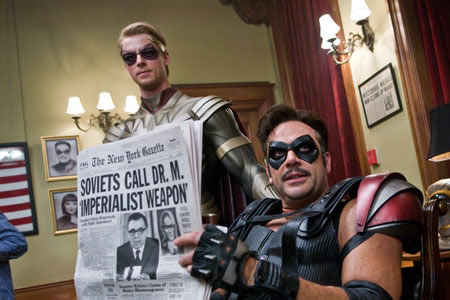 Two confessions: firstly, I am no big fan of Zack Snyder, director previously of Dawn of the Dead (2004) and 300 (2006), both of which while entertaining and exhibiting no little visual flair were let down by rather flabby storylines and frankly embarrasing characterization. Call me old fashioned for asking for a little of these. Secondly, I must also make clear that I have never read Watchmen, Alan Moore’s legendary (to put it mildly) comic book series which serves as this film’s considerable basis, so am in no position to discuss whether it adheres faithfully to the original source material or not. All I will try to do, then, is assess whether or not Watchmen works as a film.
The answer is: well, sort of. As a piece of entertainment, it is certainly riveting enough to keep an audience’s attention, even for its absurdly long 162 minute running time, a duration even some ten minutes longer than last year’s slog of a superhero epic The Dark Knight (2008). In comparison with a lot of other films adapted from comic books, it is undeniably superior: obviously better than things like Fantastic Four (2005) or The League of Extraordinary Gentlemen (2003), but I would significantly add that I found it more enjoyable than V for Vendetta (2005) which I found both tedious and shallow. Where I find fault, however, is my general beef with the director: he is perfectly able to enthrall on a visceral level, but not on an emotional or intellectual plane. This may have been okay with a glossy zombie film or a blatantly historically inaccurate swords and sandals gore-fest, but Watchmen is something different.
Firstly, I would congratulate Snyder on making what is clearly a complex, multi-layered source into a coherent, fully realised world and also in being able to squeeze out of it something of a semi-coherent narrative from it. Time will jump around considerably during the course of proceeedings, but for simplicity our ‘present’ timeframe is an alternate 1985, a world where Richard Nixon has been re-elected for another term after winning the war in Vietnam, largely thanks to the presence of a group of masked superheroes. A montage at the beginning of the film elegantly illustrates the effect that the presence of these anonymous characters has had on shaping this off-kilter version of reality: the Kennedy assassination, the moon landings, the fall of counterculture all were somehow touched by them.
Now the world stands on the brink of nuclear annihilation following a standoff between the USA and the USSR in spite of, or perhaps because of, the presence of the nuclear-powered superhuman Doctor Manhattan. For several years now the other superheroes have found themselves outlawed and have either found themselves in retirement or acting as above-the-law vigilantes. The murder of one of their clan, The Comedian, leads another, the masked Rorschach, to seek out the others warning that someone is trying to kill them off, possibly in relation to the upcoming potential war.
This much is clearly portrayed. The problems only start arising when, once again, we turn to Snyder’s handling of themes and subtexts. There are long passages of the film where the script verbosely tries to tackle what are obviously complex subjects from the Moore original: ideas about human nature, spirituality in the face of a seemingly omnipotent being, alienation and identity concealment, even the vary nature of time and the way humans perceive it. The trouble is, I get the impression that the director doesn’t know what to do with these ideas, instead loading the film with expositionary dialogue and flashy graphics and hoping this will be enough for the audience. I have to say I left the auditorium unsatisfied, wanting a lot more. I suspect I will have to read Alan Moore’s original to get this.
The long wait for Watchmen to arrive on screen appears largely to have achieved the impossible task of satisfying its legions of fans in terms of bringing to life the style and to an extent the content of the comic book series. There will always be nit-pickers at the periphery complaining about missing scenes, references or minor characters, an argument that I neither can nor want to wade into. All I can say is that were it not for the weight of expectation and the obviously grand ambition and scope of the project, this would be a worthy, enjoyable action romp. But as is obvious from the ringing out of “The Times They Are a Changin'” over the opening credit sequence, in terms of its supposed social commentary this is ultimately a film which has set its aim way too high for its own good.
Tags:
Frost/Nixon (Ron Howard, 2008, USA/UK/France)
 I, for one, was not enticed by the prospect of Frost/Nixon, a cinematic rendering of Peter Morgan’s play of the same name which dramatised the now-famous series of interviews which the disgraced former US president Richard Nixon gave in 1977. My objections were twofold: firstly, I generally dislike film adaptations of theatre productions, finding the majority of them to lose much in translation between the wooden boards and the silver screen. Secondly, and on a related note, there seemed to be something inconsequential about what took place in those interviews: certainly, the eventual candid admissions of the former president were unprecedented, but did they really change anything in the historical record, or undo the wrongs of his terms in office?
Amazingly, I found my reservations were mostly dismissed in the course of the film. Peter Morgan’s screenplay, much like last year’s excellent Man On Wire which constructed itself akin to a classic heist movie, finds cinematic terms with which to approach the subject. In Frost/Nixon‘s case what surprisingly emerges is something like a Rocky film: the plucky underdog going several rounds on the ropes against a dogged, seemingly impermeable villain before against the odds landing a series of killer punches to nail his opponent. Along the way, there is a real sense of drama, despite the apparently low stakes.
What drives things along are in fact three competing poles jostling for position. Firstly there is Nixon himself, frustrated at his political and personal exile, who sees the interviews as a chance to rehabilitate his public image and to exonerate himself of his crimes. On the other camera is David Frost, a semi-successful TV presenter looking to use the interviews as a springboard to raise his international fame, and to work on bigger more glamorous projects. And then there is the third influence, less visible but clearly behind it all: the people who wish to see Nixon brought down once and for all, demanding at the very least an admission of guilt for his actions over Watergate, Vietnam and Cambodia. Substitute the words ‘Bush’ and ‘Iraq’ in there, and see how little has changed in thirty years.
Ron Howard is not a director who I massively admire, but he manages to control the pacing and flow almost impeccably. The casting is first-rate: Langella excels as the browbeaten passive-aggressive Nixon, while secondary roles for Sam Rockwell, Kevin Bacon and Matthew Macfadyen support the leads ably. Strangely, Michael Sheen’s superb performance as David Frost reminded me of what Anthony Hopkins managed to achieve in the lead role in Oliver Stone’s Nixon (1995), in that he managed entirely to convince me that he was the character he was portraying without either going overboard in trying to resemble him physically nor descending into caricature. There are unavoidable touches of his Tony Blair there too, in particular that Cheshire Cat grin, but also something of the Steve Coogan about him – at first we see his Alan Partridge-esque bumbling TV persona, but later as he gets more entrenched in the project there is the Tony Wilson of 24 Hour Party People, slowly realising that he has stumbled across something bigger, and more important, than himself.
Ultimately, one’s interest in the film hinges on whether one considers the subject of Richard Nixon as at all fascinating; I am interested in the period because I think it marks a turning-point in attitudes towards the US presidency, permanently soured after the relative high-points of popularity enjoyed during the Kennedy and Roosevelt administrations. What I took from the film was a sense that after the Frost-Nixon interviews politicians would never be viewed the same again, which has led us up the path to the spin-centred politics which we are presented with now, where television is a more important a weapon of political control than a rifle. Nixon should have known this: after all, as we find out, it was his sweaty lip which cost him the 1960 election.
Tags:
Tullio Pinelli, 1908-2009
 The possibly apocryphal story goes that Tullio Pinelli (pictured right, with Fellini and Leopoldo Trieste) met Federico Fellini at a newsstand at which they happened to be reading opposite pages of the same newspaper. Whether this is true or not, what is apparent is that Pinelli would go on to become Fellini’s longest-standing creative collaborator, outlasting even the great composer Nino Rota’s association with il maestro. Already an experienced screenwriter, in 1950 he co-wrote the screenplay for Luci del varietà [Variety Lights] with Fellini and Alberto Lattuada, soon to be followed by the poorly received Lo Sceicco bianco [The White Sheik] (1952). It would not be until their I Vitelloni (1953), co-scripted with noted writer Ennio Flaiano, that the world began to take notice of this new director’s take on cinematic language.
Pinelli would continue to work with Fellini on all of his significant films of the 1950s and 60s, though their partnership took a hiatus after 1965’s Giulietta degli spiriti [Juliet of the Spirits], in a period which saw both the director’s experimentation with LSD and his subsequent nervous breakdown. They would not collaborate again until 1986’s Ginger e Fred and the director’s final film La voce della luna [The voice of the Moon] (1990). In the meantime, he wrote the screenplays for many commedia all’italiana films with such directorial luminaries as Pietro Germi, Mario Monicelli, Dino Risi, Alberto Sordi and Vittorio De Sica, adding to his already impressive CV which could also show Antonio Pietrangeli and Roberto Rossellini as employers.
Pinelli died on March 7, 2009 in Rome.
Tags:
 Serene Velocity