Fifty Years of La Dolce Vita

On a March evening in Rome some fifty years ago, Anita Ekberg and Marcello Mastroianni stepped into the cold waters of the Trevi Fountain in Rome to shoot what would become Italian director Federico Fellini’s most famous and iconic scene: Marcello and Sylvia’s watery midnight tryst, unconsummated like the majority of the relationships within La Dolce Vita, all flowing with sexual energy but ending in the clarity of the dawn light with the unfulfilment of shallow, empty hedonism. In Hollywood, the Hays Code was weakening but still in force, restricting the moral, religious and sexual content of American films; yet the influence European cinema was pushing back the boundaries of what was deemed acceptable for films to portray and communicate, which would eventually lead to the scrapping of the Code in 1968.

La Dolce Vita is important for it marks one of the important victories in this process. It was as much an artistic leap for the director; Fellini’s previous three films had perhaps examined similar themes such as religion and existential isolation, but they had still been narratively straightforward and coherently moralistic. What La Dolce Vita signalled was evident from the famous opening shot of the statue of Christ being hoisted by helicopter over the streets of Rome: here was a society freed from the constraints of religion, guilt and Original Sin, but what takes its place? The film is a freeform exploration of this brave new world, eschewing traditional forms to create an episodic, loosely-constructed mosaic of life without a god.

It is especially prescient of Fellini to presage what now seems an everyday given: the culture of the celebrity. La Dolce Vita came before Beatlemania, yet identified much of what was to come: even supplying the name to the baying press-packers who follow these lauded luminaries around – paparazzi. Marcello may well have been an idealist when he entered journalism, but these principles have long been forgotten by the time we join him on his helicopter ride over the Eternal City trying to pick up girls’ numbers above the din of the rotorblades. His most daring assignments now, save for covering supposed sightings of the Virgin Mary, seem to involve little more than escorting a buxom ‘actress’ on a tour of the Vatican and the Roman nightlife.

One aspect I have noticed of Fellini’s films from La Dolce Vita onwards is their increasing reflection of a globalised world: see where Sylvia is interviewed by journalists from all around Europe, their many different tongues appearing unitedly to question this obviously worldwide film star. Later on, languages and music from around the world seamlessly flow into one, marking at once the increasingly close-knit homogenised world emerging in the 1960s, but also rather humourously the way everyone in this superficial world is pretending to listen to one another, though not really paying any heed at all. In the grand, historically-rich surroundings of the Caracalla Baths, an Italian singer apes for his audience American rock n’ roll – the epitome of twentieth-century mass-produced mass-consumed popular culture.

Would the film make an interesting double-bill with Dr. Strangelove (1964)? Both exist in the shadow of the proliferation of nuclear weapons, but while Kubrick’s film plays a game of blackly-comic satire, Fellini takes a different path: in the face of instant global annihilation he offers his characters nihilistic debauchery as their escape, or at least diversion. The antics of Marcello’s fellow partyers are of little consequence or lasting joy, but is anything going to last anyway? Better to gain cheap thrills while there’s still a world to live in.

Perhaps I have highlighted too much of the pessimism of Fellini’s film; after all, one need only watch Pietro Germi’s hilariously comic Divorzio all’italiana (1961), which dramatises for comic effect a ravenous town of Sicilian men (and their wives) flocking to see this ‘scandalous’ new film, signalling the beginning of a new era of permissivity and sexual frankness. And for all of its dire warnings for Western society, La Dolce Vita remains immense fun to watch, like all of Fellini’s films so full of joy, and so celebratory of life’s rich diversities.

Tags:

Üç maymun [Three Monkeys] (Nuri Bilge Ceylan, 2008, Turkey/France/Italy)

Two films showed up in competition at Cannes in 2008 which appeared to suggest new artistic directions being taken by two sets of the festival’s recent favourite filmmakers. The first was Le silence de Lorna (2008) by the frères Dardenne, which narratively seemed to take their usual naturalistic realist aesthetic and graft in onto an increasingly fairytale-like story. The second was Three Monkeys, the latest film from Turkish director Nuri Bilge Ceylan, whose beautifully shot if languidly paced previous two films Uzak (2002) and İklimler (2006) had received significant critical acclaim and effectively established his position at the forefront of European cinema, alongside the brothers from Belgium.

Ceylan’s output may well be the very quintessence of many peoples’ idea of what constitutes an arthouse film: broadly existential themes, use of naturalistic acting, and a hugely idiosyncratic visual style. Where the work of the Dardennes frequently invites comparisons with that of Robert Bresson, Ceylan’s oeuvre unavoidably brings to mind references to the likes of Andrei Tarkovsky and Abbas Kiarostami: schools of filmmaking which glide at meditative paces, allowing the viewer to concentrate on how surrounding environments shape individuals’ assessments of their own identity. In short, his films are more than a little slower than Michael Bay’s.

Both Ceylan’s particular thematic concerns and filmmaking aesthetic can be considered to be present and correct in his new film: long unbroken takes, careful attention paid to faces and expressions, the breakdown of relationships and bonds of trust, the director’s painterly eye for capturing both urban geography and the force and beauty of the native Turkish weather. The difference though is in the type of story being told. Narratively, Uzak and İklimler, both focusing on slow disintegrations of familial relationships, could hardly be described as being stuffed with drama: Three Monkeys announces itself as different from the very off, beginning as it does with a most tragic event, a fatal car accident. Servet, a wealthy businessman running for office in upcoming elections, has run down and killed a pedestrian.

Sensing a premature end to his political ambitions, he rings up Eyüp, his usual driver, with a deal: take the blame for the accident and serve the brief prison time in exchange for a large cash sum for him and his poor family. Eyüp, wanting to do the best for his wife Hacer and son İsmail, agrees and duly enters into a short prison sentence. All is far from well back at home, however: İsmail has failed to get into college and appears to have fallen in with a bad crowd, much to the consternation of his mother who, desperate and lonely becomes ever closer to their rich, charismatic benefactor Servet.

Already a somewhat fractured family unit at the start of proceedings, the film slowly toys with the moral implications of Eyüp’s acceptance of Servet’s shady deal. The film’s title is an allusion to the proverbial three monkeys who see, hear and speak no evil respectively, and though it is never entirely a satisfactory allegory for the three family members here, the point is still a valid one: that they are all in some way in denial about what has been happening, unable either to forgive or even to accept the realities of their situation. On paper, this all sounds a little preachy and in the hands of a lesser filmmaker could have easily descended into moral soapboxing, but Ceylan keeps things ambiguously opaque enough not to suggest over-indulgence.

My enjoyment of the film was somewhat soured by my having read other reviews which explicitly made reference to the highly unusual and entirely unexpected supernatural elements which begin to filter into the story: needless to say I shall not do the same, but would comment that they were most intriguing to me; I am not entirely decided of what their presence was for, but certainly feel they add something – hinting at some hidden grief at loss which may explain other matters on further watches perhaps? As with Ceylan’s previous work, the ending seems to reinforce the director’s strongly pessimistic view of human nature, but where Uzak and İklimler were sombre reflections rooted in melancholy, Three Monkeys feels like something entirely new from him, a straight-faced parable of the dangers of moral corruption which weighs uneasily on the mind.

Tags:

My two cents….

If I were Oscar…

Best Film: Slumdog Millionaire
Best Director: Danny Boyle
Best Actor: Mickey Rourke
Best Actress: Angelina Jolie
Supporting Actor: Heath Ledger
Supporting Actress: Marisa Tomei
Adapted Screenplay: Slumdog Millionaire
Foreign Language Film: Waltz with Bashir

Possibly one of the easier years to predict – out of the 5 ‘best’ films of the year, only two have a realistic chance of winning, and only one is genuinely great. Where are the Best Picture nominations for The Wrestler, Wall-E and The Dark Knight (surely all better than The Reader?). Last year we had the likes of There Will Be Blood, No Country for Old Men, Away From Her, The Diving Bell and the Butterfly and even Juno bolstering a fairly strong lineup; this year there’s the mediocre likes of Doubt, Milk, Frost/Nixon and Benjamin Button clogging up the list. A poor year for mainstream film, or a terrible selection by the Academy voters? And don’t get me started on the Foreign Language section – an annual source of ire for me. At least Entre Les Murs and Waltz With Bashir sneaked in there, but no Gomorra? Must try harder next year, Oscar.

Tags:

Great Films: Notorious (Alfred Hitchcock, 1946, USA)

There are still some who are in doubt of Alfred Hitchcock’s genius as a director, to whom I address this question: who else in the history of cinema could invest a scene with such an unbearable air of tension simply by showing us a case of champagne slowly being depleted? This occurs two-thirds of the way through Notorious, in the centrepiece party scene which begins with a most elegant, sweeping single shot, crescendos to a frantic race against time before ending with its characters making a series of crucial discoveries: ten extraordinary minutes which amply illustrate the master suspense-maker at the peak of his craft.

Like most of Hitchcock’s best work, Notorious is ostensibly a thriller, but the audience has long-since focused on other more important matters by the time the credits roll. The film opens with an introductory placard giving us the very specific place and time at which events begin to unfold: Miami, Florida, Three-Twenty P.M., April the Twenty-Fourth, Nineteen Hundred and Forty-Six. The use of verbose wording as opposed to more succinct numbering of the date and year call attention to its specificity, the very opposite of the imprecise fairy-tale “Once upon a time”, yet by the end of the film, Prince Charming will be called upon to rescue Sleeping Beauty from her imprisonment.

The opening scene, indeed the very first shot – that of a paparazzo’s camera – highlights the theme of voyeurism, one which is clearly prevalent throughout much of Hitchcock’s oeuvre. For a film about the rights and wrongs of espionage, there is a delightful irony in the way that we then peek into the courtroom, the shot framed by a doorway, to watch Huberman Sr. being convicted of treason, and then to follow his daughter Alicia out of the courtroom past the baying press-pack; if we are at first appalled that she is being personally hounded for her father’s crimes, then we must quickly remember that we too will demand to know more about her during the following 100 minutes of the film.

The following scenes will indeed introduce us to this woman, and the other dimensions to her notoriety: her drinking and apparent sexual promiscuity. Both of these converge at a party at her house where a silhouetted stranger is the latest target of her inebriated advances. We as an audience know that this will turn out to be the debonair Cary Grant, but as Alicia’s drunken charades continue, he is kept in shadow and with his back to the camera, as if he is just another spectator, sitting in the cinema row ahead of us. He will turn out to be Devlin, a CIA agent whose job inherently involves anonymity, and whose lack of a past and emotional coldness will be sharply at odds with Alicia’s vulnerable humanity.

The CIA has a job for Alicia: to travel to Rio and infiltrate the confidence of Alex Sebastian, an old flame of hers now suspected of collaborating with what remains of the Nazis on some form of new weapon. The weapon is the Hitchcockian MacGuffin, a device used to propel the story forwards but itself of little importance, except here it underlines the theme of espionage, allowing the director to utilise an increasingly subjective camera: slow reveals and point-of-view shots placing the viewer too in the role of government spy. Suspense demands a certain degree of empathy, so our increasing identification with Alicia heightens the air of dramatic tension.

This set-up of the film allows the conflict between two sets of competing poles: the stuttering romance of the leads is continually hampered both by the requirement of the mission for Alicia convincingly to seduce Sebastian, as well as the clear personality differences between her and Devlin. As the stakes are gradually ratcheted up we see her desperately try to get him to put his love for her above his job, but his emotional passivity disguised as professionalism repeatedly drives her further away from him.

One of the great strengths of the Notorious screenplay is how the danger to the central romance and the physical danger to the protagonists are both steadily raised in parallel with each other. As Alicia is driven away from Devlin and however reluctantly towards Sebastian, so her deeper immersion into Alex’s world puts her in greater peril: on first viewing, the casual way in which poor Emil Hupka is escorted from the dinner party after creating a scene suspiciously does not appear to signify much, but this is the first signpost towards indicating the very seriousness of the stakes involved – the implication of his demise comes later, as we figure out how far Alex and his cohorts are willing to go to keep whatever is secret, secret. All the while, this seems to be a world away from the CIA operatives in the safety of their comfortable offices.

Notorious could well be argued to be Hitchcock’s most visually rewarding film: if one pays careful attention, all manner of cinematographic trickery is used throughout, but never seems to draw too much attention to itself, or to be affectedly showy. See the brilliant repetition of the use of the combination of silhouette and a Dutch-angle camera, firstly towards the start of the film and then again devastatingly as the film enters its final phase – and note how this so elegantly underscores the dual intoxication motif. And then there are the famous shots: firstly, that famously long ‘kiss’ between Grant and Bergman lasting three minutes, a tracking shot in medium close-up somehow transferring from exterior to interior and seeing the pair exchange screen position twice, something of a dance between the two which cements their intimacy. The aforementioned shot at the cocktail party, which seems to glide us down the Sebastian mansion staircase bannister.

For the cineaste, the film is rich with so many echoes of both Hitchcock’s previous and future films: the presence of his common themes of voyeurism, the control of women, doppelgängers, identity deception, overbearing mothers and the seeming banality of evil render Notorious as allusive as a Joyce or Nabokov novel. Some comparisons deserve more appraisal than others: the use of point-of-view naturally anticipates Rear Window (1954), the famous long kiss will be repeated in Vertigo (1958), while the Sebastian mansion is eerily reminiscent of the De Winter house of Rebecca (1940). Slavoj Žižek famously made the case for Norman Bates’ house in Psycho (1960) to represent the three levels of psychoanalysis, and there is a parallel here: Sebastian’s mother inhabits the upper level, respectable socialising takes place on the ground floor, while the dark truth is eventually located in the wine cellar.

The casting is impeccable, indeed it may be difficult to imagine any other actors taking the place of leads Cary Grant, Ingrid Bergman and Claude Rains. Grant is the apotheosis of his on-screen persona: always much more than the popular caricature of the suave ladies’ man, under Hitchcock he reveals his depths as a character actor: stilted, emotionally repressed, bubbling with internalised rage which he is unable to release. This, along with Casablanca (1942) would be one of the two popularly iconic roles for Ingrid Bergman, before the scandal of her affair with Roberto Rossellini would put her in the spotlight for all the wrong reasons. For me, this performance along with Valli’s in The Third Man (1948) stand as the two greatest female lead performances in 1940s English-language cinema. And spare a thought for Claude Rains, behind the two handsome leads, but somehow his Alex Sebastian holds everything together – like the others a pawn in a greater game, and one whose disposal of at the denouement comes close to being tragic.

Tags:

Better Things (Duane Hopkins, 2008, UK)

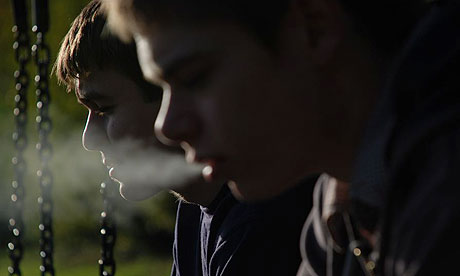
British film-maker Duane Hopkins arrives on the feature-length scene having being touted by some as “the new Lynne Ramsay”, something of a lazy label routinely applied to any young British director working in the confines of social realism. Set in Hopkins’ native Cotswolds, though this really could be anywhere in rural England, Better Things focuses on the lives of a small set of mostly unconnected individuals: a young heroin user whose girlfriend has just died of an overdose, a pair of recently split teenagers, a reunited elderly couple readjusting to life together, and a young housebound agoraphobe whose elderly grandmother has been moved in to her family’s home.

Hard drug use is prevalent amongst the younger characters, but although it can hardly be said to be romanticized here, it is presented as another escape from drab everyday realities, as much as fast drives down country lanes late at night, playing video games or fumbled, inexperienced sexual encounters. Boredom, the inability to articulate truth and emotions to close friends and partners, and the frustrations of living in a dead-end town all conspire to present drug-use not as a glamorous lifestyle choice nor a squalid retreat but merely a choice that has been made by desperate individuals. The use of a largely non-professional cast, drawn from the region and many of whom having experienced drug problems in the past, gives a feeling that the filmmaker is not being judgemental or condescending towards them or their characters.

The middle-aged are notable by their absence in this setting, and the film largely successfully illustrates the commonality between the feeling of isolation and of being trapped between old and young: the old confined by physical frailty and resistance to change, the young by geography, fear or their own poor economic prospects. Hopkins has a background in short-film making, and early on the apparent disconnectedness of the characters and their seeming lack of development do make the parallel stories feel somewhat like separate projects sandwiched together; as the film wears on, however, there is a noticeable convergence, most obviously in one scene in a park where two of the characters’ stories are beautifully juxtaposed, underlining the central thesis of common isolation across the age gap. There are no easy escapes and answers to these situations, but their possibility is more than hinted at by the close.

I always notice that when travelling through parts of rural England that the dominant, most noticeable objects protruding from the flat landscapes are the spires of the country churches, whose function I imagine in these settings to be closer to what they were many years ago in comparison to the modern role of their urban counterparts. Better Things begins with a funeral service and returns near the end of the story to the same place, yet organized religion and spirituality in general are otherwise in absence from the lives of these characters; given the theme of mortality running throughout the film, and the constant searching for something ‘other’, whether through drugs or physical love, there is clearly the invitation to ponder the implications of the absence of a god from these people’s lives.

Hopkins, with a background in photography, has a superb eye for composition, and it is noticeable that most of the film is shot with a completely static camera, pacing established through carefully controlled editing. Shooting in anamorphic widescreen could easily render a romanticized Constable-like picture of beautiful windswept English landscapes, but there is little of that here; instead, a picture of overcast gloom pervades, the landscape forbidding and chilly, and against which characters are left to roam in their own small isolations. It is this external world that the young agoraphobic Gail appears to be unable to enter, yet the same one that her frail housebound Nan wants to experience once again: perhaps since house interiors are lit in cold blues, painting them as imposing, claustrophobic places, devoid of homely warmth.

Again on a technical note, there is a very effective use of sound design to communicate some of the film’s thematic concerns; music is used sparingly and is entirely diegetic, punctuating the otherwise prevalent silences and sounds of nature only intermittently, showing its use by both young and old as a temporary, unsatisfactory release from everyday boredoms. And during one of their late night burns through the countryside, the unusually candid nature of a conversation between two characters is highlighted when the deafening roar of the car engine is artificially muted on the soundtrack, one of several occasions when sound is manipulated to heighten dramatic effect.

Better Things is a very hard watch thanks both to its unremitting emotionally downbeat tone and its graphic scenes of drug-taking, which will be enough to make it off-limits to all but disciples of the Alan Clarke, Ken Loach and Mike Leigh strand of bleakness. But while not likely to cheer or amuse, the film is invested with such genuine humanism and provides a most delicate, faint sense of hope for its characters that despite its melancholy air I found myself strangely uplifted by it. A very promising debut from a thoughtful, inventive filmmaker.

Tags: