Waltz With Bashir (Ari Folman, 2008, Israel/Germany /France)

Watching Waltz With Bashir is a singular experience, if only because it is comes in the unusual form of a fully animated documentary: personally I cannot remember seeing anything like it, and in this respect I found myself challenging many of the assumptions I had about the documentary format, and for the better. But there is more to the film than just this; lauded at Cannes earlier in the year, and rumoured to have just missed out on the Palme D’Or, this is a bold, powerful, well-constructed piece of cinema which should be required viewing for anyone interested in the troubled history of the Middle East.

Director Ari Folman is a veteran documentary filmmaker, but in his younger days he was a soldier in the Israeli Defence Forces. The film opens in a bar, where a friend is telling him of a vivid dream he has been having, relating to their shared days in army service. Folman is troubled, as he cannot remember anything from that period, in particular the events of September 1982 which led to the Sabra and Shatila massacre, a notorious event in the Lebanese Civil War in which the inaction (and probable complicity) of the IDF allowed Christian Phalangist militiamen to slaughter thousands of Palestinian refugees in West Beirut.

This inability to recall the events of that fateful day, excepting one strange vision of himself emerging from the sea beneath the light of flares in the sky, sets the thrust of the film’s narrative; Folman sets about interviewing former IDF comrades of his in order to fill in the blanks as well as to decipher his strange vision. But along the way, the journey of discovery becomes about other things: themes emerge including the loss of innocence, notions of personal and political responsibility, as well as the fragile, ever-changing nature of memory itself. For a film which relies so much on the memories of others to be so questioning of their inherent ability accurately to render the past is challenging in itself.

Where the film becomes challenging is how it uses its animated format. A more traditional documentary approach to tackling this subject would use a combination of present-day talking heads, found footage and reconstructions, with the lines between these fairly obvious to the viewer. But in choosing to animate not just the more illustrative segments but also the interviews, we are challenged to question the whole artifice of the documentary format, as well as creating a more homogeneous feel to the whole film. While the talking heads segments are the least visually exciting sections, they are well-paced, and the quiet, domestic surrounds of the interviews – spacious living rooms, sometimes with young children present in the background – come as a poignant contrast to the horrors of Beirut being described.

The tone of the film shifts between the relative calm of these present day interviewees, and the confusing, sometimes insane situations the young men in the IDF found themselves in in Lebanon. In a series of wry, blackly-comic scenes, both Israelis and Lebanese soldiers and civilians meet grisly deaths, accompanied in the score by some cheesy 1980s rock music. In one inspired moment, a soldier brandishing a machine gun begins to strum it along to the accompanying guitar riff – draw your own conclusions about the meaning. The strangely aloof, almost slapstick tone immediately recalls Apocalypse Now (1979) and a host of other ‘insanity of war’ films, Coppola’s masterpiece references more directly in a later scene where a news reporter fearlessly strides Kilgore-style into a hail of bullets, seemingly in the divine knowledge none will hit him.

The style of animation on show here is sort of a halfway house between the rotoscoped semi-realism of Richard Linklater’s Waking Life (2001) and the blocky impressionistic shapes of this year’s other animated arthouse hit, Persepolis (2007), though apeing neither – there is a feel to the film which is hugely distinctive. Amidst these more obvious comparisons, there is a discernable tonal similarity to Isao Takahata’s classic animated war film Grave of the Fireflies (1988), another powerful film about loss of innocence in wartime. What animating such horrors loses in terms of adherence to factual realism, it brings much in terms of communicating one man’s truth.

Director Folman is a veteran documentary filmmaker, which is made clear by his expert handling of the format here: a tight rein is kept on narrative, making sure that asides and digressions do not distract overly from the thrust of the piece. In a similar way to Steve McQueen’s Hunger (2008), there is no great political flag-waving, aside from one harsh condemnation of the murderous inaction of Ariel Sharon; otherwise, we are seeing just one man’s haunted rediscovery of his role in one of the Middle East’s most bloody events, and his probable equation of this to his parents’ horrific experiences in the Nazi death camps.

The film ends with found footage of the aftermath of the massacre, which I found almost unbearable in terms of its horror and magnitude. Some have criticized its insertion, but for me it is essential to balance the film: for so much of the duration it is a meditation on the fragility of memory, particularly of such horrific circumstances; but in considering this, we ourselves must not be allowed to forget the past.
Great Films: Vertigo (Alfred Hitchcock, 1958, USA)

Vertigo is one of those films, along with the likes of George Sluizer’s Spoorloos (1988), Martin Scorsese’s The King of Comedy (1982) and Alfred Hitchcock’s own Rebecca (1940), that at least according to their film certificates may be suitable viewing for all audiences and ages, yet their profound and frankly frightening delineations of the dark depths of their protagonists’ obsessions are as graphic and disturbing as any violence, horror or gore, and should be steered around with a wide berth by the young, over-impressionable or faint of heart. But for those able to stomach it, as well as those who in some way relate to the nature of the characters’ fixations, Vertigo is cinema’s greatest examination of self-destructive desire.

A film about how traumas affect psychologies begins with a fairly simple cause and effect: police detective John “Scotty” Ferguson is involved in a rooftop chase where he witnesses a colleague fall to his death, resulting in his developing acrophobia-induced vertigo. The early plot device not only sets up his retirement from the force, thus allowing him to be in a position to undertake his sunsequent unofficial investigations, but also prepares the audience for the more complex psychological changes which are to follow.

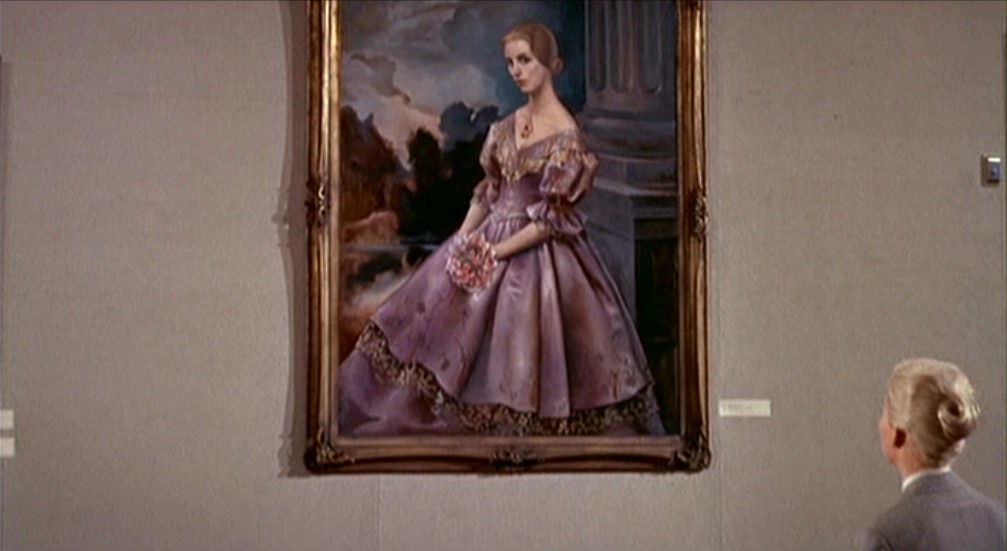
Enter the MacGuffin, that most Hitchcockian device which moves everything along so smoothly yet ultimately has little relevance to the film’s theme. But while in other films it is clear-cut (the $40,000 in Psycho, the government secrets in North By Northwest) here it is less so, and seems to be on shifting sands. Initially, it is precisely defined by the mission Gavin Elster puts Scotty on: solving the mystery of where his wife Madeleine is going. This slowly changes to discovering the relevance of the painting of Carlotta Valdes, the grave, the hotel, and how they are all interlinked, before yet another mystery surfaces, that of what Madeleine’s vision of a Spanish bell tower represents.

The famous surprise that comes halfway through Psycho is unanimously praised as daring, but it could be argued that the surprise that comes two-thirds of the way through Vertigo is just as revolutionary: here is the central mystery, or at least what has been the central mystery so far, solved before our very eyes. Is that the end of the story? Audiences at the time must have thought so, probably not suspecting that there would be at least another 40 minutes of film to come. But this is where the classic mystery thriller format ends and the psychological horror comes to its apex: no longer is a man chasing a doomed woman with whom he is in love, but a woman is now chasing a doomed man whom she loves, but who loves not her but someone who never existed.

In this setup, there is a little philosophical overlap with Andrei Tarkovsky’s Solyaris (1972), in that both films in different ways examine what it means to love someone. In the Russian film, the question is is it the other person in themselves that we love, our own perception and memory of what they mean personally to us, or is it in the forever unbridgeable gap between two existences. Vertigo offers a much more bleak outlook: Scotty falls in love with a charlatan and is unwilling to accept any other ‘Madeleine’, while the very real Judy has fallen in love with a Scotty who is perhaps just as unreal, as invented as her alter-ego.

The main characters, their interlinkings and failures to communicate the truth to each other, as well as their incomplete knowledges of the whole situation are what drive the film towards its inevitably tragic conclusion: lies, tricks, deceptions are everywhere. Even the superficially relaxed relationship between Scotty and Midge, whose early scenes together appear to offer light relief to the thickening mystery plot, have an undercurrent of jealousy and sexual tension, which surface when the latter makes an ill-judged attempt at poking fun at the former’s developing preoccupation, overstepping the mark catastrophically.

It takes an obsessive to analyse obsession; just as there is something of Vladimir Nabokov in Lolita‘s Humbert Humbert, there is much of Hitchcock in John Ferguson. As has been noted by many others, the disquieting scene where an increasingly paranoid Judy is made-over by Scotty to look exactly like Madeleine, right down to the platinum blonde hair and fitted grey suit, in many ways acts as Hitchcock’s confessional to the way he uses the women he casts in his films, meticulously and some would say obsessively controlling their looks and manners. For a director so verbally dismissive of the importance of acting talent and so frequently abusive of his female characters, it is something of an admittance of guilt.

There is so much happening for the viewer both in terms of overt plotting and underlying psychology that it is easy on a cursory viewing to overlook just what a dazzling technical achievement the film is: Bernard Hermann’s magnificent, unsettling score, making even the most trivial detail seem sinister and loaded with danger; the performances of the two leads, both playing against type but delivering career-defining roles; the use of location, San Francisco’s apartments, hills, landmarks, narrow backstreets and surrounding landscape as important a location to Vertigo as Los Angeles was to Philip Marlowe. The virtuosity with which Hitchcock can add a breathtaking effect, yet make it necessary enough to the story for it not to seem overly showy – the ‘vertigo’ shot as famously copied in Jaws, or the bravura scene between Scotty and Judy that Roger Ebert describes as the director’s best.

Note also the colour coding: the bright, passionate reds of the restaurant where Scotty first sees Madeleine, the famous grey suit, the greens of both the car he follows and the doppelganger he later stalks. It may seem like a game of directorial cat-and-mouse, but the later scene in the hotel room, where Scotty finally acquires the woman he has been fixated with, make it clear that this is no foolish joke on the audience: the translucent green of the hotel sign forms a mysterious haze around his desired one, which is later shattered by the very real red of the familiar-looking necklace around her neck. See here for more on the film’s colour coding.

One final odd curio: film censors in certain countries required the film not to end on the dramatic bell-tower ledge, but for there to be a coda explaining how the fleeing fugitive Elster was being captured in Europe, as if audiences in Europe would not be able to handle anyone guilty of murder not being seen to be brought to justice.

Great Films: I Fidanzati (Ermanno Olmi, 1963, Italy)

It comes and goes within a short 77 minutes, and during that time hardly anything dramatic really seems to happen, so why is Ermanno Olmi’s 1963 film I Fidanzati so dearly cherished by those who have seen it? The answer, at least in part, is how it presents the complexities of life, particularly twentieth century life, and the conflict between how people deal with these whilst striving both to maintain a sense of one’s own identity and to keep those that we love close to us.

The background to this, and many another Italian film from this period, is the country’s “miracolo economico” of the 1950s and early 1960s, where a series of agrarian and fiscal reforms led to unprecedented economic growth and industrial expansion, coupled with mass population transfer from the poorer South to the more prosperous North of the country. Filmmakers at this time, particularly Antonioni, sought to try to illustrate the effects that these ongoing demographic shifts were having on individuals and the way that they interacted with each other, usually showing how society was becoming more fractured, and people more isolated in these quasi-dystopian urban landscapes.

Olmi’s film, though, is a little different, and it pays to talk a little about his background. Unlike his contemporaries Rossellini, Antonioni and particularly Visconti, Ermanno Olmi was not from well-to-do stock, nor had any formal filmmaking training. Instead, he learned his craft making documentaries for the Edison-Volta electrical plant that he worked at as a clerk, culminating in his first feature-length film Il Tempo Si E Fermato [Time Stood Still] (1959). His experience of blue-collar work would undoubtedly give him a different take on the industrialization of Italy, say, relative to the more purely intellectual standpoint of an Antonioni or a Pasolini.

If his second film, Il Posto (1961), was somewhat autobiographical in nature, reflecting his own transition from small town comfort to the hustle and bustle of Milan, then there is a little of himself also in Giovanni, the main character in I Fidanzati, again a Milanese but this time older and facing a year-and-a-half-long displacement to Sicily for a work contract, taking him away from his fiancé Liliana, with whom relations seem strained enough already. As the film opens, our couple are at a public dance, he trying to rationalise his move to her, she pessimistic about what it will do to their relationship.

The film’s pacing is rather skewed – the opening dance is intercut with other scenes seemingly from different timeframes, non-linearity clearly influenced by Alain Resnais’ Hiroshima mon Amour (1959). European audiences at the time would have been sure to expect a similarly bleak outcome in Olmi’s film, perhaps also remembering the less-than-happy endings of L’Avventura (1961) La Notte (1961) and L’Eclisse (1962). But after the opening act, the majority of the film is devoted to Giovanni and his slow adjusting to life in Sicily, more in terms of being away from home than being away from Liliana, and it almost plays like a Werner Herzog-like discovery of a new land and peoples. It is only near the very end do we get the expected rush of pathos and emotion that we have been waiting for.

Amidst the story gradually unfolding we glimpse Olmi the documentarist peeping out, his camera catching the small details of everyday Sicilian life, like an over-zealous tourist: the huge white mounds of the salt mines, a small boy in a cafe hurriedly making coffee so he can run off to play with his friends, a masked New Year party where the women wear masks presumably to protect their honour, the final shots of heavy rains sweeping across the plains. It is not just these snapshots he captures, there are also some lovingly shot scenes of industrial work, sparks from welding irons cascading down scaffolding like flourescent waterfalls. Yes – cinematic romanticised welding.

As both Giovanni’s exile and his separation from Liliana wear on, the film once again shifts to non-linearity, as a series of postcards hesitantly exchanged between the couple elicits more snapshot details about their past together, but also begin to make the couple begin to envisage a future time where they are together. This temporal shift into a future not yet happened, whilst not completely out of step with the changing timeframes of the early part of the film, do mark an important turn in events, as we can see that the couple are now at least optimistic about their future, and that there is hope for them where there seemed little. It is such a seemingly simple cinematic device used, but like much of the rest of the film it is its very simplicity that makes it resonate emotionally.

The influence of Italian neorealism hangs large over Olmi’s work, and no more so here: the subject matter is focused on the lives of working people, filming done in genuine locations as opposed to studio sets, a documentary-like shooting style, and most importantly the use of non-professional actors. One of the major triumphs of I Fidanzati is the naturalistic performances of the two main characters: firstly, the quiet reserve of Carlo Cabrini as Giovanni, looking much like one the passively observant leads in a Wim Wenders film, always aimlessly wandering and wondering in his newly found surrounds.

Just as importantly, the wonderfully Anna Canzi as Liliana, whose silent face conveys the depth of emotion that dialogue seldom can. One scene in particular stands out to me, where she has returned to the dancehall where she met Giovanni for a New Year celebration, but sits alone in the corner, unable to join in the festivities. We see her only briefly, yet in that time her solemn expression and slouched posture are enough for any viewer to relate exactly to her postition, clearly somewhere where she wished not to be at all.

I introduced the film by questioning why I Fidanzati is so beloved, yet it feels entirely inadequate merely to sketch out these details and expect to communicate its simple power to someone who has not actually seen the film. This is a film for everyone in love, or who has ever loved: warm, a little sad, tender, humane, cautious but quietly optimistic.

Unrelated (Joanna Hogg, 2007, UK)

If there is one thing more cringeworthy than Brits abroad then surely it is pompous, middle-class Brits abroad, so the fact that Unrelated, which centres on a group of such horrors holidaying in Chiantishire, is in any way engaging is very little short of a miracle; what emerges is a sensitive and touching examination of what it means to be ‘middle-aged’ in these times, and flags up first-time feature director Joanna Hogg as a possible auteur of the future.

The setting is the Tuscan countryside near Siena, and a picturesque villa in which a group of well-to-do British families are summering. We are given very little in the way of exposition, which allows the dynamics between the main characters to emerge naturally through their interactions: the newly-arrived Anna has turned up without her husband, and there is implication that something disastrous has happened between them to explain his absence. Her old friend Verena seems in charge of most matters, and is enjoying her vacation with her new-ish husband, a family friend, and an assortment of adolescent offspring.

What follows is Anna’s speedy assimilation into the ‘youngs’ group, given relatively free reign in their Italian holiday home by the ‘olds’ who want to kick back and relax in their Mediterranean surrounds. In particular, Anna takes a shine to the confident, teetering into cocky, young Oakley, who appears to reciprocate her admiring glances. A few carefully placed anecdotes with the ‘olds’ place Anna a little at odds with her similarly-aged companions, and she clearly thrives on reliving her youth with the obnoxious, over-confident younglings. But as things progress, it becomes clear that the age difference, as much as it is irrelevant in so many circumstances, becomes too much in many ways.

Other critics have been keen to point to the fact that there is a dearth of films about the British middle-classes as opposed to, say, the great French tradition of such films. So it is quite refreshing, despite the obvious horrors of seeing such horrendously over-confident brats and their parents indulging in middle-class decadence, to see such a situation portrayed on-screen. Anyone who comes into contact with such people will instantly identify the archetypes we see: the busybody mother, the hypertense careerist father, the alpha-male lecherous twat of a son and the namby-pamby daughter, all viewed through the lens of Anna, who we presume is similarly bourgeois, but whose unnamed life crisis is causing her to rethink her preconceptions and expectations of life.

As few films there are about the British bourgeoisie, there are perhaps fewer about women of what would be euphemistically described as being ‘of a certain age’, and once again it is great to see a British director, especially one making their first feature, to look at this issue head on. The film offers no simple answers, no Richard Curtis-like easy options, and in summation (despite an ending which is perhaps a little too neat and tidy for my liking) gives a well-argued perspective on what it sets out to portray. There is also much to applaud in its overall visual style: there is always the danger of this type of film turning into a glorified travelogue, but the camera never strays too far from the characters’ faces, frequently focusing in on their reactions to dialogue as opposed to those who are speaking, giving much more of an insight into character than straightforward shot/reverse shot would.

Joanna Hogg cut her directorial teeth with television dramas such as London Bridge and Casualty, but here she has demonstrated a very fine eye for well-observed, character-driven drama which makes for fine cinematic viewing, and with enough style and eye for detail which suggests there is much to come from her; let us hope her talent is given the chance to shine in the future.