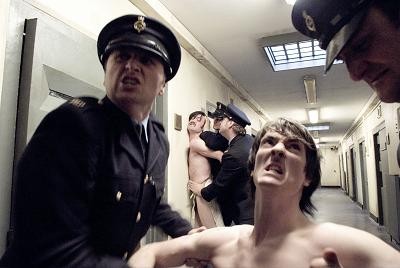
Hunger (Steve McQueen, 2008, UK/Ireland)

From the standpoint of a UK mainlander, it is quite easy to forget the dark days of The Troubles in Northern Ireland, so this first feature film by renowned visual artist Steve McQueen is an opportunity to remember recent history, as well as to reconsider it in the light of the present political climate and the current treatment of ‘political’ prisoners.

Bobby Sands was a member of the Provisional IRA who, in 1977, was sentenced to 14 years in jail for firearm possession. Housed in the newly opened prison in Maze, he rose to prominence through his eloquent writings and rhetoric, eventually becoming not only leader of the prisoners in Long Kesh, but also winning a seat in the House of Commons following his victory in a by-election. In his role as leader he became the spearhead of a series of protests against the treatment of those held in the prison, beginning with the infamous ‘blanket’ and ‘dirty’ protests, and subsequently leading the 1981 hunger strike which would lead to his slow physical degradation and painful death.

The first surprise about McQueen’s film is that it takes a long time for the main character to arrive, a bit like the wait for Orson Welles to turn up in The Third Man; instead of Sands, we start the film seeing through the eyes of a newly arrived inmate. We are spared little of the horrors of what conditions were like inside the Maze at the time of the protests of the inmates – excrement covered walls, maggot-infested piles of food rotting in corners, urine soaked corridors – and the director’s frequent use of slow, drawn-out takes allows the full horror to sink in. Beatings by the prison staff are frequent and bloody, but the director is careful to show the human side of some of the guards, unable to shut themselves off from the pain they are inflicting on their fellow men, but helpless to stop it. Political fence-sitting, maybe, but wise given the still delicate subject matter.

Is its only well into the running time that we are introduced to the ragged-looking Sands, played in hypnotically charismatic fashion by Michael Fassbender. He first explodes onto the screen being violently shorn of his hair and beard by a group of prison officers, such brutal treatment one suspects he was regularly subject to. But whilst other prisoners naturally react with pain from their beatings, there is an element of resignation and almost perverse pleasure about how he takes them. The film’s key theme, particularly in its second half, is the extent to which a man can put himself in through intense physical agony in order to make a political or personal point. Later on, we see the decay of Sands’ body as a result of the hunger strike, physical debilitation which is hard to describe in words in anywhere near enough graphic detail, but an extraordinary transformation from a well-built man to a frail shell.

Sands is celebrated by many Republicans as a hero, a martyr who died for his beliefs, and whose death inspired a new wave of volunteers to the IRA’s cause. Though McQueen denies any intention of this in interviews, there is an undeniable Christ-like presence in this screen portrayal of the man: despite his blasphemous ‘smoking’ of pages of the Bible, his stoic acceptance of torture, and the stigmata-like markings on his flesh towards the end of his life indicate otherwise. Perhaps to underplay this, the film is keen to stress that the man who Sands identified his actions with was actually his younger self, who put an injured young foal out of its misery to spare it of its pain, regardless of the consequences for himself.

Steve McQueen won the prestigious Turner Prize in 1999, and presumably this has given him much more artisitic freedom than other directors might expect to have, but this is where Hunger runs into difficulties. As much as it is hard to criticize a director for taking risks and straying from the conventions of the filmmaking rulebook, there are moments in the film where storytelling appears to play second fiddle to technique. One scene, where a porter slowly disinfects and sweeps the prison corridor of urine, lasts far too long to the point of becoming boring, whilst offering nothing to the story or mood. Other moments are stretched out for all they are worth, often feeling like filmmaking experiments rather than necessary elements to the story.

In the film’s most bravura scene, Sands and his priest conduct a twenty-minute conversation almost entirely framed in one shot and in one take. Whilst this can be applauded on a technical level, it adds virtually nothing to the scene, and actually has the effect of slightly distancing the viewer from what is being said, as well as highlighting the rather clunky, over-expository dialogue. Some of the film’s risks do pay off: for instance, the lack of dialogue for much of the film’s opening, suddenly punctuated by the chatter of inmates gathered at Mass, works extremely effectively.

Hunger will no doubt cause controversy on its release, if only for its subject matter rather than what it is trying to add to the debate: Sands remains the most divisive figure in the Republican-Unionist clash, and the film is bound to open old wounds. One has somewhat to question the motives of the filmmaker in choosing to make this film at this point in time – far enough away from the actual event, but still in a time when the partisan likes of Gerry Adams, Martin McGuinness and Ian Paisley are still on the political scene. While undeniably a hard-hitting document of a terrible period of history in a particular place, there is not enough outside information about the context to inform a viewer with no knowledge of the Troubles, nor is there a central argument to please either side of the debate, ultimately pleasing no-one. Maybe this is the point – to show that there are no winners or losers in a situation as horrific as this. Powerful, if unfocused, filmmaking.

Gomorra (Matteo Garrone, 2008, Italy)

The subject of organized crime in Italy is nothing new to the cinema, and there is much in Matteo Garrone’s film of Roberto Saviano’s bestselling expose of the Neapolitan Camorra that feels like ground which has been firmly trodden on previously. The film’s real strength, however, lies in its real sense of location: the urban buildings, beaches and countryside of Campania, and the colourful dialect of Naples, placing it in the even grander tradition of neorealism.

Firstly, let me say that this film is not, and should not be, entertaining. For two-and-a-quarter hours we are thrust into the squalid side of Naples, seemingly a universe away from the beautiful city Ingrid Bergman and George Sanders were having such a tough time in in Viaggio in Italia (1954). Instead, there are grim Antonionian apartment blocks, sweatshops, seedy strip clubs, the side of Italy seldom seen in the tour books or holiday guides. The film somewhat disjointedly weaves together several different stories, all involving the mafia-like Camorra crime syndicate on some level, however, subtle: from more ‘legitimate’ operations such as waste disposal all the way down to drug-running and murder.

There is little in the way of glamour, or even an insight into a Cosa Nostra-like controlling hierachy; instead, life (and death) appears arbitrary, ad hoc, at the whims of small-time hoods rather than smartly dressed calculating godfathers. If the consequences of messing up in this world are all-too familiar to us, then it is the sheer splintered disorganization of the Camorra which is new. The multiple stories all show reasonably likeable characters – a tailor who copies couture dresses, two kids who find a stash of guns and want to play Tony Montana, an ageing Camorrista accountant – and how these people find it impossible to either maintain their independence or escape from their urban trap.

The stories are not all successfully executed: the two gun-toting young men are so obviously doomed from the outset that their story becomes rather tiresome and played-out, while the strand involving a young man lured by the prospect of money and travel into helping the illegal dumping of toxic waste feels a little flabby and simplistic. But for all of its weaker moments, there are some tremendously effective ones too – the young Totò’s initiation into gang life, donning a bulletproof vest and being shot in the chest, whilst other boys queue as if waiting at the doctor’s surgery; he later proudly examines the bruise on his chest, a near-literal badge of honour.

For me, the most interesting segment was that of the tailor making copies of couture dresses, who is courted by Chinese immigrants into teaching them his craft, inevitably putting the backs up of the local mafiosi who are reliant on their own trade in knock-off frocks and are less than happy with the prospect of cheap competition. The introduction of new immigrant communities is an indication of cinema increasingly showing the new, economically and culturally diverse Italy.

The film’s greater cultural significance lies with its use of a largely non-professional cast, drawn from the very areas it is trying to portray. The Neapolitan dialect is sufficiently removed from Italian for domestic audiences to have required subtitles in order to understand the dialogue, and this feeling for local flavour recalls some of the best postwar Italian films, in particular Luchino Visconti’s Sicilian La Terra Trema (1948). The actors, most of whom new to the screen, deliver superbly naturalistic performances, perhaps having lived the lives of their characters off-screen – see Vittorio De Sica’s use of Lamberto Maggiorani in Ladri di Biciclette (1948).

Critics of the film have pointed its lack of a wider context of Camorra operations: in a piece in Sight and Sound, Silvia Angrisani notes that the organization penetrates widely into official Naples life, and its permeation into everyday existence is much more profoundly disturbing than the petty criminals elsewhere. The film does end with a series of statistics showing how deadly they have been over the years – 4,000 attributed murders, making them the most ‘successful’ crime organization in the world. There is also the small matter of its 150 billion Euro turnover. But the addition of these stats at the end merely seek to flag up the preceeding 135 minutes’ inability to frame this context; why tell us this?

As a piece of cinema, Gomorra is a little lacking in cohesiveness – lacking either the narrative thrust (however artificial) of City of God (2002), or the vibrancy and punch of something like La Haine (1995). As a series of interconnected stories, there is nothing like the innovation of early Alejandro González Iñárritu, or even Robert Altman. But it is still a solid piece of work, largely down to its insights into the city of Naples, far beyond the Castel Nuovo and the Piazza Plebiscito – a city of people living beneath a dirty, inescapable system of organized crime.

Great Films: El Espíritu de la colmena [The Spirit of the Beehive] (Victor Erice, 1973, Spain)

For those entranced by Guillermo Del Toro’s recent Pan’s Labyrinth (2007), here is that film’s spiritual forefather, and one of the great masterworks of Spanish cinema. Made in the last years of the Franco dictatorship, what is surprising about The Spirit of the Beehive is just how much Victor Erice managed to slip under the censors’ gazes and onto the screen, even if cloaked somewhat in allegory. Beyond this political context lies one of the greatest films, if not the greatest, to examine childhood innocence and its slow surrender to the real world.

“Once upon a time”, the opening titles describe, setting up the mythical, more mystical side of the film’s narrative. A vehicle pulls into a small village in rural Spain, which a group of children excitedly gather around. Its precious cargo is the reels of film containing James Whale’s horror classic Frankenstein (1931), which on projection hold the youngsters spellbound. One girl, the impressionable Ana, is left, mystified by one particular scene: when the monster is taught by Little Maria to throw flowers into the river, only for him to throw her into the waters too. Why did he kill her, Ana enquires of her sister, the older Isabel, who toys with her younger sibling by suggesting the monster lives in a nearby sheepfold, and may be summoned if Ana calls for him.

The year is 1940, and the other side of the film is framed by context of the location: the dusty plains of Castile. By this time, the Spanish Civil War had long been won by Franco’s Nationalists, but beginning were the small-scale Maquis Republican guerilla operations which would last well into the next decade. What becomes more noticeable throughout the screentime is the absence of young men from the town, whether killed in the violent, bloody conflict just ended, or participating in the wider European conflict of the time. The few we do glimpse are on trains, whether bound to or from the lines of battle. One young man will eventually enter the story, though, which will have its own inevitable consequences.

Ana and her sister live with their parents: their father, an older man who silently tends to his beehives, observing and writing about their microcosmic patterns of life, as well as taking the girls on walks in the country explaining to them about the ways of the natural world. Their mother, much younger than he, daydreams and writes long letters to a lost lover who is away fighting, and quite possibly dead. Though both the father and the mother are loving to their children, they are clearly no longer communicative to each other, and their respective preoccupations allow the girls time and room to roam around and play.

The young Ana, given this somewhat free reign, is allowed to be led astray by Isabel, roaming around the countryside and playing on the nearby train tracks. Isabel is older, more worldly-wise than her younger, more impressionable sister, and plays a number of tricks on her; some critics have pointed to their cruelty, yet for me are typical of the type young siblings play on each other. The two sisters illustrate the transition into adulthood: the older sister playing with ‘adult’ things like lipstick and shaving brushes, losing the innocence of childhood, while the younger sister, still learning about the world and life, at the mercy of the limits of her imagination. There is undeniably some subtext here about the loss of Spain’s innocence in the blood soaked years of the late 1930s, which saw brother killing brother, but it is the film’s sense of enigma which allows interpretations to be drawn without being forced.

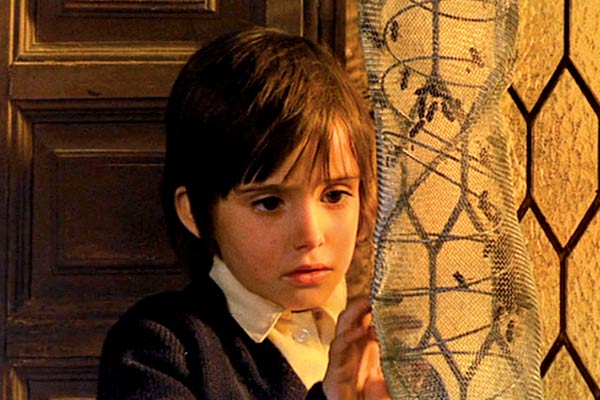
Part of the film’s wistful air can be certainly laid down to the remarkable cinematography; Bergman-like interiors are bathed in light streaming through the hexagonal-patterned (beehive-like) windows, betraying a debt to Vermeer both compositionally and in terms of the rich golden hues. Exterior shots are similarly rich in colour, the Castilian plains as full and golden as anything we would later see, for example, in Terence Malick’s spectacular Days of Heaven (1978). Cinematographer Luis Cuadrado was slowly going blind around the time in which the picture was shot, and it is all the more remarkable that the subtle nuances of chiaroscuro indoors, as well as the more grandiose outdoor shots, are as superbly photographed as they are.

As much as the film is memorable for its visuals, what stands out equally is the central performance of Ana Torrent, later to make an equally memorable impression in Carlos Saura’s Cría cuervos (1976), and who continues to work in Spanish cinema to this day. It is a demanding role for any actor, with most scenes communicating emotion through facial close-ups rather than dialogue, yet her visage – full of wonder and sadness, inquisitiveness and fear – seems to sum up a lot of what childhood is about. The parallel with Pan’s Labyrinth would be that much of what Ana fears in the world is what her imagination creates, yet this allows her to deal with real-world problems with much more ease – much like Del Toro’s protagonist.

The Spirit of the Beehive won its director much acclaim, but Victor Erice has since gone on to make only two subsequent feature films. A little strange, maybe, given Spain’s increasing moves towards liberalization, openness, and artistic freedom. But then again, perhaps he managed to say all he wanted to say in this, one of the great films of European cinema, one of the great meditations on childhood, and a poetic allegory of a beautiful country’s sad recent history.

Quality vs quanitity: the age-old cinema debate

Interesting piece in today’s Indy about the so-called ‘competition‘ between the two big French films currently on release, Entre Les Murs and Faubourg 36. Of course there is an element of media exaggeration at stake here, a kind of Stones vs Beatles fabricated rivalry between two sets of filmmakers, distributors, cinema-goers etc etc…

But there is a grain of truth amidst the hype, and in many ways the divergent ethoses of the two films represent a debate which is as old as cinema itself. Take, for example, the case of established classic of French cinema, Les Enfants Du Paradis (1945), an epic love story set around the Paris theatre world of the 1830s. As undeniably great a spectacle and production that film was, it would later come under criticism from the Cahiers du Cinema crowd as the antithesis of what they considered to be the more auteurist visions of the likes of Robert Bresson, Jean Cocteau and most significantly Jean Renoir.

Why does this matter? After all, should films not be allowed to be escapist entertainment? Renoir makes an interesting case in point. His famous World War I film La Grande Illusion (1937) stands as a perfect example of what filmmaking can express; made on the eve of the Second World War, it was a reminder for Europe not to forget her history, nor her humanity, in the near inevitable build-up to continental war again. Post-war, the most significant cinematic movement was Neorealism, which at least partially grew out of the resentment against the prevailing ‘white telephone’ genre’s inability to represent the suffering of ordinary Italians.

Cinema, like all art, is not isolated from reality, but a distorted reflection of it; the times we live in are seeing unprecedented upheavals of orthodoxies and identities, and it is the very least that film can do to stimulate and challenge our views and thoughts on such matters. I’m off to see Entre Les Murs….