Great Films: Amarcord (Federico Fellini, 1973, Italy / France)

It hardly seems a criticism, but the problem with much of director Federico Fellini’s output is that it is too entertaining to take it with the seriousness that it deserves. Take Amarcord as a key example; from the outset what we have is a wildly funny look at Italian small town life, replete with bawdy humour, sequences of pure slapstick, and a lightness of tone which fools the viewer into thinking that it is merely a simple pastiche of everyday life beside the Adriatic.

One of the clues to the film’s meaning is in the title; Amarcord is an approximation of ‘I remember’ in the dialect of Fellini’s hometown of Rimini, and what is clearly being portrayed here is the small seaside town of his childhood. Much, but not all, of what we see is filtered through the eyes of a group of pubescent boys: the boring lessons at school, the buxom women whose derrieres populate their gazes, the coming and going of the seasons over the course of the year. But this is not pure bildungsroman, as from the outset there are competing narrative perspectives: the opening sees the town idiot explaining to us the significance of the spring puffballs, and the town’s lawyer regularly intercedes with pieces to the camera detailing facts and fancies about the locale.

Fellini’s later films were frequently criticized for the exaggerations and indulgences which were seen to be the antithesis of the pared-back Italian Neorealist school in which he cut his cinematic teeth. It must be remembered, however, that, like that more recent over-the-top documentor of the grotesque Terry Gilliam, Fellini came from a background of cartoon-making, and this instinct for caricature provides an interesting, if not entirely surprising, insight into his filmmaking mindset. Take the gruesomely comical visage of Mussolini that is paraded before the assembled Fascist parade – the contrast between its ridiculousness and the later scene where a Communist sympathiser is forced to drink castor oil flags up the duality between the absurd and the serious which runs throughout the director’s work.

Another accusation lazily thrown at Fellini is that his films are sexist – the superficiality of the women of La Dolce Vita (1960) and 8 1/2 (1963), coupled with a consistent voyeuristic obsession with the female form has fed into these claims. The fact is, if women don’t come off too well in some of his films, frankly neither do the men. Marcello in La Dolce Vita is equally as shallow as his female counterparts, and the famous harem scene is suitably avenged in his later La Città delle donne (1980). The women of Amarcord present an equally curious mix, representing different aspects of sexuality, both public and private. The promiscuous Volpina is in stark contrast to the class of town beauty Gradisca, as underlined by their colour coded uniforms (Volpina’s green dress the opposite of Gradisca’s bright red coat). Yet the former’s is a more honest sexuality, while the purity of the latter is questioned when she is offered up as bait for a visiting Fascist official.

The undercurrent of Fascism underlines one of the film’s other important strands: that of the disparity between the public and private, the indoor and the outdoor. While the town puts on a face of community and civic pride with its rituals, such as the burning of the witch of winter, or the daily passeggiata through the town square, behaviour inside the town’s buildings is far from harmonious: the arguments, sexual intrigues, political discontents all play out behind closed doors. When Uncle Teo is released from the insane asylum for a day out in the countryside, the worst he does is climb a tree and proclaim “I want a woman!” – an honest cry of frustration, but enough to demand incarceration. All is about appearance and superficial calm – as Fellini embodies with the grand but clearly artificial SS Rex ship passing by the town. It is this unwillingness to publicly admit discontent which allows good people to submit to Fascism.

Amarcord is a dense, thematically complex film, yet it all seems to hang together effortlessly. Of course, this is evidence of a true directorial master at work, but no mention of Il Maestro can go without flagging up the immeasurable contribution that his own maestro, Nino Rota, made to his work. It is often said that Fellini’s films make no sense without Rota’s scores keeping them going, and with Amarcord their collaboration’s synthesis of image and music is at is very peak: the opening theme with its melody which gently falls before soaring again still higher perfectly evokes much of the imagery of the sea, and the puffballs of the opening shots. The theme later recurs in many different forms: a romantic Hollywood-style theme, an upbeat lounge-jazz version, and one absolutely magical slower syncopated variant accompanying the boys’ glide through the snow-covered town square. Along the way, there is also polka, flamenco, accordions and even Arabian-influenced sounds. An astonishing array of sounds, yet entirely coherent, and testament to the true genius of Nino Rota.
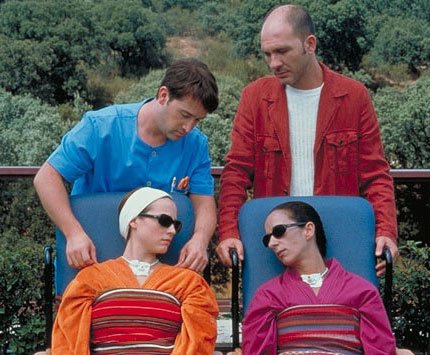
Great Films: Hable con ella [Talk to Her] (Pedro Almodóvar , 2002, Spain)

Coincidence, chance, fate, whatever it is that drives a Pedro Almodóvar pelicula, there always seems to be a guiding force moving proceedings along, whether dealing crushing blows or handing great fortune upon its characters. In Hable con ella it is mixed blessings: two lonely men, both infatuated by two very different women, find themselves united when the objects of their desire suffer accidents which put them in long, deep comas. For Almodóvar this represents a break with his traditional lines of enquiry: so often a great director of women, trying to penetrate their world which he has been denied merely by dint of his gender, this is a film about men, and that eternally unknown mystery to them of the opposite sex.

We begin, as in his previous film Todo sobre mi madre (1999), with a performance, this time a piece of dance, with two women gracefully moving about a stage littered with chairs. A man enters, the women scatter, knocking over the wooden props. In the audience are Marco and Benigno, who do not know each other yet, both entranced by the production. Marco is a journalist, and another day catches sight of a female matador, Lydia, appearing on a trashy talkshow (now there’s an Almodóvar trademark) and storming off when asked about her ex-lover, also a famous bullfighter. Something in seeing this prompts the writer to ask his editor to allow him to write a profile of her, which is agreed to. On meeting, he admits to her that he is drawn to women like her, and a stroke of Almodóvarian fortune thrusts them together.

Flash-forward, and Lydia has a dramatic ‘accident’ with a bull, which puts her in a vegetative coma. At the hospital, Marco meets Benigno again, who is a nurse tending to another girl in a coma, Alicia, a dance student, who it turns out the young man used to watch train from his bedroom window across the road. Benigno, like his name, seems a harmless, unthreatening fellow, lonely after having cared for his sickly mother up until her recent death. The two men are like light and dark – Marco, still haunted from losing a prior love jaded from experience, and Benigno virginal and innocent – so unlike each other, yet they find common ground in their shared predicaments. Benigno, thinking himself more in tune with his female patient offers Marco one piece of advice – hable con ella: ‘talk to her’. If the men are contrasting, then so to are the women: despite the similarities which the director clearly wants to draw between bullfighting and dancing, there are clear differences: the colourful adornments and costumal complexity of Lydia’s matador outfit in stark contrast to the simple white gown which the unconscious Alicia wears in her hospital bed, the blood-soaked bull next to the elegance of the dancer.

Almodóvar’s films are often populated with female dialogue: chit-chat, gossip, and more serious matters which men generally seldom would admit to talking about with their male friends. Yet his films are not aimed strictly at a female audience; i feel that his films are often a means by which men can venture into the cinema and gain a window of insight into what women really talk about to each other, whilst still holding their arthouse heads held high. Here though, this kind of talk is kept to a minimum – save for some idle staff-room gossip about Benigno’s true sexuality, and one woman’s charming description to a friend about her ‘elephant sized’ defecation. What the elegant setup of this film allows is for men to talk to each other about women – in one particularly great moment, Lydia and Alicia have been brought together, and Marco speculates at to if they weren’t comatose, ‘what do you think they would be talking about?’.

If this is a film about loneliness, then it is also about voyeurism and co-dependency. Aside perhaps from the angelic and mostly prone Alicia, the other main characters seem to be living their lives through someone else: Benigno through Alicia and latterly his deceased mother, Lydia through her former amor Niño, and Marco at first for his ex-love, then by Lydia’s bedside, before finally assimilating much of Benigno’s identity. The nurse by definition works for the benefit of others, and Marco too in his capacity as a travel journalist acts as a cipher for other peoples’ experiences. As they conduct their bedside vigils, we have to question how much do we ourselves live our lives through other people – is this not, to an extent, what love is? ‘Love’, of course, is never a simple concept in the Almodóvar world, much like in the real world, and sexuality is ill-defined at best. Benigno pretends to be homosexual in order to get the job tending to Alicia’s bedside, but is he ‘sexual’ at all?

The much celebrated, perhaps over-praised, Todo sobre mi madre wore its artistic influences on its sleeve – John Cassavetes’ Opening Night (1977), Tennessee Williams’ A Streetcar Named Desire, Joseph L. Mankiewicz’s All About Eve (1950) – and here there is a segment which pays tribute to silent films gone past, a bizarre Freudian B-movie the details of which are probably too spoiler-filled and quite frankly bizarre to reveal to any readers who have not seen the film yet. The interlude would seem an amusing exercise in style were it not for the fact that the key turn in the narrative occurs here – what is its significance? There is much to debate here, but once again, not without seeing the film first.

Hable con ella is my most favourite of Almodóvar’s films, though it could be construed as his most least auteurist work. Certainly there are most of his trademark elements present: the driving, mysterious plotting, vibrant use of bright colours, sexual confusion, an emphasis on theatricality over narrative realism. But while most of his films are to one degree or another built from his background in exploitation cinema, Hable con ella feels his most honest: his best statement about what it is to be a man in the world, wanting to be close to women, perhaps even be one, but never being able fully to understand their mysteries, their sheer incomprehensibilities from a male standpoint.

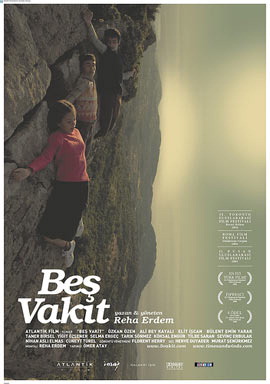
Beş Vakit [Times and Winds] (Reha Erdem, 2006, Turkey)

Reha Erdem’s film Times and Winds seems to have taken an age to reach the UK since its win at the Istanbul International Film Festival back in 2006, but it has been well worth the wait: I doubt there will be a more elegant, subtle, quietly moving film released this year.

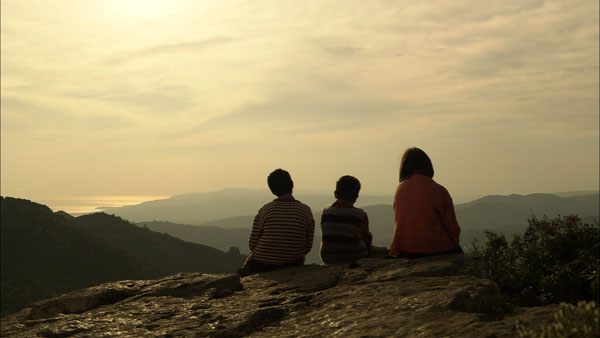
The setting or time is not explicitly defined, but we are clearly in a small Turkish village on the mountainous terrain overlooking the vast expanse of sea, a vista given the full widescreen treatment beautifully by cinematographer Florent Herry. The people are simple farming folk, and as such their lives are governed by the rhythm of the natural elements: the weather, and the coming of night and day. The film is structured with another rhythm at its core: the five calls to Islamic prayer during the day (as the original Turkish title, Beş Vakit, describes). As the film opens, the local muezzin is unable to make the call, so his son Ömer is called upon to rouse another man to climb the town’s central minaret instead.

It is through the eyes of the village’s children that we see most of what goes on, and it is one of the film’s great strengths that is is neither overly sentimental nor melodramatic in showing the joys and agonies of their lives. Ömer intensely dislikes his abusive father, whose frequent beatings lead him secretly to wish to kill him. Ömer’s friend Yakup is a little happier, and has a rather infantile crush on their pretty teacher at school, whom he is constantly attending to. A girl, Yildiz, is quiet and studious, but has to contend with looking after her small brother.

Through these three, still with everything to learn about life, we too learn much about their location and its way of life there. Though there are brief glimpses of the modern world beginning to seep in – a man brings an electronic camera, whose flash makes a young boy think he’s seeing ‘angels’, the minaret has been equipped with PA speakers, whose wires snake up one of its sides – their lives are still primarily agrarian, and inevitably there is the expectation on their parents’ parts that they will learn the skills to carry this on. But being young, they are inevitably rebellious, and curious as to what else there is out there, beyond the sea which seems to stretch away for eternity.

Amidst the quiet dramas of the children’s lives, we see life going on around them: human births and deaths, animals born, slaughtered and occasionally procreating – much to the amusement of the young kids – and the sun and the rain attending to the lush scenery surrounding the village. A great sense of place develops very quickly, in large part thanks to Erdem’s long, flowing tracking shots, following people around the uneven streets, and up and down the rocky peaks outside of the village. There is a very interesting use of orchestration in the score – for such an austere piece, one would expect a more languid use of music, but composer Arvo Pärt opts for a more dramatic tone, lending a sense of urgency and drama to proceedings. At times it seemed counter-intuitive, but go with it: it works.

For all of the film’s realism, there is also a mystery element, one that it is difficult to decipher. At times the narrative stops, pauses, and slowly lingers over an overhead shot of one or more of the child protagonists lying prone on the ground. Are they asleep, resting in the hot Turkish afternoon? Or something more metaphorical or even catastrophic? This certainly adds a mysterious air to the tone of the film, perhaps also allowing a little breathing-space from the main stories.

One point of fascination for me was not in the non-diegetic sounds, but in the copious number of songs and poems being recited by the children; nationalistic ones at school, pledging allegiance to Turkey, as well as more naturalistic ones, reflecting the theme of nature and season; an interesting contrast to the Muslim prayers and calls also peppered througout. While at times nature seems in harmony with religion, there are times when they seem grossly incompatible – in particular underlined by the prayer lines uttered about the sanctity of the paternal figure, in stark contrast to the unsympathetic, unworthy fathers portrayed onscreen.

A blend of East and West, secularism and Islamism, Turkey is a country of contrasts, which its increasingly high-profile cinema output is continuing to address. Reha Erdem has made a great film about his country, with all of its contradictions and joys, and also a film full of the simple joys and pains of all of our childhoods. Simply wonderful, and quite probably the best film of the year.

Great Films: Fucking Åmål [Show Me Love] (Lukas Moodysson, 1998, Denmark / Sweden)

The best line in Richard Linklater’s 1993 high school comedy Dazed and Confused is when Randall ‘Pink’ Floyd says “if I ever start referring to these as the best years of my life – remind me to kill myself”. That one line seems to eloquently sum up the wide gap between the idealised notions of blissful adolescence we are frequently spoon-fed and the altogether more grim realities of growing up which we all faced, or are facing, as well as the almost inevitable glossing over of these which seems to occur in our oh-so-tough later years of mortgages, pensions and rising energy bills. Like Linklater’s influential film, Lukas Moodysson’s debut feature Show Me Love reminds us all of the emotional traumas, as well as the fleeting triumphs, of those ever-fading-from-memory days of youthful naivety and boredom.

The setting is Åmål, a small town in the Swedish south-west so unaffectionately described in the film’s original title, but viewers may quickly recognise it as like many a small town elsewhere in the Western world. There is quickly established the sense of there being really nothing for young people to do, aside from going to school, hanging around each others’ houses and the occasional teenage ‘party’. The popular, attractive Elin sums this frustration up wonderfully in an early scene; wanting to go to a ‘rave’ but grounded by her parents for a tantrum, she roots around in the medicine cabinet, finally reasoning that her best chance of getting high will be to take a massive dose of antacid pills – when told the folly of her plan, she can only scream “I want to take drugs!”. For all of her popularity, she seems jaded by the insularity of her small-town existence.

It could be worse for Elin; at least she has friends. Agnes is a girl who attends the same school, but is a loner, depressed and frustrated by her inability to make any real friends. She looks up to her more popular, attractive classmate, and has also developed something of a crush on her, knowing full well that realistically nothing could ever happen between them. Her kindly, well-meaning but rather out-of-touch parents try to do their best to help her, telling her that it is because she is new to the area, and that anyway the popular kids at school always end up as the ones that never amount to anything. How this is supposed to comfort a sixteen year-old girl is anybody’s guess.

Still meaning well, Agnes’ parents arrange a birthday party for her, even going so far as to print out invitations for the others at school, not realising the probable humiliation this would bring on their daughter. Sure enough, when Agnes hands them out, she is treated with scorn, and sure enough, when the time comes for her party, no-one shows up except for a similarly friendless girl, the wheelchair-bound Viktoria. Angry at her humiliation, Agnes screams abuse at her and storms off to her room without eating.

In the meantime, Elin and her sister Jessica, remembering the invitation they received and desparately wanting to get drunk but also to avoid another party elsewhere, decide to go to Agnes’ party, drink as much free booze as they can, and then leave. Rumours have spread around school about their classmate’s supposed sexual preference, and Viktoria dares her sister to kiss Agnes, for the princeley sum of a few kronor. Game for a laugh, she agrees to do it, quickly running off to the other party after having done so. On arriving at the other, more populated party, Elin feels guilty at what she has done, and returns to Agnes’ house to invite her over as well.

Up until this point, the film has been about contrasts, but from here on an affinity develops between the two girls, despite their differences. On the way to the other party, they both begin to talk about how stifled they feel in Åmål, Elin in particular fearful of getting pregnant and winding up as a single mother stuck in the town for the rest of her life. They both have dreams and ambitions, but neither is particularly confident of bringing them to fruition. Stoked up on the booze, they even attempt to hitchhike to Stockholm (a five hour drive away) as at least a tokenistic, temporary escape.

Show Me Love could so easily be many things – exploitative, leering, predictable, whimsical, patronising to its characters – but its real triumph is that it is none of these things, and the ease with which it tells its story and sets up its environment it effortless. Critics of the film have pointed to its lack of character development or depth, but for me this is symptomatic of its strengths. In one scene, Elin is quizzed by her sister about an ‘Italian guy’ she was supposed to be in love with, which she dismisses with a simple “no, that was yesterday”. How can we expect straightforward Hollywood character development from the rapidly changing moods of teenagers? The film’s rapid shifts from light to dark, from comedy to seriousness, are just reflections of the fluctuations of the flyaway teenage mood.

One of the other strengths of the film is the performances of the two leads: Alexandra Dahlström really shines as Elin, a mess of teenage contradictions, somehow both superficial and deep, while Rebecka Liljeberg as Agnes has less of a showy role but invests her character with equally numerous nuances. And it was not until seeing Juno (2007) this year that I have seen such a warmly-drawn parent figure, here in the person of Agnes’ father: he sympathetically tries to do his best for his daughter, but is painfully out of touch and is no comfort. Sometimes there really is nothing a parent can do or say to help matters.

Show Me Love was well received both critically and publicly, even grossing more than Titanic (1997) at the Swedish box-office in 1998. The late Ingmar Bergman even labelled Show Me Love “a young master’s first masterpiece”. Since then, his subsequent films have become increasingly dark in tone and subject matter, such as the bleak Lilya 4-ever (2002) and the highly controversial A Hole in My Heart (2004), which now seem a long long way away from the optimism of this and his second feature, Together (2000). While i appreciate his later work greatly, his debut remains for me his masterpiece, and one of the greatest portrayals of the pains and trivialities of adolescence.

Be Kind Rewind (Michel Gondry, 2008, USA)

There’s many reasons to find fault with Be Kind Rewind. Let’s start with the sheer ludicrousness of the plot; Mr Fletcher (Danny Glover) is the elderly owner of a failing small video (yes, VHS) rental store in Passaic, NJ, threatened with closure by some cliched evil property developers. For one week he entrusts the store to his clerk Mike (Mos Def) so he can go away to a Fats Waller convention, but also in order to go and check out the methods of the store’s more successful local competition, the large Blockbuster-like West Coast Video.

Plot point: Jerry (Jack Black), who works at a garage nearby, and more frequently than not comes into the video store to bother its staff, somehow manages to magnetise himself while breaking into a power station, with the consequence of his erasing all of the shop’s magnetic tapes on his next entry into the shop. Faced with piles of blank cassettes and some angry, impatient customers, most notably Miss Falewicz (Mia Farrow), Jack and Mike elect quickly to whip up a home-made, ‘sweded’, version of her requested film, Ghostbusters.

This is all a rather silly, laboured device to set up what follows: Mos Def and Jack Black remaking classic films on a zero-budget. The idea is a good one, and is ultimately the films’ saving grace; who could not find funny the idea of Roger Corman-esque productions of the likes of Robocop, Driving Miss Daisy or even The Umbrellas of Cherbourg? This ‘sweding’ of films has become something of an internet phenomenon, with hundreds of would-be amateur directors having a stab at their own imitations/tributes to classic films. See here.

If the recreations are funny, then the rest of the film is decidedly not. Outside of the sweded world, the characters are ill-drawn and under-performed by what is a talented cast; Jack Black is only just reined in from his annoying worst, i’m never convinced by Mos Def, and Danny Glover and Mia Farrow are left to chew on the scenery. The whimsical plot – involving the threatened demolition of the shop – is weak and unengaging: it is as if the filmmakers put more thought and effort into their micro-Rush Hour 2 then they did with the rest of the script. Unfortunately, this has the effect of rather spoiling what could have been a more thoroughly enjoyable 97 minutes.

Michel Gondry, to me, seems to have become a victim of his own success, in that expectations of the quality of his output are still at the level of his masterpiece, Eternal Sunshine of the Spotless Mind (2004). Since then, both this film and The Science of Sleep (2006) have demonstrated his undeniable visual flair and playfulness, but also have lacked the narrative coherence of his earlier film’s watertight Charlie Kaufman script, and so have felt ultimately disappointing. Whether this is fair is questionable; it is certainly not like the case of Wes Anderson, whose films since Rushmore (1998) have shown a director increasingly coasting on autopilot. What Gondry has is imagination and creativity in abundance, what he needs is someone who can focus it constantly in the right direction.