2007 Halloween films

Yes folks, the time is nearly upon us when the film companies attempt to lure the hard-earned money from our wallets on the promise of providing blood, guts and painfully obvious jumps. Sadly, this year seems another where endless sequels or remakes of 70s classics are making up the majority of the ‘new’ releases; here’s a sample of the delights:

First up, well, it looks like nothing is sacred these days. Rob Zombie, whose career so far has consisted of the woeful House of 1000 Corpses, and the even worse Devil’s Rejects, this time has a stab at remaking John Carpenter’s all-time classic Halloween. Expect none of the subtlety, subtext or genuine creepiness of the original. Apparently Carpenter has given the project his blessing, but he lost the plot a long time ago too. Let’s hope White Zombie reform soon and get RZ back to what he knows how to do.

Next up, a rather guily pleasure of mine; the Resident Evil series of films, loosely based on the premise of a series of superb video games, has maybe not delivered anything particularly memorable, but my love of zombies and seeing Milla Jovovich running around looking constantly perturbed seems to entertain me more than it has any right to. This time around it’s Resident Evil: Extinction, the third installment in the franchise, and this time is set in the Nevada desert. It’s probably not going to be a classic by any means, but you will probably leave the cinema feeling you’ve got your money’s worth of gore. Then again, I spy Paul W.S. “not Thomas” Anderson on the credit list, which means it may well be teeth-grindingly tedious…
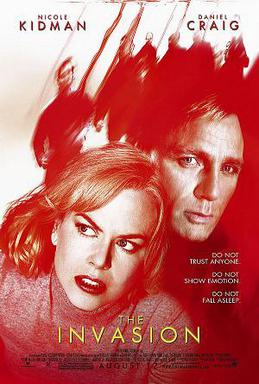
And then we come to The Invasion, which has the dubious distinction of being a re-make of a re-make, and even that ignores Abel Ferrara’s own underrated 1993 remake, entitled Body Snatchers. This version stars Nicole “I act only in moody looks” Kidman and Daniel “filling time between Bond films” Craig, also to co-star in the upcoming series of Philip Pullman adaptations. It appears to have had a rather chequered production history, with reshoots and rewrites flying around all over the place, leading to the fairly safe assumption that it will be a complete mess and not at all scary at all. Shame for DC, who you feel needs a few solid vehicles to shake that “oh, he’s that bloke who was in Our Friends in the North once and now is James Bond” tag, and establish himself as a worthy character actor. Nicole Kidman? Well, a few more duff films like this and maybe everyone will start seeing just how overrated she really is..

And just when you thought a horror franchise had run out of ideas, they’ve made Saw 4, undoubtedly with even nastier ways of making people mutilate themselves for self-preservation. The first Saw film was genuinely entertaining, though it ran out of steam towards the end, but since then its been an exercise in cynical franchise-weaving, with plot and ingenuity seemingly playing second fiddle. Piss-poor stuff really, and no doubt we will be seeing the likes of Saw 20: The Beginning (again) pop up sometime around 2025. Joy.

Finally, one film that’s taken its time to come over here is Black Sheep, an extremely odd-looking New Zealand made film which features, well, zombie sheep attacking helpless passers-by. Could be genius, may well be bloody awful, but i guess full-marks for the idea. I’m now going to go off and check my dictionary for the word ‘Sheepsploitation’…

Review: Control (Corbijn, 2007)

Roughly two-thirds of the way through Anton Korbijn’s excellent debut feature Control, the double meaning of the film’s one-word title is made apparent; though an obvious reference to one of Joy Division’s more well-known songs, She’s Lost Control, what we see is the opposite: a portrait of a young man as an artist, who cannot cope with both the world he has created for himself, and the world that has been thrust upon him.

As with other rock biopics such as The Buddy Holly Story, the film’s denouement will come as no surprise, even to the viewer with only a passing aquaintance with the singer. There are also dramatic ironies for the more die-hard fans, for instance Curtis’ insistence that he will be on the plane taking the band on their tour of the USA; and once Iggy Pop’s The Idiot makes an appearance, well, we know the rest. However, what is a rather pleasant surprise is the film’s occasionally richly comic tone; this is not Gus Van Sant’s dreary Last Days, in which a quasi-Kurt Cobain mopes around Seattle for a while before topping himself; at times we are back watching 24 Hour Party People, Michael Winterbottom’s raucous biopic of another Manchester legend, the late Anthony H. Wilson. He makes regular appearances in Control, played brilliantly by Craig Ferguson, and almost all of them are sidesplittingly funny. Even more so with Toby Kebbell’s portrayal of manager Rob Gretton, whose constant volley of obscenities gets funnier as it gets progressively ruder. Surely no portrait of Manchester cannot omit this aspect of its culture?

As for the narrative, it initially follows the standard rock biopic formula: obliquely introducing the key players, wives, girlfriends, bosses, jobs, neighbourhoods, and so on. This, of course is standard practice, neccessary for those who are unaware of the factual background but also neatly framing the film’s exposition. What follows is a tender portrayal of different aspects of Ian Curtis’ life, and an attempt to understand what drove him to write such heartbreakingly beautiful but bleak words. Perhaps more than this, it is an attempt to understand his failed relationships; the screenplay borrows largely from Curtis’s wife Deborah’s memoir Touching From a Distance. Here she is played by Samantha Morton, who is seemingly mopping up all of the doomed women roles these days, though her portrayal here satisfactorily combines a combination of toughness and fragility.

And then we come on to Sam Riley’s performance; after watching Sean Harris as Curtis in 24 Hour Party People I thought his mimicry couldn’t be bettered, but Riley here provides a more complete character, fleshed out, warts and all. For the most of the later parts of the film he often comes across like a frightened young boy (a look that Pete Doherty seems to have hegemony over these days) compared to the confident, if detatched, Velvet Goldmine-esque glam rocker at the start. Onstage, he performs the same miracle that Joaquin Phoenix achieved as Johnny Cash in Walk the Line, in that he makes the viewer forget they are watching an actor, instead completely inhabiting the role. Curtis’ distinctive dancing is replicated to a tee, similarly messrs Sumner, Hook and Morris are accurately aped; it is this attention to detail which gives the film its feeling of authenticity.

At this stage, it must be emphasised how good Corbijn’s photography of the band’s live performances is; clearly this is a man who has been to a few gigs in his time, and understands the dynamic between the performers and the crowd. In this sense I was reminded of how Wim Wenders demonstrated a similar knack in Wings of Desire, in which the ambience of a typically frenzied Nick Cave live performance is captured wonderfully. When these things are done well, it is as good as being there seeing the real thing; when done badly it creates distance between the viewer and the performances. Great to see that the band are clearly playing their instruments, and that Riley performs the songs himself, as this gives the live performances an organic feel to them, replicating that magical feeling when a band recreates live what one has heard a thousand times on record. Only twice do we hear the actual Ian Curtis singing, both times at key moments in the film, and both times with their two most ‘untouchable’ songs, Love Will Tear Us Apart and Atmosphere. Corbijn’s reverence for these is too great for them to be touched.

Great Films: La Haine (Kassovitz, 1995)


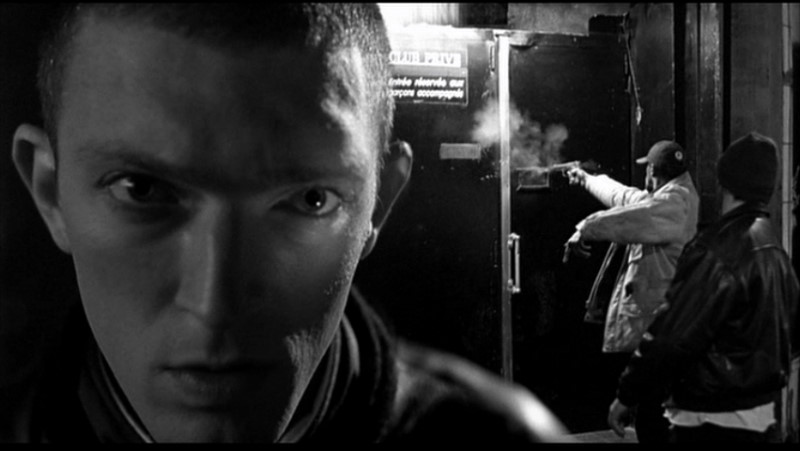
Matthieu Kassovitz’s portrait of a day in the life of the residents of the Parisian banlieues still feels as fresh and relevant today as when it debuted at Cannes back in 1995. Indeed, it manages to be both of its time and timeless, in a similar way to Scorsese’s Taxi Driver, one of the film’s key influences. In the earlier film, alienation and existential isolation are the key drivers towards the inevitably violent denouement, while La Haine illustrates the same inevitability arising from social, economic and racial unrest. However, while Taxi Driver has often been accused of being nihilistic, a charge which i would refute, La Haine is more of a polemic, a plea to address the inequalities and prejudices which will inevitably lead to tragedy.

This social commentary contained in La Haine has been criticized from various quarters; the police in France were naturally concerned with their portrayal as violent thugs; others questioned Kassovitz’s outsider status, claiming he was portraying a culture he neither came from nor understood. This is, however, too cynical a view of the film’s intentions. Kassovitz is no Tarantino-like dimwit throwing blood around the screen for the audience’s titilation; the consequences of violence, riots and revenge are all considered carefully, and the scenarios are carefully set up so as not to give the viewer easy answers to what are profound questions. Whilst the film’s themes are universal, the setting is unmistakeable; like Spike Lee’s Do the Right Thing, unmistakeably tied to Brooklyn’s Bed-Stuy, La Haine is convincing in its portrayal of the Parisian banlieue. In a similar way to Lee’s film, we are encouraged to appreciate the colour and vibrancy of the setting, and understand a little about why our protagonists act and react to situations like they do.

The most obvious visual aspect to the film is the black-and-white photography; this was not the original intention, as it was shot in colour and only converted to monochrome in editing. The effect is to create an unsettling feeling in the viewer, creating a similar atmosphere to Rene Belvaux’s earlier Man Bites Dog, another film concerning the glamourization of violence. This is, perhaps, also a nod to the nouvelle vague, Godard, Truffaut et al, as well as the Cinéma Vérité tradition. Kassovitz’s snappy visual style and sharp edits give the film its breathless (no pun intended) pacing, again betraying the influence of the likes of Scorsese and Spike Lee. The sound design is similarly dynamic, a chiarosuro of blasts and silence. The lead performances are all spot-on; Vincent Cassel gets just the right balance between psychopath, clown and lost child, while Hubert Koundé and co-writer Saïd Taghmaoui both create equally believable characters who we feel we know versions of in our own lives. We come to like these characters, understand where they come from and why they behave as they do, and by the end of the film wonder why they their lives have to be so inevitably doomed.

Great Films: La Grande Illusion (Renoir, 1937)


Widely regarded not simply as one of the best films about war, but one of the greatest films in cinema history, Jean Renoir’s La Grande Illusion remains a powerful artistic and moral statement about the consequences of conflict.

The film is set during the First World War, and one of the key themes is one of class conflict; the two aristocratic characters on either side of the war, Boeldieu and Rauffenstein, through their mutual respect and multi-lingual verbal jousts, are shown to have more in common with each other than they do with officers on their own sides. Time is running out for them, though; both are aware that the war will signal the end of the hegemony of the aristocracy in Europe, an overdue death knell for their feudal positions; “For a commoner, dying in a war is a tragedy, but for you and I, it’s a good way out”, Boieldieu utters in one particularly poignant scene. This sense of inevitable change would later be a key theme of a protege of Renoir’s, Luchino Visconti, in particular in Il Gattopardo, his dramatisation of the Risorgimento in nineteenth-century Italy.

Within the film, issues concerning the First World War are addressed, but it must be remembered that it was made in 1937, when Europe was once again on the cusp of bloody conflict. Any doubts that the film was intended to have a contemporary message are dispelled by the inclusion of a Jew as one of the key protagonists, a defiant challenge to political situation in Germany. The fraternity between the Jew Rosenthal, the French Maréchal, and later a German widow, was clearly intended as an illustration that war is merely a means of dividing people and their common humanity.

La Grande Illusion is a war film without any war sequences, though its presence is always palpable. In one memorable scene we see a lingering shot of a German widow’s dining table, now too large for her depleted family, reminding us of the human cost of war. There is an added level of irony, as she describes that her brothers died in “some of our greatest victories”; win or lose, the consequences are still the same, still just as life-alteringly destructive. The bleak picture of the effect of war on ordinary civilians is in stark contrast to life in the POW camps; the scenes here are played with a light, joky tone, and are much echoed in John Sturges’ classic The Great Escape.

Jean Renoir (1894-1979), whom Orson Welles labelled “the greatest of all directors”, is widely regarded as one of the key fathers of cinema. The son of impressionist painter Pierre-Auguste Renoir, he developed an interest in cinema after being severely injured during the First World War. He started making films in 1924, heavily under the influence of both Austrian silent film legend Erich von Stroheim, and Charlie Chaplin. By 1936, he had made two of his enduring classics: Toni, a clear influence on the later Italian neo-realism movement, and Partie de Campagne, on which a young Luchino Visconti worked as an assistant. His two magnum opi, La Grande Illusion and La Règle du Jeu, followed in 1937 and 1939 respectively.