2012 Tweet Review Round-up

Sara Paxton in The Innkeepers (Ti West, 2011, USA)

21 JUMP STREET (B+) Amiability marred by misplaced crassness, but smart & witty throughout, reflexively subverting teen movie tropes with aplomb

ALPS (C+) Lanthimos’ rigorous sphere of morbid social dysfunction here feels an admirable folly; reflexivity mildly enlivens lethargy

AMOUR (B+/A-) Humanity, and Haneke, stripped bare. Unfliching, insidiously horrifying, unimpeachably performed, tho restraint borders on passivity

THE AVENGERS (A-) Assembly instructions: slot sub-franchises [B]-[E] into film [A]; glue together with wit, warmth & visual flair. Nailed it.

BARBARA (A) Profoundly moral yet never pedagogic and, unlike ‘Others’, oppression by gesture& suggestion powerfully, insidiously devastating

BEASTS OF THE SOUTHERN WILD (B-) Strikingly hermetic, appropriately ramshackle world-building, muscularity drowning out creaky Malickisms

BERBERIAN SOUND STUDIO (A-) Warm, affectionate meta-cinematic glow dissolves into Polanskian purgatory between reality & art. Mesmerizing.

BOMBAY BEACH (B+/A-) The messy underweave of the American social tapestry. Visually elegant, disarmingly non-judgemental, quietly remarkable

CABIN IN THE WOODS (B+) A cellarful of meta-chuckles, though setup leaves some awkward problems which the script only partially resolves

CARNAGE (C+) Fizzingly acrid chamber farce a shoo-in for the arch misanthrope Polanski, but as cine spectacle becomes increasingly wearisome

CHRONICLE (B+) Found footage gripes aside, a relentlessly entertaining tranchette of teen super-hijinks, flying while grounded in reality

COCKNEYS VS ZOMBIES (C-) Handful of decent gags keeps things just the right side of amiable, though in too many depts more than a bit ‘pony’

A DANGEROUS METHOD (C-) A welcome mischief sometimes undercuts semi-serious façade, but ideas too inchoate, central conflict too stagnant

THE DARK KNIGHT RISES (B+) Most satisfying of the three: a thrilling leap, inadequate only in terms of its own (impossibly?) lofty ambitions

DREDD (C-) Nails its heads-a-poppin’ aesthetic, but script, narrative and scope naggingly unsatisfying, carrying the air of a TV series pilot

ELENA (A-) Pulsating, fastidious ice-cold noir & dissection of Russian society, elegantly camouflaged beneath surface of glacial mundanity

THE GIANTS (B-) Beguiling hard edged boys own fantasy; freewheeling/lackadaisical (to taste), unassumingly génial, delightfully performed

GRABBERS (B-) Hugely endearing Irish small town creature feature, delicately genre savvy & a great paean to the joys of getting pissed

THE GREY (D+) Marooned between existential hardship drama and creature feature, sadly unwilling to acknowledge own crescendoing silliness

LE HAVRE (B+) More colourful comings-and-goings in Akiland, with a dash of Pierre Etaix & a warmth which embraces like a salty sea breeze

HOLY MOTORS (A-), or “Faces Without an I”? Barmy mélange of cine amuses-bouches, deftly juggling notions of performance, spectacle & self

THE INNKEEPERS (A-) Smartly keeps its scares rooted in the subjective, but it’s the warm, endearing characters which persist in the memory

INTO THE ABYSS (B-/C+) Compelling subject matter, grand themes, but strangely feels a minor Herzog: too much respect, not enough Werner

IRON SKY (F) Limited resources no excuse for this level of all-round incompetence. Concept shorn of laughs, satire already horribly dated

ISN’T ANYONE ALIVE (C-/D+) Playful anti-genre mischief surgically undercuts apocalypse expectations & pathos; fleetingly amusing but jejeune

JOHN CARTER (B+) Derivative, yes, but still hugely enjoyable romping fare, directed with storytelling nous & wit. Who cares how much it cost?

THE KID WITH A BIKE (B-) Brightly-hued, dark-edged fairytale, landing between Bresson & De Sica. Energetic, but nagglingly Dardennes-lite

LAWLESS (D+) Aimless, listless jumble of incongruities. Rompishness amuses but never stirs, punctuated bursts of violence an affectation

LOOPER (C+/B-) Entertaining enough knotty yarn, admirably freewheeling in its storytelling, but overstuffed with billowing, under-developed threads

MARTHA MARCY MAY MARLENE (C+) Moody, meritorious, meticulous but ultimately meritricious. Fragmentary structure renders material oddly inert

THE MASTER (B+) Eschews straight dialectics for murkier blurs. Enigmatic rope-a-doping deliberately estranges, heavier punches hit hard

MOONRISE KINGDOM (B-) Further variations on familiar themes; younger leads a reinvigoration, partially puncturing shell of meticulousness

NOSTALGIA FOR THE LIGHT (A-) Plaintive, yet wonder-filled meditation on overlap between the corporeal & the cosmic; unpretentious, sublime.

ONCE UPON A TIME IN ANATOLIA (A-) A sprawling miniature, elegaic & comic; pick as much from the twined contradictions as you wish

OUTPOST: BLACK SUN (D+) Technically adept, if chronically under-lit, but story’s a bore; flavourless characters had me rooting for the Nazis

THE POSSESSION (C+) Polished studio product, no more or less. Ditches early character work for derivative, predictable hokum

PROMETHEUS (B-) An odd beast, jarringly swivelling between the hokey and grandiose, but entertains more & more as it slowly shows its hand

THE QUEEN OF VERSAILLES (B+) Garishly compelling, yet locates pathos & humanity amidst capitalist grotesquery, trumping Inside Job’s didactisism

[REC]³ GENESIS (B-) No idea what, if anything, defines the franchise any more, but this was great, ribald taffeta-clad fun

RUST & BONE (B-) Remain unconvinced by Audiard’s worthy Melotrash material, but performances & corporeal blend of the tender & visceral are stirring

SAMSARA (D+) Yes, a feast for the retinas, but for the brain it’s undernourishing; synthesis of imagery feels cumulatively trite& sophomoric

SEARCHING FOR SUGAR MAN (C+) After the (cold) fact doc sluggish out of the blocks, though slow reveal eventually yields ANVIL-like poignancy

SEVEN PSYCHOPATHS (D+) Staid, sophomoric meta-ness wearisome, causing gags to fall flat. Outer narrative shell dull cf scripts-within-script

SHAME (C+) Technical virtuosity is dazzling, but wanton meticulousness blunts material. Too much glistening surface, not enough murky depth

SINISTER (B-/C+) Throws its net wide, pecking corn like the metaphorical blind hen, though with surprising frequency. Effective sound, Hawke classy

SWANDOWN (B-) Psychogeographical search for confluence between Herzog & Jerome K Jerome. Fleetingly piquant, but poignancy punctures whimsy

TABU (A) History as memories of a papered-over, near-mythical past. Upshift into swooning reverie of Nerudan yearning a minor miracle

THIS MUST BE THE PLACE (C-) Alice Cooper in the Cities? Penn’s oddball perf a grower; pathos, ideas & momentum all frustratingly staccato

TINY FURNITURE (B-) Hardly revelatory, but ample flashes of drollery & pathos. Painfully well-observed and – crucially – never feels vain

TOWER BLOCK (C+) Frantic LIFEBOAT-meets-Broken-Britain setup, better before moralizing & explanations. Cutaways to gunman a misfire

THE TURIN HORSE (A-) Precise, rhythmic four-beat gait hypnotic, bearing this heaviest of burdens; allegories near-parodic, yet tantalising

W.E. (D-) Lacklustre, ill-conceived, though not the outright catastrophe I expected. Still, a poor man’s Sofia Coppola is a poor man indeed

THE WOMAN IN BLACK (2012, C+) Ornate, serviceable retread. DR can’t hack backstory heft but gleeful relentlessness of jumpy second act a plus

YOUNG ADULT (B+/A-) Smartly reduces bunny-boiling down to a gentle simmer, steaming off credulity but thickening the delicious character darkness

Five Things I Learned From Frightfest 2012 (and some questions too)

Tulpa (Federico Zampaglione, 2012, Italy)

The Italian horror renaissance is still some way off

When questioned about the state of his country’s national genre cinema, Friday’s special guest, legendary Italian director Dario Argento, described it as “a sleeping beauty”; from the efforts on display at this year’s festival, it seems that the blood may still have yet to have dried on the spindle. Exhibit A was the Manetti Bros’ PAURA 3D, a quasi-incarceration thriller remarkably devoid of anything remotely approaching suspense, and whose use of 3D seemed little more than a perfunctory means of making the film’s title sound snappier. Also screening was Federico Zampaglione’s TULPA, a neo-giallo whose lacklustre, bilingual (or, more accurately, a-lingual) dialogue and surprising lack of visual ambition will prove depressingly familiar to viewers acquainted with the more recent Argento-directed entries in the sub-genre. To make matters worse, Italy’s rich horror heritage was lovingly paid homage to in Peter Strickland’s superb, Polanskian BERBERIAN SOUND STUDIO, further confirming the sense that the long shadow of the country’s cinematic output still continues to eclipse the present paucity.

Torture is, mercifully, still off the US film agenda

Two years ago, the likes of I SPIT ON YOUR GRAVE, VILE and THE TORTURED populated the festival’s programme, reflecting the continuing post-HOSTEL, post-SAW vogue for so-called ‘torture porn’ narratives. Last year’s programme saw a decrease in the number of such films, suggesting a decline in their popularity, and this would seem to be confirmed by this year’s selections which were again remarkably free from such sadistic revenge narratives. CHAINED director Jennifer Lynch elucidated the shift most obviously, clearly stating that she had modified the film’s original script in order to divert the story away from the familiar torture porn template. Elsewhere, the Twisted Twins’ AMERICAN MARY (notably dedicated to HOSTEL director Eli Roth) shaped towards such a narrative but pleasingly moved into other territories speedily enough, while other American studio films THE POSSESSION and SINISTER were remarkable only in terms of their sheer inoffensive conventionality. Indeed, it was the Italian PAURA 3D came the closest to broaching HOSTEL-like material, though ultimately contented itself with a handful of relatively restrained sequences of bound sadism.

Franchises don’t have to be formulaic

Most pleasant surprise of the weekend was [REC]³ GENESIS, not just in terms of sheer entertainment value, but also in its refusal to conform to the confining strictures of its own franchise. The sudden shift from the strict first-person perspective of its previous two installments (arguably the single defining characteristic of the series) via a transition marked by a near-iconoclastic destruction of a video camera, led to some viewers crying foul, but the overwhelming feeling was one of liberation, freeing up the storytelling from the gimmicky confines of POV storytelling, the entertainment potential of which had, frankly, already begun to wear thin even before the closing credits of the first film. Like the torture porn setup, which almost always essentially revolves around the same moral framework of ‘bad things can turn good people into evil ones’, there seems a natural limit to what can be achieved with the found footage setup, something which franchise co-creator Paco Plaza seems have acknowledged and attempted to look beyond here. Other franchises – take note.

The Seasoning House (Paul Hyett, 2012, UK)

Very Bad Things are still happening to women in horror films

As the festival progressed the hashtag #rapefest began to be shuttled around Twitter, inaugurated by the critic Kim Newman in response to this tweet by the screenwriter James Moran which decried the apparent ubiquity of sexual assaults on females taking place on-screen, including in THE SEASONING HOUSE, HIDDEN IN THE WOODS and V/H/S on the first two days alone. Women have always had a rough time in horror – the presence at the festival of Dario Argento, a director frequently accused on misogyny in his gleeful mistreatment of his film’s female characters ought to have served as a reminder of this – and one doesn’t need to consult a copy of Carol J Clover’s Men Women and Chainsaws to be able to come up with a substantial list of rape-based texts.

There is a wider, more complex debate to be had about whether violence against women on screen represents institutionalised misogyny or just a convenient cinematic shorthand for certain types of vulnerability, but with regard to sexual violence, female sexual assualt seems ultimately still considered something of a ‘safe’ transgression in comparison to that of the male (DELIVERANCE, in this regard, still feels an isolated anomaly rather than a ‘game changer’). Naturally, the context of individual films matters; worst offender this year was the odious HIDDEN IN THE WOODS, which fudged (at best) the issue by falling prey to the same kind of lecherous leering at its young female leads that its narrative was ostensibly critiquing.

Interestingly, two further examples offered differing takes on similar ideas: Paul Hyett’s THE SEASONING HOUSE and Jennifer Lynch’s CHAINED. Both films created hermetically sealed spheres in which women are ritualistically abused: the former set in a brothel during the Yugoslav Wars, the latter in contemporary America, and both viewed through the eyes of young protagonists who find themselves in moral complicity with violent, sadistic patriarchs.

Both are strongly visceral, challenging works, but while they have other significant differences – the former has a more pronounced fairytale-nightmare feel and the protagonist is female, compared to the more brutal-realist latter which centres on a male – what seems most pertinent is the difference in historical context, and it prompts wider questions about the degree to which they are likely to provoke controversy. My impression is that Lynch’s film, because of its more familiar setting, will be the subject of greater problems, the implication being that the ‘otherness’ of Hyett’s film somehow has greater leeway for the atrocities it portrays. Ought this necessarily be the case? Does a context which distances the viewer result in harder content becoming more easily digestible?

Maniac (Franck Khalfoun, 2012, France | USA)

It’s a fine line between stupid and, er, clever

The main talking-point of the festival appeared to be MANIAC, the Alexander Aja-penned remake of the 1980 psycho-thriller, which employed a strict first-person POV virtually throughout. Such an aesthetic choice, coupled with the woozy ambience and particularly gruesome details, appeared to make it the most effectively disturbing film of the long weekend, but also seemed to render the material genuinely problematic.

Subjective viewpoints are, of course, nothing new in horror cinema as evidenced by the post-BLAIR WITCH PROJECT vogue for found footage shockers. What makes MANIAC unusual is that, unlike those films, there is no mediation between the audience and the protagonist via the implication of a video camera recording the action; we are (one assumes) sharing exactly the perception of reality which the character is experiencing, placing the film closer to the more ‘purely’ subjective mode which includes Zac Baldwin’s HANAH’S GIFT, Gaspar Noe’s ENTER THE VOID, and even the television sitcom PEEP SHOW.

The urtext for such material in horror is Michael Powell’s PEEPING TOM (though, once again, its use of POV is restricted to what is seen either through the viewfinder of Mark Lewis’ camera, or on subsequent playbacks of his recordings). The film famously provoked revulsion on its release but has since gone on to inspire countless theoretical analyses, most notably the work of Laura Mulvey, who identifies it as a significant text in terms of the way it plays with notions of spectatorial identification, forcing the viewer into a complicity with its protagonist Mark’s brutal crimes.

The original MANIAC, as noted by Kim Newman, was a retrograde return to the deformed monster meme of early 20th century horror, a mode which PEEPING TOM, and the same year’s PSYCHO, had subverted two decades earlier by presenting its murderous protagonists as somehow sympathetic victims. This new MANIAC, however, is feels more ambivalent. The casting of as unshakeably likeable a screen presence as Elijah Wood would suggest the presentation of the protagonist in a positive light, as do the offered explanations for his actions (uncaring, promiscuous mother; loneliness; gender and sexuality confusion), however simplistic and cod-psychological they feel.

Yet there is a conflict between this feeling of sympathy and the extreme violence which is being presented onscreen. Is this intended as a kind-of absolution for his crimes? There seems no conclusive answer, and intertextual nods to the diverse likes of THE SILENCE OF THE LAMBS, TAXI DRIVER and THE CABINET OF DR CALIGARI only serve to muddy the waters, hinting that perhaps he ought to be viewed as nihilistic villain, deluded anti-hero or merely criminally insane. That there appears to be no satisfactory answer to this contradiction at the film’s core makes it unclear whether the questions the POV ploy prompts are there by design, and whether the form single-handedly raises the same schlock content of the original towards something more metaphysically disturbing and challenging for the spectator.

Frightfest 2012 Review Round-up

Berberian Sound Studio (Peter Strickland, 2012, UK)

AFTER  (F) Painfully ill-conceived hey-where’d-everyone-go drama, suffocating in a fog of misplaced, morose sentimentality

AMERICAN MARY (B-/C+) Titular protagonist well sketched, but narrative slips out of focus, body mod plot never as subversive as promises

BERBERIAN SOUND STUDIO (A-) Warm, affectionate meta-cinematic glow dissolves into Polanskian purgatory between reality & art. Mesmerizing.

CHAINED (C+) Remorseless grimness lifted by committed performances, but thematic concerns only partly served by storyline twists

COCKNEYS VS ZOMBIES (C-) Handful of decent gags keeps things just the right side of amiable, though in too many depts more than a bit ‘pony’

DEAD SUSHI (B-/C+) Perfect throwaway midnight fodder; predictably nutso, and never runs out of suitably barmy fish/rice based ideas

EUROCRIME!  (B-) Thorough, entertaining passegiata thru poliziotteschi sub-genre; great talking heads from Franco Nero, Henry Silva & Chris Mitchum

GRABBERS (B-) Hugely endearing Irish small town creature feature, delicately genre savvy & a great paean to the joys of getting pissed

HIDDEN IN THE WOODS (F) Frenetic, morally confused feral tale of two sisters; telenovela-like hysteria (& aesthetic) generates unsolicited LOLs

MANIAC  (C+/B-) Undeniably brutal, but is it a formally innovative approach to themes of voyeurism & spectatorial identification, or merely retrograde & intellectually vapid?

OUTPOST: BLACK SUN (D-) Technically adept, if chronically under-lit, but story’s a bore; flavourless characters had me rooting for the Nazis

PAURA 3D (D-) Devoid of anything approaching atmosphere/suspense; botches scares, though descent into gratuitous sadism mercifully brief

THE POSSESSION (C+) Polished studio product, no more or less. Ditches early character work for derivative, predictable hokum

[REC]³ GENESIS (B-) No idea what, if anything, defines the franchise any more, but this was great, ribald taffeta-clad fun

THE SEASONING HOUSE (C+) Uneven; best when hermetic, puce-hued fairytale-nightmare, though edges softened by Balkansploitation silliness

SINISTER  (B-/C+) Throws its net wide, pecking corn like the metaphorical blind hen, though with surprising frequency. Effective sound, Hawke classy

SLEEP TIGHT (B+/A-) Taut, suspenseful but above all deliciously blackly comic, propelled by darkly twisted Almodovarian obsession

STITCHES (B-/C+) More than a little rough around the edges technically, but on the whole an inventive, funny & gleefully gory delight

THE THOMPSONS (D-) Nice rural setting, but standalone blood-sucking mythology is wispy & forgettable, + some terrible secondary performances

TULPA (D+) Familiarly hokey neo-giallo awfulness, rendered entertaining by magnificently (Euro)criminal dialogue & performances

TOWER BLOCK (C+) Frantic LIFEBOAT-meets-Broken-Britain setup, better before moralizing & explanations. Cutaways to gunman a mis-step?

UNDER THE BED (C-) Resolutely ludicrous. Nice central fraternal axis, but needed *something* extra (ambiguity? verisimilitude? Joe Dante at the helm?)

V/H/S (C+) Gripes about ‘VHS’ aspect aside, a portmanteau of efficient – if strikingly bland – found footage stories; Skype-ological 4th chapter pick of the bunch

Polanski at the crossroads: Knife in the Water

This is the text of my introduction to Roman Polanski’s film Knife in the Water which I gave for Film Club Bristol at Arnolfini on 27 May 2012. You can follow Film Club Bristol on Twitter here.

Roman Polanski’s début feature film Knife In The Water (1962), shot in the summer of 1961 and released in Poland the following year, came at the end of a significant period for the Polish film industry. The great director Andrzej Wajda described his former protégé’s debut feature as “the beginning of the new Polish cinema” and i’d like to go into a little detail about the filmmaking circumstances in order to provide some context. Poland had been occupied by the Soviet Union at the end of the Second World War, and a Communist government had been in operation since 1948. Like other satellite states, it had quickly adopted the centralised Soviet system of film production.

Film was considered a very important propaganda tool, and consequently film-making was financially subsidized by the Ministry of Culture, which also oversaw the establishment of a national film school in the city of Łódź in 1948. Films had to be strictly Party-approved for their ideological content at all stages of production, from the script stage all the way through to post-production, when it was viewed by a panel called a kolaudacja, after which  it was not uncommon for re-shoots to be ordered by the Ministry after a film had been finished if it was not considered ideologically sound. This had a constricting effect on the creativity of filmmakers, whose films were, from the outset, forced to follow dogmatic political lines.

The death of Josef Stalin in 1953 and a subsequent speech made by Nikita Khruschev’s which denounced his ‘cult of personality’ led to the so-called ‘thaw’ in the Soviet Union; the effect of this quickly spread to Poland, leading to the Polish October uprising of 1956 and the rise to power of the reformist politician Władysław Gomułka. This thaw had the effect that Eastern Bloc countries began to decentralise their creative policies and weaken these ideological controls, and also led to the establishment of new modes of film education and production. In 1955 the Creative Film Unit system was introduced, in which a regional production unit, headed by an artistic director, was given greater autonomy over film production, and which allowed greater freedom for filmmakers to express themselves.

From this, emerged a kind-of New Wave referred to as the Polish Film School. Films by directors such as Andrzej Munk and Andrzej Wajda moved Polish cinema away from proscribed Socialist Realism and towards a national cinema dealing with personal issues more relevant to the country’s experience, in particular the still very recent memories of wartime. The thaw continued up until the early 1960s, with films such as Wajda’s Innocent Sorcerers (1960) and Kawalerowicz’s Mother Joan of the Angels (1961). However, Polish leader Gomułka was becoming increasingly vocal in his denunciation of where the industry was heading; at a Prague conference in 1957 films of the Polish School were condemned, with calls for an ideological line one again to be towed. With political pressure intensifying, the most influential filmmakers soon found themselves silenced. Andrzej Wajda quickly went abroad where he would make international co-productions; Andrzej Munk died in a car crash in 1961.

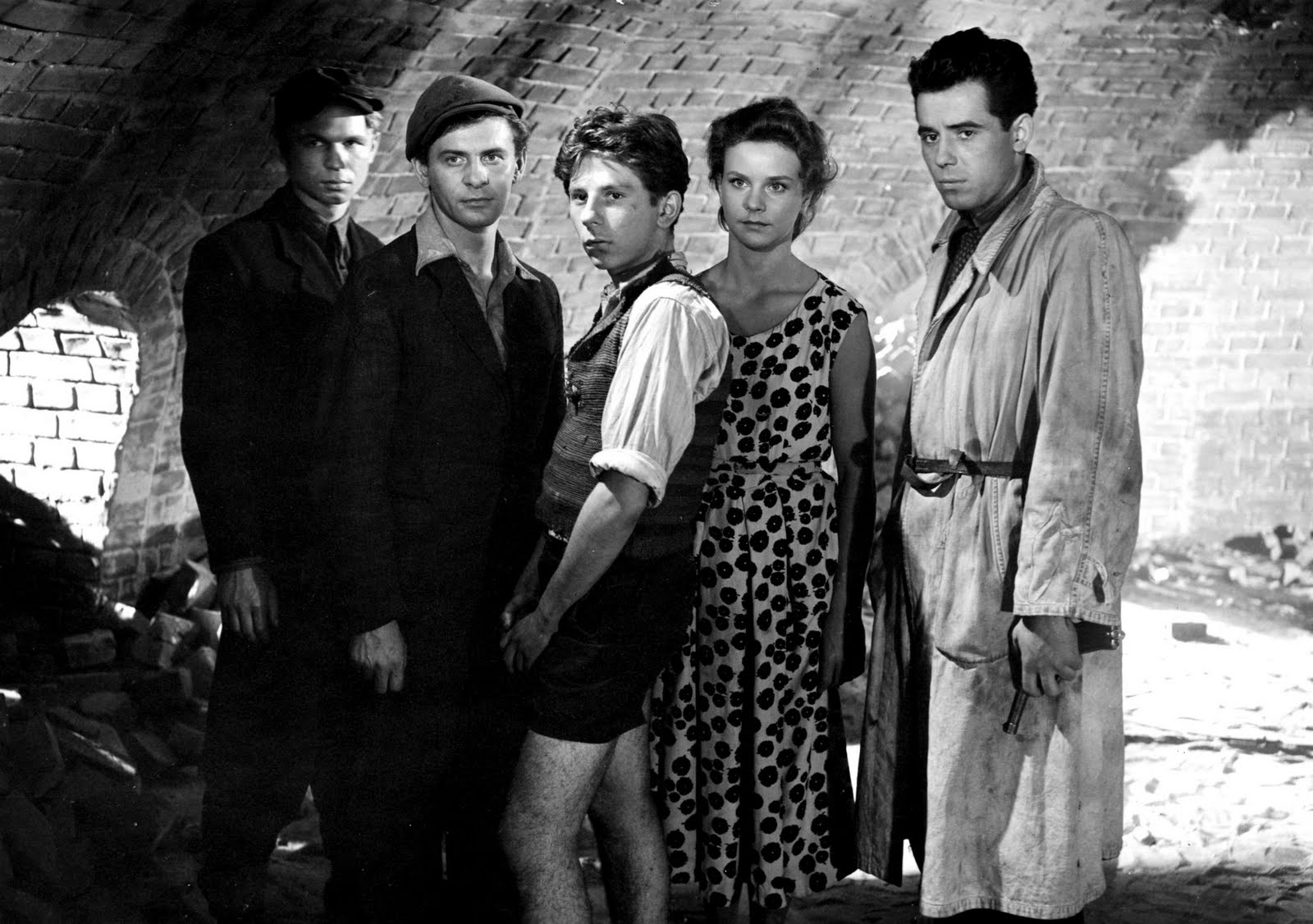
Roman Polanski (centre) in Wajda’s Pokolenie (A Generation) (1955)

It was in this climate of thaw and freeze in which Roman Polanski entered the filmmaking stage. He had enrolled at the Łódź national film school in 1954, just as the Polish School was beginning to emerge, and thanks to the new Creative Film Unit system he would rub shoulders with the likes of Wajda and Munk, even appearing as an actor in Wajda’s fim A Generation (1955) . Before graduating in 1959 he would make several short films, including Two Men in a Wardrobe (1958), which would win a prize at the prestigious Brussels Experimental Film Festival. Emboldened by this success, he began writing an outline for his debut feature film with the intention of keeping it minimalistic: three characters, one setting – on a boat in a Mazurian lake – and occurring over the course of three days. The setting is particularly important – Polanski felt that the theatricality of the three person setup was lost when located on a sailboat.

Needing extra input in order to bring a more earthy feel to the dialogue, he recruited a fellow Łódź attendee and future filmmaker Jerzy Skolimowski. Skolimowski had an enormous input into the finished script, paring the dialogue down to a bare minimum, fleshing out the character of the younger man, but also, inspired by the unities of Greek tragedy, changing the timeframe to the course of 24 hours. His subsequent Polish films deal with tensions between the younger and older generations of Poles, and with drifters disillusioned by contemporary society, and the central conflict in Knife in the Water – between a materialistic, faux cosmopolitan couple who can afford Western luxuries such as a car and a yacht and a poor, hitchhiking student more aligned with primal matters such as hunting and roughing it – makes the film fascinating to examine as much as a product of Skolimowski’s interests.

In spite of this, the film is definitely identifiable as a Roman Polanski film, and it offers many resonances with the films he would make later in his career. Much of the writing about Polanski’s work has focused on the more lurid details about his private life, interpreting his later work in the light of both the murder of his pregnant wife Sharon Tate by the Manson Family, and later on his conviction for the sexual assault of a minor and subsequent flight from the United States. However, for me the most important details in his autobiography which came to shape his work are from his childhood. He was living in the city of Kraków when Nazi Germany invaded Poland, and was forced to subsist in the crammed Jewish Ghetto while his parents were deported to labour camps. Like the author JG Ballard, whose work was informed by his experiences as a child in a Shanghai internment camp, Polanski’s childhood trauma seems throughout his career to have shaped his obsession with power, domination, cruelty and the barbarism which underscores all human interactions.

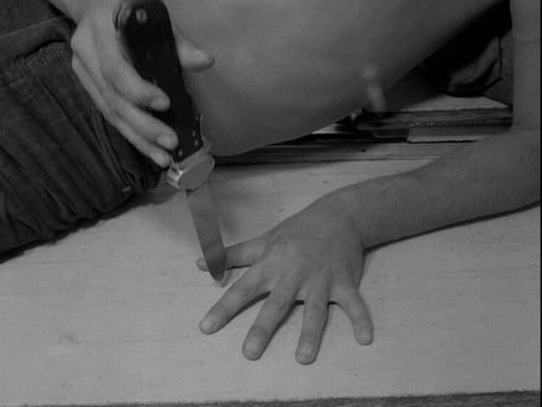
The first of Knife in the Water‘s Polanskian characteristics is the setting – though the water-borne location might suggest freedom and liberty, for Polanski it represents confinement and aimlessness. His best films – especially the so-called apartment trilogy of Rosemary’s Baby (1968), Repulsion (1965) and The Tenant (1976) – deal with characters existing in confined personal spaces, in a figurative sense cut off from the outside world, while other films such as Death & the Maiden (1994), Cul-De-Sac (1966) and his more recent film The Ghost Writer (2010) take place on windswept islands more literally cast adrift from the rest of humanity. Water is a key symbol in these latter films, and so too elsewhere: in Pirates (1986) and Bitter Moon (1992) Polanski situates us once again aboard ships, in Chinatown (1974) it is the core of the central mystery plot, and in Rosemary’s Baby, the first of Rosemary’s hallucinatory dreams takes place on a vessel on stormy seas. The other motif in the title – the knife – has both a literal and metaphorical value. Its presence in the film’s title, as well as being an ominous presence throughout the story itself, intimates towards violence, though, as in Michelangelo Antonioni’s ironically titled L’Avventura (1960) – the adventure – it is a promise which goes largely unfulfilled in the narrative. The knife also carries with it a rather obvious phallic connotation for this film about male rivalry, and it is also worth noting that Polanski would go on to make an adaptation of Macbeth, in which a knife and water are both important symbols of violence and the quest for purity and absolution.

There is almost always an undercurrent of violence in Polanski’s films, though rather than exploding physically it more often comes in the form of emotional violence; couples in Polanski’s films are seldom happy together, their relationships more often characterised by cruelty, emotional manipulation, possessiveness, frequently sliding into a kind-of sadomasochistic co-dependency and repressed passion. These relationships are then frequently further disturbed by the introduction of a third party, interlopers who bring these problems in to sharper focus. These sexual triangles – most visible in the likes of Cul De Sac, Death & the Maiden and Bitter Moon – then become funny games about domination. In Knife in the Water, Polanski communicates this visually in his narrow, Academy Ratio frame by employing a deep focus, one character in the foreground looming large over the others in the distance. In spite of this, Polanski’s trademark black humour is evident throughout, thanks largely to the jaunty score by his most important collaborator, the musician Krzysztof Komeda. In spite of its virtues, Knife in the Water suffered from the climate of “freeze” which was once again subsuming the Polish film industry. The Ministry of Culture board initially rejected the script of the film for its lack of social commitment, causing Polanski and Skolimowski to go back and add extra dialogue, what they describe as “some bullshit about the younger man living in student accommodation” which, when the script was resubmitted, was enough to get it accepted several years later. At the kolaudacja screening of the film, the reception by party officials was lukewarm – the ending was deemed too ambiguous, a problem which – bizarrely enough – was apparently solved by changing it from two shots of the scene to just one.

The critical reaction was less favourable: “all Polanski has is an international driving licence and no film school diploma”,  ran one review, and the film was released without fanfare with only a limited run. Even Communist leader Gomułka condemned the film publicly as being “not relevant to Polish society.”  Wajda, however, sensed its importance as a way of moving past the old mode of wartime cinema, describing it as “the beginning of the new Polish cinema”. Miraculously the film was eventually picked up by the New York Film Festival, and it became an international hit, making the cover of Time magazine and eventually winning an Academy Award nomination, where it lost out to Fellini’s 8 ½.

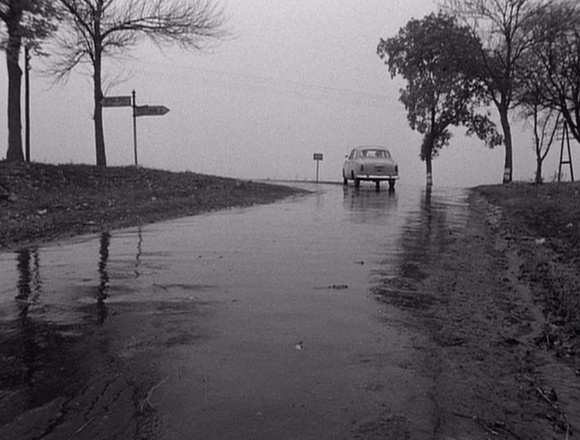
The final shot of the film – a stationary car sitting at a crossroads – is an elegant summation of where it had left Polanski and Skolimowski. The latter continued to toil under the censorious Polish system for the remainder of the 60s until the banning of his film Hands Up! led him to go and work abroad, most famously in England with his films Deep End and The Shout. Polanski, however, took the other road; he moved to Paris, began writing Cul De Sac with Gerard Brach, and emerged two years later in Britain with Repulsion. The rest, as they say, is history.

2012 so far….

Bombay Beach (Alma Har’el, 2011, USA)

While blowing off the dust of this here blog, i’ve decided to collate some of my Tweet reviews of  films released last year, for my benefit, if no-one else’s:

UK 2011 releases

ATTACK THE BLOCK (C-) Blockploitation? Too shy of laughs or scares to satisfy on either count, though a ragged charm lurks in the shadows

ATTENBERG (B-/C+) Not so much Son of Dogtooth as its morbid, mischievous niece. Troubling and amusing in equal measure, if undercooked.

THE AWAKENING (C+) Fastidiously tape-measured Gothic goings-on; ornate, but stuck in too high a gear too early on, cramping emotional breathing space.

THE BLACK POWER MIXTAPE 1967-1975 (B-) Searing slice of History From Below necessarily lacks breadth but powerful time capsule footage jolts

BRIDESMAIDS (C+) Overlong, meandering & visually flat, though comedy hits as much as it misses & Wiig delivers an affecting sense of pathos.

CONTAGION (C+) No little skill in the flow of ensemble narrative, but focus on the intimate feels somehow cold & depletes meta-urgency

COWBOYS & ALIENS (C-) Admirably straight-faced in the face of po-mo smuggery, but ought to put a ‘Wanted’ poster up for conspicuously absent laughs. Ensemble cast as wasted as that title.

THE FUTURE (A?/B?/D?) July’s world (bravely/cloyingly, to taste) entirely composed of affectation, with BIG THINGS to say to very few people

THE DEEP BLUE SEA (B-) Faithful to the stillness & tumult of the Rattigan, if encumbered by its limitations. Weisz its tempestuous heartbeat.

THE GUARD (B-) Visual wit, zinger-laden dialogue & a delightful Gleeson amply cover minor shortcomings. If only Hot Fuzz had been 92mins…

THE HOUSEMAID (2010, C-) Stylish, steamy psycho-soap, tho visual sumptuousness a distraction & satire effete. Last reel surrealism v odd

HORRIBLE BOSSES (D+) Well, I laughed a handful of times (mostly Farrell), and it’s not *that* misogynistic. Is that enough these days? Bosses ought to have been more horrible.

HUGO (C-) Like its stony-faced automaton, it’s striking, but clunky & in need of a heart. Less a love letter to cinema than a glossy brochure for the World Cinema Foundation.

MARGARET (B+) No wonder we had to wait so long! Capricious tonal short-shifting scene-to-scene makes this surely a editing job worthy of Sisyphus

MIDNIGHT IN PARIS (D+) Idea for a sequel: set in 2091, struggling director travels back to 2011, comes across Allen, Bruni & Wilson, finds no inspiration.

RISE OF THE PLANET OF THE APES (B-) Solid, well paced unpretentious B-movie-ish fluff, though simian cast excel better than a rather lost looking Franco & Pinto

SEEKING JUSTICE (D-) Formulaic, forgettable Nic Cage hokum, not so much phoned in as rung thru to a bland, generic answerphone message

THE SKIN I LIVE IN (C-) Customary Almodóvarian flourishes, but weighed down by overstuffed, cumbersome narrative which undermines the chills

SNOWTOWN (A-) Doesn’t so much get under the skin than perform an all-over body excoriation. Horrifying, clincally precise & utterly draining.

SUPER 8 (C+) I Love The 1970s over-cramming aside it’s perfectly serviceable, though it’s a shame Abrams didn’t set his aim higher than fairly straight Spielberg Xeroxing

X MEN: FIRST CLASS (C+) Second-class origins tale cf Abrams’ Star Trek; too much X-Club Juniors, at expense of intriguing Fassy/McAvoy axis