Dead of Night (Alberto Cavalcanti Charles Crichton Basil Dearden & Robert Hamer, 1945, UK) Part One

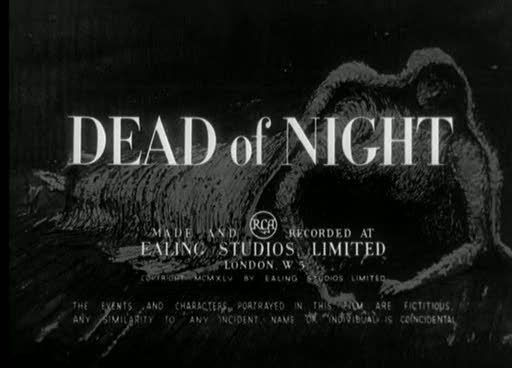
Whilst it can be said that, in the more than a century of cinema, films have been able to inspire many kinds of ideas in viewers, theories about the nature of the cosmos can seldom have been frequently among them them. Yet this is what Dead of Night, the supernaturally-themed anthology film produced by Ealing Studios in 1945, is said to have done in the minds of physicists Fred Hoyle, Thomas Gold and Hermann Bondi, whose Steady State theory of the apparent expansion of the universe apparently derived from the film’s distinctive and much-imitated meta-structure. But whilst their theory has long since been refuted in favour of the Big Bang model, the film which inspired it continues to endure as one of the true classics of British horror.

It starts oddly cheerfully, and in a broad daylight seemingly at odds with the title. A car canters along a country lane, with Georges Auric’s breezy score betraying only a hint of the sinister through the brief shiver of strings which greets Walter Craig’s (Mervyn Johns) shake of the head as he appears to recognise his destination, a country manor aptly named Pilgrim’s House. On arrival, Eliot Foley (Roland Culver), model of stiff-upper-lip Englishness the kind of which Ealing’s output is more commonly identified with, greets the spooked Craig, who mysteriously seems to be already familiar with the details of his host’s house and his gathered houseguests. Unable to recall anything more than scant details, he remains convinced that he has had repeated dreams placing him in this same situation and with the same group of people; “It sounds like a sentimental song, doesn’t it? I’ve dreamed about you over and over again”, he exclaims with bemusement.
Prominent among the group is Dr Van Straaten (Frederick Valk), a psychologist who will cast his scholarly eye over proceedings, in a way a physical embodiment of the cognitive dissonance internal to Craig as he tries to rationalise why he is able to recall these surroundings which should be entirely unfamiliar to him. The other guests humour him, and one-by-one they take it in turns to recount their own personal encounters with the supernatural. This sets up the primary internal structure of the film, the now-familiar but then-relatively novel anthology format which in this case comprises five sub-stories chained together by the link-narrative of the house party.

The anthology or portmanteau film, a format which was popularized in the 1930s with the star-studded likes of Paramount’s If I Had a Million (1932) and MGM’s Grand Hotel (1932) but whose roots can arguable be traced back as far as D. W. Griffith’s Intolerance (1916), was a convenient way for a studio to showcase the talent it held on its roster. In the case of Dead of Night, four directors shared the directing duties of the six segments: the now poorly-regarded Basil Dearden handled the linking narrative as well as contributing first tale “Hearse Driver”; Alberto Cavalcanti, who had had enjoyed previous successes at the studio with Went the Day Well? (1942) and Champagne Charlie (1944), provided two segments, and future star directors Charles Crichton and Robert Hamer one apiece.

When considering its various episodes, the inevitable tendency has been to compare their respective qualities. This, to me, seems an erroneous approach, since the film works so successfully precisely because of their differences and their position within the film’s global narrative structure. Credit for this lies with Angus MacPhail, the veteran screenwriter and script doctor who had worked on Cavalcanti’s Champagne Charlie and adapted the Palmer and Saunders story The House of Dr. Edwardes into what would become Alfred Hitchcock’s Spellbound (1945). Notably, he is also generally considered to have coined the term ‘MacGuffin’ for Alfred Hitchcock, and as Charles Drazin argues in his book The Finest Years, McPhail was taken on at Ealing as something of a problem-solver; his input here was essential in helping to weave together the seemingly disparate stories of Dead of Night into a more homogeneous whole.
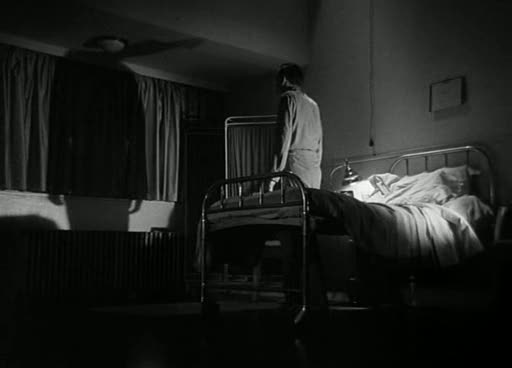
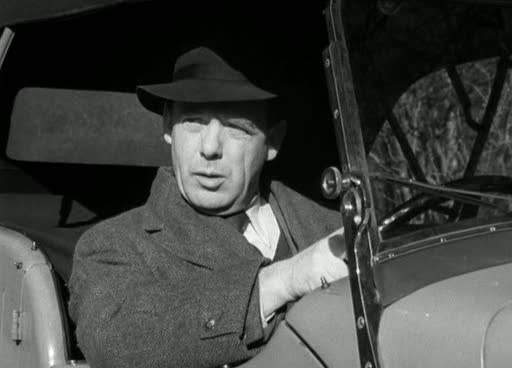
The first sub-story “Hearse Driver” – in which a man has a vision which appears to warn him of his impending death – is often cited as the weakest of the film’s segments, but though it lacks the both the visual imagination and psychological effectiveness of the other stories, it plays a key role in the wider story. Indeed, the very fact that the occupation of its main focus, Hugh Granger, is a racing driver can be interpreted to be emblematic of the film’s meta-structure: the film opens and closes with the same shot of a car driving along a road, in a sense signifying Craig’s completion of one ‘lap’ in an apparently endless race. The story, lasting a mere 6 minutes, serves as a gentle prelude for the longer, more developed stories to come, as well as acting as an introduction to several of the film’s main running themes. Most importantly, its position in the narrative comes between Craig’s presaging of the arrival of a sixth character – a “penniless brunette” – and her arrival in the link narrative. The short story of clairvoyance thus is bookended by a much longer one; this mirroring is reinforced by the presence in the story of Granger’s doctor, whose rational explanations are in agreement with Dr Van Straaten.

The lack of critical attention give to the Hearse Driver segment may mostly derive from Dearden’s unsubtle directing technique, in particular the way he over-emphasises key elements of the story through a series of clumsy zooms. The key central moment – a reveal from a darkened hospital room to daylight outside – lacks drama, and the sight of the horse-drawn hearse pales into insignificance when compared to the ethereal otherworldliness of Victor Sjöström’s Körkarlen (1921). The story is not entirely without visual merit: the shot of Granger emerging from his bed, casting a massive shadow on the curtain covering the hospital room’s window catches the eye, but there is too much that is forgettable in its short duration. Nevertheless, there are two items of note which will be echoed in later stories. Firstly, the sexual dynamic in the story: while in hospital Granger flirts with his nurse, a women who will later go on to marry. Secondly, the nature of his vision of the hearse, reality and unreality being separated by the frame of his hospital window. Both motifs will be repeated later.

The second tale, Alberto Cavalcanti’s “Christmas Party”, is the film’s most straightforward ghost story. Told by the Sally, the youngest present among Foley’s gathered guests, it begins in the opulent living room of what is evidently a spacious country mansion. The frame is filled with young children scurrying about, playing games with Sally and her friend Jimmy Watson, both visibly older than their playmates. The mise en scene is rich, lively and warm, but as a game of ‘Sardines’ begins and Sally runs upstairs to hide, the upper floors of the house are revealed to be cold and cloaked in menacing expressionistic shadows. There, Sally encounters a boy who she will discover afterwards to be the apparition of a child who was murdered by his older sister in the house many years beforehand.
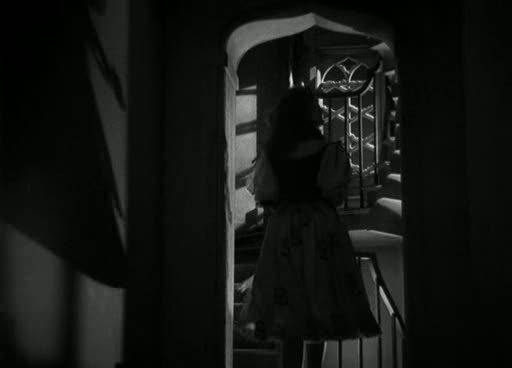
Despite being only slightly longer in duration than the Hearse Driver segment, it feels a much more satisfying piece and of much greater depth, Cavalcanti evidently proving himself a much more inventive, imaginative director than Dearden. The disparity between the warmth and familiarity of the living room and the cold strangeness of the upper floors is beautifully evoked, the air of mystery teeing up the sense of the supernatural which the first story was lacking. As Sally pauses in the doorway to a spiral staircase there is even a fairytale-like sense of the ethereal, not too dissimilar to Belle’s entry into the Beast’s mansion in Jean Cocteau’s La Belle et la Bête (1946), surely a reflection of Cavalcanti’s association with the French avant-garde during the 1920s. The muffled, calamitous piano score as she ascends also helps to suggest entry into an off-kilter alternate world.

Once again, there is a sexual element to the story. Sally and Jimmy are noticeably older than the young children they play with, both evidently of pubescent age and already familiar with each other as evidenced by her blindfolded recognition of the shape of his ‘silly’ nose. Their exchanges illustrate a flirtatious, deprecatory fondness between the two of them, though one might advisedly not take too Freudian a reading of the mask he wears with its large protuberant nose. His persistently makes advances, taking advantage of the coldness of the house’s upper levels, though his attempts to kiss her ultimately lead Sally to her discovery of the ghost. On encountering the boy, her very maternal tending and singing to him further suggest her own burgeoning sexuality.

Continued in Part Two…

Predators (Nimród Antal, 2010, USA)

After the pedestrian turgidity of the Alien vs. Predator (2004) sub-franchise it became clear that all the demonic killing machine of Predator (1987) needed a metaphorical fresh lick of paint and to be sent back out into the jungle to tangle with another group of hapless marines without too much trouble: the formula worked, while attempts to stray from it proved unworkable. This is, in essence, what this Robert Rodriguez-produced action film offers, though coming post-Lost, there is the inevitable need to contrive a plot which throws together a seemingly arbitrarily-selected group of strangers and literally throw them into a deserted wilderness where they come to overcome their initial suspicions of each other and try to figure out where they are and what has happened to them.

And so Predators does, and for a few of its opening scenes there appears to be some life in the simple rehashing of John McTiernan’s original action thriller, but unfortunately this promising setup of disorientation and team-building quickly descends into farce as soon as it becomes obvious that the characters within the film are mostly little-more than borderline-racist caricatures of broad national stereotypes. There’s poor Danny Trejo, playing yet another comedy Hispanic muscleman, the kind that even a Spaghetti Western hack director might have balked at for being too one-dimensional. There’s the big Bond-villain-sized Russian half-wit who is sure to turn out to have a heart of gold before dying violently. Then there’s the stern-faced but sexually alluring Latina who obviously has to make it through to the last reels in order to sustain some sense of sexual tension as a character motivation for the protagonist. Worst of all, there’s the silent Yakuza inevitably handy with a samurai sword, and a lumbering African tribal warrior who is (of course) more in tune with nature than the rest of the troupe and therefore more able to sense danger than the others.

Throw in a knowledgeable doctor and an ex-Black Ops marine for regular expositional helping hands, as well as a wisecracking jocular type for levity (though an obviously inferior aping of Aliens’ Hudson) and you have the gang whose plight Predators asks us to sympathise with. The sheer cardboard simplicity of these archetypes gives a sense of the ambition of the film, which is ultimately very limited indeed – with depressing predictably they swiftly come face-to-face with the dread-locked trophy hunters and face routine fights to the death for their survival. Somewhere in the combination of the utter lack of sympathy for any of the characters and a leaden script which never rises above the run-of-the-mill , Predators somehow manages to be crushingly dull, despite director Nimród Antal’s fairly competent handling of the action set-pieces. As opposed to the creeping sense of dread that McTiernan’s film successfully inspires, the story offers a near-complete lack of physical menace here, quite an acheivement given the inherent menace of the titular ruthless extra-terrestrial assassins. In the UK, the film has been rated a 15 (in comparison to the original’s 18 certificate) redolent of the fact that this is ultimately a film designed to scare adolescents rather than adults.

Predators, then, proves to be an utter waste of time, though it will undoubtedly take money and, by extension, spawn a host of unnecessary sequels and prequels. The concern on Adrien Brody’s face throughout speaks not of his character’s travails but of an Oscar-winning actor who has been reduced to doing bilge like this and the only marginally worse Giallo (2009). Lawrence Fishburne appears midway-through, but appears to be watching an off-screen video of Apocalypse Now (1979) in order to pick up acting riffs from Marlon Brando, as well as just-as-unsuccessful dietary tips. I can’t help but mourn slightly for what has been lost in the transformation the original’s post-Vietnam paranoia into this bland, meaningless game of intergalactic cat-and-mouse; a symptom of a wider malaise in action movies, or just a plain lazy cash cow? Either way, avoid.

Vincere (Marco Bellocchio, 2009, Italy / France)

In contrast to Francisco Franco, his Spanish counterpart who displayed little interest in the subject, Benito Mussolini never neglected the social importance of cinema; indeed, on opening the world-famous Cinecittà studios in 1937, he stood in front of a massive sign bearing a slogan he had coined himself, “Cinema is the most powerful weapon”. Though, as Peter Bondanella points out, recent archival work has suggested that the actual propaganda content of the films produced during World War Two was minimal, the shadow of the Mussolini name still looms large over the industry’s history: as well as his government’s construction of Cinecittà, his son Vittorio was a noted film critic and heavily involved in establishing the careers of Federico Fellini, Roberto Rossellini and Michelangelo Antonioni. and even the top prize at the Venice Film Festival proudly carried the Mussolini name for the first years of its existence.

The Mussolini years also saw the foundation of the other major pillar of the modern Italian film industry, the Centro Sperimentale di Cinematografia, the important filmmaking school which would one day count one Marco Bellocchio as a graduate. There is, then, a sense of Oedipus-like patricide to Bellocchio’s making of a film which paints Il Duce in such an unflattering light, but then the 70 year-old director has taken dysfunctional families and their internal psychologies as his central interest from his debut film – the intensely savage domestic drama Fists in the Pocket (1965) – onwards, so it ought to be of little surprise that he eventually turn his attention to that most notorious of Italian father figures.

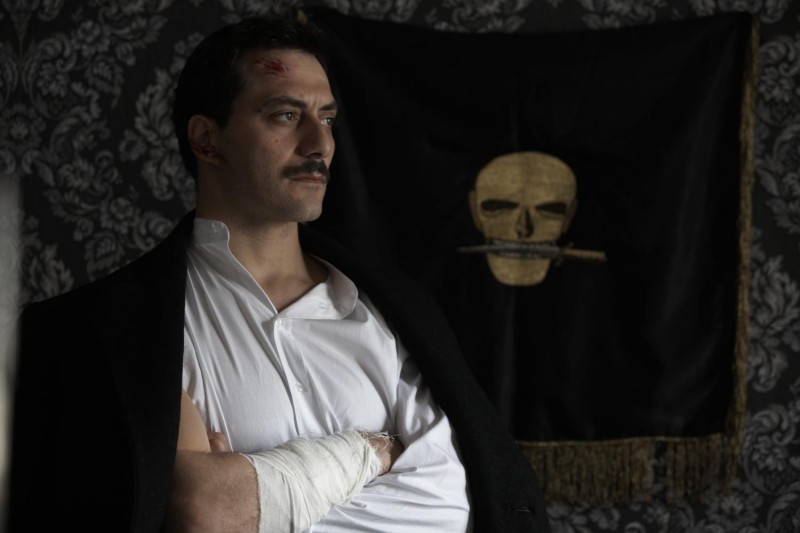
Vincere takes as its main subject not Mussolini himself but Ida Dalser, his first wife and the mother of his first-born son, but who the dictator-to-be expediently came to deny all knowledge of during the course of his political ascent. The film traces two parallel narratives – Ida’s own personal story and the story of Benito’s increasing prominence in political affairs. What may loosely be described as the first half of the film charts Ida and Benito’s chance meeting and eventual romance; the young Mussolini is painted here as a firebrand atheist and left-wing agitator with an immense personal magnetism, with whom the rapt Ida is overwhelmingly enamoured. They marry, and she eventually sells all of her possessions to help him set up his newspaper Il Popolo d’Italia, but it soon emerges that he has married another woman, Rachele, and fathered a daughter with her. Ida is subsequently abandoned and painted as a mad obsessive, prevented from seeing her husband, and eventually incarcerated in a series of psychiatric hospitals for the remainder of her life for protesting the existence of their marriage.

In the film’s first half, Mussolini is a very real presence in Dalser’s life, but as Dalser is placed under police surveillance and eventual imprisonment, what we see of Il Duce is increasingly glimpsed only through newsreels, portraits, and even at a later stage a large bust which his unrecognised son sends crashing to the floor in disgust. From the very personal view of the very passionate man established in the film’s first half, all that is seen of Mussolini in its second half is that famously gurn-like public face, monstrously grimacing and gesticulating wildly in front of baying crowds. It is not just his personality which has changed; a complete political volte-face has seen him change from republican atheist left-wing pacifist into warmongering Fascist in alliance with the King and the Pope.

The film, then, invites the viewer into drawing a parallel between Mussolini’s treatment of Dalser and his chameleonic political transformation, both of which demonstrative of his characteristically Machiavellian ability to recast himself according to expediency. In this sense, it is a continuation of Bellocchio’s best films of the 1960s which posited that dysfunctional personal lives are both the cause and effect of a wider dysfunctional culture; where Vincere differs from those though, as well as placing it apart from Bernardo Bertolucci’s more famous The Conformist (1970), is that instead of offering a psychosexual explanation for the causes of fascism, Bellocchio seems to be presenting Mussolini’s conversion as much more straightforwardly stemming from an overriding, all-consuming ambition.

This simplicity makes for a much more accessible film than one might associate with the director. Dalser’s steadfast refusal to deny that she was ever married to Benito – an admission which would likely see her freed from institutionalisation – paints her as an anti-fascist heroine, refusing to submit to a lie for personal convenience, and Giovanna Mezzogiorno’s powerful central performance makes for a moving portrait of a woman completely unable to understand or accept her husband’s betrayal. Carlo Crivelli’s score, by turns bombastic and pulsating, raises the drama far beyond realism and into the heights of operatic tragedy.

On this plane of melodrama, Vincere functions well, but as political polemic it feels unsatisfactory. The film’s first half feels rushed, necessarily crammed with inserted pieces of newsreel footage illustrating the political situation which gave rise to Mussolini’s ascent, but at the expense of allowing breathing space for the characters to become fully delineated. As such, when Dalser is spurned, the viewer is left as confused as she as to the reasons for her abandonment, and these are never satisfactorily resolved later in the film. This serves the drama, and allies us well to Dalser’s point of view, but offers little in the way of insight into the character who is of real interest in the story, Mussolini himself.

Vincere, then, represents something of a compromise: that the chief interest of the story is absent for most of the film’s duration presents a challenge which it only partially meets up to. Yet there are moments of genuine brilliance: in one comical early scene, the young Mussolini foments a fight between partisan pro-war and anti-war supporters inside a cinema, the calamitous violence onscreen replicated in front of it, both continuing to be scored by an increasingly frantic silent film accompanist at the piano. Later, the grown-up son of Mussolini – played by the same Filippo Timi who portrayed the young Benito Sr – struts around aping the comically grotesque figure he has seen on newsreels of the father he never knew. Both scenes – comic and tragic – point towards the social function of cinema as a reflection of – and shaper of – society, a dual function that Mussolini’s own recognition of gave rise to the birth of modern Italian cinema.

The Bad Lieutenant: Port of Call – New Orleans (Werner Herzog, 2009, USA)

Werner Herzog has presided over what might loosely be termed ‘remakes’ before: Nosferatu: Phantom der Nacht (1979), his predictably odd re-imagining of F.W. Murnau’s silent classic actually seems to sit quite comfortably in amongst his other classics of the 1970s, and while Rescue Dawn (2007) could hardly be termed a replica of his earlier documentary Little Dieter Needs to Fly (1997), their similarities do reflect the always fine line between fact and fiction that all of his best films carefully tread. This last point has always struck me as the major value of his work; as such, Les Blank’s Burden of Dreams (1982), for all of its merits, seemed only to be the second best documentary about the making of Herzog’s Fitzcarraldo (1982), the first being the film itself and its self-reflexive examination of the director’s relation to his chosen artifice through the proxy of Kinski’s titular character.

If there is reason to be disappointed with his latest film, the mouth-numbingly wordily-titled The Bad Lieutenant: Port of Call – New Orleans, then it is for an absence of this sense of Herzogian ambiguity between fiction and fact; one might question why this usually picky auteur plumped for making what is a reasonably straightforward thriller in the first place, save for the possibility of working with Nicolas Cage, whose gloriously deranged central performance – bouncing around from scene to scene and from score to score – rivals virtually anything that the Bavarian director’s famously lunatic collaborative partnership with Klaus Kinski committed to celluloid.

That aside, there is very little of note; none of his famous eye for establishing an extreme sense of location, whether through visuals or diegetic sound, surely a waste considering both the architectural specificity and the unparalleled musical tradition of the city of New Orleans. Indeed, as lensed by long-time DP Peter Zeitlinger, the film looks much like a bog-standard cable TV police drama. Neither does there seem to be much in the way of an overarching theme, unlike in Abel Ferrara’s original Bad Lieutenant (1992) which was much more obviously steeped in a strongly Catholic sense of sin, foregiveness and redemption. Herzog himself has said the film is about “the bliss of evil”; the bliss certainly shines through in the film’s sheer enjoyability, but the near-slapstick tone detracts from the idea that its protagonist is genuinely evil, particularly when one remembers just how bad Harvey Keitel was in the earlier film.

As a standard crime drama, the film is hard to fault thanks to a tight and at times highly amusing script from veteran scribe William M. Finkelstein, save for some horribly shoehorned-in clunkiness towards the end about a childhood spoon. As one might expect from a Herzog film, the emphasis is very much placed on just the one central character, putting what is one of Cage’s career-best performances in the full spotlight but at the cost of marginalizing an under-used supporting cast. Eva Mendes has little more to do than Isabelle Adjani did Nosferatu; as if we needed reminding, Herzog’s is worldview is unmistakeably male-centric.

Except maybe it isn’t. Outside of the narrative there are some genuinely odd moments, all seeming to involve animals. Iguanas are filmed in extreme close-up while Johnny Adams sings Release Me on the soundtrack, a camera views the scene of a car crash as if through an alligator’s eyes, a family dog seems to cause characters more trouble than one might suspect, and the film ends with a shot of its main character being dwarfed by a background of sharks swimming in an aquarium tank. What is the relevance? Perhaps, when all is said and done, Herzog cares little for this silly world of cops, drug dealers and hookers; it would seem to be an opinion which shared by these animals, indifferent and largely undisturbed by the petty goings-on of the human world. Maybe this is why Bad Lieutenant feels hardly like Werner Herzog’s film at all; it just is not in the world he is interested in. Regardless, it is an amiable-enough piece of popcorn entertainment and, along with Kick Ass (2010), a welcome reminder of just how much fun Nicolas Cage can be.

Four Lions (Christopher Morris, 2010, UK)

Thanks to his presence as the lynchpin of the much-lauded television programmes The Day Today (1994) and Brass Eye (1997), the name Chris Morris has become practically synonymous with a particular brand of satire: the lampooning of the mores and excesses of tabloid broadcast news media and the illustration of how both their verbal language and their visual presentation serve to render absurd what little information content is contained within them. Such is these shows’ influence, and the degree to which they are associated with him specifically, that the adjective ‘Chris Morris-esque’ is almost invariably applied to any subsequent programme with a similarly satirical bent.

The expectation that Four Lions (2010), his debut feature film, will follow in this tradition is, however, a misguided one based on the reductive assumption of his status as a kind-of satirical auteur. In fact, the lens through which it is best to examine his career is by seeing it as a series of important collaborations. Significantly, The Day Today, its radio precursor On The Hour (1991) and the later Brass Eye were the product of a largely consistent core writing team: Morris, production whizz-kid Armando Iannucci and co-writers Peter Baynham, Graham Linehan, Arthur Matthews and David Quantick. They were also the programmes in which Morris was not just behind the camera, but in front of it playing the central egotistical anchor, and it is this artificial persona which is as much part of the perception of his work as anything more strictly authorial.

Following this, the surreal and often disturbing late-night oddity Jam (2000) was again a collaboration with Baynham but rather than pastiching the televisual medium, it instead explored a dream-like world with a markedly darker, downbeat tone. His later Nathan Barley (2005) came out of a partnership with writer and columnist Charlie Brooker and was a further move away from outright satire and towards character-based observation. A first foray into something approaching cinema, a short film entitled My Wrongs 8245-8249 and 117 (2002) hinted at a more slapstick approach to comedy than had necessarily been dominant beforehand.

Four Lions is then, despite its obviously political subject matter, an extension of this move away from satire and towards situation-based comedy, reflected in Morris’ choice of collaborative writing team: Sam Bain and Jesse Armstrong, most familiar as the creators of sitcom Peep Show (2003), as well as contributors to Armando Iannucci’s The Thick Of It (2005) and In The Loop (2009). The former two shows share a commonality in that while ostensibly using ‘realistic’ visual aesthetics – Peep Show is shot exclusively in the first-person, The Thick of It resembles a fly-on-the-wall documentary – the dialogue is written in a heavily-stylized a micro-language that Dashiell Hammett might have done had he been born in the second half of the twentieth century.

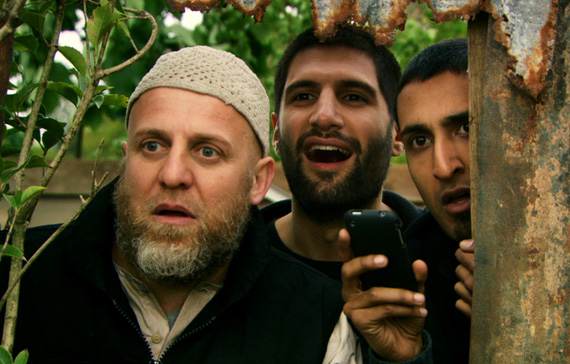
The witty dialogue in both shows derives from the internal tensions which arise within a disparate group of individuals thrown together by circumstance, and this proves to be Four Lions’ strong suit too. The characters of the would-be suicide bombers are drawn with broad strokes and, like Peep Show‘s Mark and Jeremy, of little interest in isolation. However, it is in their interactions with each other – their misunderstandings, verbal sparring and exasperation at each others’ stupidity – which raises the most laughs, as does the way that their combined idiocy leads them to conclusions that one idiot alone could not have arrived at single-handedly – one rabble-rousing speech in particular managing to inspire another character to declare their Jihadi ire against a famous brand of wax-covered cheese.

As a knockabout farce, the laughs come thick and fast, and I suspect a less confident filmmaker and writing team would have eased up on the comedy and succumbed to greater concessions towards illustrating the actual physical threat that such a group could cause, even an incompetent one. As it is, our budding Jihadis come over as about as menacing as a Dad’s Army character waving a bayonet but holding it the wrong way around. The wider political point is underlined by the closing montage of mock-CCTV stills, the kind that are shown on news programmes after an actual terrorist attack: far from the anonymous, menacing characters that are impressionistically disseminated in hindsight, the reality that Morris discovered in his research is that they are fallible, comic figures as we all can be on occasion.

If Four Lions succeeds as a comedy, as a film ultimately it feels flawed. The reliance on short, fairly self-contained gag-based routines provides a series of laughs within each individual scene, but because the overall narrative is flimsy and, more often than not, lacking in a clear storytelling direction, all too often each scene feels isolated from the wider story. Since the characters are painted broadly and largely caricatures, there is by-and-large little or no discernible character development, at least until the final scenes, and their very two-dimensional nature removes the reality of the situation to diminish the impact of what political points Morris is trying to make. What pathos is generated is entirely for the character of Omar, the protagonist and most recognizably normal member of the gang, and whose interactions with his wife and young son prove to be the film’s only emotional outlets. It seemed odd to me that his wife Sofia had such an unquestioning attitude towards his plan to widow her, but there are some genuinely touching scenes with his son and his trying to explain to him what he plans to in terms of a badly-judged Lion King metaphor.

Four Lions is, then, a very funny film but one that is let down by some of its own contradictions. Watching this and Cemetery Junction, the Ricky Gervais and Steven Merchant film, in close proximity did make me consider what I would prefer: the former, a flawed but challenging singularity, or the latter, a by-the-book film desperately lacking a soul. In the end, I would rather have more of the first.