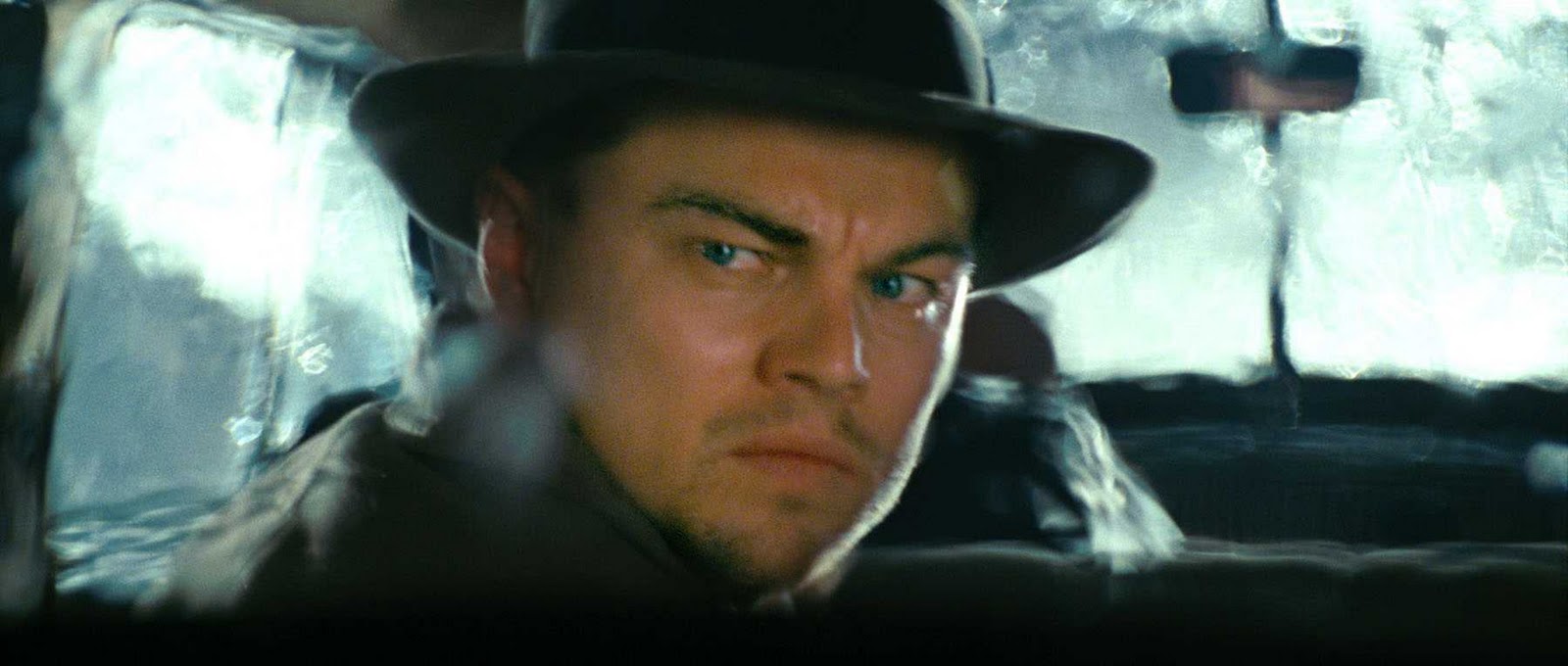
Shutter Island (Martin Scorsese, 2010, USA)

Those a little perplexed by the sheer pulpy excess of Shutter Island, Martin Scorsese’s follow-up to his Oscar-winning The Departed (2006), should remember that, like Quentin Tarantino after him, the director’s famously encyclopaedic knowledge of cinema has long placed on equal par the genre picture and the art-house classic, a democracy in which Gun Crazy (1950) is as important an influence as Ossessione (1943). One ought not to forget either that Scorsese was a graduate of the Roger Corman film school, an early brush with exploitation which can be betrayed to varying extents in his output ever since Boxcar Bertha (1972) gave rise to Mean Streets (1973). The problem is, running to an overlong 138 minutes Shutter Island if anything needed to be a little more Corman and less Cimino.

The year is 1953, and we begin aboard a ferry carrying US Marshal Teddy Daniels and his newly-appointed investigative partner Chuck Aule, who together have been sent to the small titular island, home to the Ashecliff Hospital for the criminally insane, a forbidding place established from these early shots aboard the boat – the hold all clanking chains and handcuffs – to their arrival through the high-security electric-fenced perimeter of the hospital. On arrival, the hospital’s head psychiatrist, the charming, smooth-talking Dr. John Cawley, explains that it is his liberal-minded philosophy that these dangerous prisoners may be ‘cured’ of their mental traumas by allowing them to act out their anxieties rather than by punishing and medicating them; this awakens hostility from Teddy, who in a series of dreamlike flashbacks recalls not only his wife’s death in an arson house fire but also his presence as a soldier at the liberation of the Dachau concentration camp, dually haunted by the ghosts of a loved one and strangers he was unable to save from mechanised slaughter.


Ostensibly Teddy and Chuck’s mission is to investigate the mysterious disappearance of one of Ashecliff’s patients/inmates, Rachel Solando, who had been locked up for the brutal drowning of her three young children. But just how did she manage to escape from her locked cell, barred at the windows? Within the opening reels, this is the apparent central mystery, but slowly the detective story mutates as it transpires that Teddy has other, hidden reasons for coming to the island: not only has he reason to believe that his wife’s killer has been sent there, but he also suspects that the facility has been conducting mind experiments on its inmates. Thus, he is conflicted between two motivations: on the one hand avenging his wife’s death, and on the other crusading against what he sees as the appropriation of the Nazi thought experiments he fought against during the war.


This is only the piano terra of what quickly becomes a complicated Memento-like (2000) house of cards representing the fractured psychology of Marshal Daniels. Communicating to the ghost of his dead wife, who seems to be urging him on in his investigations, albeit then decaying into a pile of ash, he begins to question the trustworthiness of all around him – inmates, staff, even his own partner. Most of all, he is suspicious of Dr. Jeremiah Naehring, the German ex-pat colleague of Cawley’s who seems to suggest a link to the wartime experiences he is unable to forget. But can he believe even himself, led by ghosts of his own memories?


Based on the novel by Dennis Lehane, whose comparably more sober Mystic River (2003) and Gone, Baby, Gone (2007) have also been filmed, Shutter Island is the kind of story which translates very well to the visual medium, and Scorsese employs a full gamut of camera techniques in order to send us hurtling around the menacing prison’s corridors and its surrounding windswept island in a whirlwind fashion. Hitchcock seems the key reference point in terms of storytelling, reflected most obviously in the Bernard Herrmann-esque score as well as visual nods to Vertigo (1957) and Psycho (1960), but one can’t help but think that Hitch might have trimmed the running time down by a reel or so; the drawn-out ending in particular makes the full 138 minutes feel just too long, and the sheer obviousness of the big plot twist makes it seem as if Scorsese is showing his cards more than a little too early.


The length issue is reflective of the film’s essence as a hybrid of detective story and psychological autopsy, and the film ends up feeling a strangely schizophrenic mish-mash of visual styles. The opening reels feel strangely old-fashioned, an homage to the classic post-war film noir tradition right down to the apparent use of very retro-looking back-projection placing the island ferry atop the ocean waves, and veteran DP Robert Richardson’s camera and lighting take ecstatic delight in showing the period mise en scene. And yet despite the hokey, over-expositionary dialogue, there is an unease about those early scenes, largely thanks to some odd jump-cut editing and subtle use of minor temporal discontinuities to set the viewer on alert that all is certainly not what it seems. The dream sequences, though, are pure Tarkovsky, undercranked and littered with symbols and associative elemental imagery, with a feeling of po-faced unease that occasionally threatens to turn into slapstick.


The pastiche of film noir tropes is unsurprising for the director whose films always seem so enamoured with cinema history, but the evocation of the Holocaust seems flippant, almost frivolous, to what is ultimately an insubstantial story, if an entertaining one. Of course, noir owed its existence to World War Two, not only as a reaction to its horrors but as a product of its resultant immigration to Hollywood of the likes of Fritz Lang and Billy Wilder, and it is certainly possible to use experience of it to great achieve great empathic effect – see how Nabokov subverted the apparent comedy of Pnin with the haunting tragedy of Buchenwald – yet here it feels like Scorsese is unable convincingly to work it in to the story, at least with the unresponsive DiCaprio as lead. Not that DiCaprio is bad – in fact he seems well suited to this period hokum – but for a film which about interior psychology his performance is simply too opaque.


For its problems, Shutter Island remains enjoyably entertaining, and a film unashamedly soaked in love for the history and traditions of cinema, and for the sheer craft of old-fashioned thriller filmcraft. Still, it is an obtuse, awkward work, and will surely baffle many more than it will delight, but this seems to be where its charm lies; file under ‘personal projects’ alongside The Aviator (2004) and Kundun (1997). Maybe this is where the true value of his work has resided all along.
Män som hatar kvinnor [aka The Girl with the Dragon Tattoo] (Niels Arden Oplev, 2009, Sweden/Denmark /Germany)

The massive global popularity of Stieg Larsson’s Millennium trilogy of novels owes not as much to their innovation or any authorial distinctiveness as to just how successfully they stick to the classic rules of thriller storytelling – establish memorable characters while placing them up the proverbial creek and then show how they manage to wriggle out of the sticky situation while solving the plot’s central mystery. It should come as little surprise, then, that Niels Arden Oplev’s rigorously effective and entertaining screen adaptation plays to this strong suit; yes, on the whole it plays to the standard genre rules, but in exploiting these to their full potential what emerges is one of the more memorable – and unashamedly thrilling – thrillers of recent times.

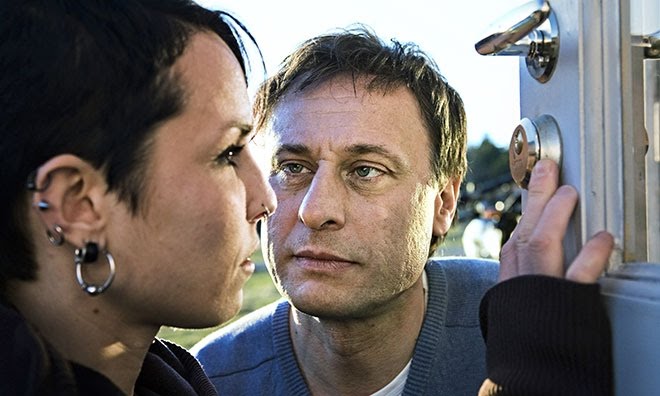
The title The Girl With the Dragon Tattoo places the focus of the film on character, choosing to eschew both the unappealing if more interesting original Swedish title Men Who Hate Women as well as the rather more forgettable Millenium tag which it was carrying at last year’s Frightfest. A basic description of said titular Lisbeth Salander as a high-kicking, bisexual computer hacker does make her sound like the kind of mess of cliches one might expect to see in an early 90s straight-to-video erotic thriller, but between Larsson, Oplev and striking lead actress Noomi Rapace she somehow seems to transcend this and emerge as a likeable character, just within the realms of the believable as half unapologetic outsider, half fantastic super heroine.

When compared to the preposterousness of comparable Hollywood leading females – stand up, Keira Knightley’s Domino – she carries a much more believably tough persona, both mentally and physically, illustrated nowhere better than in the unsettling early scenes showing her abuse by her unmistakeably evil legal guardian Nils Bjurman. He, a respectable lawyer and apparent pillar of society, behind closed doors turns out to be a violent sadist towards his ward, yet as he explains to Lisbeth his position of power allows him to be able to get away with his violent fetishes unquestioned. A recurring undercurrent in the film will be not merely the misogyny of individuals, but its virtual enshrinement in the power structures of seemingly placid, progressive Swedish society.

A pleasing amount of time is spent carefully establishing Lisbeth’s past history – naturally as means of setting up not just one film but the three of the projected trilogy – but perhaps a little too much at the expense of introducing the main thrust of the story. So too, the significance of her screen partner and yang to her yin, Mikael Blomkvist, editor of the tenacious and controversial investigative magazine Millennium – presumably a Swedish equivalent of the British Private Eye, though this unfortunately produces an unwelcome parallel with Ian Hislop. Licking his wounds following losing a high-profile libel case after the publication of a particular article, Mikael finds himself not only facing a jail sentence but also his being tailed electronically by the hacker-stalker Sander and courted by wealthy industrialist Henrik Vanger who wants to enlist his investigatory skills to investigate the disappearance of his niece, who went missing more than forty years previously.

Cue the mystery plot and, predictably, the coming together of unlikely pairing Salander and Blomkvist. Some kind of chemistry between the two, both professional and personal, inevitably begins to arise – he is obviously flattered by the interest shown in him and his work by his newly-found ingénue, she drawn to him in varying degrees as both a crusading truth-seeking hero and a surrogate father-figure. As the mystery plot begins to pick up pace and the pair spend ever-increasing amounts of time together alternately staring at their laptop screens, flitting between legwork at significant locations and bookwork at archives, and occasionally getting into scrapes with less-than-friendly interested parties, their strange working relationship shows signs of teetering over into something more. Accusations here of middle-aged man wish-fulfilment are perhaps fair, and the lurch towards the heteronormal from the more ambiguous undermines the unconventionality of our heroine, but these complaints ought to be laid at the door of Larsson himself.

Director Oplev does nothing particularly spectacular, though one might argue it is enough that he manages successfully to balance off this burgeoning if rocky central relationship with the demands of the series of convoluted plot turns that even Raymond Chandler might have balked at. What is a long duration of 152 minutes fly by pretty effortlessly, largely thanks to the numerous alleyways of intrigue the pair take us wandering down, labouring significantly only in the final reel coda, whose presence necessarily sets the audience up for the two films to follow.

Quite extraordinarily – largely indicative of the substantial global following Larsson’s novels have enjoyed – the film earned comparable box-office receipts to Ron Howard’s megabucks behemoth-like Dan Brown pot-boiler Angels and Demons (2009) when both opened at similar times to each other across Europe last year, an unthinkable level of success for a Swedish-language film. I doubt whether many of those fans who saw it could have been disappointed with this entertaining, effective and surprisingly endearing home-grown adaptation of a modern cult classic, not least before the inevitable glossier and sanitised Hollywood remake sits Megan Fox (or suchlike) in front of Lisbeth’s laptop.

Treeless Mountain (So Yong Kim, 2008, USA / Republic of Korea)

For all of the wealth of films produced by middle-aged directors which focus on the coming-of-age of female adolescents – a subject which can take in as great and diverse films as Gigi (1958), Mouchette (1967) and Spirited Away (2001) – the lives of protagonists of a younger age are proportionally under-represented in film. Why should this be? As characters are they are more difficult to delineate convincingly, their personalities emerging but yet to form fully? Is imposing a narrative onto characters who are yet to be able to perceive such a concept is too great an artifice? Maybe it is simply that their lives are viewed as being simply not interesting enough.

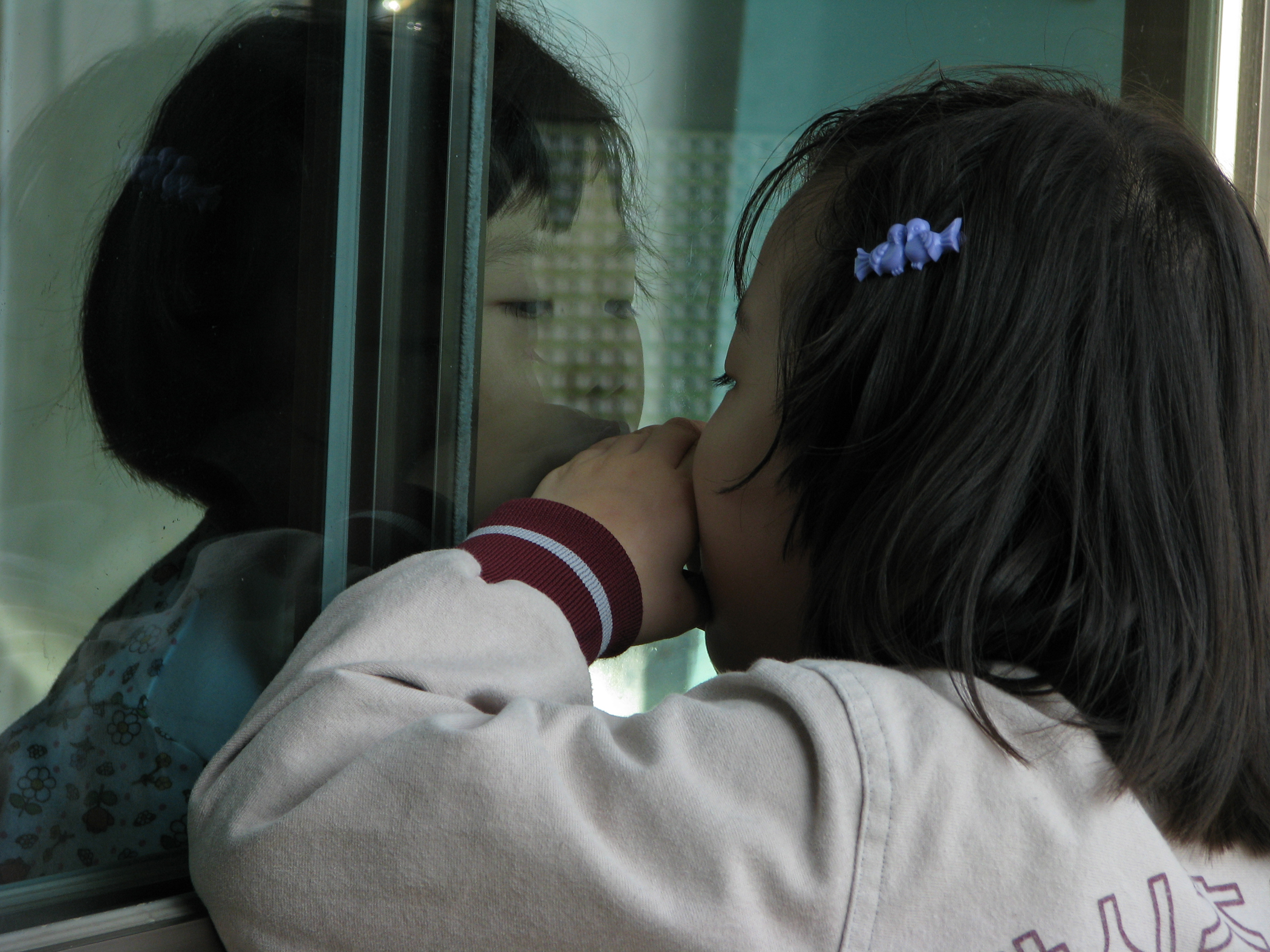
Filling this void is Asian-American director So Yong Kim’s Treeless Mountain which places the world of young children at its very centre, observing the rhythms and small triumphs of their lives with a quiet patience. Like her strongly autobiographical début feature In Between Days (2006), her second film takes elements of her own childhood as the inspiration for its storyline, but while it may be looking further back into her own life story, it represents a for her a large career step forward; in asking the viewer not to judge or moralise, her strongly observational style serves to portray elegantly the world as viewed through a child’s eyes.

The story introduces us to six-year old Jin, making her way home from school and picking up her younger sister Bin, who is being looked after in their neighbours’ flat. Their busy working mother is a notable absentee, and who on eventually arriving is evidently too harried to pay her children their due care and attention. On a following day we see her take them on a long bus ride out of the city where she announces that she is going to go away in search of their estranged father, and in the meantime they are to stay in this strange new town with their Big Aunt, whom they are introduced to for the first time. She gives the girls a large piggy bank, promising to return as soon as they manage to fill it with coins.

Life with their Big Aunt in this strange new town proves to be troublesome – far from being a caring foster-parent she pays them scant attention, leaves them undernourished and proves quite happy to use them as a means to blackmail money from another child’s mother in order to fund her alcoholism. The girls learn to take refuge with a generous and kindly neighbour, and discover that if they catch and cook grasshoppers they can make money with which to fill their piggy bank which they continue to believe, heartbreakingly, will guarantee the speedy return of their mother.

These relatively bare bones are as much as the film offers in terms of plotting, and aside from the initial drama of the children’s abandonment, there is little concession to providing narrative impetus – only the sub-narrative of the girls’ quest to fill up their piggy bank offers any sense of direction – and this noticeable absence suggests that the children, whose eyes we are undeniably witnessing events through, are yet either to form or to expect narrative coherence as an overlay to life. This lack of event makes it is possible to come away with an impression that the film is a touch slight, but while there are certainly passages of the film which play slowly, start to peel away at its layers and what begins to emerge is a work of remarkable complexity beneath its seemingly simple surface.

Firstly, it is revealing what director So Yong Kim chooses not to do as much as what she does do with such material. Tonally, we are not in the realms of the lyrically elegiac (The Spirit of the Beehive (1975)), the polemical (The 400 Blows (1959)) or the harshly poetic (Forbidden Games (1952)) but rather strictly observational: the vérité filming style and the hugely naturalistic acting from the two very young leads gives the film an authentic, documentary-like feel, and the regular use of close-ups gives a heightened sense of intimacy with the main characters. Through what we are selectively shown, the film sees the child’s viewpoint not as an essentially simplistic one awash with incomprehension and fear, but instead one with a combined sense of wonder and curiosity. As such, its closest forebear may be Koreeda Hirokazu’s similar Nobody Knows (2004).

If Treeless Mountain shares a kinship with any broader genre then it is mostly Italian neorealism, both in terms of its non-studio location shooting and eye for everyday detail, as well as extensive use of non-professional actors. Though lacking the movement’s tendency for out-and-out melodrama, there is curiously the very De Sica-like subtle background use of fairytale archetypes: the absent parent and quest to ensure her return, the wicked stepmother charged with their keep, and the two princesses exiled in a strange land – the latter point highlighted by the young Bin’s wearing of a princess-like dress in many scenes.

What often goes unnoticed about the classic De Sica films is that they take place over a very carefully-defined period of time, in Treeless Mountain it seems the opposite is true: there are no visual or verbal signposts within the diegesis to indicate whether hours, days or months are passing, events happen episodically but the only indicator of timescale is the girl’s piggy bank gradually filling up – though this too proves no measure as they later discover how to go about filling up quicker. Relocated to a strange new location and no longer subject to the everyday rhythms of their previous lives, time for the girls within the film seems to have stopped.

It is in this stasis that the girls are left to discover this new world on their own terms, and the real drama of the film emerges from the focus on the girls’ interactions with each other: their slow realization of the reality of their situation, their overcoming of certain naiveties, and ultimately their acceptance of their new lives, achieving a kind of Bressonian transcendence. It is this which prevents the tone from being overly morose, and viewing the girls’ lives as somehow quietly triumphant lies in contradiction to the view of the lives of adults as riddled with problems and alienation.

There are other questions which reside in the background, outside of the children’s perception, questions which another film might have sought to answer: what happened to the father? Why is the sister-in-law unmarried? As the film transfers from the city to the town and then on to the countryside, how much of the social dislocation we see can be placed on increasing urbanization in Korea? However, it is only as adult observers that we have been taught to pick up on such matters; for the girls in Treeless Mountain, whose eyes have not yet learned how to perceive them, they have yet to take on any importance. As such, it may be one of the most accurate cinematic accounts of the experience of childhood yet.

Aruitemo aruitemo [Still Walking] (Koreeda Hirokazu, 2008, Japan)

The shomin-geki, a particular type of Japanese family drama, is a long-established genre dating back to the early 1920s, but it is one which is perenially associated with, indeed practically synonymous with, the director Ozu Yasujiro, whose work is currently the subject of a major retrospective at the BFI. There is perhaps no better context within which to view this film by Koreeda Hirokazu, a director who has long been spoken of as his natural heir, given that his films share similar themes and concerns with those of his predecessor. Still Walking sees the parallels between them stronger than ever, and if one were to imagine the ghost of the great director watching with us, he would surely be nodding in silent approval.

A prologue introduces us to Kyohei and his wife Toshiko, an elderly middle-class couple living in a quiet coastal town. We see the old man doggedly struggle up some steps before exchanging kind greetings with a lady, from which exchange we learn that he is the area’s retired former doctor, and later that his house is his former surgery, still full of now disused medical paraphernalia. In contrast to this character, we are then swiftly introduced to his son Ryota who is travelling by bus with his new wife and stepson to visit his parents. In these early exchanges he seems uncaring towards his father and mother, expressing his wish to stay with them for as little time possible; in the meantime his own concerns have blinded him to the nervousness of his new bride at the prospect of meeting her in-laws for the first time.

Such a setup inevitably recalls Tokyo Story (1953), and the expectation is that the story will be about an uncaring son who is woefully neglecting his kindly parents, yet as soon as he arrives this is turned on its head. In truth, it is the father who is the transgressor, and greets his son with cold inhospitability; he holds lingering resentment that Ryota decided not to follow in the family tradition and become a doctor, and shows disdain for his chosen career as an art restorer. Toshiko is little kinder to her son, and confesses to daughter Chinami her disdain for his marrying a widow: after all, at least a divorcee might have chosen to leave her husband.

The film takes its time to reveal important pieces of information, and it is largely relayed through offhand remarks rather than expositionary dialogue. Slowly, we piece together that the family have gathered to mark the anniversary of the death of eldest son Junpei, the apple of his father’s eye who drowned many years ago in saving another man’s life. Kyohei clearly believes that Junpei would have become a doctor himself and carried on his work, and his resentment towards Ryota is based in a belief that the ‘wrong’ son died that day. The mother, too, is unable to let her son go. Later on, the man whom Junpei saved comes to pay his respects, a sweaty, obese, unkempt man who is both embarrassed and ashamed to be present in front of the family; Toshiko confesses that she insists that he return every year in order for him to suffer as she continues to her son’s death

Much of the subject matter makes the film sound depressing, and one suspects in the hands of a Western director such material would make for more of a melodrama, yet Still Walking, in the tradition of Ozu, is anything but morose. For long passages, the tone is light and playful, brightened by lively, colourful cinematography – the camera keen to linger on seemingly insignificant domestic details – a lilting acoustic guitar score, and the dialogue filled with the pleasantries and idioms with which the characters generally interact. Food is the major topic of conversation, and even the cold father softens and is lured out of his den when he smells frying tempura in the kitchen. Most of all, it is through the presence of the younger generation’s children of their own: while the adult dramas are playing out onscreen, there is frequently the accompanying sound of offscreen children at play, their lives so far mostly untouched by these frivolous grown-up concerns

Where Koreeda’s script and direction excel, though, is in how skilfully he manages to weave the tangled web of characters and their inter-relationships so that frequently within the same frame we can see a whole variety of emotions being experienced simultaneously by different characters, usually along generational lines. As well as dramatically underlining the gap between their attitudes, it also lends a huge sense of authenticity to this familial portrait: after all, how many family gatherings see all participants synchronised emotionally? More often the blinkers are on for the duration.

The shooting style – mostly carefully composed medium shots – might suggest observational distance rather than emotional intimacy, and yet film proves to be a bridge between the two; like Ozu’s films we feel like another visiting guest in the household, and when narrative resolution is achieved and the film closes there is a sense of emptiness in having to leave the world we have been living in for the previous two hours. The other director whose work springs to mind as a comparison piece is the late, great Edward Yang, another master of deep, subtle humanism. Koreeda’s beautiful, delicate film deserves such illustrious company.

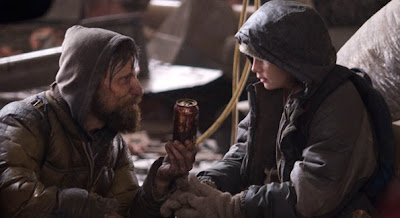
The Road (John Hillcoat, 2009, USA)

Perhaps it is the recent passing of the fiftieth anniversary of his death that brings it more readily to mind, but the spectre of philosopher Albert Camus seems unquestionably to hang over the characters in John Hillcoat’s adaptation of Cormac McCarthy’s novel The Road. The film is, in a very broad sense, existential, but more specifically it seems to be confronting those issues which troubled the French-Algerian writer throughout his life: how are we to live our lives in a universe so apparently devoid of meaning? If all is ultimately futile, is there anything which makes suicide an unacceptable escape? Can a morality still exist, and how, if at all, may one achieve a ‘happy death’?

In McCarthy’s vision, death is the only certainty, and one that constantly looms so close as to be able to touch it. An unspecified disaster has befallen the Earth – viewers may speculate as to its exact nature – which has set in motion an unstoppable environmental catastrophe: the sky grows ever darker, life has all but died out, and what remains is a deserted world of ashen, moribund tree husks and the abandoned wreckage of buildings, roads and vehicles. A handful of starving humans roam around in cannibalistic tribes scavenging for any remaining food and commodities, and as the story progresses we will see glimpses of the desperate, horrifying depths to which they have sunk in order to survive.

Also roaming this barren wasteland is an unnamed man and his young son, struggling with their cumbersome trolley loaded with what goods they have managed to forage for themselves. Through parallel flashbacks interspersed through the story we see glimpses of past events: golden-hued memories of ‘before’ and the man’s loving relationship with his wife, the coming of the apocalypse and their child’s traumatic birth, and finally the couple’s increasingly disparate reactions to the ongoing destruction, resulting in her complete abandonment of hope and flight from the family home.

In the present timeframe, the man has determined that the pair head south and towards the coast, and so the story follows their labourious journey, flanked by the twin vultures of death by hunger and murder at the hands of a cannibalistic gang. Their significant other companion is the man’s gun, loaded with one bullet for each of them, and which the father repeatedly and frantically reminds the son how to use on himself if the worst happens; better this than the prospect of being raped and eaten alive. As in reality, the role of the parent is to prepare the child to face the world without them.

Tales of earthly apocalypses are ten-a-penny in Hollywood, but however bleak their outlook, there is always the certainty in such films that their protagonists will in some way save the day in the last two reels. Not so here; the tone is unremittingly bleak, the world terminal decline and in the process of taking its last few gasps of air before expiring forever. Where, then, can any sense of hope be derived from this situation? How can the father make the son believe that life is worth living for a second longer?

It is a truism, if a trite one, that the road movie is seldom about the destination but the journey itself, and this is never a more correct observation than in The Road, though here it is a more philosophically abstract idea. Take two comparable films; firstly, Children Of Men (2005), also set in a world where life (and hope) is slowly dying out, but which observes the narrative trajectory of a thriller once the key plot point is revealed. Similarly Stalker (1979), which is more philosophically complex, yet still has a clear destination end point – the mysterious ‘Zone’ to which the characters are heading.

The question in The Road, perhaps related to the MacGuffin of the nature of the disaster itself, is why is the man so insistent in heading both south and towards the coast? Does he know it is safer there? His reasoning is never made explicit, likely because there isn’t one; it is just important that they have a direction, some form of purpose. In a later scene, when the pair discover an underground cache of supplies, enough to keep them alive and more comfortable for months, they continue on nevertheless. Survival is not enough; existence precedes essence, but it is not enough on its own; the man has embraced the Absurd and transcended it.

Director Hillcoat’s previous film, the superbly grimy The Proposition (2005), took the template of the Western and reinvented it in a nihilistic late nineteenth century Australian Outback where the rule of law is unenforceable and morality is an unobserved luxury. The Road takes this further: law is not only unenforceable but has been dispensed with altogether, along with any value attached to money or property. What remains of humanity?

What is fascinating is the divergence in political attitudes between father and son. The older, more world-weary character sees fear and danger behind every corner and in every person they meet, and is careful to delineate to his son the idea of they as the ‘good guys’ and others as the ‘bad guys’; the child, seeing through kinder but perhaps more naive eyes is less inclined to believe his father’s snap judgements, and as the film progresses is clearly forming a moral code of his own, constantly questioning that of his father. Perhaps ‘before’ the father was less wary of others, while the child, born into this new world, lacks this frame of reference. Their moralities, then, are hugely subjective, borne out of circumstance and forged by experience.

A story which is so unremorseful in its depiction of a future deprived of any sense of hope might seem like an unrewarding, morose watch, and yet the overriding message is a positive one. Camus wrote The Myth of Sisyphus in the darkest days of World War 2, exiled and alone in Paris, staring down the barrel of an oppressive, authoritarian future. And yet he looked to Greek myth and found the most hopeless of all characters – the man condemned to spend eternity rolling a rock up the side of a mountain in the knowledge of the certainty of its fall – and found hope, and laughter, in its Absurdity. It is the triumph of The Road that it also manages to find, even the the face of the most unrelenting despair, enough to suggest that life must continue be lived, and embraced.