Drag Me To Hell (Sam Raimi, 2009, USA)

Many moons ago, director Sam Raimi made a low budget horror film called The Evil Dead (1981). The plot was ridiculous, the dialogue was hokey and the acting was mostly abysmal. It also happened to be brilliant, making an instant cult hero of star Bruce Campbell, and going on to become one the most rented films of all time. What marked the film out was its inventiveness: dynamically jarring camera angles and moves, clever pacing of its jumps and frights, a boldly experimental sound design and score, but along with the terrifying horror a blackly comical tone clearly informed by slapstick. Here was a young new director bursting with fresh ideas about horror filmmaking, and what it could do simultaneously to entertain and to thrill.

Fast-forward 28 years and Raimi, now a big Hollywood player after helming the massively successful Spider-Man film franchise, has returned to the genre which he first made his name. It may seem a curious move for a director now used to making blockbusters to return to low-budget horror, but his bigger films have to me have always seemed like merely upscaled versions of his earlier work, with coincident themes and characters. What is striking about Drag Me To Hell is just how exhilarating his style has remained, all these years later.

The story concerns Christine, an ambitious but good-hearted loan officer at a bank with one eye on the vacant assistant manager desk across the office from her. She is urged by her boss to make tough decisions if she wants to succeed against Stu, her irritating rival for the job, and so when a grotesque and classically ‘sub-prime’ elderly woman comes to her begging for some financial help to stop her being evicted from her house, Christine is reluctantly unforviving.

However, like the hapless Ash before her, she doesn’t know what she’s letting herself in for. The elderly woman, shamed by events in the bank earlier, returns at the end of the day to attack our young protagonist as she tries to drive home from work. After a protracted struggle, the lady mysteriously removes a button from Christine’s coat. Later that evening, confused by the incident, she visits a conveniently placed friendly neighbourhood fortune teller, who informs her of her dire situation: she has been cursed by a dark spirit, which will visit her in physical form over the coming days, and as the film’s prologue has delightfully shown us has happened to others before, she will then be literally dragged through the ground to an eternal fiery inferno.

The film takes its time setting all of this up, probably to the disappointment of those expecting wall-to-wall horror, but in being patient with the story, director Raimi is then allowed to do what he does best: violently assaulting his main character in as many comical different ways as can be imagined. Fans of the abuse meted out to Bruce Campbell will delight in the various ways poor Christine is flung around, tossed up in the air and generally harassed by ghosts both real and imagined, and as she is thrown into ever more of a paranoid frenzy she pictures the elderly Gypsy woman invading her life in increasingly horrible ways.

Christine is played by a radiant (initially, at least) Alison Lohman, apparently a last-minute stand-in for Ellen ‘Juno’ Page, not that you would notice. Similarly baby-faced and playing things entirely straight-faced, she makes for a sympathetic lead, much like Jess Weixler’s little-girl-lost in Teeth (2007). Support comes from her drippy boyfriend Clay, but whose disapproving parents make for a hilariously awkward dinner party scene where Christine, eager to make a good impression, ends up screaming and flinging her chardonnay across the room. Not the way to ingratiate yourself with the future in-laws.

There are possibly some questions which should be asked about the film’s presentation of Gypsies, but tasteless is what Raimi does well, and I feel that there is nothing malicious here, perhaps just a little naïve and childish. There are also curious moral questions raised: if placed with such a curse, what would one do to rid yourself of it? Would an animal-lover be willing to perform a sacrifice? Would a good-natured soul be happy to condemn another to suffer her fate instead? All this is framed by Christine’s initial refusal to help someone else for her own gain, a timely message given the recent messy history of global financial mismanagement.

The laughs are funny, and typically Raimian – gross-out bodily fluids, Three Stooges-esque physical comedy – and the scares when they come are typically well-crafted, but the film never feels quite like a true classic. The artificially metronomic pacing of the jumps, which worked so well in the claustrophobia of the Evil Dead cabin, is not so menacing in the urban environment. The frayed edges of the characterization – that Christine was raised on a farm, that she used to be overweight, and that her mother is an alcoholic – are casually thrown in to advance the story without much care. And at 99 minutes the film is probably about 10 minutes too long, and drags noticeably in places.

All said, this is still the work of a master horror director, albeit a minor work. For its flaws, there are still the unmistakeable hallmarks of Sam Raimi’s genius as a filmmaker is uniquely able to scare and entertain at the same time, and for that it is essential viewing.

*EDIT* There is sadly no Bruce Campbell present, though one character looks like a surrogate for him. Raimi geeks will, however, be reassured that ‘the Classic’ is present, as ever.

Coraline (Henry Selick, 2009, USA)

Since Toy Story (1995), the standard bar for animated features has been set so high by the likes of CGI pioneers Pixar and Dreamworks, as well as the more traditional animations from Studio Ghibli and Aardman, that many new films fail to make much of a lasting impact. In twenty years’ time we will remember The Incredibles (2004) and Princess Mononoke (1997), but will anyone be going back to Bee Movie (2007)?

The proliferation of the requisite technology to make such films has allowed them to be made more quickly and inexpensively, while the leading animation studios attempt to outdo each other with newer flashier effects. Last year’s WALL-E (2008) represents the current high-water mark, but no doubt five years down the line it will look horribly dated compared with the latest releases. What makes the likes of the best of the Ghibli and Pixar films is not how cutting-edge their graphics were at time of release, but the quality of their stories.

Into this market is thrust Coraline, being hailed by some as ‘the best 3D movie of all time’, and heralding a new dawn for the cinemagoing experience. If this is not a reason to get suspicious, I don’t know what is: showcases of new technology, while undeniably technically impressive, seldom make for lastingly great films. Smell-O-vision anyone?

Coraline, though, comes to us from good stock: director Henry Selick previously helmed the superb, if misleadingly titled, stop-motion classic Tim Burton’s The Nightmare Before Christmas (1993), a masterpiece of darkly macabre imagination recently reissued in 3D. Furthermore, the story itself comes from the pen of revered fantasy author Neil Gaiman, creator of the Stardust (2007) universe amongst many others.

The story begins with the young Coraline Jones and her parents moving cross-country from Michigan to Oregon into a house labelled the ‘Pink Palace’. Her mother and father are both gardening writers, both rather drab and both too absorbed in their work to pay much attention to their daughter. Friendless, save for one strange local boy named Whybourne, Coraline spends her time exploring the house’s large garden and many rooms, as well as acquainting herself with her new eccentric neighbours.

On one of her explorations, she finds a small door which has been covered over with wallpaper, but upon opening it, she discovers whatever behind it bricked up. However, awoken one night by a jumping mouse, she is led back to the door to discover that it leads via a tunnel to a replica of the real world, but where everthing is more fantastical and exciting. Replicas of her parents are more loving and dynamic, cooking sumptuous food and playing games with her rather than ignoring her. The ‘Other World’ garden, far from the derelict real world equivalent, is transformed into an enchanted living forest.

All of this wonder is of great excitement to the previously bored Coraline, who soon becomes a nightly visitor to this strange wonderland. However, all is not well there; all of the characters there sport the extremely sinister look of having buttons sewn in where there should be eyes, and the young girl soon learns that if she wants to stay in the Other World that she must have the same done to her. When she refuses, it soon becomes clear that her Other Mother is not as kind and benevolent as she seems, and that Coraline is in big danger.

The first thing to say about Coraline is that there are many moments where it is truly visually breathtaking. Ignoring the 3D element, which though at times is impressive can too be distracting, there is so much to feast the eyes upon in the Other World that it can be overwhelming: troupes of dancing mice, plants and flowers exploding into bloom, and all manner of miscellaneous creatures and gadgets which fire the imagination. The curious neighbours, both in the real world and Other World, are similarly bizarrely grotesque and entertaining.

It is pleasing to note that this visual splendour is not let down by the story. Initially things in the real world are slow to start, perhaps too slow for children raised on Transformers (2007), but once the Other World begins to become more fully formed the narrative pace picks up, particularly as the urgency of Coraline’s situation becomes apparent. Some critics have suggested that the film is in fact too dark for children, and whilst this may be true for much younger viewers, I think that the PG certificate just about gets it right.

My initial fears about Coraline being merely a vehicle for 3D technology proved to be unfounded. Brush aside the gimmicry and here is a vibrant, modern spin on the classic Through the Looking Glass tale with enough darkly visual delight to make children of all ages think twice about turning the light off at bedtime.

Synecdoche, New York (Charlie Kaufman, 2008, USA)

Charlie Kaufman, creator of the ingenious labyrinthine worlds of Being John Malkovich (1999) and Eternal Sunshine of the Spotless Mind (2004), makes his directorial debut with his most maddeningly complicated film yet. It will not win him any more admirers; it will almost certainly lose him many. It will divide opinion into those who consider it the logical continuation of his previous work, and those who think he has completely lost the plot. I would love to declare it to be brilliant, but frankly I can’t be too sure its not a load of twaddle.

Everything starts off reasonably simply. Caden Cotard is a hypochondriacal theatre director obsessed with death. Staging an unambitious production of Death of a Salesman, he casts a young man as Wille Loman, elucidating that it doesn’t matter whether he’s old or young – he will die anyway. Caden’s home life is beginning to fall apart: relations with his artist wife Adele have deteriorated to such an extent that she soon moves to Germany, taking their young daughter Olive with her. Cue much moping, leading to him finding solace with the theatre box-office assistant Hazel.

So far, there have been some wonderfully deadpan Kaufman flourishes: curious word games and references to high literature; Caden envisioning himself in TV adverts, getting referred to a comical succession of medical specialists, and eventually end up seeing a therapst whose self-help books literally address him personally. Hazel lives in a house which is permanently on fire – a surprisingly successful metaphor for life itself. Indeed, black comedy which, for better or for worse, has come to be labelled ‘Kaufmanesque’.

Things, though, begin to take a turn towards the bizarre when, on the back of his successful production of Salesman, Caden receives a MacArthur ‘genius grant’ which he can use to finance whatever artistic project he wishes. Increasingly obsessed with his own mortality, he decides to rent a Manhattan warehouse and attempt to recreate as nearly as possible life outside of it. In doing so, he believes, he will create art which is honest and real. The trouble is, his vision grows increasingly large, so large as being unable to accomodate an audience.

Here is where things get rather muddled, intentionally so. Time, frequently a key motif in the film, begins to jump forward rapidly. Seeking out his wife and daughter in Germany, Caden is told that Olive is no longer four years old but ten; in film time this elipsis has taken only a few minutes. The world of his play is rapidly expanding and begins to blur with Caden’s real life; he ends up auditioning for someone to play himself in his own life, and then finally he ends up playing a minor character in his own story. In the meantime, peripheral characters around him are dying with increasing frequency, heightening his own morbidity.

Following all of this? I thought not. There are many fine concepts and ideas at the centre of all of this: most significantly the folly of trying to make art which accurately mimics life which ends up as a kind of infintely repeating Borgesian labyrinth. Within this, other ideas are shoehorned in, sometimes as distracting asides, sometimes as comedic tonic to the bleakness of the bulk of the film. The cast, a dream ensemble of fine character actors, do their best to make an unappealing group of individuals watchable, but ultimately their best efforts get squashed underneath the weight of portent.

It is a tough two-hours to sit through, and not one that I wish to do again in a hurry. Some critics have thrown out comparisons to Lynch and Fellini, but I would point out that those two directors never failed to make their films entertaining; sometimes Kaufman’s film is plain dull. Synecdoche, New York with all of its wildly Quixotic ambition comes across as self-indulgent but not in a self-satisfied way like the terrible I Heart Huckabees (2004). Instead, there is the feeling that Kaufman is reaching for something that is just out of his grasp – but at least he is trying.

Star Trek (J.J. Abrams, 2009, US / Germany)

Before the screening of Star Trek, a trailer ran for the new Michael Bay travesty Transformers: Revenge of the Fallen (2009), two minutes of inhuman objects pointlessly crashing and banging into each other which seems neatly to sum up his entire film output so far. The continuing success of these films seems to be symptomatic of the state of the post-Spielberg/Lucas blockbuster market where those old-fashioned elements, story and character, now run a distant second in importance to the film’s CGI department. Ironically, this has seen the best written big-budget entertainment films of recent years being from computer-generated animation stables Pixar and Dreamworks.

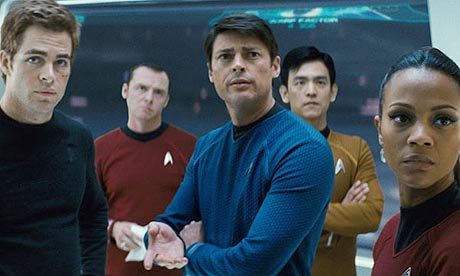
Thank heavens, then, for Star Trek. Director J.J. Abrams has taken what has become one of the most tiresome franchises since Police Academy and achieved a double coup: firstly, he has entirely redrawn the familiar Trek universe and formed it into something excitingly fresh, freed from the leaden boots of the prior films. Secondly, and more importantly, he has made a good old-fashioned action film which romps along like these sort of films used to, bursting with likeable characters, a decent plot, directorial nuance and no little wit.

Casino Royale (2006) rebooted the James Bond franchise by going back to the start of the MI6 agent’s career, wiping out all that had gone before in the preceding twenty films and starting again. Star Trek could easily have done the same, showing us the young cadets on their route through Starfleet to the USS Enterprise, but what we are given here is something altogether more daring. For reasons that will be made clear, a Romulan craft has somehow managed to travel back from the year 2387 to a time some 153 years earlier; in this ‘past’, it intercepts and destroy a Federation ship, killing the Captain, a certain George Kirk, whilst his wife is in an escape pod giving birth to their son, James Tiberius.

Fast-forward twenty-odd years and the now grown-up Kirk Jr. is a somewhat reckless and aimless young man, but is talented and is eventually convinced by a friend of his late father to follow in his footsteps and use his abilities for good in Starfleet. Meanwhile on Vulcan a young Spock, finding himself bullied as a child and discriminated against as an adult for being of mixed Vulcan-human blood, decides to joins Starfleet as a rebellion against his elders’ expectations of him. The two men progress up the ranks, along the way meeting some other familiar names – Uhura, McCoy, Chekov, Sulu – if at times through some rather fortuitous and unlikely plot devices.

What becomes clear, and is subsequently explained to us in case we don’t get it, is that the time-travelling Romulan craft has created an alternate parallel reality, one where, for example, Kirk does not grow up knowing his father. This is not a prequel in the sense that these characters will eventually go on to become those in the television series and then the films, the path of their lives have been irrevocably changed. An existentially questionable idea, but one which matches some of the franchise’s other bits of bad science, and also one which allows complete freedom in subsequent films.

The scenes of the young crew members finding their feet are lively and fun, the minipop versions of the original crew still slightly wet behind their ears (some pointy) and getting used to their new vessel – Sulu not yet able to get the thing in warp speed, and Chekov’s thick Russian accent seriously raising the question as to why he was chosen to be the ship’s announcer. The casting is nearly impeccable – in particular Zachary Quinto excels as the emotionally confused and repressed Spock, topped only by the magnificent Karl Urban as the younger ‘Bones’ McCoy, whose grouchy sarcasm consistently reduced me to tears of laughter. Only Simon Pegg is miscast, horrifyingly so, but his fleeting scenes as Scotty are faintly forgettable.

Though it remains to be seen what the hardcore fanboys will make of this newly imagined Trekverse, I for one was impressed with the film’s emotional content. Though there is much enjoyable light fluff, there are also a depths of sadness: of Spock’s isolation, confusion but eventual pride arising from his mixed-race heritage, and the deepening parallels he will share with Kirk’s feelings of loss and inadequacy. Like in many a trite love story, the two men initially despise each other but events make them grow ever closer, aided by the intervention of a familiar face from the past (or is that future?).

There is so much fun to be had with the characters that it is easy to forget the serious matter of the Romulans from the future armed with advanced weaponry threatening the destruction of the entire universe. Here is where the film enters familiar space-romp territory where the new Enterprise has to save the day, and is perhaps where the film is at its weakest – the final third of the film struggles to match the magnificence of the first two-thirds. Still, the action sequences are handled well enough, Abrams’ direction filling the screen with plenty lens flares, dutch angles and gliding camera moves to keep the audience visually entertained.

J.J. Abrams blotted his copybook early on with a writing credit on Michael Bay’s Armageddon (1998), but since then he has carved a name out for himself as creator and producer of TV hits Alias and Lost. His only previous directorial effort was the passable Mission:Impossible III (2006) but with this dynamic and hugely entertaining reinvention of the ailing Star Trek franchise it seems as though he has put himself at the top of the Hollywood tree. Smart, funny, visually exciting and at times surprisingly moving, it puts the recent Star Wars and Indiana Jones films to shame, and as a piece of slightly old-fashioned blockbuster filmmaking it may announce him as the true heir to the Spielberg/Lucas mantle.

Låt den rätte komma in [Let the Right One In] (Tomas Alfredson, 2008, Sweden)

It would be a lot easier not to consider Let the Right One In a ‘vampire film’, as attaching this label has a tendency to conjure up in most people’s minds images of Christopher Lee, crucifixes and garlic braids. Tomas Alfredson’s film is in an entirely different sphere from these, a reclamation of the genre both from high camp and from high-kicking high-school girls into a social-realist world where growing-up and not growing-up are equally as painful.

Strip away some of the film’s layers and there is some similarity with fellow Swede Lukas Moodysson’s growing pains drama Fucking Åmål [Show Me Love] (1998), for this is a film primarily concerned with loneliness, trust and loyalty. Oskar is a shy, spindly 12-year-old growing up in a chilly Stockholm suburb, juggled between his separated parents and frequently picked on by the school bullies. In his room he dreams of exacting revenge on his persecutors, manifesting itself in an unhealthy obsession with knives and newspaper stories of grisly murders.

One night he meets Eli, a reclusive young girl who has recently moved into the same apartment complex as him. She is mysterious, with a haunted demeanour which suggests an inner sadness Oskar can well relate to, and the two tentatively begin to strike up an odd friendship, perhaps even a cautious romance. In the meantime, we have already been introduced to Håkan, an older man whom Eli lives with whose main nocturnal habit appears to be stringing people up and draining them of their blood, though at times failing comically.

The viewer has already worked out what Eli’s big secret is, but then perhaps so too has Oskar. In the traditional vampire film, the revelation to the protagonist of the blood-sucker’s feeding habits comes as a moment of intense drama, yet here by contrast it is a gradual understanding and acceptance. Eli constantly hints at suggesting that she is not ‘a girl’, highlighting the outward sexless androgyny of both youngsters; but an imaginative, lonely twelve-year-old boy is more able to accept this as a mere difference rather than a threat. In fact, the central contradiction is that Oskar is seen as ‘good’ for plotting his unnecessarily violent revenge, while Eli is viewed negatively for the killings which she must do to stay alive.

Those expecting an action-packed thrill ride will be disappointed, as the story unfolds at a measured, stately pace, and aside from a few scenes of blood-letting the visual aesthetic is mostly spare and sombre. The architectural setting, a drab Stockholm apartment complex, not too dissimilar from the humdrum Belgium of the Dardennes or even the Poland of Kieslowski’s Dekalog (1989), is far removed from the glamour and mystery of Nosferatu’s Transylvanian castle. Yet there is just a hint of something magically supernatural in the snowy Swedish chill, in particular the beautifully lit night-time exteriors where Oskar and Eli make their first meetings, and in the spellbinding shots of the young vampire’s piercingly-blue eyes.

It is in this juxtaposition of the mundane and the horrific that the film allows us truly to consider its themes of isolation and despair. The familiar vampire traits – fear of sunlight, a bestial thirst for blood, the sadness and inevitable loneliness of never ageing – all carry a hugely greater emotional punch when placed in a deliberately realist setting and placed in parallel with a character with whom some could relate to and most would sympathise with. Not made explicit, but certainly implied, is that Håkan’s relationship with Eli may have once been like that now developing with Oskar, suggesting that even if their friendship blossoms, there is certain to be no conventionally happy ending.

If we are considering Eli’s immortality, then in straight counterpoint to that is Oskar’s very mortality. If childhood is being painted in an entirely unsentimental way here, then so too is adulthood: whilst not demonised, his parents are hardly role models which he could find himself idolising, neither too his teachers, authority figures nor the pathetic adult residents of his apartment block whose petty squabbling and layabout lifestyles the film openly mocks. Caught at the beginning of awkward pubescence, sandwiched between the twin dystopias of childhood and adulthood, it becomes less surprising that he finds solace with a 200-year-old perpetual adolescent after all. He already knows a little about growing up – about ‘going steady’ for instance – but only about as much as he should for his age. But then Eli, whose life for so long has essentially been one long press of the ‘pause’ button at the same age, knows just as little.

Let the Right One In is a profoundly sad film, yet peppered with moments of black humour. Håkan’s bumbling attempts at securing fresh blood for Eli more than once raise the question of what to do if caught red-handed hanging someone upside down with a jerrycan below their bleeding neck. Elsewhere, one woman’s struggle against a band of CGI cats needs to be seen to be believed, and there is one valedictory scene towards the end which somehow brilliantly combines stunning cinematographic beauty and intense off-screen violence, and on top of that will still have everyone in metaphorical stitches.

Great horror films function by attaching themselves to our fears, sometimes rational, sometimes irrational. Let The Right One In, well deserving of being called a truly great horror film, does this by combining the ordinary with the extraordinary, showing them to be mirror images of the same thing, and by placing them within the confines of the everyday then holds the mirror up to the audience to show what we all are capable of doing if the situation demands it. But beyond this, the film is a work of exquisite beauty, of deep yearning and sadness, but also of the comfort and strength that can be found in kinship and love.