Pigs Eels and Insects: Reassessing Imamura Shohei

If there was any unified conclusion to draw from Pigs Eels and Insects, a symposium examining the legacy of Japanese director Imamura Shohei, it was that there are many difficulties in positioning such a unique and at times contradictory oeuvre within a broader analytical framework. For starters, as Jasper Sharp explained in his outline of the industrial and cultural backdrop to Imamura’s film-making, the group of Japanese directors of the 1960s commonly grouped together under the umbrella term Nuberu Bagu (New Wave) could hardly be considered to be part of a homogenous thematic, aesthetic or political movement.

Nor is Imamura’s output thoroughly consistent, despite in many respects and for a large part clearly suggesting his status as a genuine auteur; Patrick Crogan’s appraisal of the later work Black Rain (1989) found thematic and stylistic kinships with the great Ozu Yasujiro, under whom Imamura worked as an assistant and whose subject matter of quietly-suffering members of the lower-middle-classes is ubiquitously viewed as the younger director’s anti-inspiration for choosing to focus on the Japanese underclasses ignored by ‘quality’ cinema. But Black Rain, with its elegaic tone and focus on familial disintegration shows that perhaps the older master’s influence was not entirely negative.

Mark Bould also cast doubts over received critical opinion, in this case that suggesting Imamura to be a pro-female director, a tag which perhaps owes much to the frequent comparisons to his similarly-labelled compatriots Naruse Mikio and Mizoguchi Kenji. Rightly questioning whether the strong-willed protagonists such as those in The Insect Woman (1963) and Intentions of Murder (1964) could be considered in any way female role models, at least according to Western models of feminism; all-too-frequently Imamura’s heroines achieve some form of triumph and economic independence only through some form of submission, usually reduced to their biological sexual and maternal fuctions. Bould payed special attention to the difference between the English word feminist and the similar-sounding word used in Japanese criticism feminisuto, whose definition is more connoting of a woman’s sexual availability.

Where then to place the director’s work? Isolde Standish argued that the focus of his films was placed on marginalised characters largely removed from modern Japanese history in order to overcome not only the Westernisation process being imposed on the country since the Allied Occupation, but so too that of the Meiji State, instead going back to what the director considered a more essential ‘Japaneseness’ found in the folkloric studies of Yanagita Kunio, and thus free the national cinema both from the channels of ‘official’ history, and also the imported neo-Confucianism of the Samurai rulers. As a unified theory it holds much water, offering an insight into his choices of subject matters: the early films with their emphasis on the underbelly of society, the mid-period documentaries looking at the subjective nature of truth, and films such as The Ballad of Narayama (1983) and The Profound Desire of the Gods (1968) which focused on the agrarian peasantry.

Taking an aesthetic approach, Alastair Phillips focused mainly on early scenes from Vengeance Is Mine (1979) looking at how Imamura visual style in what is one of his less typical films still manages to emphasise some of his recurring themes. Despite being a film with a much higher shooting ratio, appearing to counter the director’s favouring of ‘messy’ cinema, the use of odd, fractured framing and a careful manipulation of looking relations within the cinematic frame combine to create a feeling of temporal and spatial instability. ‘Inside’ and ‘outside’ are prominently defined, and part of a larger aesthetic strategy with undertones of voyeurism and spying – here once again surfaces the often blurred distinction in Imamura’s films between documentary and fiction, and parallel ideas about the relationship between society and the individual recur.

One final note: Sharp commented that while the starting point for Japanese ‘Pink’ Cinema is often taken as being the notorious Flesh Market (1962), some critics in fact consider Imamura’s own The Insect Woman as the first example of such a film; another reason along with those others discussed as to why the work of this uniquely distinctive director is ripe for reappraisal.
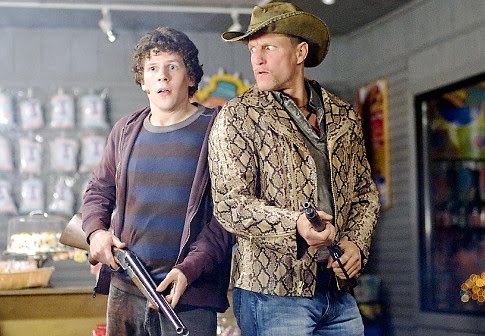
Zombieland (Ruben Fleischer, 2009, USA)

Thanks to a resurgence in its popularity following the box-office hits Dawn of the Dead (2004) and Shaun of the Dead (2004) earlier in this decade, the zombie film has been enjoying something of a renaissance in the past few years, culminating in the relatively low-key Zombieland topping the US box-office chart ahead of its bigger budget screen rivals. Its arrival is something of a significant one; while Shaun, and to a lesser extent Dawn, were clearly produced by die-hard fans of the genre, Zombieland’s existence appears to be largely a product of the increasing mainstream appetite for what could be happily dubbed the zom-com; in short, the undead have become socially acceptable.

The standard formula for this kind of film is a simple one: take some easily-identifiable stock characters, preferably of radically different demeanours and outlooks on life, throw them together and allow them to run amok in their newly-deserted surroundings, give them enough time to learn to rely on each other in a survival situation, add some witty one-liners and some inventive zombie deaths, and wrap things up fairly quickly before the audience starts getting twitchy. Easy, yes? Of course, it really isn’t that straightforward, and Zombieland, for its enjoyable performances and at times very witty script, fails to satisfy not for want of containing all of the above constituent elements but on a more basic, fundamental level – the underlying story really isn’t up to much.

Not that the setup isn’t without promise. We are instantly thrown into the immediately recognizable post-apocalyptic world of the undead, seen first through the eyes of a highly neurotic young man who explains that his very survival is surprisingly a result of these. He narrates us through his Scream (1996)-like list of rules key to the surviving of a zombie invasion, rules which will be pretty well familiar to anyone who has seen more than a couple of these films – fitness, making sure the zombie is fully dead, and the all-important observation of proper seatbelt-wearing procedures – the narration accompanied with the text of the rules graphically incorporated into the unfolding carnage. While it is hard to argue with the rules themselves, the exercise itself is gimmicky, mildly irritating and, on a purely practical level, not nearly comprehensive enough.

Our young guide wants to travel from Texas to Ohio to find out whether his parents have succumbed to the living dead or not, and eventually strikes up with a rather deranged truck driver, insistent that they refer to each other by the impersonal names of their hometowns, Columbus and Tallahassee respectively, in case one needed to expediently dispose of the other one. Tallahassee, it turns out, is also on a mission, though a rather less noble one: to find out if this post-apocalyptic world still contains any Twinkies before they all pass their expiry dates.

There is, however blackly, something inherently funny about a world being overrun by the living dead, and the film-makers here are clearly aiming for the audience’s funny bone rather than the cerebellum. In terms of comedy they largely succeed, thanks to their trump card of the choice of actors playing the two male leads – Jesse Eisenberg and Woody Harrelson. With the former playing an even more nervous Michael Cera and the latter seemingly playing a less restrained version of the his Natural Born Killers (1994) role, the two together make for as amusing a chalk and cheese duo as could be imagined; not only does the dialogue fizz with glee at their unlikely partnership, but both actors share a gift for physical comedy which is well exploited by director Fleischer.

Zombieland seems to tick a lot of other boxes too. The duration – a crisp 82 minutes – is on the money for a light comedy, and it is creditable that rather than carefully set up the world of the undead we are dropped immediately into it, dispensing with the all-too-common rigmarole of a long-winded prologue. Comedy is clearly what the director is best capable of handling, and in keeping matters light and frivolous never falls into the trap of either lurching into any kind of inappropriate sentimentality, or attempting to shoot anything genuinely nerve-jangling. Last but not least, a cameo in the film’s second half, while gratuitously shovelled into the storyline, offers some unexpectedly rich avenues of mirth – just wait for it.

Yet for all of what the film does right, there is too much of a lacklustre feeling to it all. Individual reels are fairly well self-contained, but the narrative threads linking them together are ragged and poorly thought out, and as such the film feels like a series of short sketches rather than a unified homogeneous story. One might easily forgive these inconsistencies in the plotting and tone if the film had more of a sense of charm or innovation, but these appear not within its ambitions. The film actually becomes a something of a bafflingly obtuse genre puzzle, for here is a film with horror elements but which isn’t even remotely scary, a road movie but which lacks any real sense of direction, and a character-based comedy but where the most clearly defined motivation is one man’s search for a sugar-rich cake snack. Eisenberg may be a funny performer, but his nerdy loser schtick was fleshed out much better in the recent Adventureland (2009), while the main female character Wichita is relegated to being the all-too-easily identifiable Hot And Fairly Kickass Horror Female. In sketching out such predictable, two-dimensional characters, when the film slows down and tries to form a romantic sub-plot, it falls woefully flat.

Zombieland entertains more than most comedies, largely thanks to its two leads, but the flaws in its conception and execution betray a certain degree of disingenuousness surrounding the film. The reflexivity of Columbus’ ‘rules’ appears to suggest an homage to the zombie movie genre, yet the film-makers fail to display this anywhere else; is the film therefore as much a superficial cash-in on contemporary big-name successes as the likes of Scary Movie (2000), Meet the Spartans (2008) et al? It is a mark of how far zombie movies have come from the realm of exploitation into the mainstream consciousness. But like the elusive Twinkie that Tallahassee is seeking to find, Zombieland may taste superficially deliciously sweet, but it leaves an uncomfortable sickly feeling in the stomach afterwards.

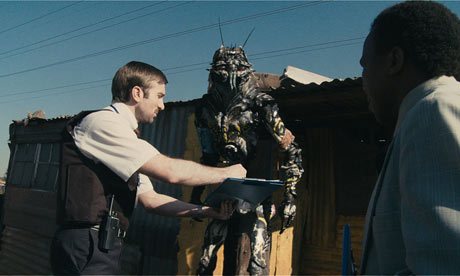
District 9 (Neill Blomkamp, 2009, USA /New Zealand)

It is reflective of both the great strengths and the weaknesses of District 9 that of all of the wealth of interesting things to say about the film, almost all of these are in reference to the film’s first half hour. Almost, since despite the disappointing shape the narrative begins to take after its astounding opening, it is still an intelligent, thought-provoking and above all entertaining film for the course of its duration; the problem is that it is possible to consider it a failure because the elegant brilliance of its exposition, and what that exposition appears to promise, is sadly not matched by the predictability of its later plotting. What a shame that the film has to settle for mediocrity above brilliance.

The opening half hour of District 9 is extraordinary in many ways, but primarily it is through its use of a simple device which subverts many of the rules of traditional science fiction storytelling. We begin with a familiar scenario: a large, monstrous alien craft has appeared in the sky. In the typical alien invasion film this would come as the first plot point, usually after a lengthy amount of scene-setting, yet here this is the scene-setting: we learn that in the film’s timeframe the craft has been hovering over Earth for over twenty years in which time its inhabitants, a reptilian species derogatively nicknamed ‘Prawns’, have been ghettoised by the military into their own city suburb, the shanty town-like District 9.

The film’s second coup is setting this not, say, in New York or Los Angeles where cinematic expectation would predict such events would occur – there is even a very sly reference to this very early on – but in the South African city of Johannesburg. In a stroke it becomes immediately clear that we are in the realm of the symbolic; most obviously the presence of a starved, segregated ‘other’ race living in squalid conditions raises the not-too-distant memories of apartheid, though significantly director Neill Blomkamp has distanced his film from being direct allegorical to this. I would agree; the broad elegance of the metaphor allows it equally to be representative of many other situations of displaced populations around the world – refugee camps, asylum seeker detention centres, and hauntingly the Sabra and Shatila camps rendered so vividly in last year’s Waltz with Bashir (2008).

The initial tone of the narrative is set by its aesthetic: a combination of mock documentary talking heads and rolling news style footage assembled with such skill as to make plausible its supposed coverage of an alien invasion – much like Orson Welles achieved with his The War of the Worlds radio broadcasts over seventy years ago. The documentary format serves the exposition perfectly, instantly setting up the back-story of the aliens’ arrival before thrusting the viewer almost immediately onto the front-line with Wikus Van De Merwe, an irritating, self-satsfied government jobsworth who through nepotistic favour has been assigned the important job of relocating the Prawns to a new camp further away from the city.

Wikus’ job, though, is not going to be easy, as the Prawns demonstrate staunch unwillingness to leave, even at gunpoint. Why? Is it attachment to what have been their Earthbound homes for over two decades, or something more sinister? Here things gets more complicated, as the film begins to shift from its sole reliance on an extremely subjective documentary viewpoint to start incorporating into the narrative omniscient cinematic shots showing the aliens inside their homes apparently hatching some sort of scheme, possibly involving weaponry. It is a confusing directorial choice: by initially sticking to the documentary format, the film draws the viewer into complicity with the prejudiced ‘human’ perspective on matters alien, offering what is a stinging satire of the bias inherent in populist media coverage. Yet by bringing in more traditional storytelling elements in at this stage, the effect, while also to advance the story, is to diminish the impact of the presentation of these early scenes.

It is significant that despite the frequent shifts in film style, the film remains coherent to the viewer. Is this reflective of the modern viewer’s ability to disseminate information from a variety of different types of sources near-simultaneously? Perhaps this makes District 9 a truly contemporary film – a product of a generation used to the constant background hum of YouTube and 24-hour news channels. The film is also strikingly up-to-the-minute in terms of its visual effects. To my mind at least, it feels like a true landmark in its seamless integration of CGI aliens into the ‘real’ world, aliens which look perfectly tactile in their movements and interactions with the tangible mises en scène. This ‘reality’ of the aliens is crucial to reinforcing the film’s initial feeling of documentary authenticity.

So far, so spectacular, but come an important plot point the film spectacularly veers away from what it has built to thus-far to morph into a hybrid of overly familiar science fiction tropes, among them the pseudo-Cronenbergian body horror, evil corporation parable, gung-ho guns-a-blazing action flick, and plain old sub-ET (1982) get-the-cute-aliens-home thriller. Gone, mostly, is the documentary aesthetic in favour of a fairly straightforward storytelling structure. Gone too is much of the subtext; the central idea that the presence of foreign invaders often makes monsters of us all is replaced with two simplistic comic-book villains – the private military body MNU personified by over-zealous bloodthirsty officer Venter, and a murderous, debased Nigerian gang led by the horribly two-dimensional warlord Obesandjo. Instead of examining the wider issues of integration and racial tension, the story cops out and instead focuses on a more easily digestible battle of clearly delineated ‘good’ characters versus ‘evil’ ones.

Why does the film take such a radical turn? There is an argument to be made for its structure, if one accepts that the focus of the story is not strictly socio-political or allegorical but largely focused on the central character of Wikus and his metaphorical road to Damascus. The plot forces him to see things from the Prawns’ point of view, and so his character sees a development from yes-man scaler of the corporate ladder to sympathetic, heroic mensch. The wider message of the film is consistent: the sympathetic portrayal of the aliens by the film’s end is in contrast to the earlier views of them which were narrow stereotypes created by populist media coverage stoking up racial tensions, in doing so the film asks us to look beyond these and realize the commonalities with ‘the other’.

At the story’s centre, then, is the person of Wikus Van De Merwe, and it is thanks to a superb performance from actor Sharlto Copley that the film is able to be carried by him through its many stylistic turns. Even ignoring his physical metamorphosis, his is one of the greatest transformations in recent blockbuster memory. When we first meet him his most significant attribute would appear to be just how unremarkable he is – a middle-ranking bureaucrat, fairly incompetent in performing his job, nervous in front of the camera and largely devoid of anything approaching a personality. Yet as the film progresses he slowly grows in stature and determination, and as sympathy for him grows as his snivelling is replaced with steely resolve we eventually wish to see him receive some kind of redemption.

As brilliant as its lead performance is, it must be said that the focus on this one character is the root of the main problem with District 9. It seems strange to criticize a film for concentrating too much on character as opposed to exposition, but by narrowing the field of view to one player the broadness of the story is lost, its central metaphor abandoned, and its innovation makes way for a predictable story trajectory. There are, in a sense, two quite separate films here, both operating within their own terms perfectly well, but the opening film serving to highlight inadequacies of the following one which in isolation may not have been noticeable. It is significant that the film began life as an expansion of a short film, and it seems that this has not entirely successfully been inflated to feature length. District 9 ultimately should be judged an entertaining, at least partially thought-provoking action-filled romp.. but it could have been so much more.

Frightfest 2009 Roundup

There are a many reasons why Frightfest is a joy to attend, but chief among them is the chance to watch films with an appreciative, knowledgeable and attentive audience of like-minded horror fans. This struck me most during Saturday night’s screening of Dario Argento’s Giallo (2009), a blisteringly bad addition to the Italian director’s ignoble recent run of duds, when, roughly thirty minutes into the running time, the audience seemed communally to begin to delight in all of its awfulness. In different environs, say at a poorly-attended multiplex showing or a home viewing on DVD, the film would easily be written-off as one of the most poorly-executed thrillers ever made, yet somehow this mass realization allowed the audience positively to revel in its terribleness, rendering it one of the most enjoyable screenings of the long weekend. A unique experience. Readers are advised to avoid the film at all costs, however.

The film of the weekend in terms of sheer quality was undoubtedly Michael Dougherty’s Trick ‘r Treat (2008), a wonderfully imaginative anthology of five stories set on Halloween night, all delicately woven together in the manner of Robert Altman’s Short Cuts (1993). Director Dougherty, a frequent collaborator with Bryan Singer, uses as his starting points different aspects of the traditional Halloween night and weaves them into a series of modern folkloric tales stuffed with viciously black humour, visual grace and storytelling invention, and the result is an absolute joy from start to finish. A genre classic which I defy anyone not to fall instantly head over heels in love with.

By way of comparison, also Halloween-themed and by far the worst film I had the misfortune of watching was Adam Gierasch’s remake of Night of the Demons (2009). The very antithesis of Dougherty’s film: a shallow, hugely unimaginative and derivative snoozefest, apparently swimming in the same sea of retarded sexuality as the songwriting members of Spinal Tap. The only entertainment I could find was in gawping at how, in the 18 years since Terminator 2 (1991), Edward Furlong has managed to metamorphose into K.D. Lang.

British films had a strong showing on the Monday night closing the festival, with two major world premieres. First up was Heartless (2009), the long-awaited new film from The Reflecting Skin (1990) director Philip Ridley; set recognizably in what David Cameron would have us believe is ‘Broken Britain’, the story is of a young man with a large heart-shaped birthmark on his face who is led into a pact with the devil to rid him of it and allow him to fall in love. The film is highly praise-worthy: imaginative ideas, genuine filmmaking flair and a unique, distinctly British feel to proceedings made it a rewarding watch, and festival organizer Alan Jones described it as his favourite film of the year. While I felt that it was not without its clunky moments, it is undeniably a bold piece of work from one of our cinematic national treasures, and for this reason, as well as for a fantastic cameo by Eddie Marsan, I recommend it.

The other major British release, and the one film I went into with most reservations about, was The Descent: Part 2. When it was announced that a sequel to Neil Marshall’s excellent caving shocker was in production my immediate reaction was that it would be pointless, and the double whammy of Marshall relinquishing the directorship as well as the tampering with the haunting ending of the original made me intensely wary of the project. After a worryingly shaky start, however, the sequel proves itself more than a match for its predecessor: taking the Aliens (1985) route of sending the sole survivor back down to locate her missing friends, the film successfully recreates the claustrophobia and character-driven tensions that marked out the original. This is in no small part down to the presence of director Jon Harris, editor and second unit on Marshall’s film, who not only creates a feeling of continuity between the films, but also imbues this one with some cleverly thought-out new ideas and an occasional skilful insertion of black comedy to proceedings. All-in-all a worthy sequel, one as good as a fan of the original could hope for.

Outside of the British and American films, as usual there was an array of interesting international films. The Miike Takashi award for most out-there film clearly would be handed to Dutch filmmaker Tom Six for his truly bizarre The Human Centipede (First Sequence) (2009). The synopsis tells pretty much all you need to know: a brilliant German surgeon who specialises in separating Siamese twins kidnaps and incarcerates three foreign tourists in the basement of his house with one intention: to graft them together anus-to-mouth to form the titular creation. The implications of such a creature are suitably explored, and though the film may be found to be lacking in a number of quarters, the sheer loopiness of the idea is enough to make it linger unpleasantly in the memory for quite some time.

A highlight for many attendees appeared to be the UK première of Swedish international hit Millennium: The Girl With the Dragon Tattoo (2009), a more elegant if less descriptive title than the original Män som hatar kvinnor [Men who hate women]. The film, based on the posthumously-published bestseller by Stieg Larsson, is an effective twisty-turny thriller with two likeable, memorable lead characters and tears through its 150 minute duration surprisingly quickly. My reservation would be that there is simply too much typical thriller chaff – hunching over laptops, blowing up photographs, digging in archives – for it to be particularly memorable, but if it sticks to the rules then admittedly it does so particularly well. Already a massive hit all over Europe, the source book’s popularity should ensure crossover appeal when the film is released here in April.

One of the most anticipated films in this year’s line-up was Tommy Wirkola’s Død snø [Dead Snow] (2009) and, after something of an unpromising start, the film delivered enough humour, gore and grisly deaths that one would hope for come the eventual arrival of the promised flesh-eating Nazi zombies roaming around a snowbound Norwegian forest. By contrast, Australian thriller Coffin Rock (2009) was a disappointment: a good premise – involving an infertile couple and an increasingly deranged young stalker – as well as a suitably gritty visual aesthetic set up tension promisingly, but the over-the-top pantomime madness of the villain began quickly to annoy and alienate. Saturday night climaxed with the deliriously unhinged Black (2009), which began as a French heist film, but began dipping its toe into genres as diverse as Blaxploitation, camp sixties thrillers and – amazingly – sci-fi animorphism; audience members fading at the 2am start time were quickly shocked out of their slumbers.

A final word for Dread (2009), perhaps the most divisive film of the festival, which screened on the Sunday night. Based on a Clive Barker short story, it centres on three students who embark on a college project involving video interviews with their peers to investigate the nature of their deepest fears, but inevitably the subject of their investigations begins to turn towards themselves and their own revelations lead to predictably messy consequences. Moving at times at a glacial pace, the film seemed to lose viewers still pumped up from the din of Night of the Demons, but I found it to be an intriguing, unashamedly psychological thriller – not a classic by any means, but in tone reminiscent of Crash (1996)-period Cronenberg and with a satisfyingly bleak denouement. An original story, and one which deserves to find an audience.

10 Years of Frightfest

Having outgrown the bijou surroundings of the Prince Charles Cinema as well as the larger Odeon West End, Frightfest, London’s annual celebration of contemporary horror films this year moves to the more spacious surroundings of The Empire, Leicester Square. The main screen this features a line-up of premieres of both major domestic and international genre films, and for the first time this year there will be a second smaller screen entitled the ‘Discovery Screen’ will be used to show a variety of lesser-scale delights. The festival’s continued expansion is illustrative of not only an increasing appetite in the UK for cinematic thrills and spills but so too the rude health that the genre continues to be in internationally.

Among the highlights this year include world premieres of Christopher Smith’s Triangle, The Descent Part 2, Philip Ridley’s Heartless, Aussie thriller Coffin Rock, the highly-tipped Italian thriller Shadow and the bizarre-sounding Human Centipede, as well as first UK showings of Swedish Euro-sensation Millenium, Michael Dougherty’s already-classic Trick R Treat, and cult Norwegian Nazi Zombie flick Dead Snow. All in all, more than thirty different films from twelve different countries, and the extra promise of special guest appearances and introductions by cast and crew members.

Frightfest runs from this evening through to Monday 31st August. Festival passes have long since sold out, but tickets for single films will still be available for many films. See the official Frightfest website for details: http://www.frightfest.co.uk/

And be sure to follow my (hopefully) live coverage on Twitter (see sidebar link) or my post-festival roundup here early next week.