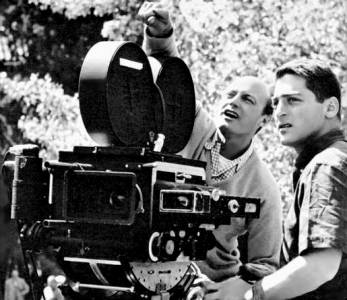
Synecdoche, New York (Charlie Kaufman, 2008, USA)

Charlie Kaufman, creator of the ingenious labyrinthine worlds of Being John Malkovich (1999) and Eternal Sunshine of the Spotless Mind (2004), makes his directorial debut with his most maddeningly complicated film yet. It will not win him any more admirers; it will almost certainly lose him many. It will divide opinion into those who consider it the logical continuation of his previous work, and those who think he has completely lost the plot. I would love to declare it to be brilliant, but frankly I can’t be too sure its not a load of twaddle.

Everything starts off reasonably simply. Caden Cotard is a hypochondriacal theatre director obsessed with death. Staging an unambitious production of Death of a Salesman, he casts a young man as Wille Loman, elucidating that it doesn’t matter whether he’s old or young – he will die anyway. Caden’s home life is beginning to fall apart: relations with his artist wife Adele have deteriorated to such an extent that she soon moves to Germany, taking their young daughter Olive with her. Cue much moping, leading to him finding solace with the theatre box-office assistant Hazel.

So far, there have been some wonderfully deadpan Kaufman flourishes: curious word games and references to high literature; Caden envisioning himself in TV adverts, getting referred to a comical succession of medical specialists, and eventually end up seeing a therapst whose self-help books literally address him personally. Hazel lives in a house which is permanently on fire – a surprisingly successful metaphor for life itself. Indeed, black comedy which, for better or for worse, has come to be labelled ‘Kaufmanesque’.

Things, though, begin to take a turn towards the bizarre when, on the back of his successful production of Salesman, Caden receives a MacArthur ‘genius grant’ which he can use to finance whatever artistic project he wishes. Increasingly obsessed with his own mortality, he decides to rent a Manhattan warehouse and attempt to recreate as nearly as possible life outside of it. In doing so, he believes, he will create art which is honest and real. The trouble is, his vision grows increasingly large, so large as being unable to accomodate an audience.

Here is where things get rather muddled, intentionally so. Time, frequently a key motif in the film, begins to jump forward rapidly. Seeking out his wife and daughter in Germany, Caden is told that Olive is no longer four years old but ten; in film time this elipsis has taken only a few minutes. The world of his play is rapidly expanding and begins to blur with Caden’s real life; he ends up auditioning for someone to play himself in his own life, and then finally he ends up playing a minor character in his own story. In the meantime, peripheral characters around him are dying with increasing frequency, heightening his own morbidity.

Following all of this? I thought not. There are many fine concepts and ideas at the centre of all of this: most significantly the folly of trying to make art which accurately mimics life which ends up as a kind of infintely repeating Borgesian labyrinth. Within this, other ideas are shoehorned in, sometimes as distracting asides, sometimes as comedic tonic to the bleakness of the bulk of the film. The cast, a dream ensemble of fine character actors, do their best to make an unappealing group of individuals watchable, but ultimately their best efforts get squashed underneath the weight of portent.

It is a tough two-hours to sit through, and not one that I wish to do again in a hurry. Some critics have thrown out comparisons to Lynch and Fellini, but I would point out that those two directors never failed to make their films entertaining; sometimes Kaufman’s film is plain dull. Synecdoche, New York with all of its wildly Quixotic ambition comes across as self-indulgent but not in a self-satisfied way like the terrible I Heart Huckabees (2004). Instead, there is the feeling that Kaufman is reaching for something that is just out of his grasp – but at least he is trying.
Star Trek (J.J. Abrams, 2009, US / Germany)

Before the screening of Star Trek, a trailer ran for the new Michael Bay travesty Transformers: Revenge of the Fallen (2009), two minutes of inhuman objects pointlessly crashing and banging into each other which seems neatly to sum up his entire film output so far. The continuing success of these films seems to be symptomatic of the state of the post-Spielberg/Lucas blockbuster market where those old-fashioned elements, story and character, now run a distant second in importance to the film’s CGI department. Ironically, this has seen the best written big-budget entertainment films of recent years being from computer-generated animation stables Pixar and Dreamworks.

Thank heavens, then, for Star Trek. Director J.J. Abrams has taken what has become one of the most tiresome franchises since Police Academy and achieved a double coup: firstly, he has entirely redrawn the familiar Trek universe and formed it into something excitingly fresh, freed from the leaden boots of the prior films. Secondly, and more importantly, he has made a good old-fashioned action film which romps along like these sort of films used to, bursting with likeable characters, a decent plot, directorial nuance and no little wit.

Casino Royale (2006) rebooted the James Bond franchise by going back to the start of the MI6 agent’s career, wiping out all that had gone before in the preceding twenty films and starting again. Star Trek could easily have done the same, showing us the young cadets on their route through Starfleet to the USS Enterprise, but what we are given here is something altogether more daring. For reasons that will be made clear, a Romulan craft has somehow managed to travel back from the year 2387 to a time some 153 years earlier; in this ‘past’, it intercepts and destroy a Federation ship, killing the Captain, a certain George Kirk, whilst his wife is in an escape pod giving birth to their son, James Tiberius.

Fast-forward twenty-odd years and the now grown-up Kirk Jr. is a somewhat reckless and aimless young man, but is talented and is eventually convinced by a friend of his late father to follow in his footsteps and use his abilities for good in Starfleet. Meanwhile on Vulcan a young Spock, finding himself bullied as a child and discriminated against as an adult for being of mixed Vulcan-human blood, decides to joins Starfleet as a rebellion against his elders’ expectations of him. The two men progress up the ranks, along the way meeting some other familiar names – Uhura, McCoy, Chekov, Sulu – if at times through some rather fortuitous and unlikely plot devices.

What becomes clear, and is subsequently explained to us in case we don’t get it, is that the time-travelling Romulan craft has created an alternate parallel reality, one where, for example, Kirk does not grow up knowing his father. This is not a prequel in the sense that these characters will eventually go on to become those in the television series and then the films, the path of their lives have been irrevocably changed. An existentially questionable idea, but one which matches some of the franchise’s other bits of bad science, and also one which allows complete freedom in subsequent films.

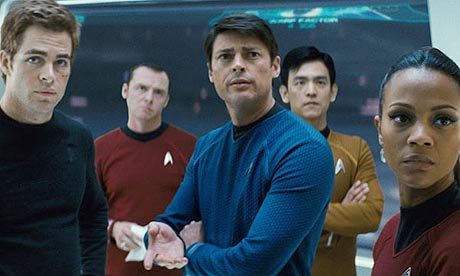
The scenes of the young crew members finding their feet are lively and fun, the minipop versions of the original crew still slightly wet behind their ears (some pointy) and getting used to their new vessel – Sulu not yet able to get the thing in warp speed, and Chekov’s thick Russian accent seriously raising the question as to why he was chosen to be the ship’s announcer. The casting is nearly impeccable – in particular Zachary Quinto excels as the emotionally confused and repressed Spock, topped only by the magnificent Karl Urban as the younger ‘Bones’ McCoy, whose grouchy sarcasm consistently reduced me to tears of laughter. Only Simon Pegg is miscast, horrifyingly so, but his fleeting scenes as Scotty are faintly forgettable.

Though it remains to be seen what the hardcore fanboys will make of this newly imagined Trekverse, I for one was impressed with the film’s emotional content. Though there is much enjoyable light fluff, there are also a depths of sadness: of Spock’s isolation, confusion but eventual pride arising from his mixed-race heritage, and the deepening parallels he will share with Kirk’s feelings of loss and inadequacy. Like in many a trite love story, the two men initially despise each other but events make them grow ever closer, aided by the intervention of a familiar face from the past (or is that future?).

There is so much fun to be had with the characters that it is easy to forget the serious matter of the Romulans from the future armed with advanced weaponry threatening the destruction of the entire universe. Here is where the film enters familiar space-romp territory where the new Enterprise has to save the day, and is perhaps where the film is at its weakest – the final third of the film struggles to match the magnificence of the first two-thirds. Still, the action sequences are handled well enough, Abrams’ direction filling the screen with plenty lens flares, dutch angles and gliding camera moves to keep the audience visually entertained.

J.J. Abrams blotted his copybook early on with a writing credit on Michael Bay’s Armageddon (1998), but since then he has carved a name out for himself as creator and producer of TV hits Alias and Lost. His only previous directorial effort was the passable Mission:Impossible III (2006) but with this dynamic and hugely entertaining reinvention of the ailing Star Trek franchise it seems as though he has put himself at the top of the Hollywood tree. Smart, funny, visually exciting and at times surprisingly moving, it puts the recent Star Wars and Indiana Jones films to shame, and as a piece of slightly old-fashioned blockbuster filmmaking it may announce him as the true heir to the Spielberg/Lucas mantle.

Happy 50th Birthday Antoine…

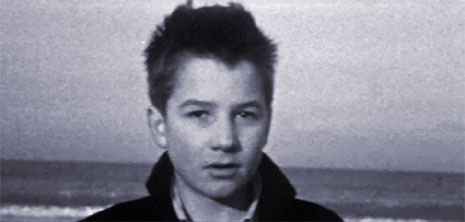
…and by extension, a happy 50th birthday to the French New Wave, not necessarily initiated with the release on May 4th 1959 of Truffaut’s The 400 Blows, but that film marked the first major artistic achievement of a movement which, regardless of one’s opinion of individual films and directors, unarguably changed cinema forever. Quite how has been and will be a matter for film historians to debate and revise, probably for as long as film remains a serious art form.

Cannes unveils its lineup…

..and while most commentators are noting the presence in competition of such heavyweight auteurs as Tarantino, Loach, Almodovar, Von Trier and Ang Lee, is not also of significance that the jury is this year headed by the bonkers duo of Isabelle Huppert and Asia Argento? Sounds like the recipe for an ‘interesting’ winner of the Palme D’Or….

The full lineup is here

Jack Cardiff, 1914-2009

Sight and Sound recently ran a feature in praise of cinematographers, and suggesting that few could really be called household names. One name which might spring more readily to mind than others is Jack Cardiff, and for good reason.

Several good reasons in fact, most significantly a trio of films which he shot for Michael Powell and Emeric Pressburger starting with the startling kaleidoscopic visions (in colour and black and white) of A Matter Of Life and Death (1946), continuing with the stunning (false) Himalayan sweep of Black Narcissus (1947), and finishing with the ravishing colourful flourish of The Red Shoes (1948).

These three films not only sealed Powell and Pressburger’s reputations but so too Cardiff’s, who then became cinematographer to the stars, shooting subsequently for the likes of Alfred Hitchcock, John Huston and Laurence Olivier, as well as intermittently turning his hand to direction himself.

The Powell/Pressburger films stand as his testament. All three remarkable for their use of Technicolour, but also in very different ways from each other: the fluid dynamism of The Red Shoes, the stately elegance and breathtaking scale of Black Narcissus, and the sheer visual wizardry of the range of visual tricks in Life and Death show a visual artist with an incomparably complete mastery of the camera. Marilyn Monroe described him as ‘the best in the world’. It is hard to argue against this.