Che: Part One – The Argentine (Steven Soderbergh, 2008, France/Spain/USA)

Steven Soderbergh occupies a unique and rather contradictory position in the filmmaking world: on the one hand, he continues to turn out those glossy, big-budget, no-brainer Oceans films every three or four years, to quite staggering box office returns – Ocean’s Thirteen (2007), for example, grossed $300 million-plus from an $80 million budget. On the other hand, these big-hitters are interspersed with more low-key and obviously personal projects: the philosophically meditative Solaris (2002) or the noir-ish The Good German (2006), both of which were stylistically interesting, though proving to be box office poison.

Given this pattern, an assessment of a new Soderbergh film means, to an extent, figuring out which category it falls into. A budget of $60 million may suggest that Che is no minor vanity project, but neither is a four-hour film largely in Spanish about a famously anti-American icon likely to appeal to the Oceans demographic. However, it seems safe to presume that Guevara’s iconic status both in Latin America and the wider world guarantees this film an audience independent of the director’s fan base.

On its arrival in Cannes last year, the film was subject to both praise and criticism in almost equal measure, and it is not hard to see why; not only is its protagonist a figure of much historical controversy, but the film itself is far from conventional. In its original form, it was screened as a single 268 minute film simply entitled Che, a running time which was dramatically cut by 30 minutes by the time it made its arrival at the Toronto Film Festival some four months later. Now it hits cinema screens as two separate films, The Argentine and Guerilla, and, in the UK at least, released several weeks apart. Having only seen the first part, The Argentine, it is a little difficult completely to pass judgment on Che as a whole, but it is possible to make some key assessments of its structure, tone, and intentions.

The life of Che Guevara reads something like a film plot – young, well-to-do doctor is transformed into a revolutionary leader, only to meet a messy and premature demise – and there have been several prior Ches on screen, most notoriously Omar Sharif (unbelievably!) in 1969’s Che!, and more recently in Walter Salles’ warm portrait of the young Ernesto in The Motorcycle Diaries (2004). His life has been portrayed in books, art, and music for the last fifty years, and his legacy the subject of fiercely partisan debate for just as long. The question facing anyone approaching this contentious subject matter is this: which Che do I examine?

What many will expect from the films is a conventional biopic format, i.e. portray certain key moments of the protagonist’s life, show how these affected his worldview, and with a nice linear narrative (preferably romantic) beneath everything so no one gets lost or bored. What is surprising is just how little of that The Argentine gives us; instead we have a meticulously researched and crafted reconstruction of the minutiae of Che’s role in Fidel Castro’s assault on Cuba, intercut with scenes portraying his famous visit to the United Nations in New York in 1964, but with little or no information about his background: it can practically follow on from The Motorcycle Diaries with no overlap.

Though we see much of the public Che – speechifying, organising his men, running, jumping, and shooting – there is precious little of the real Ernesto shown onscreen; close-ups are eschewed in favour of long and medium shots, the camera seemingly unwilling to invade his personal space for any length of time. What little we learn about the man is then confined to what we can glean from his public persona, which presents the audience with as oblique a portrait as Alberto Korda’s famous Guerrillero Heroico.

In avoiding the usual biopic genre expectations, what emerges is something very different and unexpected. The public Che, with his pronouncements on politics and imperialism, becomes a personification of the revolution itself: falteringly human, contradictory in his very nature, but unerringly sure of the righteousness of his convictions. The film’s timeline begins in the confines of a pleasant dinner party, and we are invited to think about why this young man would leave this comfort to spend years in the jungle fighting for an ideology. What we do see along the way is the plight of the ordinary people, toiling both under a military dictatorship and gross social inequality, and can begin to understand better his motivations. In one comical but poignant scene, when attending to villagers’ ailments, one lady confesses to Dr. Guevara that nothing is wrong with her, she was there simply as she had never seen a doctor before.

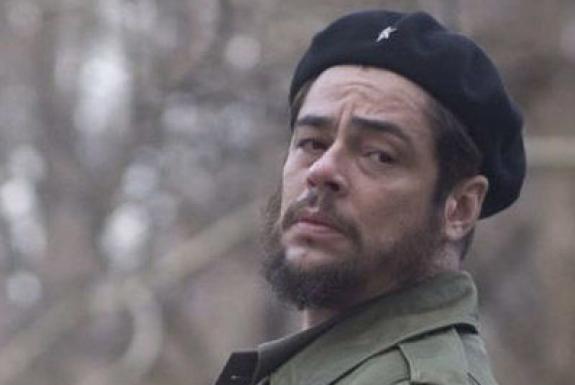
In terms of casting, it is hard to find fault. Benicio Del Toro’s stocky frame and seriousness of expression match that of the Che being portrayed, and his performance never seems overly mannered, even his continued labouring under his asthmatic wheezes. Squinting, I might not be able to tell apart Demián Bichir from the young Fidel Castro, who in his relatively minor role captures the dictator’s charismatic demeanour with suitable charm. Only Catalina Sandino Moreno seems misused, thanklessly having to be content mostly with jogging around with a rifle, though as the future Señora Guevara she is bound to figure more prominently in the film’s second part. On a more technical note, the film marks the most high profile use of the Red One digital camera, and the cinematographic results are no less than spectacular — this is certainly the future of filmmaking.

Che Part One stands as a fascinating piece of biography making, not compromising towards linearity, generic expectation or narrative; for some this will be enough of a turn-off for it to be viewed as a failure, but a failure on whose terms? As I began, Soderbergh is a filmmaker of contradictions, aware of the financial realities of his craft, and able to make interesting projects happen thanks to his almost unique position within the industry. Perhaps that is why he was attracted to making a film about Che Guevara, who also had to defend the contradictions of his position – revolution may be about love of one’s fellow man, but this love necessitates killing. How can this paradox be reconciled? In private, this may be impossible, but in public one must attempt to square this circle.

The Day the Earth Stood Still (Scott Derrickson, 2008, USA)

Earlier in the year I gave a rather sniffy review of Frank Darabont’s The Mist (2007), laying into what I saw as its very two-dimensional characterization and repeated insistence on B-movie cliché. Well, I take it all back, because compared to this remake of the 1951 Robert Wise sci-fi classic, Darabont’s film looks like a spectacular cinematic coup: The Day the Earth Stood Still is a shambles, not knowing whether it wants to ape the original film or diverge onto some sort of modern-day warning of impending environmental catastrophe, and ultimately succeeding with neither.

For those who are unaware of the original film, it can be summarized thus: alien craft land in Manhattan, man-like alien come out, man shot, biiig angry robot come out, man begin to learn about humans’ war-like ways, man have message for humans: stop killing each other or be destroyed by aliens, man leave. Rightly regarded as a classic of its time for its clear anti-war message, a worldview looked upon with suspicion in a time of anti-Communist paranoia, what makes it endure is not necessarily the quality of the production but the pointedness of its social commentary. Thus, a remake which tries to do the same but with a modern-day relevance seems plausibly a good idea.

Unfortunately, the film makes a complete hash of this. It appears that Keanu, sorry, Klaatu, the smaller of the two invaders, this time has been sent here to warn us that the damage the human race is doing to the environment is the evil which has deemed us worthy of galactic destruction. He meets scientist Dr. Helen Benson, who helps him to escape government incarceration, and in doing so she becomes an unwitting representative for humanity, and must convince him that we can undo all this bad stuff we’re doing to our planet. Man. Surely a noble cause? Unfortunately, a quick squint at some of the unsubtle product placement throughout the film renders this all a bit silly – do we save the world by driving Honda cars, using LG palmtops and eating at McDonald’s then? Or indeed by throwing huge amounts of C02 into the atmosphere by making films which exist solely to keep Keanu Reeves in acting roles? Well, no, i don’t think that’s what Al Gore was trying to tell us.

It gradually becomes clear that what the film is trying to manoeuvre us into thinking is that it is Dr. Benson’s love for her adoptive son, coupled with her Nobel-winning colleague Professor Barnhardt’s work on altruistic biology, are enough to prove that mankind is trying to do something about it all, and so is ultimately worth saving. So we are to believe that while the aliens have done phenomenally complex research into studying our behavioural patterns, levels of industrial output and its consequent damage to our ecosystem, what they hadn’t managed to spot was Jennifer Connelly being nice to Will Smith’s son, and John Cleese scribbling on a blackboard.

There is a spectacular lack of tension, or indeed scale, throughout the proceedings, but what really deflates the piece is Keanu Reeves, who at first seems very apt to play an alien unfamiliar to a human body – after all, he spent the majority of the three Matrix movies just wandering around with a confused look on his face. Unfortunately, the role here demands a little more than that, but his entire lack of ability to convey any sense of empathy or emotion just makes you wonder why Klaatu decides to spare us all in the end anyway. And there is one unintentionally hilarious moment where he starts speaking in Mandarin which lost all seriousness for me because it made me uncontollably think of a scene from Wayne’s World (1992).

Two points which did make me think: number one, the notable absence of the President of the USA from proceedings – he and his VP we are told have been ushered away to the safety of a bunker, a dry commentary in what will be one of the last films of the George W. Bush era. Secondly, all of the obvious Biblical connotations to the Klaatu/GORT axis, as well as talk of apocalypses, floods, arks etc.. etc.. sit very uneasily with me in a film supposedly about global scientific co-operation. Creationism really needs to stay away from environmentalism.

Of Time and the City (Terence Davies, 2008, UK)

There is nothing more likely to make me balk with horror than anything fitting the description of “English heritage cinema.” I think of all of those horrifying Merchant-Ivory productions which wistfully yearned for a glorious, happy period of imperial dominance which clearly never existed in the real world.

For many, the antidote to that particular cinematic poison has been the work of director Terence Davies who, beginning with his Trilogy (1976-83), and later with the masterful Distant Voices, Still Lives (1988) and The Long Day Closes (1992), painstakingly portrayed elements of his own personal experiences of growing up in a post-war and post-Empire England with unflinching honesty. Though at times sentimental for the lost days of his childhood, there is also a focus on ever-present forces of repression, whether they be in the form of organized religion, paternal domestic violence, or societal suppression of the director’s own homosexuality.

What is continually disappointing is that funding for Davies’ films has been hard to come by, and so his output has been rather meagre; just four features in twenty years gives even Terence Malick a run for his money. A new Terence Davies film, in whatever form it takes, is therefore an event which needs to be celebrated in itself. Of Time and the City in appearance looks like a documentary about Liverpool. Book-ended with grand shots of the modern-day city, the majority in between is composed of found footage mostly of the kind of working-class neighbourhood where Davies grew up, as well as images of the city’s proud but dwindling industrial past. As the film marches on, time does too, and we move away from the grainy black-and-white images of Austerity Britain, past the Korean War and the Coronation towards the Sixties and the Beatles, from red-brick housing terraces to grim, menacing tower blocks, and from the director’s childhood to his adulthood and self-discovery.

However, those expecting a balanced look at the city’s history should be warned that they will be disappointed: for example, the footage of the Beatles, surely a key focus of any examination of twentieth century Liverpool, is brief, with the narration dismissing them as looking like “a firm of provincial solicitors”. This is a highly subjective, personal piece of work, in many ways much more about the director than the city of the film’s title. His similarly fierce opinions on such matters as the Church, the monarchy, Empire, modern architecture and indeed most anything else modern, smack of curmudgeonly belligerence, and there is a danger with this sort of material of slipping into a kind of Philip Larkin-esque misanthropy. Yet there is also something alluring about this rebelliousness, an anti-establishment stance seemingly at odds with nostalgia, which raises some of the contradictions of what true Englishness, or Britishness, constitutes.

Davies himself supplies the narration, and his extraordinary voice dominates the proceedings: a rich, well-spoken baritone (which some have backhandedly compared to Richard Griffiths’ Uncle Monty in Withnail and I (1986)) which guides us through his memories like a kindly grandfather offering a child some Werther’s Originals. It is something of an acquired taste, but it is impossible for me to imagine anyone else delivering anywhere near as affectingly the words of his remarkable script: weaving quotation, poetry, and experience, by turns full of warmth and radiant recollection, sombre and sober self-examination, and peppered with his trademark razor-sharp wit. I don’t think I have laughed so much with a film this year.

In the hands of a less confident, less intelligent, or less talented director, this would be faintly forgettable Sunday afternoon television documentary fare. But Terence Davies is much more than that, and Of Time and the City is much more than just misty-eyed nostalgia. It is informed as much by both sadness and rage at the betrayal of a great industrial city, and by extension the working classes in general, by those forces which claimed to be working for the common good: the Church, the monarchy, and more subtly, the State. The film is about his own fall from grace, but also a country’s; in a time when there is a national debate in the UK media about the breakdown of society and communities, the film’s juxtaposition of footage old and new makes clear the director’s personal feelings on the matter.

Those who love Terence Davies will love this film, but equally his detractors are likely to have their doubts reconfirmed. To my mind, he is a national treasure, a cinematic equivalent of Morrissey, another product of the industrial North-West, and someone who who at his peak covered similar thematic ground with as much intellect, dry wit, and maybe just a little despair. Trying to recommend to get someone to watch a Terence Davies film is like trying to get someone to listen to The Smiths for the first time — it is nigh-on impossible to explain his films’ strange magic, but one must try regardless.

Film of the Year 2008

1. Beş Vakit aka Times and Winds (Reha Erdem)

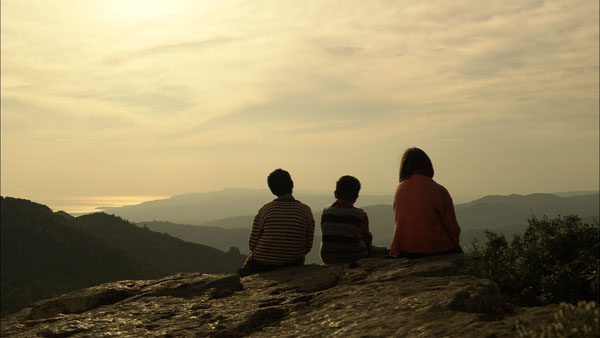
Why is a film set in a remote, subsistent Turkish village with a threadbare narrative my favourite film of the year? It is in the way in which it transcends its location, its characters and its events to touch on more broadly universal themes: life and death, love and hate, responsibility and neglect, fathers and sons, mothers and daughters, as well as the confusions and pains of growing up. The film’s structure, based on the five daily Muslim calls to prayer, sets the rhythms of religious ritual against the larger rhythms of the natural world – are they entirely compatible?

In some senses, the film is a piece of sheer escapism – the cinematography rapturously capturing the spectacular terrain of coastal Turkey. But to my mind what makes it special is how it frames its universal themes, without recourse to any form of closure, and uses them to allow us to reflect on our own lives, the fleeting nature of both joy and pain, and the fear of the inevitable march of time but also taking comfort in life’s natural rhymes and seasons. A slow burner, yes, but the film which most captured my heart and imagination this year, and so my Film of 2008.

The Films of 2008: Part Four

2. There Will Be Blood (Paul Thomas Anderson)

Many critics wrote off Anderson’s last feature, Punch-Drunk Love (2002), as a throwaway piece, almost a vanity project for the director to work with Adam Sandler before returning to the serious business of making another Robert Altman-inspired ensemble drama like Magnolia (1999) or Boogie Nights (1997). But if they had inspected his last film more closely, they would have seen a signpost for what was to come: what Punch-Drunk was doing was challenging the very foundations upon which modern cinema is based – playing with genre convention, narrative expectations and characterization, as well as demonstrating the director’s incredible flair for both innovative visual and sound design.

Five long years on from this, and what emerges is another such challenge, a meticulously rendered period piece, but one whose allegorical content raises what could be a simple tale of greed and corruption to the level of near-Biblical tragedy. It is the story of the coming of modern America, and so becomes a story of our oil-soaked times: the incompatibilty of unfettered and inhuman capitalism with the evangelism upon which the country was founded. Day-Lewis’ barnstorming performance has been well documented, but Paul Dano opposite him as his nemesis, preacher Eli Sunday, is just as spellbinding. The balance between the two is essential to the film: one can constantly feel the two poles of religion and greed tussling beneath a surface veneer of social respectability, each despising but also failing to comprehend the other.

And pulling everything along is Jonny Greenwood’s phenomenal score: ear-piercing violin screeches alternating with driving pizzicato rhythms, keeping the films relentless march towards its eventual denouement. I have now seen There Will Be Blood four times, and still feel entralled watching it, bemused and questioning about its cinematic language, and above all further in awe at the best director currently working in mainstream American cinema, Paul Thomas Anderson.