The opening shot of Martin Bargiel’s Augenblicke, seen through the eyes of its main character as he stares vacantly back at his reflection in the distorting mirrored wall of an empty elevator car, may seem a mere matter of cinematic trompe l’oeil, yet it serves as an elegant motif for the film in its entirety, which plays like a dizzying waltz through a carnival’s hall of mirrors in which the disoriented viewer is scarcely able to orientate themselves amidst their new surroundings before being whisked away into another, more sinister sphere of consciousness.
The consciousness in question is that of Schenker who, upon leaving his apartment block one evening, stumbles upon the dead body of a fellow resident who has apparently fallen from one of its high windows. From this seemingly straightforward beginning, the film progresses into a maze of shifting perspectives and time-frames as the increasingly baffled Schenker tries to piece together the preceding events; or have they, in fact, happened at all? Rather than a Rashomon-like meditation on the perspectival nature of memory, the film’s elaborate construction seems to call into question the very plasticity of reality itself as Schenker is plunged ever further into a many-circled Dantean inferno.
What is remarkable is that, in spite of its complexity, the film is propelled by narrative coherence rather than hampered by it, and the seemingly breathless pace of its meta-narrative is in direct contrast to the slow near-mundanity of many of its individual scenes. This latter stillness, coupled with the woozy, jaundiced visual aesthetic reminiscent of Roy Andersson, only serves to make this surreal Borgesian labyrinth all the more unnervingly nightmarish.
Perhaps reflecting our more economically-uncertain times, this year’s Frightfest felt a little quieter than in recent years. Not in terms of turnout – which seemed another increment on the festival’s upward spiral of attendees – but in terms on the films on offer: fewer world premieres than we’ve been used to, and no defining stand-out film around which things felt centred. But if there was a more low-key feeling to the programme, then it ought to be said that this was also a more fun year than has been had in recent festivals too: yes, still the residual dregs of unpleasant torture porn films which had appeared to be on their last legs last year, but also signs of a new playfulness in both US and European horrors. While not necessarily offering anything from major household-name directors, the presence of mature works from two significant young auteurs also offered hopeful signposts for genre filmmaking.
The opening and closing films proved something of a disappointment. Opener Don’t Be Afraid of the Dark (2010) offered further evidence of diminishing returns from the “Guillermo Del Toro presents…” stable, failing to decide whether it was a serious or silly examination of childhood fears, and ending up being effective in neither regard; a Joe Dante would have made a much more effectively creepy film for kids AND grown-ups, while still ducking under the PG-13 bar that this film tellingly didn’t limbo underneath in the US. Closer A Lonely Place to Die(2011) offered some viscerally exciting location-based thrills while still abseiling around the Scottish Highlands in its first half, but badly mishandled the use of its villains, and its increasingly colander-like plot ended up in an unsatisfying heap by the end.
Other British offerings this year also seemed intent on making the countryside seem so macabre as to make those planning their holidays forgo a staycation and fork out for the extra airfare to get to the safety of the Seychelles. The Holding (2011) played like a gloomily-lit blood-soaked episode of Emmerdale, replete with a suitably theatrical soap-opera-deranged villain, but despite an effectively moody tone and visual style, ultimately was let down by a babbling, uninteresting plot. Inbred(2011), by contrast, offered over the top splatter and crass humour against the same backdrop of tractors and livestock, but a hokey script, sloppy direction and barn-full of derivative sub-League of Gentlemen cliches were redolent of its general air of laziness. Robin Hardy’s The Wicker Tree (2010) at least had a sense of camp in its transporting of Bible Belt missionaries to a remote village in the Borders, but couldn’t quite seem to sustain any kind of tension for its duration. Most solidly-satisfying was A Night in the Woods (2011), which transcended its logical inconsistencies and familiar Blair Witchiness with its well-drawn Polanskian trio of mutually-suspicious protagonists and an interesting play on notions of spectatorial identification in such found footage matter.
Neil Maskell in Ben Wheatley's Kill List
The two other, more significant British films both attempted part-satires of the current recession with their focus on upwardly-mobile but underlyingly-insecure protagonists. The Glass Man (2011) saw its lead character mysteriously lose his job for unspecified transgressions, making his precarious financial position even worse, threatening everything he has based his superficial bourgeois life around. Likewise, Kill List (2011) saw a suburban, comfortably middle-class former hitman forced to take another mysterious new job when his money dries up. Both films overlap in their delineation of a deeply-complacent milieu driven to despair, violence and fantasy worlds by financial ruin, though diverged in tone: the former’s increasingly mysterious but strangely offbeat feel is matched only partially by a rather threadbare narrative ultimately short of enough ideas – essentially an over-stretched short film. The latter exhibits Down Terrace director Ben Wheatley’s unique gift for capturing an offbeat naturalism seldom seen in anywhere else in British cinema, but its narrative twists ultimately feel undeserved and unsatisfactory. I have no doubts he will one day make an outright masterpiece, but this isn’t it.
The American offerings this year were noticeably lighter in tone than last year’s, and captured a real sense of fun in the genre. Final Destination 5(2011) proved to be the most confidently relaxed, assured of the franchise, offering expected but still entertaining Heath Robinson-like convoluted schadenfreudic silliness, even if the films have now ended up playing more like workplace hazard identification training videos than anything genuinely terrifying. Fright Night(2011), an unpretentious modern update of the Eighties classic, was more enjoyable a remake than expected, with terrifically good supporting work from both Colin Farrell and David Tennant, while DeadHeads (2011), a sweet-natured and even strangely poignant “good zombie” take on the rom-zom-com was only let down only by a slightly lacklustre, unfocused narrative. Best of all was Tucker & Dale vs Evil (2010), not the “Deliverance with dick jokes” that I had initially feared, but instead a playfully subversive flip of urbanoia cliches, illustrating that rednecks are in fact loveable and misunderstood rather than murderous monsters. Y’all.
Amidst this light-heartnedness, torture did still remain on some filmmakers’ agendas: Rogue River (2010) was a predictable rural-incarceration-by-numbers thriller, though did have an air of mischief with regard to its more transgressive content. Urban Explorer (2011) disappointingly threw away its promising strangers-down-a-drain conceit to veer into over-familiar Hostel territory, but the director does manage to sustain an admirable air of tension with such material. Panic Button (2011), a British internetsploitation took aim at zeitgeist-y Facebook-related business, but a promising, witty start swiftly descends into unimaginative turgidity. Vile(2011) at least aimed for Cube-like social comment with its setup of strangers forced to torture each other in order to escape a preposterous predicament, but the script sees them far too quickly and eagerly turn to barbarism, making it seem that the they must already have been predisposed towards particularly creative sadism, or at very least adept at finding new uses for mundane items such as cheese graters.
The midnight movies, usually a personal festival highlight, proved something of a disappointment this year. Two were anthologies: The Theatre Bizarre (2011) barely sketched its wrap-around storyline, and its individual segments were on the whole fairly dire, though Douglas Buck’s asynchronous The Accident episode was moving and lyrical enough to be a standalone piece. Better was Chillerama(2011), which had a stronger framing story and much better ideas, including the entertaining high-concept likes of “Anne Frankenstein” and “Wadzilla” – a giant killer spermatozoon. Inexplicably popular was Detention(2011), an incessantly irritating pile-up of pop culture name-dropping, its razor-thin superficiality apparently protesting some kind of postmodern profundity. Operating at such a frenetic pace that makes Hausu look like it was directed by Béla Tarr, character and plot ended up playing less second fiddle than fourth triangle to the relentless referential landslide. Is this where cinema is headed? If you want a picture of this future, imagine a 1992 Smash Hits annual slapping into a human face – forever.
Trollhunter
Three mainland European horrors coincidentally all offered mythologies relocated to the present day as means to torment their characters. Best was TrollHunter (2010) in which a Norwegian documentary crew tail the titular character who, it turns out, is employed by the government to keep the existence of trolls a secret; a little too episodic, but it eeked out plenty of fun toying with the various aspects of this folklore, as well as poking fun at bureaucratic red tape and incompetent civil servants. Dick Maas’ Sint(2010) was an enjoyable-enough yarn suggesting what St Nicholas is really after when he comes down Dutch chimneys at Christmas, while first-ever Swiss genre mouthful Sennentuntschi: Curse of the Alps (2010) by contrast used an old myth to perform a more serious examination of patriarchy and the idealisation and subjugation of women. Handsomely shot amidst stunning Alpine scenery and warmly-inviting interiors, only an over-long running time and a needlessly convoluted non-linear narrative marred the effectiveness of its moral message.
The major highlights of the festival, though, were two offerings by two young, distinctive American auteurs. The Innkeepers (2011) proved to Ti West’s best directorial effort to date, a creepy old hotel film more in keeping with is-it-or-isn’t-it-real likes of The Haunting and The Innocents, and boasting some superbly warm, endearing character work from its two leads. But the pick of the festival was Lucky McKee’s The Woman (2011), a tremendously potent blend of suburban satire, darker-than-dark fairytale and mischievous black humour whose cumulative power was so strong it left me something of a wreck by the time it had reached its poetic, if horrifying, denouement. Perhaps not a surprise that the director of the still-astonishing May could create something so simultaneously beautiful, utterly horrifying and emotionally wrenching, but that makes it no less of an achievement; the best film of this Frightfest, or any other for that matter.
Five to watch:
The Woman (Lucky McKee, 2011, USA)
The Innkeepers (Ti West, 2011, USA)
Tucker & Dale vs Evil (Eli Craig, 2010, USA | Canada)
Yang Chul-soo’s Bedevilled (2010) features many of the tropes associated with the ‘urbanoia’ revenge film, the sub-genre of horror defined by Carol J. Clover in Men, Women and Chainsawsin which a city dweller travels to a rural setting where what they take as the usual accepted rules of civilization are shown not to apply in their new, unfamiliar locale. The characters within such a narrative become metonyms for a wider conflict, and this pitting of the urban against the rural comes to carry associated economic, social and very often gender-based antagonisms. Whilst the themes in Bedevilled bear a similarity with those explored in the likes of The Hills Have Eyes (1977) and I Spit on Your Grave (aka Day of the Woman) (1978), what is significant is how, by dint of its two-protagonist structure, it is able to develop a more sophisticated city-country axis than its exploitation content might suggest.
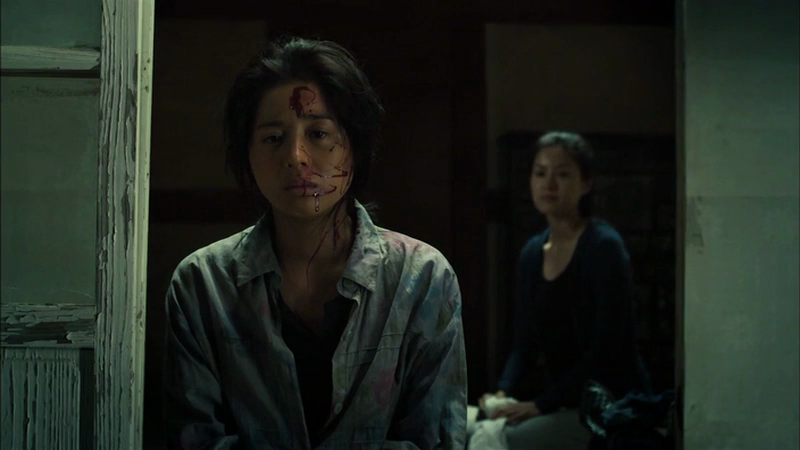
The film’s initial focus is Hae-won, a clerk at a bank who we first encounter snapping at an elderly woman desperately pleading for a loan to pay for her house. Hae-won has earlier witnessed a violent assault, but at the police identification parade she refuses to finger the perpetrators for fear of reprisals. Returning to work, she coldly reproaches a colleague after she learns she has been more sympathetic to the woman seeking the loan, and then turns nastier when she makes a case of mistaken identity, after which she is told to take a forced vacation from work. She elects to take up an offer to visit old childhood friend Bok-nam on the remote island of Moo-do.
Bok-nam lives on the island with her young daughter Yeon-hee, husband Man-jong, brother-in-law and a small group of elders, mostly women. The initial excitement at visiting the exotic surrounds quickly disappears as Hae-won observes the daily cycle of abuse and oppression experienced by her childhood friend; beaten into submission, forced into gruelling manual labour by the elders, humiliated by her husband’s shameless and blatant philandering with prostitutes shipped in from the mainland, and nocturnally having to be the reluctant outlet for her primitive brother-in-law’s apparently insatiable sexual appetite.
The urbanoia film functions primarily by setting up an axis which exaggerates the differences between the city and the country, and to a certain extent Bedevilled is no different in this regard. In terms of the setting, the island of Moo-do is very obviously far removed from the neon-lit bustle of Seoul witnessed in the opening scene, an exoticism underlined by Hae-won’s inauguration by Bok-nam into both open-air laundry drying and alfresco bathing, underlining Hae-Won’s very evident status as the metaphorical fish out of water. The city is noisy, overcrowded but impersonal. The country folk, by contrast, have a sense of interdependence with each other, but also a concomitant paranoia fuelled by the self-interest of the group: the elders are shown to be willing to turn a blind eye to Man-jong’s crimes as long as they perpetuate their own interests, namely keeping on the island Bok-nam and Yeon-hee, who represent both their present and future enslaved workforce. Thus a kind of pre-industrial patriarchy is perpetuated on the island, one which appears to condone even incest and paedophilia, a familial dysfunction which is a familiar urbanoia convention. If the police are powerless in the city, then in the countryside it is their very absence which arouses fear in the urbanite.
The contrast between city and country is also highlighted by the two women and their outward signifiers: Hae-won’s fussily urbane image of pale skin, sophisticated hair and makeup, white dress and high heeled shoes are in plain contrast to Bok-nam’s earthly look of heavily-tanned skin, tousled hair and general sartorial scruffiness. If the images of the two women are shown to be hugely disparate, then so too are their physical and emotional characteristics. Thusfar, Hae-won has by-and-large been an aloof, insular character, emotionally cold and largely isolated from those around her; in comparison, Bok-nam is characterized as being friendly and warm-hearted. Hae-won carries herself in a stilted poise, while Bok-nam is flat-footed, sometimes animalistic in posture (in one scene her husband even chastises her for literally eating “like a pig”). This in part reflects her natural physical practicality, in contrast to Hae-won’s technical ineptitude as evidenced in her earlier débâcle when trying to escape after being trapped in the toilet cubicle; instead, she is shown engaging in the practised, schooled form of physical exertion of yoga which the more clumsy, unsophisticated Bok-nam comically fails to imitate, an echo of an earlier flashback which illustrated the young Hae-won’s superiority of the learned skill of playing the recorder.
This divide between the characters is also a typical configuration of the urbanoia film. The city-dweller, whether male or female, is symbolically gendered ‘female’ since their sedentary urban existence, removed from the more ‘manly’ tasks of farming and hunter-gathering, has effeminized them; by extension then the rural characters are symbolically gendered ‘male’, in this case the female Bok-nam (her later use of a bladed weapon to stab her oppressors with can be seen to take on an obvious Freudian connotation). Indeed, while Hae-won may be associated with outward signs of feminity – handbags, coiffured hair, high heels – she is shown to lead a largely asexual existence. Early on, she reprimands her work colleague for what she sees as her flirtatious behaviour with her seniors, significantly an event which occurs shortly after she is sexually humiliated by a group of thugs outside the police station. A flashback makes a suggestion of a childhood ‘crush’ on Bok-nam, though later on when Bok-nam attempts belatedly to reciprocate this in the present timeframe, Hae-won withdraws. If the city is then rendered ‘female’, so too is it a neutered femininity.
In spite of sharing many of its conventions, this dual protagonist setup provides the key differentiation between Bedevilled and the traditional urbanoia storyline. Instead of unquestioningly aligning our spectatorial viewpoint with the city-dweller, as in the majority of this type of film from Deliverance (1972) onwards, our sympathies here are divided. While Hae-won’s outward signifiers speak of familiarity which we are perhaps more likely to identify with, her coldness makes us emotionally aligned with the more responsive, emotive Bok-nam. Indeed, although Hae-won’s city lifestyle is ostensibly the more familiar to us, it speaks more of urban alienation than any positive view of urban life: her moodiness suggests she is liable to fall out with what friends she has, and given time off work she is shown spending it alone, whether a solitary figure at a restaurant or back at her apartment guzzling on cans of beer. She is reprimanded for routinely ignoring the letters for her stacking up in her mailbox, and apparently has no contact with her immediate family. If one compares the opening city sequences of Bedevilled with those of I Spit on Your Grave, in which we witness Jennifer Hills’ comfort with her urban existence, then we can see that here the view of city life is more ambivalent.
If life in the city is not entirely eulogised, then neither is the country entirely demonised. In the countryside there is at least some notion of family and community, even if arising from a sense of self-interested dependency; the elders are at least treated with a sense of due respect by their juniors, in marked contrast to Hae-won’s summary dismissal of the elderly woman she has to deal with at the bank office who seems to be little more than a pest in her eyes. Additionally, while the usual city-country dynamic traditionally divides quite clearly into a master-slave dynamic of economic domination and exploitation, there is little sense of it here; there is not the sense that modernity is encroaching on the island, save for the oddly modern juxtaposition of a mobile phone mast on the island, and indeed the fact Man-jong is able to afford to ship in prostitutes from the mainland (paying over the odds too) suggests an affluence.
In fact, as opposed to showing the disparity between the two women’s lives, what the setup encourages is the paralleling of their experiences as a whole. Whether in the country or the city, women are assaulted by men and the authorities appear helpless either to prevent it or to dispense punitive justice to the perpetrators. While Man-jong and his brother are evidence of rural cruelty and sexual dysfunction, they are little different to the thugs who carry out the film’s initial assault in Seoul and intimidate and sexually humiliate Hae-won afterwards (the visual coding is similar in both cases, Man-jong’s brother’s battered tracksuit equivalent to the city thugs’ sportswear). Women, whether economically independent like Hae-Won or physically independent like Bok-nam, are still forced to be emotionally isolated resigned victims in both societies.
Another consequence of the parallel alignment of spectatorial identification is that the film’s ‘revenge’ segment takes on a greater level of complexity than the traditional generic formula. When Bok-nam enacts her bloody revenge on her oppressors there is a sense of moral justice to her actions, yet when she turns her attentions to Hae-won, the viewer is left divided; Hae-Won, after all, is a co-protagonist with whom the spectator is partially aligned with, yet her acquiescence to the conspiracy of silence on the island effectively renders her as guilty as the islanders, so is she therefore not as deserving of comeuppance? This section of the film, now relocated to the mainland, punctures the prior triumphalism of Bok-nam’s vengeance by inserting an ambiguity to the moral framework which had previously seemed justifiable. Rather than the didacticism of the ‘good’ city pitted against the ‘bad’ country, what Bedevilled has drawn up is a morality founded more purely on victimhood rather than geography or class.
These questions may add complexity to the traditional urbanoia revenge plot, but on a symbolic level it remains conventional. Bok-nam’s story illustrates that a country-on-country axis of violence is acceptable, indeed perhaps even the the only effective solution to her problems, her ‘masculinization’ on the island permitting her to slay her fellow ‘masculine’ countryfolk (most of whom, significantly, are female – the one survivor is male). However, her subsequent attack on the ‘effeminized’ Hae-won, effectively a double-axis of country-on-city, male-on-female violence is considered too much of a transgression. Hae-won’s use of her recorder as a weapon, in turn suggests a conventional regendering of her character as ‘male’ victim-turned-hero.
Bedevilled, then, is a blend of complexity and conventionality with regard to the urbanoia sub-genre. While providing the viewer with many of the traditional outward signifiers of an antagonistic city-country axis, the two-protagonist setup develop a drama which instead parallels the experiences of women as victims within both types of social environment, and which replaces the straightforward revenge formula with a more morally ambiguous equation, even if there is a striking conventionality to it in symbolic gender terms.
Bong Joon-Ho’s latest exercise in genre-bending featured the most unpredictably twisty of thriller plots as well as the stand-out individual performance of the year from Kim Hye-Ja, who overcomes her physical frailties to find the steely resolve to battle against inept authority figures, local hoodlums and suspicious townsfolk in order to prove her son innocent of a murder. The plot, though, is a mere framework to investigate wider issues: the corruption endemic in Korean patriarchy, the speed with which society throws suspicion on those it considers eccentric, and, perhaps most disturbingly of all, the sinister and occasionally morally elastic side to the maternal bond.
A masterpiece of understated disorientation, Martel’s film places protagonist Verónica’s life at a slight angle to what it was after she is involved in a car accident. Did she run down a boy, or merely a dog? The question itself quickly becomes irrelevent, as the viewer too begins to doubt everything that they may think that they have seen beforehand. The everyday has seldom seemed less familiar, or more sinister. A marvel.
Little to add here that hasn’t been said several thousand times over elsewhere, really. Pixar really make storytelling, comedy and pathos look so easy – so why can’t every other American animation studio keep up?
The blackest of black comedy. Some might call it perverse but I thought Dogtooth, essentially the results of a sociological experiment gone very badly wrong, sticks to its own internal logic with perfect fidelity – and lets human nature do the rest. What happens if you keep you children locked away from the outside world all of their lives? And what happens if they then catch a glimpse of Rocky? A salutary lesson not to tell children lies about their teeth, at the very least.
Beautifully observed shomin-geki story of a son returning home to visit his family on the anniversary of his brother’s death. The setting may be rich in the mores of Japanese life, but the themes are universal – transience, disappointment, and the things that families find themselves unable to speak to each other about.
Any doubts I held about Jacques Audiard were comprehensively dispelled by A Prophet, his best film, and the most muscular, viscerally thrilling prison drama since HBO’s Oz.
Damning indictment of the (anti)social habits of the internet generation? I’m not convinced, but Fincher’s film was one hell of a lot of fun, especially thanks to the contributions from messrs Sorkin, Hammer and Timberlake.
I tend to require several viewings of Claire Denis’ films before coming to any film opinions about them, but what I will say about White Material is that it gave me the overwhelming feeling of unease which characterises what I feel to be her best work. A malaise hangs over everything – illness, political turmoil, that inescapable oppressive heat, and Maria’s wilful refusal to accept that she is in a place where she is no longer is welcome.
I wasn’t as taken with the story as most others quite obviously were, but Granik shows an eye and ear for capturing the sights and sounds of the Ozarks, and invests her film with an impressively restrained sense of simmering menace.
This wonderful Chilean film proved to a most unexpected delight, the story of a long-serving family maid Raquel who, despite the obvious physical toll, steadfastly refuses to accept any assistants to help her around the house. What begins as light farce slowly develops into a moving character study of a woman who has devoted herself to a family who she will, ultimately, never fully belong to. Watch in a double-bill with Mother.




 Serene Velocity