The Road (John Hillcoat, 2009, USA)

Perhaps it is the recent passing of the fiftieth anniversary of his death that brings it more readily to mind, but the spectre of philosopher Albert Camus seems unquestionably to hang over the characters in John Hillcoat’s adaptation of Cormac McCarthy’s novel The Road. The film is, in a very broad sense, existential, but more specifically it seems to be confronting those issues which troubled the French-Algerian writer throughout his life: how are we to live our lives in a universe so apparently devoid of meaning? If all is ultimately futile, is there anything which makes suicide an unacceptable escape? Can a morality still exist, and how, if at all, may one achieve a ‘happy death’?

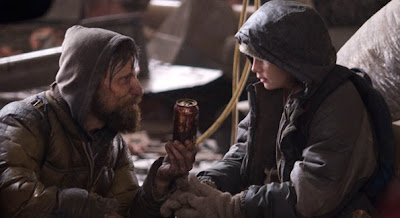
In McCarthy’s vision, death is the only certainty, and one that constantly looms so close as to be able to touch it. An unspecified disaster has befallen the Earth – viewers may speculate as to its exact nature – which has set in motion an unstoppable environmental catastrophe: the sky grows ever darker, life has all but died out, and what remains is a deserted world of ashen, moribund tree husks and the abandoned wreckage of buildings, roads and vehicles. A handful of starving humans roam around in cannibalistic tribes scavenging for any remaining food and commodities, and as the story progresses we will see glimpses of the desperate, horrifying depths to which they have sunk in order to survive.

Also roaming this barren wasteland is an unnamed man and his young son, struggling with their cumbersome trolley loaded with what goods they have managed to forage for themselves. Through parallel flashbacks interspersed through the story we see glimpses of past events: golden-hued memories of ‘before’ and the man’s loving relationship with his wife, the coming of the apocalypse and their child’s traumatic birth, and finally the couple’s increasingly disparate reactions to the ongoing destruction, resulting in her complete abandonment of hope and flight from the family home.

In the present timeframe, the man has determined that the pair head south and towards the coast, and so the story follows their labourious journey, flanked by the twin vultures of death by hunger and murder at the hands of a cannibalistic gang. Their significant other companion is the man’s gun, loaded with one bullet for each of them, and which the father repeatedly and frantically reminds the son how to use on himself if the worst happens; better this than the prospect of being raped and eaten alive. As in reality, the role of the parent is to prepare the child to face the world without them.

Tales of earthly apocalypses are ten-a-penny in Hollywood, but however bleak their outlook, there is always the certainty in such films that their protagonists will in some way save the day in the last two reels. Not so here; the tone is unremittingly bleak, the world terminal decline and in the process of taking its last few gasps of air before expiring forever. Where, then, can any sense of hope be derived from this situation? How can the father make the son believe that life is worth living for a second longer?

It is a truism, if a trite one, that the road movie is seldom about the destination but the journey itself, and this is never a more correct observation than in The Road, though here it is a more philosophically abstract idea. Take two comparable films; firstly, Children Of Men (2005), also set in a world where life (and hope) is slowly dying out, but which observes the narrative trajectory of a thriller once the key plot point is revealed. Similarly Stalker (1979), which is more philosophically complex, yet still has a clear destination end point – the mysterious ‘Zone’ to which the characters are heading.

The question in The Road, perhaps related to the MacGuffin of the nature of the disaster itself, is why is the man so insistent in heading both south and towards the coast? Does he know it is safer there? His reasoning is never made explicit, likely because there isn’t one; it is just important that they have a direction, some form of purpose. In a later scene, when the pair discover an underground cache of supplies, enough to keep them alive and more comfortable for months, they continue on nevertheless. Survival is not enough; existence precedes essence, but it is not enough on its own; the man has embraced the Absurd and transcended it.

Director Hillcoat’s previous film, the superbly grimy The Proposition (2005), took the template of the Western and reinvented it in a nihilistic late nineteenth century Australian Outback where the rule of law is unenforceable and morality is an unobserved luxury. The Road takes this further: law is not only unenforceable but has been dispensed with altogether, along with any value attached to money or property. What remains of humanity?

What is fascinating is the divergence in political attitudes between father and son. The older, more world-weary character sees fear and danger behind every corner and in every person they meet, and is careful to delineate to his son the idea of they as the ‘good guys’ and others as the ‘bad guys’; the child, seeing through kinder but perhaps more naive eyes is less inclined to believe his father’s snap judgements, and as the film progresses is clearly forming a moral code of his own, constantly questioning that of his father. Perhaps ‘before’ the father was less wary of others, while the child, born into this new world, lacks this frame of reference. Their moralities, then, are hugely subjective, borne out of circumstance and forged by experience.

A story which is so unremorseful in its depiction of a future deprived of any sense of hope might seem like an unrewarding, morose watch, and yet the overriding message is a positive one. Camus wrote The Myth of Sisyphus in the darkest days of World War 2, exiled and alone in Paris, staring down the barrel of an oppressive, authoritarian future. And yet he looked to Greek myth and found the most hopeless of all characters – the man condemned to spend eternity rolling a rock up the side of a mountain in the knowledge of the certainty of its fall – and found hope, and laughter, in its Absurdity. It is the triumph of The Road that it also manages to find, even the the face of the most unrelenting despair, enough to suggest that life must continue be lived, and embraced.

The Film of 2009

1. Il Divo (Paolo Sorrentino, 2008)

The biopic can be one of the most teeth-grindingly awful forms of cinema and, with only a few notable exceptions, political ones especially so. Take, as an example, a film like Gus Van Sant’s Milk (2008) which, chained to the constraints of the biopic format, rendered very dull a subject matter which had made for a lively documentary in the form of The Times of Harvey Milk (1984).

Almost regardless of the subject at hand, there is the need in such films to simplify their protagonists’ lives in order to follow a simple trajectory: a first act establishing their early successes, second act showing their further rise to prominence and their inevitable meeting with personal problems, and concluding with some form of redemption and at least partial resolution of these problems. So while specific details might differ, in Hollywood’s eyes Harvey Milk’s story is very similar to that of the Ray Charles of Ray (2004), the Johnny Cash of Walk the Line (2005) or any number of other subjects.

There are, of course, exceptions. Last year, for instance, saw Steven Soderbergh’s long awaited Che (2008) diptych, a curiously oblique portrait of the revolutionary superstar, taking an approach which dealt purely with his public surface rather than trying to penetrate his interior psychology. While still obviously reverential to its subject matter, and with a narrative following a near-symmetrical pattern of his rise and fall, the films’ refusal to simplify this highly contradictory figure into an easily-comprehended secular saint made for a more much more thought-provoking and memorable piece of work.

Il Divo might broadly be termed a political biopic, focusing as it does on the life of seven-time Italian Prime Minister Giulio Andreotti, but it shows such scant regard for the mores of the genre that it barely deserves the tag at all. Indeed, if the much-praised Gomorra (2008) displayed a clear debt to the brutal documentary-like realism of Gillo Pontecorvo’s The Battle of Algiers, then Sorrentino’s film is more readily identifiable as being in the tradition of Italian political cinema exemplified by Francesco Rosi, in particular his Salvatore Giuliano (1962). Rosi’s film eschewed conventional notions of biography and cast doubts on cinema’s ability to show the past within the confines of a straightforward narrative by telling its story highly subjectively rather than through plainly observed historical fact, and though to an extent large sections of Il Divo contradict this, it is clearly a major touchstone.

Andreotti is a figure who is without parallel in Western Europe: a politician who has circulated near the centre of his Italy’s political heart for the last sixty years. Elected Prime Minister seven times during this period, he was one of the key men who steered the country, rightly or wrongly, through those years, years which saw near-constant political instability and acts of violence from terrorists on both extremes of the political spectrum, and yet also a period which saw the country witness a remarkable ‘miracle’ which saw it build itself up from the rubble and poverty of World War 2 to become one of Europe’s key economic powers. He is also a figure surrounded by controversy: linked to any number of crimes and corruption scandals, as well to various Mafia organizations and the sinister, secretive P2 Masonic Lodge. Despite the allegations, his ‘official’ record remains unblemished.

How, then, to tackle the life of such a figure? If the political biopic commonly tends towards either blind hagiography or rabid character assassination of its chosen subject, it is significant that Sorrentino treads such a careful path between them that after two hours it is by no means clear what the director’s own opinion of the man is. But then Il Divo seeks not to provide easy answers to the complex questions raised by the history of post-war Italy, and how could it? Instead we have a figure as inscrutable as those in the director’s previous films, his inscrutable, unemotional exterior concealing whatever thoughts lie beneath it.

The title of the film suggests someone with a reputation of high, almost divine, celebrity, and yet Andreotti is a figure who tends to attract much less flattering descriptions; “Beelzebub” and “Man of Darkness” are among his other nicknames, and he was once described by Margaret Thatcher as having “a postivie aversion to principle”. From the very outset of the film, it is clear that there is no little irony in titling the film thusly: the first shot we see of him is distant, head-bowed in surrounding darkness, a slow zoom reveal his face to be covered in acupuncture needles, an image inevitably recalling the horrific Pinhead from Clive Barker’s Hellraiser (1987). At other times in the film he will resemble Murnau’s Nosferatu (1922) with ears reminiscent of something from Gremlins (1984); these visual references should be enough for most viewers to realise that we are clearly not in the realm of strict realism but caricatured expressionism.

That is not to say that the film has no basis in fact. Quite the opposite, as from as early as the opening title cards – a glossary of some of the key political groups – and onwards from there, the viewer is bombarded with a deluge of onscreen information : places, faces, names, infamous assassinations, political parties, Parliamentary votes, tribunals, all of which likely to be alien to a large majority of viewers, and far too much to begin to digest in one viewing. Cumulatively, though, the effect is to convey the stupefying complexity of the workings of the Italian system, and to illustrate just how many groups have fingers in the political pie.

Andreotti’s own career trajectory – from humble beginnings through to inglorious fall, via personal triumphs and mistakes – actually sounds like the stuff of a simplistic biopic, and yet here the film’s main timeframe of events is extremely narrow, confined to the period in 1992 between Andreotti’s seventh election as Prime Minister and his appearance at the Tangentopoli bribing investigations, and it is only through flashbacks that significant events such as the are shown. Of particular weight is his refusal to bend to the terrorist Red Brigades after their abduction of his friend and political colleague Aldo Moro, a decision which effectively signed Moro’s death warrant. The guilt of this haunts him like Banquo’s ghost does Macbeth.

Far from a straightforward biography, non-linear in its storytelling, a mixture of journalistic enquiry and fancy, social realism and monster movie, just what is Il Divo? The best lens through which to view it is as an unequivocally idiosyncratic Paolo Sorrentino film, a work which sits easily with oeuvre as well as expanding its range, its protagonist a logical progression from those of his previous two films The Consequences of Love (2004) and The Family Friend (2006). Like those films, it boasts a bravura central performance from the remarkable Toni Servillo, though the difference here – that his character has a real world equivalent and one of huge historical significance – has the effect of raising the stakes considerably.

The film also displays the director’s flair for reconciling a fluid, fast-moving visual style with the subject matter of an emotionally detached, inscrutable protagonist. I would not be the first to suggest a splash of post-Tarantino brashness in the mix somewhere here, and early scenes have the irresistible storytelling urgency of vintage Scorsese – Goodfellas (1990) in particular. The soundtrack, a combination of classical music suggesting an operatic tragedy and rock music hinting at a more modern sensibility, is used to very frequent potent effect: see how Andreotti’s alleged hugely symbolic kiss with a Mafia don is ironically followed with a tender love song. The heavily stylised aesthetic pays dividends; if the viewer is finding themselves lost within the film’s political labyrinth, the presentation alone is enough to sustain interest.

Ultimately, it is in the political ideas that Sorrentino manages to convey that the film’s triumph lies. Two scenes stand out: firstly, in an interview with La Repubblica‘s Eugenio Scalfari, it is put to Andreotti that he is “either the most cunning criminal in the country because you never got caught, or you’re the most persecuted man in the history of Italy”. Surely the web of allegations against him cannot be some perverse coincidence? Andreotti, instead of answering, turns inquisitor: why did he prop up his interviewer’s ailing newspaper when allowing it to fall into the hands of Silvio Berlusconi would have made his own political life so much easier? To this, the answer is that it was “more complicated”; Andreotti offers this as his own reply, too. So does the film.

The second key scene is the solitary one where the mask of inscrutability slips – though it is clearly framed as speculation on the director’s part, Andreotti ‘confesses’ his political sins almost straight to camera, revealing his strategy of deliberately antagonizing those terrorists who threatened to throw the country into anarchy in the 1970s. By making them resort to ever more extreme tactics, including the murder of Moro and other assassinations, they were marginalized to the point of isolation from the political mainstream, thus putting them in a context which would prevent their ever gaining any sort of real power. This strategy, making him personally seen to be iron-willed and cold-hearted, resulted in the relative stability the country now enjoyed.

There is a wider point being made here, and one which ties in with many of the film’s repeated references to opera, gothic horror, Catholicism, as well as the role of the body politic itself, and that is the nature of ‘good’ and ‘evil’ and their interlinking. Sorrentino ultimately suspends judgement on Andreotti not because he has any sympathy for him, but because his thesis is that his subject’s moral framework is centred around the notion that certain evils are necessary in order for other goods to prevail. This is quite distinct from moral relativism; in Andreotti’s world there is good and evil – he repeatedly makes reference to “the will of God” – but they must be based in pragmatic political realities.

Here is the coup of the film: it is a portrayal of a severely flawed man, one distant to the point of inhumanity, and seemingly bereft of anything which could be considered humane. Yet he is also a man whose personal history is so inexorably tied to Italy’s political history that if we are to condemn him and his political actions, then so too must we his country: the decision, then, is ultimately the viewer’s. Il Divo is no mere political biopic: as a meditiation on the nature of politics, and the sacrifices and apparently immoral decisions which come with it, it is a work worthy of mention in the same breath as Machiavelli’s.

The Films of 2009: Part Four

=3. Antichrist (Lars Von Trier, 2009)
=3. Martyrs (Pascal Laugier, 2008)

Both Antichrist and Martyrs arrived in cinemas amidst hails of accompanying moral uproar from both expected and unexpected quarters of the media, yet as always these blew over after the failure of either a) society to collapse or b) the world to stop turning after their releases. Viewed as a pair, they can both be seen as experiments in toying with the language of horror cinema, as well as both being exhaustingly intense viewing experiences.
Antichrist, from renowned enfant terrible Lars Von Trier, plays like a vulgar joke told with the straightest of poker-faces; shot luminously by cinematographer Anthony Dod Mantle and with an air of Bergmanian seriousness, the plot nevertheless dismantles conventional horror notions about unconscious feminine evil, doomed masculine rationality and the uncontrollable ferocity of nature, often in such a deliciously hammy way as should be impossible for anyone to take it at all seriously. And yet the joke seems to have eluded many stern-faced viewers, so much so that the final punchline, a throwaway dedication to cineaste’s demi-god Andrei Tarkovsky, drew horrified gasps rather than titters when the film premiered at Cannes.

Martyrs, by contrast, could not be more deadly serious, a bleak stare into the metaphysical void rather than an exercise in audience manipulation. Inevitably placed within the recently-coined trends of Extreme French Horror and so-called ‘torture porn’, it is certainly more significant than most of what has come before in either, though not lacking in the graphic content associated with each. Like Antichrist, though, the film is in the realm of the experimental, and what comes through most strongly is how confidently it takes in familiar tropes and jumps between sub-genres, a narrative stubbornness which leaves the viewer as disorientated as its confused protagonist(s). Let The Right One In may have been a triumph for its unexpectedly effective matching of genre and tone; the achievement of Martyrs is its successful exploitation of the mores of horror sub-genres to form a coherent, singular story.

2. The Hurt Locker (Kathryn Bigelow, 2009)

The most successful of the films which have in some way tried to deal with 9/11 and its aftermath have not been those which have focused on the larger questions of the justness or otherwise of the subsequent ‘War on Terror’; Kathryn Bigelow’s suitably muscular entry into the canon joins Paul Greengrass’ United 93 (2006) and Nick Broomfield’s Battle for Haditha (2007) as one the films which has instead sought to reflect the moral uncertainties of our times, through the lens of characters living on the front line of conflict.

Bigelow, a director for whose films the adjective ‘macho’ never seems far from critics’ word processors, has made the most bombastic and testosterone-filled war film of recent times, such a vigorously cacophonous entry into the field as almost literally to blow away the opposition: one suspects cinema screens adjacent to those showing The Hurt Locker were likely to have been caught up in the film’s sonic blast radius. This is understandable given its subject matter, a team of soldiers whose job it is to defuse improvised explosive devices (IEDs) in post-invasion Iraq, but the real triumph of the film is not its pyrotechnics in themselves, but how effectively the unbearable internal mood of claustrophobia and tension of its characters is conveyed – an extraordinary combination of dizzying handheld cinematography and a carefully constructed sound design, an overall effect which left me in nothing short of a cold sweat in my cinema seat.

The film never makes the mistake of overlaying a full-blown commentary on the Iraq invasion, looking into the faces of the locals seems to convey enough. Instead the central core is the soldiers’ own questioning of just why they personally are in such a far-flung, hostile theatre of conflict. For Sergeant William James, our eventual protagonist played with superb nuance by Jeremy Renner, the answer is that the adrenaline rush resulting from a successful defuse is for him a very real addiction, and one which is likely one day push him over the threshold to his death. Bigelow’s films have frequently meditated on the personal, seemingly irrational desire for men to throw themselves into danger; by alighting on the subject matter of the US military complex, she has made the best war film of the decade.

The Films of 2009: Part Three

=6. Star Trek (J.J. Abrams, 2009)
=6. Moon (Duncan Jones, 2009)

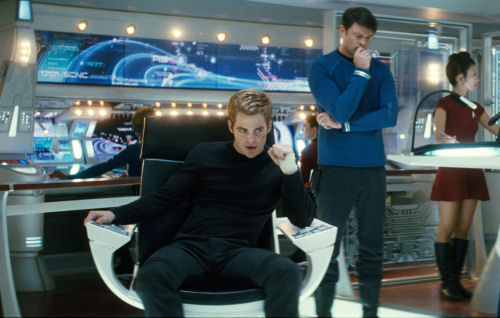
In the year of the fortieth anniversary of the Apollo 11 moon landing, it seems fitting that not one but two of the best space science fiction films of recent years should be released, though they share little more in common with each other. Firstly Star Trek, J.J. Abrams’ reboot of the long-standing franchise, elegantly if preposterously redrew the Trek-verse in the space of one sweeping plot point, freeing us up to travel along with a younger, wet-behind-the-ears version of the USS Enterprise crew of the original television series and early films. The most relentlessly entertaining blockbuster of this and many a year, it is only let down by a weak, generic final act and the occasional unwise downshift into slapstick and pratfalling comedy. Personally, though, I could watch this minipop version of those familiar characters, in particular Karl Urban’s hilariously grumpy McCoy, all day long.

Amazingly made for just one fiftieth of Star Trek‘s budget, Moon was practically the opposite film: slow moving, intimate, and clearly an aspirant philosophical treatise rather than pure popcorn entertainment. A phenomenal solo central performance from Sam Rockwell holds together a compelling story about a man whose lonely job operating a mining base on the surface of the Moon begins to affect his mental stability, and for whom a dramatic, startling discovery leads to him beginning to question the nature of his own existence and mortality. Clearly following in the existential tradition of Solyaris (1972) in using science fiction as a vehicle for exploring metaphysical questions, Moon is a thoughtful, low-key pleasure, not quite a classic but an extremely promising first feature from Duncan “Zowie Bowie” Jones.

=5. Anvil! The Story of Anvil (Sacha Gervasi, 2008)
=5. The Wrestler (Darren Aronofsky, 2008)

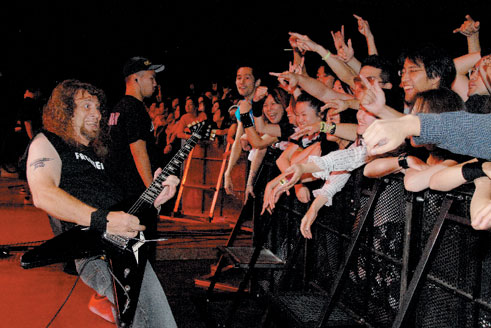
Released towards the start of the year, these two surprisingly similar films examined nature of celebrity, in particular what remains in its aftermath. Documentary Anvil! The Story of Anvil introduces Steve ‘Lips’ Kudlow and Robb Reiner, the remaining members of the eponymous band who apparently were one of heavy metal’s should-have-beens back in the early 1980s, and who despite their repeated failures continue to perform today. Firstly, it is hugely funny to see their Spinal Tap-esque idiocies and disasters on tour, but what emerges even more is a captivating and surprisingly moving story of resoluteness in the face of adversity; and as has been suggested elsewhere, the relationship between Lips and Reiner really is the year’s greatest cinematic love story.


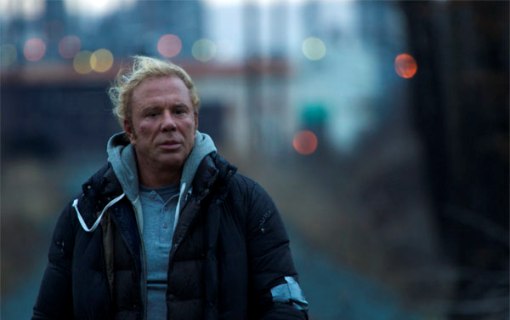
The Wrestler, though palpably not a documentary, both looks and feels like one, and the presence of famously washed-up mess Mickey Rourke playing a formerly-famous washed-up mess invites comparisons to his sad fall from grace from his heyday. It is more than likely that his character, former wrestling megastar Randy ‘The Ram’, would like a song or two by Anvil: at one point, confiding to stripper friend Pam, he mourns the passing of the overblown musical artifice of 1980s hair metal in the wake of Kurt Cobain and self-wallowing ‘realism’. This is significant to his character because likewise in the modern-day wrestling arena, theatricality has given way to brutal reality – razor blades, barbed wire, broken glass – a ‘reality’ which is likely to lead him to an early death. Aronofsky’s film excels at showing the dark, addictive side to performers and their need for an audience, and feels as fleshily visceral as David Cronenberg at his best.

4. Let the Right One In (Tomas Alfredson, 2008)

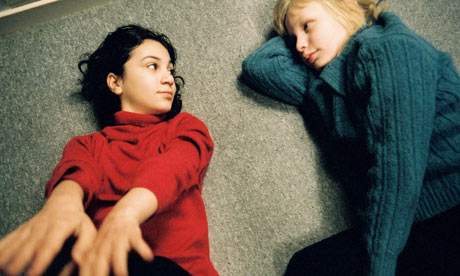
Vampires were unavoidable this year, whether on the big screen in Park Chan Wook’s Thirst and the second instalment of the continuing Twilight franchise or on television in the HBO drama True Blood, but the real highlight seemed barely about vampires at all. Indeed, Let the Right One In resembled more closely Lucas Moodysson’s much underrated Fucking Åmål (1988) than the writings of Bram Stoker, substituting in the boredom of being young and isolated in drab Stockholm suburbia for the gothic goings-on in Transylvania. Instead at its heart is a strong emotional core: Oskar, a young boy who is being mercilessly bullied at school finds a kinship with Eli, a mysterious newcomer to his apartment block who seems to understand and share his loneliness.

It comes as no surprise what Eli’s big secret is, but what is novel is how the story goes against the tropes of the genre; there is a overriding sadness to film’s blood-sucking elements, so that rather than the act being sinister, evil, even sexual, we see how it is for Eli a reluctantly-performed but necessary life-giving ritual. Although the film tonally has the icy chill of a Scandinavian winter and a glacial pacing which may deter viewers expecting more full-on gore, this is ultimately its main strength; in successfully placing familiar generic elements in a completely new tonal and emotional context, Let The Right One In feels like a breath of fresh air, as well as being an affecting meditation on friendship, trust, revenge and loyalty.

The Films of 2009: Part Two

=9 Avatar (James Cameron, 2009)
=9 District 9 (Neill Blomkamp, 2009)

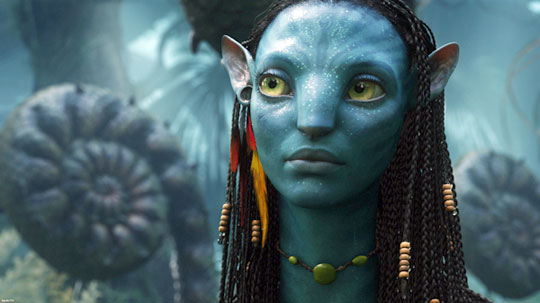
Two of the most visually spectacular and biggest grossing blockbusters of the year seemed to share a link in their considering of society’s relation to an ‘otherness’ in the allegories they drew. The similarities between them are striking: both feature protagonists ‘going native’ and finding sympathy with alien races rather than warmongering humans, and in both cases ideas of mixed-race hybridisation – and a consequent rejection by both races – is considered.

So too do the films have their differences: James Cameron’s much hyped Avatar occurs on an alien world being exploited by humans and is much more straightforwardly didactic in its approach to its politics, while first-time director Blomkamp’s District 9 is set on an Earth being settled by prawn-like aliens and by comparison affords more of an air of moral uncertainty. The former is much more outwardly a demonstration of new technology, in particular its much-talked-about use of digital 3D, while the latter is equally impressive but more subtle in its clever blending of live action and CGI ‘prawns’.

The films are in many ways like negative images of each other. While District 9’s allegorical content openly invites parallels to apartheid, it is a much more elegant and wide-ranging polemic against all forms of discrimination and segregation; by comparison while Avatar seems to have broad anti-war and pro-environment themes, it is actually the more restricted vision, really only commenting post-Vietnam US war economy rather than the world or history as a whole. If I have a preference, Avatar seems the more balanced, consistently constructed film, but in isolation the opening twenty minutes of District 9 are the most astonishing.

=8. Up (Pete Docter & Bob Peterson, 2009)
=8. Coraline (Henry Selick, 2009)

Another year, another great Pixar film. It is easy to get blasé about the quality of their output, and perhaps this has affected my slight underwhelmment with their latest offering Up, a quietly moving film about an old man trying to come to terms with life after the death of his wife. Dealing with mortality in such an unsentimental way seemed a little odd against the sheer beauty of its visuals, but this is not a negative comment – I suspect a further viewings will yield a greater understanding and admiration for what they have produced here.

The other great animation of the year was Coraline from A Nightmare Before Christmas stopmotion genius Henry Selick, based on a short story for children by Neil Gaiman. A young girl moves with her family to another town far away from her friends, but in her unhappiness finds a mysterious tunnel which transports her to an alternate universe where people have buttons for eyes and everything is a much more spectacular version of her drab, boring life on the other side. Soon, though, she discovers that all in this world is not as perfect as it seems. A delightfully entertaining gothic Alice-like tale, and truly a feast for the eyes. And what is it about buttons that are so scary? (see also Sam Raimi’s Drag Me To Hell)

7. A Serious Man (Joel & Ethan Coen, 2009)

A merciless cruel streak runs through much of the Coen Brothers’ work, a tendency which gains them detractors as well as fans, and A Serious Man is unlikely to change the opinions on both sides of this argument. Poor Larry Gopnick, a Jewish university professor in late 1960s US suburbia, sees his life slowly fall apart, leading to him to seek the answer to a simple question – why is this happening to him? A series of progressively older but so too increasingly out of touch Rabbis appear to be of no help at all in these matters, though he appears to find no solace in reason either. Black comedy is the brothers’ signature, taken to new heights in this, a very personal project revisiting the Midwest of their youths. Where their previous work has worked within the parameters of genre, A Serious Man falls into a category all of its own; what notable is that it is one defined by their back catalogue, and consequently as the brothers’ purest film d’auteur it may well prove to be their most significant film to date.