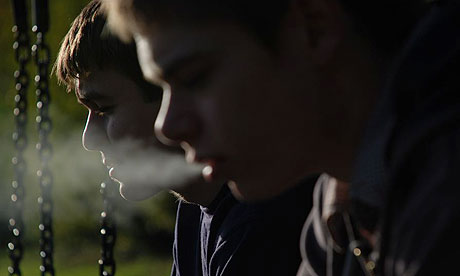
Better Things (Duane Hopkins, 2008, UK)

British film-maker Duane Hopkins arrives on the feature-length scene having being touted by some as “the new Lynne Ramsay”, something of a lazy label routinely applied to any young British director working in the confines of social realism. Set in Hopkins’ native Cotswolds, though this really could be anywhere in rural England, Better Things focuses on the lives of a small set of mostly unconnected individuals: a young heroin user whose girlfriend has just died of an overdose, a pair of recently split teenagers, a reunited elderly couple readjusting to life together, and a young housebound agoraphobe whose elderly grandmother has been moved in to her family’s home.

Hard drug use is prevalent amongst the younger characters, but although it can hardly be said to be romanticized here, it is presented as another escape from drab everyday realities, as much as fast drives down country lanes late at night, playing video games or fumbled, inexperienced sexual encounters. Boredom, the inability to articulate truth and emotions to close friends and partners, and the frustrations of living in a dead-end town all conspire to present drug-use not as a glamorous lifestyle choice nor a squalid retreat but merely a choice that has been made by desperate individuals. The use of a largely non-professional cast, drawn from the region and many of whom having experienced drug problems in the past, gives a feeling that the filmmaker is not being judgemental or condescending towards them or their characters.

The middle-aged are notable by their absence in this setting, and the film largely successfully illustrates the commonality between the feeling of isolation and of being trapped between old and young: the old confined by physical frailty and resistance to change, the young by geography, fear or their own poor economic prospects. Hopkins has a background in short-film making, and early on the apparent disconnectedness of the characters and their seeming lack of development do make the parallel stories feel somewhat like separate projects sandwiched together; as the film wears on, however, there is a noticeable convergence, most obviously in one scene in a park where two of the characters’ stories are beautifully juxtaposed, underlining the central thesis of common isolation across the age gap. There are no easy escapes and answers to these situations, but their possibility is more than hinted at by the close.

I always notice that when travelling through parts of rural England that the dominant, most noticeable objects protruding from the flat landscapes are the spires of the country churches, whose function I imagine in these settings to be closer to what they were many years ago in comparison to the modern role of their urban counterparts. Better Things begins with a funeral service and returns near the end of the story to the same place, yet organized religion and spirituality in general are otherwise in absence from the lives of these characters; given the theme of mortality running throughout the film, and the constant searching for something ‘other’, whether through drugs or physical love, there is clearly the invitation to ponder the implications of the absence of a god from these people’s lives.

Hopkins, with a background in photography, has a superb eye for composition, and it is noticeable that most of the film is shot with a completely static camera, pacing established through carefully controlled editing. Shooting in anamorphic widescreen could easily render a romanticized Constable-like picture of beautiful windswept English landscapes, but there is little of that here; instead, a picture of overcast gloom pervades, the landscape forbidding and chilly, and against which characters are left to roam in their own small isolations. It is this external world that the young agoraphobic Gail appears to be unable to enter, yet the same one that her frail housebound Nan wants to experience once again: perhaps since house interiors are lit in cold blues, painting them as imposing, claustrophobic places, devoid of homely warmth.

Again on a technical note, there is a very effective use of sound design to communicate some of the film’s thematic concerns; music is used sparingly and is entirely diegetic, punctuating the otherwise prevalent silences and sounds of nature only intermittently, showing its use by both young and old as a temporary, unsatisfactory release from everyday boredoms. And during one of their late night burns through the countryside, the unusually candid nature of a conversation between two characters is highlighted when the deafening roar of the car engine is artificially muted on the soundtrack, one of several occasions when sound is manipulated to heighten dramatic effect.

Better Things is a very hard watch thanks both to its unremitting emotionally downbeat tone and its graphic scenes of drug-taking, which will be enough to make it off-limits to all but disciples of the Alan Clarke, Ken Loach and Mike Leigh strand of bleakness. But while not likely to cheer or amuse, the film is invested with such genuine humanism and provides a most delicate, faint sense of hope for its characters that despite its melancholy air I found myself strangely uplifted by it. A very promising debut from a thoughtful, inventive filmmaker.

Tags:

Milk (Gus Van Sant, 2008, USA)

It might seem churlish to shoot down a film about a prominent civil rights icon, particularly in a week which saw Barack Obama sworn in to the highest political position in the world, but there is something deeply unsatisfying about Gus Van Sant’s biopic of Harvey Milk, which suffers from a severe case of ‘biopic-itis’: time and time again I felt like this was a made-for-TV movie, albeit a well-made one, but nevertheless entirely lacking in anything which demanded its presence in the cinema. Or is Milk indicative of US cinema audiences’ inability to handle homosexuality portrayed onscreen with any sort of invention – the more interesting Queer Cinema of Van Sant’s own Mala Noche (1985), for instance?

The story of Harvey Milk is a fascinating, multi-layered one, and one which is surprisingly little known outside of San Francisco. At its centre, we have the reluctant hero, a gay man who realises at the age of forty that he has nothing to be proud of so far in his life, and who goes on to become the first openly gay elected public official in the US. Then there is the downfall, and the villain: Dan White, a colleague of Milk’s who notoriously shot both Milk and San Francisco Mayor George Moscone, and then even more notoriously received a reduced sentence of manslaughter on the basis of his having eaten too many sugar-coated cakes that day. For those who do not know the Milk’s story, the film does come as an important lesson in one key moment in the history of the gay rights movement. Fine.

The trouble with this is, that it is quite simply all the film does: tell us the story. What are interesting characters – Milk and his followers, the probably closetted White, the rather scary poster girl of the religious right Anita Bryant – are all sketched out for us, but because the film’s rigid adherence to the traditional biopic rules of merely illustrating key events in the protagonist’s life, we gain little or no insight into what made these men really tick. White in particular, Josh Brolin at his most nuanced and subtle, would have made a much more interesting character study than what his scant over-expository screentime here allows. Much of what we see feels a retread of Rob Epstein’s superb The Times of Harvey Milk (1984) documentary, whose existence only further calls into question the neccesity for further biography.

Is it fair to criticise a film which brings into wider public knowledge the struggle against prejudice and bigotry which still continues to this day? In aiming for the mainstream, Van Sant is perhaps aiming to educate rather than to make any bold artistic visions, but his doing so seems to me an admission of defeat: that despite the success of the likes of Brokeback Mountain (2005), the subject is still one which must be diluted rather than explored with any level of complexity.

The Wrestler (Darren Aronofsky, 2008, USA)

On the face of it, The Wrestler would seem an unusual winner of both widespread critical acclaim and the top prize at last year’s Venice film festival. In terms of its bare storyline, it may seem like fairly run-of-the-mill sporting genre fare: former great living off past glories, seemingly friendless except for a kindly stripper, unable to cope with ‘real’ life, and being coaxed back into the ring for one last big fight. From this basic description, it could quite easily pass underneath the cultural radar, except for two facts which draw it to our attention: that the film comes to us from former Wunderkind director Darren Aronofsky, and the extraordinary story of its star Mickey Rourke.

Here are those basics: Randy “the Ram” Robinson is an anachronism, a star of the 1980s Professional Wrestling boom, but now reduced to living in a shabby rented trailer home, working weeks stacking boxes in a supermarket, whilst continuing to wrestle part-time. However, times have moved on in the entertainment world, the theatrics of the ring no longer pulling in the big crowds, meaning venues are now small school sports halls with plastic chairs instead of large arenas and worldwide TV audiences. What does pull in the crowds however is a much more visceral form of the sport, involving such macabre items as barbed wire and stapleguns: while there was obviously some level of physical pain involved in ordinary wrestling, it is made clear that this new form increasingly blurs the distinction between theatrical pain and real pain.

What comes through from the very off is that Randy is at most times a likeable character, one hugely respected in the small but brotherly wrestling fraternity. But outside of this world he is mostly friendless, spending lonely hours in a strip club talking to what seems to be his only friend ‘Cassidy’, a middle-aged woman in a young woman’s world. They appear to share much in common, though it is in their differences that we see them for the people they are: ‘Randy’ is very much still ‘Randy’ outside of the ring, in one well-crafted scene we even hear the imaginary roar of the crowd as the camera tracks him walking down the steps to.. the meat counter at the supermarket. ‘Cassidy’, by contrast, is plain Pam outside of work, doting mother to her child unlike Randy who is estranged from his teenage daughter.

Had the film, as originally planned, starred Nicholas Cage in the title role, there would be plenty to applaud here: thematically, it is a study of identity confusion coupled with the very real corporeal abuse which The Ram undergoes – did David Cronenberg turn the project down? They feel much like the kind of recurring cinematic themes we have come to expect from the Canadian auteur’s recent films. The idea that the the 1980s idea of spectacle – as undelined by Randy’s anachronistic perma-tan and long wavy bleach-blonde hair, and musical taste which seems not to stretch to anything more recent than Appetite for Destruction – died with Kurt Cobain’s early 1990s focus on miserable realism is one which is confidently explored, and here the vérité shooting style serves the film exceptionally, counterpoint to the artifice of events inside the wrestling ring. The idea of regulation – that Pam knows that her profession has limits and rules, while Randy does not – is thoughtfully and carefully balanced.

After his astonishing debut π (1998), and the famously graphic Requiem for a Dream (2000), director Aronofsky was considered to have gone off the rails with his troubled The Fountain (2006) project, so The Wrestler is something of a comeback for him after being on the metaphorical cinematic ropes, as it were. The first surprise is how stylistically pared back he shoots the film: there is a documentary-like feel to its framing and editing, an aesthetic which serves the subject matter well, but comes as a shock to those accustomed to Aronofsky’s usual visual flourishes. The second surprise might well be the structural linearity and the seemingly genre-friendly storyline: playing it safe, directorially but once again suiting the purposes of the film without making things too showy – the director’s first signs of mature filmmaking?

However, focusing on these directorial aspects is to neglect woefully the importance to the picture’s resonance of the reappearance on our screens of Mickey Rourke: in the 1980s the impossibly handsome star of Diner (1982), Rumblefish (1983) and Angel Heart (1987), but whose off-screen troubles have come to define his career as much as those early successes. Is his role in this film an exorcism of those demons, or merely to illustrate his character faults? This can be left to idle speculation, but what is clear is that he inhabits the role of The Ram so fully that the parallels between his life and that of his character become blindingly obvious. It is an undoubtedly brave performance from a troubled man, and adds weight to what is already a very moving portrait of one man’s self-destructive imperfections.

Stuck (Stuart Gordon, 2007, USA)

Brandi Boski, a youthful carer at an old people’s home, seems to have it good: a comfortable apartment, a healthy social life, and the distinct possibility of a promotion at work. On the other hand, there is Tom, an out of work middle-aged man who is swiftly bundled out of his lodgings and onto the streets, forced to try to spend the night on a park bench. They inhabit completely different spheres, but their paths (literally) cross when, whilst attempting to drive home after a drink-fuelled night out, Brandi crashes her car into Tom, who survives the initial impact, but which results in him getting impaled in the glass of her windscreen.

‘Stuck’ may well be a massive understatement for Tom’s situation, but it applies too to Brandi who, fearing for her future, opts not to help him but to drive the car back home, park it in the garage and try to work out how to get out of the mess she has found herself in. Shockingly, this premise is based on a real incident, the infamously grisly case of a Texan hit-and-run with a difference where the actual driver left her victim in the garage until the man eventually died. She was later tried and convicted of his murder. Thankfully, the film’s plot only borrows from this horrific story up to a point, and then wisely starts to picks its own path, by turns a thriller and blacker-than-black comedy.

Stuck comes to us from horror maestro Stuart Gordon, who most famously made the now-classic adaptation of H.P. Lovecraft’s Re-Animator (1985), and has been consistently making cult films ever since, often attracting big-name talent. Here, we have Mena Suvari as the hapless Brandi and a terrific Stephen Rea given the somewhat thankless task of being attached to an automobile for most of the duration. The story is well constructed and has enough twists to sustain itself for its 85 minute duration, and for an exploitation film there are a surprising number of moral questions asked of the audience: would we care so much if Brandi wasn’t young and attractive, or if Tom was ‘just’ an ‘ordinary’ bum? A neat subplot involves Brandi’s Hispanic neighbours, who discover the vehicle next door, but do not report it to the authorities for fear of their own discovery and deportation. In each of the film’s situations, no-one is really entirely demonised, but in acting in their own self-interest the darker side of their humanity is revealed. But then, what would YOU do in their situation?

As an aside, I love IMDB’s ‘recommendations’ section, apparently there to offer advice as to what films to watch if one enjoyed the one you have currently selected; browsing casually through those suggested for Stuck, I was astonished to find Malèna (2002), Giuseppe Tornatore’s slow-moving Sicilian period drama about one man’s coming-of-age, and a beautiful woman’s increasing emotional isolation. Quite what this has to do with a low-budget exploitation film featuring a man who gets impaled in a car windscreen is anybody’s guess, but I suspect that IMDB’s formula for calculating these suggestions may not be up to scratch. Or is there some hidden link between them I have missed? Answers on a postcard, please…

Slumdog Millionaire (Danny Boyle, 2008, UK/USA)

One of the worst things about being British is having the predisposition to turn on any fellow countryman who becomes successful. In the case of director Danny Boyle, one could feel that even as Trainspotting (1996) enjoyed its considerable and deserved international acclaim, the knives were already sharpening for him – and we still wonder why domestic talent so frequently moves abroad.

Some of the criticism which has been thrown at him can be at least partially justified: after establishing himself as an innovative director with genuine visual flair with both Shallow Grave (1994) and Trainspotting, the commercial misjudgements of A Life Less Ordinary (1997) and The Beach (2000) suggested that a move to the mainstream was not suiting him particularly well. Two low budget sleeper hits, the superbly grisly 28 Days Later (2002) and the charming Millions (2004) reconfirmed Boyle’s critical status, though Sunshine (2007), even with its many positives, was tarnished by a very messy, non sequitur third act.

That last film is a classic example of, for me, where the problem with Boyle’s style of film-making lies. Trainspotting was a hugely episodic affair, but it was a success in spite of its lack of narrative cohesion by its insistence on strong characterization and its sonic and visual innovation, both of which kept the viewer constantly engaged. What the bigger budget films exposed was that the director was not comfortable in handling more conventional storytelling; even the otherwise brilliant 28 Days Later suffered in its well-meaning but unsatisfying final third.

Fortunately his latest film, Slumdog Millionaire, has as its greatest strength the elegance of its construction. The film is framed around the staggered questions of familiar television show Who Wants to be a Millionaire, facilitating the main narrative conceit – that contestant Jamal’s ability to answer the questions being posed results from key events which happened in his life beforehand, rather than broad knowledge. This may sound like one of those annoying Orange adverts that have been going around recently, but what it primarily offers is a simple device in order to tell a story in flashback without losing a mainstream audience’s attention. In doing this, it also allows a more loose and fractured narrative, adhering more to Trainspotting’s episodic structure, where Boyle found his greatest success. Credit must therefore go to Simon Beaufoy’s superb screenplay, which is sure to gain recognition come awards season.

The film has oddly managed to arrive in the public’s eye as something of a soft, cuddly family film – perhaps it is the young cast, the colourfulness of the posters and promotional clips or the presence of what looks to be a standard central cheesy love story – but be clear that this is no easy watch; scenes of violence, torture, murder and mutilation will be enough to convince that this is no Disney film. Visually, Boyle and cinematographer Anthony Dod Mantle pull out all of the stops and employ what seems life the entire spectrum of cinematic trickery in framing the action, at one moment bathed in rich colour, the next a sharp chiaroscuro, offset by returns to the drab surroundings of the police station where Jamal is being questioned. The camera seldom seems to stop for rest, and add to this the frenetic pace of Chris Dickens’ editing and a storming soundtrack prominently featuring the wonderful M.I.A., and what emerges is one of the most exciting, dynamic films this side of the next Paul Greengrass film.

One might call into question why it requires an English director, largely British crew and a British Asian lead actor to tell a story which is ostensibly about India. But this is very much a Western film, and it would be a mistake to view it as anything otherwise: the semi-realist ethic, the use of English as the main language, the British soundtrack, the thankful absence of condescension to Bollywood pastiche, even the use of a globally familiar central gameshow mark this out quite clearly. Thematically, though clearly engaging with life in India’s slums, later on the film concentrates on her burgeoning economic miracle, with call centres and high-rise apartments springing up in the place of shanty towns: this is a film about globalization, and so naturally seeks to look beyond the confines of its own geographical location.

But beyond the realism of some of the film’s content, what is on display is more of a parable-like tale. The phrase ‘it is written’ opens the film, suggesting something mystical, and which allows the rather weak plot to twist and turn beyond the realms of belief without too much cause for complaint; only a truly hardened cynic might find fault. There is every chance, in my mind at the very least, that Slumdog Millionaire could stand as director Boyle’s greatest film – it plays so keenly to his strengths, yet with a tightness of construction which harnesses his unquestionable talents into finally making a mainstream film worthy of everyone’s attention.