Where the Wild Things Are (Spike Jonze, 2009, USA)

The brevity of Maurice Sendak’s children’s book Where the Wild Things Are its story contained in only a few hundred words and a few dozen pages of illustrations – shows the other side of the coin of the problem of literary adaptation to, say, Watchmen (2009). Instead of what Zack Snyder had to do with that film, i.e. condense a large, sprawling work down to a coherent audience-friendly narrative, the job for director Spike Jonze and his co-screenwriter Dave Eggers has been to conjure up a feature-length picture from the bare bones of a relatively sparse source.

In theory at least, this should be the easier task, and one which opens up the possibilities of exploring avenues of theme and character absent or not fully fleshed-out in the book. In fact Jonze and Eggers have gone one step further in overlaying broad new ideas over the story’s template. The approach has worked to a large extent; Where The Wild Things Are has benefited greatly from this room for manoeuvre which has allowed both of their distinct authorial voices clearly to emerge in its story. Yet the lack of narrative meat in the source material proves to be the root of film’s biggest weaknesses.

Sendak’s simple story centres on a young unruly boy named Max who one day travels by boat to an island populated by large hairy monsters; they duly appoint him king and he remains for a while as their monarch before returning home. The most immediate difference that Jonze and Eggers make is with Max himself, rounding out his personality and back-story by making him emotionally isolated – apparently friendless, his mother frequently busy with work or with her gentleman friend, his teenage sister hanging out with her friends – an isolation which causes or at least exacerbates his tendency for violent tantrums.

Max is a creative child, a teller of fantastical stories, so when he eventually runs away from home to set sail for the imaginary island of monsters we can expect it to be a product of his imagination. Once on the island and acquainted with its inhabitants, what swiftly becomes apparent is that there is something deeper going on: again supplementing the original book, here in the film the monsters are all physical manifestations of the different sides of his personality: most immediately the short-fused Carol, quick to lose his cool and throw a wobbly, represents Max’s ill-temper, but so too the timid, seldom listened-to Alexander who personifies (or monsterifies?) his loneliness, and the elusive K.W. who appears to be a product of with his longing to be close to his sister.

It is a novel approach to interpreting and expanding on the book, and is particularly effective in developing the bildungsroman idea of maturity deriving from a loss of naïve innocence and the discovery and acceptance of both one’s own imperfections and those of others. The stories we tell, whether we are a child or a successful filmmaker, are in some way reflective of our own subconscious. As such, as Jonze has been keen to point out, this is an often melancholy film about childhood rather than for children, and a PG certificate and a frequent sense of fun should not be enough to dissuade otherwise.

This setup is very elegant, but such pop-psychology does not make for a good film in itself, and for all of its merits there is a feeling incompleteness to the film as a whole, a problem which seems to go back to the paucity of the Sendak source. The thinness of the plot renders large stretches of the film whimsical and at times, much worse, boring; it is the absence of what forms the basis of many classic films from The Wizard of Oz (1939) to Labyrinth (1986) and beyond: a central quest or goal to sustain the film for its duration.

Max’s self-discovery comes as a character development but not a dramatic one; indeed his decision to return to reality comes late into the film and more as a product of fear of the island’s inhabitants rather than anything along the lines of a there’s-no-place-like-home feeling, by which time the inconsequentiality of the goings-on on the island have become more than a little tiresome. If Jonze’s previous feature films – Being John Malkovich (1999) and, ironically, Adaptation (2002) – have been narratively obtuse then it has been the sheer ingenuity of their Charlie Kaufman scripts which has kept them so watchable; here Eggers’ psychological insights come at the expense of a tight storyline.

It is a shame that Sendak’s wonderful book has not made for the great film that it perhaps could have done, but I suspect there may be something inherent in the simplicity of the story which prevents it from translating to the 90-minute-plus mark. A shame, because it proves to be a rich resource of visual imagery, the scale of which translates comfortably to the big screen; the island and its natives are delightfully brought to life through a winning combination of puppetry and CGI, giving them a tactility and warmth lacking in so many other purely-rendered fantasy realms. And a shame, since Jonze’s and Eggers’ vision of Where the Wild Things Are as a parable about innocence and maturity feels so very right.

Das weisse Band – Eine deutsche Kindergeschichte [The White Ribbon] (Michael Haneke, 2009, Austria / Germany / France / Italy)

The problem with the films of Michael Haneke is that it always seems that their aesthetic virtues must be considered separately from looking at the rights or wrongs of their political content. A case in point may be his much acclaimed 2005 film Caché [Hidden] (2005), praiseworthy for its meticulously constructed crescendoing sense of dread through minimalist means, but whose pretensions to commentary on post-colonial politics were naïve at best.

This duality becomes more prescient to me when considering those films of his I personally dislike – in particular La pianiste (2001) and Funny Games (1997) – films whose technical virtues are not able to overcome political peccadilloes I find more difficult to swallow. A viewing of his new film, The White Ribbon, serves only to reinforce this opinion of his work, for once again here is a film whose masterful realization is not fully reinforced by a coherent ideology; indeed Haneke’s mastery of tone, creating such a successfully ambiguous mysterious air, possibly has the detrimental effect of watering down the film’s political motives.

The film’s political cards appear to be lain face up on the table as the film opens, when we hear an as-yet unidentified narrator explain that the story we are about to be told comes from his memories of some strange events which happened many years before, and in some way explain what happened in his country later on. Though initially the mise en scene very deliberately offers little in the way of information as to geographical or historical setting, it becomes apparent that we are in a northern Lutheran German village close to the turn of the twentieth century, and that the older narrator who corresponds to a younger man in the story is talking with the hindsight of the experience of the rise of Nazism.

Before considering the film’s politics, it must first be emphasized what a brilliantly constructed film The White Ribbon is. As is typical of Haneke’s best work, there is a simmering sense of dread underlying almost every scene – even the film’s lighter moments, almost unheard of from this director, feel never too far from violent catastrophe – and the sense of peril, despite the relative lack of real on-screen drama, cumulatively makes for a nerve-wracking watch for most of its 144 minutes. As ever, this creeping tone is largely due to the director’s handling of violence, only selectively shown on-screen yet always threatening to surface at any given moment. When it does come, it is graphic but not sensational, all the more potent for being presented stark and unheralded.

It is one such violent act which opens the film: one afternoon, the village doctor is thrown from his horse by a carefully planted trip-wire, throwing the other villagers into shock and rumour as to who could have done such a beastly act in this seemingly placid rural idyll. That event then seems to be the trigger for a series of apparently unconnected incidents – escalating from an accident with farm machinery to blatant acts of vandalism and sadism which suggest sinister forces are at work. As seen before in Le corbeau (1943), it only takes very little for local civility to descend into suspicion and recrimination, and so we begin to see the murky underweave beneath the tranquil pastoral scene: key figures of this late-feudal society such as the pastor and the baron are shown to be corrupt pillars of a brutal patriarchical system who habitually inflict vengeful cruelty upon their wives and children.

While Clouzot’s film may be a more explicit narrative reference point, the overall feel of the film is as if Ingmar Bergman had directed Village of the Damned (1960). The cinematography readily recalls the formal – here eerily over-formal – compositions of Sven Nykvist, but the major debt to the Swede might be in the person of Burghart Klaußner playing the local pastor, physically a ringer for Bergman regular Gunnar Björnstrand but closer in character to the wicked Bishop Edvard Vergerus in Fanny and Alexander (1982), all bottled-up rage and repression and with ideals of purity for others severely lacking from his own soul. Observation of outwardly visible community rituals such as religious penance and harvest festivals only serve as the shop-front for the behind-closed-doors rituals of punishment and humiliation. Around this theatre of cruelty there swarms a strange group of children, seemingly always there or thereabouts when tragedy strikes, and at least in the eyes of the narrator are implicated in them.

The moral message of the story would appear to be quite apparent: this violent patriarchal society bred a generation of Germans who would grow up willing to follow a strong, cruel leader who conveniently offered them an easy scapegoat to victimise in the form of the Jewish people. Most obviously this manifests itself in the the titular ribbon which young transgressors are made to wear as a symbol of purity – a disturbing echo of the Jewish stars of Nazi Germany. Here, though, is where the film begins to run into some problems. This idea as a standalone thesis as to the roots of Nazism is clearly a reductive one, ignoring a whole historiography of economic and political factors; if a denunciation specifically of the cruelty of authoritarian Lutheranism then why did fascism not spread to, say, Sweden? How does the experience of one small rather backward village come to represent the urban proletariat who would vote Hitler into power some twenty years later? By disregarding the politics of post-Bismarck Germany, Austrian Haneke fails to deal with the very German-ness of the Nazis’ willing executioners.

That the film does not try to answer these questions is not a flaw in itself, since the lack of specificity in terms of the story’s pre-industrial setting gives the story a kind-of universality. Indeed, the director’s own statements in interviews describing his film as being about “the origins of every type of terrorism” illustrate that he is aiming more for a general comment on human nature rather than dealing with the specifics of twentieth century Germany. On this plane, the story as moral tale functions more satisfactorily, yet one cannot help but feel that in doing so it falls between two stools; on the one hand not convincing as a document of pre-war Germany and on the other offering the over-simplification that all so-called terrorism stems from patriarchy and childhood repression. By way of comparison, Amarcord (1973) made for a much more convincing argument as to the roots of Italian fascism by dealing with more broadly national and regional characteristics, The Conformist (1970) the roots within individual psychological dysfunction.

There is also the problematic issue of the framing device: the narrator, speaking many years after the events being shown, concedes that he has more than a degree of uncertainty over some of the details of the story. Indeed, given the film’s large cast of characters, how can such an apparently omniscient view of their private interactions be trusted, particularly given through distorting lens of memory? The narrator and the local girl he begins to court are presented as the only wholly sympathetic characters in the village, but can we trust this apparently one-sided account? In the hands of a less skilled director this could be seen as narrative carelessness, yet Haneke’s talent and reputation suggests something else; indeed, given his record of contemptuousness for his largely bourgeois audience, is there a certain degree of game playing going on here? Those fleeting moments of tenderness in the film are in this director’s hands disquieting enough as to ring alarm bells – by making the audience hope for a happy ending, is he tricking them into their assent to rewriting history? It is a narrative subtlety, but another item in the list of questions this ambiguous film seeks not to provide easy answers to.

It seems ironic, if not entirely surprising, that while The White Ribbon walked off with the top prize at Cannes this year Lars Von Trier’s Antichrist (2009) was roundly jeered by the same crowd, since the two directors are really not too dissimilar in their cinematic visions, and both films are fascinating extensions to their respective cinematic grammars. If there is a difference then the former is cerebral while the latter visceral, and those stalking the croisette undeniably prefer the first of these to the second; I might also suggest that the former has the type of sobriety which is screaming out for it to be labelled a ‘masterpiece’ much louder than Brad Pitt’s throwaway line at the end of Inglourious Basterds (2009). That is for others and posterity to decide, but while there is no denying Haneke’s fearsome talent, for this viewer he is still yet wholly to convice.

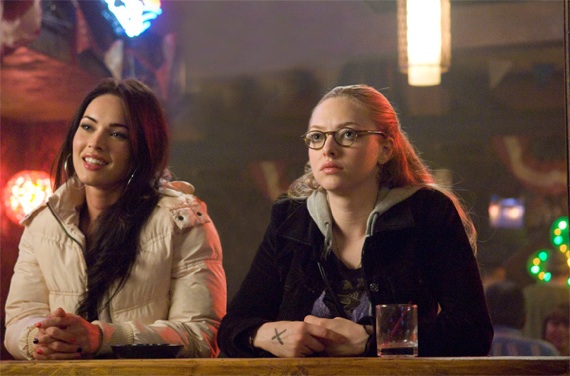
Jennifer’s Body (Karyn Kusama, 2009, USA)

The curious thing about the success of Juno (2007) was that it made the bigger star not of its director Jason Reitman, nor its lead actress Ellen Page, but its writer and creator Diablo Cody. Perhaps on a surface level this was as a result of the distinctiveness of its relentlessly verbose, heavily stylized dialogue, but looking beyond this the film’s lasting appeal derived from the fact that at its core was an original and captivating story which did not seek to patronise its viewers or descend into nauseous Sundance kookiness.

A move to horror is perhaps unsurprising for a writer whose first film name-checked Herschell Gordon Lewis and Dario Argento, and Jennifer’s Body betrays on Cody’s part a clear understanding of, and affection for, the High School Horror sub-genre. However, the precedent to which Juno owed the most to was Terry Zwigoff’s Ghost World (2000), and once again in Jennifer’s Body that film is a key reference point, foregrounding as it does an increasingly strained central relationship between two adolescent female characters. Anita – nicknamed “Needy” – is the caricature of the bookish nerd, but who has also enjoyed a close friendship with popular cheerleader-type Jennifer since childhood. They appear to share little in common, and their chalk-and-cheese relationship is met with bemusement by their peers, yet there is a ring of truth about it; how many childhood friendship are forged as a result of circumstance and location rather than personality?

One evening, the unlikely partners head off to a local bar to see a ropey indie band whose lead singer Jennifer has taken a fancy to, a man who it turns out has a fixation on whether his young fan is a virgin or not. Soon after the gig begins, the venue becomes engulfed in a massive fire, killing several people. Jennifer, in shock, is whisked away from Needy by the singer to his tour van, only to return to her concerned friend’s house late that evening covered in blood and ravenously hungry, seemingly in the grip of some form of possession. By the morning, however, Jennifer is seemingly normal again, only now much bitchier towards her friend and with an unhealthy appetite for promiscuity.

The film is exploring terrain similar to hormonal horrors, much closer to Ginger Snaps (2000) than to Carrie (1976), and it is praiseworthy that it tries to subvert the old horror paradigm of approaching the monstrous feminine through the mediating eyes of the male; in positioning Needy as our cipher and illustrating the conflict at the ending of her pre-sexual friendship with Jennifer, the narrative arc breaks away from the usual over-played phallic symbolism and tiresome gender-based tropes. Cody’s continuing examination of the relationships of young females through popular mainstream cinema should hopefully encourage other filmmakers to do the same, whilst once again her script shows a keen ear for witty dialogue, creating its own distinctive world of plausible if overly-articulate teenspeak.

However, while there is much to comment on in terms of its themes, the surface of the film falls down on several counts. Firstly, it appears that the confines of genre do the script little favours; the narrative freshness which made Juno such a pleasingly original watch is stifled when confined in the straightjacket of horror convention, and as such the film becomes something of a tiresome spectacle of predictable plotting interspersed with stray snippets of snappy dialogue. Megan Fox is well cast personality-wise as the dislikeable prom queen but is clearly not the physical embodiment of awkward adolescence, while Amanda Seyfried, nicely cast as Needy against her previous Mean Girls (2004) persona, lives up to her nickname far too much to be a likeable protagonist. As such, there is a central lack of sympathy which makes the revenge story trajectory much harder to sustain.

Karyn Kusama, whose previous work includes the under-regarded Girlfight (2000) and the overly-ridiculous Aeon Flux (2005), provides functional if unspectacular direction, never quite pitching the horror at the correct level of scare to sate the thirst of the genre fans, nor sufficiently getting to grips with the comedy to appease the Juno crowd, usually falling between the two stools rather uncomfortably. There are visual nods to Twin Peaks (1990), particularly in the contrasting warm/cold inside/outside lighting, but if David Lynch’s work is an intended yardstick, Jennifer’s Body is sorely lacking in bite.

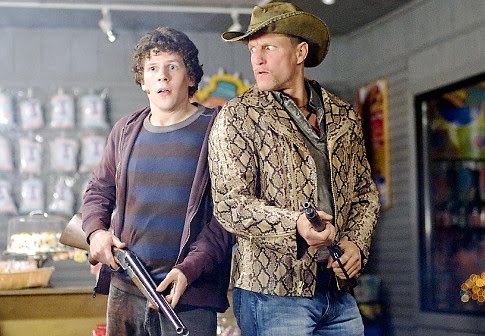
Zombieland (Ruben Fleischer, 2009, USA)

Thanks to a resurgence in its popularity following the box-office hits Dawn of the Dead (2004) and Shaun of the Dead (2004) earlier in this decade, the zombie film has been enjoying something of a renaissance in the past few years, culminating in the relatively low-key Zombieland topping the US box-office chart ahead of its bigger budget screen rivals. Its arrival is something of a significant one; while Shaun, and to a lesser extent Dawn, were clearly produced by die-hard fans of the genre, Zombieland’s existence appears to be largely a product of the increasing mainstream appetite for what could be happily dubbed the zom-com; in short, the undead have become socially acceptable.

The standard formula for this kind of film is a simple one: take some easily-identifiable stock characters, preferably of radically different demeanours and outlooks on life, throw them together and allow them to run amok in their newly-deserted surroundings, give them enough time to learn to rely on each other in a survival situation, add some witty one-liners and some inventive zombie deaths, and wrap things up fairly quickly before the audience starts getting twitchy. Easy, yes? Of course, it really isn’t that straightforward, and Zombieland, for its enjoyable performances and at times very witty script, fails to satisfy not for want of containing all of the above constituent elements but on a more basic, fundamental level – the underlying story really isn’t up to much.

Not that the setup isn’t without promise. We are instantly thrown into the immediately recognizable post-apocalyptic world of the undead, seen first through the eyes of a highly neurotic young man who explains that his very survival is surprisingly a result of these. He narrates us through his Scream (1996)-like list of rules key to the surviving of a zombie invasion, rules which will be pretty well familiar to anyone who has seen more than a couple of these films – fitness, making sure the zombie is fully dead, and the all-important observation of proper seatbelt-wearing procedures – the narration accompanied with the text of the rules graphically incorporated into the unfolding carnage. While it is hard to argue with the rules themselves, the exercise itself is gimmicky, mildly irritating and, on a purely practical level, not nearly comprehensive enough.

Our young guide wants to travel from Texas to Ohio to find out whether his parents have succumbed to the living dead or not, and eventually strikes up with a rather deranged truck driver, insistent that they refer to each other by the impersonal names of their hometowns, Columbus and Tallahassee respectively, in case one needed to expediently dispose of the other one. Tallahassee, it turns out, is also on a mission, though a rather less noble one: to find out if this post-apocalyptic world still contains any Twinkies before they all pass their expiry dates.

There is, however blackly, something inherently funny about a world being overrun by the living dead, and the film-makers here are clearly aiming for the audience’s funny bone rather than the cerebellum. In terms of comedy they largely succeed, thanks to their trump card of the choice of actors playing the two male leads – Jesse Eisenberg and Woody Harrelson. With the former playing an even more nervous Michael Cera and the latter seemingly playing a less restrained version of the his Natural Born Killers (1994) role, the two together make for as amusing a chalk and cheese duo as could be imagined; not only does the dialogue fizz with glee at their unlikely partnership, but both actors share a gift for physical comedy which is well exploited by director Fleischer.

Zombieland seems to tick a lot of other boxes too. The duration – a crisp 82 minutes – is on the money for a light comedy, and it is creditable that rather than carefully set up the world of the undead we are dropped immediately into it, dispensing with the all-too-common rigmarole of a long-winded prologue. Comedy is clearly what the director is best capable of handling, and in keeping matters light and frivolous never falls into the trap of either lurching into any kind of inappropriate sentimentality, or attempting to shoot anything genuinely nerve-jangling. Last but not least, a cameo in the film’s second half, while gratuitously shovelled into the storyline, offers some unexpectedly rich avenues of mirth – just wait for it.

Yet for all of what the film does right, there is too much of a lacklustre feeling to it all. Individual reels are fairly well self-contained, but the narrative threads linking them together are ragged and poorly thought out, and as such the film feels like a series of short sketches rather than a unified homogeneous story. One might easily forgive these inconsistencies in the plotting and tone if the film had more of a sense of charm or innovation, but these appear not within its ambitions. The film actually becomes a something of a bafflingly obtuse genre puzzle, for here is a film with horror elements but which isn’t even remotely scary, a road movie but which lacks any real sense of direction, and a character-based comedy but where the most clearly defined motivation is one man’s search for a sugar-rich cake snack. Eisenberg may be a funny performer, but his nerdy loser schtick was fleshed out much better in the recent Adventureland (2009), while the main female character Wichita is relegated to being the all-too-easily identifiable Hot And Fairly Kickass Horror Female. In sketching out such predictable, two-dimensional characters, when the film slows down and tries to form a romantic sub-plot, it falls woefully flat.

Zombieland entertains more than most comedies, largely thanks to its two leads, but the flaws in its conception and execution betray a certain degree of disingenuousness surrounding the film. The reflexivity of Columbus’ ‘rules’ appears to suggest an homage to the zombie movie genre, yet the film-makers fail to display this anywhere else; is the film therefore as much a superficial cash-in on contemporary big-name successes as the likes of Scary Movie (2000), Meet the Spartans (2008) et al? It is a mark of how far zombie movies have come from the realm of exploitation into the mainstream consciousness. But like the elusive Twinkie that Tallahassee is seeking to find, Zombieland may taste superficially deliciously sweet, but it leaves an uncomfortable sickly feeling in the stomach afterwards.

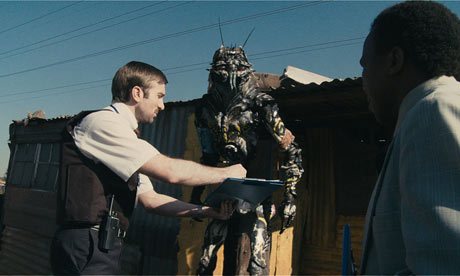
District 9 (Neill Blomkamp, 2009, USA /New Zealand)

It is reflective of both the great strengths and the weaknesses of District 9 that of all of the wealth of interesting things to say about the film, almost all of these are in reference to the film’s first half hour. Almost, since despite the disappointing shape the narrative begins to take after its astounding opening, it is still an intelligent, thought-provoking and above all entertaining film for the course of its duration; the problem is that it is possible to consider it a failure because the elegant brilliance of its exposition, and what that exposition appears to promise, is sadly not matched by the predictability of its later plotting. What a shame that the film has to settle for mediocrity above brilliance.

The opening half hour of District 9 is extraordinary in many ways, but primarily it is through its use of a simple device which subverts many of the rules of traditional science fiction storytelling. We begin with a familiar scenario: a large, monstrous alien craft has appeared in the sky. In the typical alien invasion film this would come as the first plot point, usually after a lengthy amount of scene-setting, yet here this is the scene-setting: we learn that in the film’s timeframe the craft has been hovering over Earth for over twenty years in which time its inhabitants, a reptilian species derogatively nicknamed ‘Prawns’, have been ghettoised by the military into their own city suburb, the shanty town-like District 9.

The film’s second coup is setting this not, say, in New York or Los Angeles where cinematic expectation would predict such events would occur – there is even a very sly reference to this very early on – but in the South African city of Johannesburg. In a stroke it becomes immediately clear that we are in the realm of the symbolic; most obviously the presence of a starved, segregated ‘other’ race living in squalid conditions raises the not-too-distant memories of apartheid, though significantly director Neill Blomkamp has distanced his film from being direct allegorical to this. I would agree; the broad elegance of the metaphor allows it equally to be representative of many other situations of displaced populations around the world – refugee camps, asylum seeker detention centres, and hauntingly the Sabra and Shatila camps rendered so vividly in last year’s Waltz with Bashir (2008).

The initial tone of the narrative is set by its aesthetic: a combination of mock documentary talking heads and rolling news style footage assembled with such skill as to make plausible its supposed coverage of an alien invasion – much like Orson Welles achieved with his The War of the Worlds radio broadcasts over seventy years ago. The documentary format serves the exposition perfectly, instantly setting up the back-story of the aliens’ arrival before thrusting the viewer almost immediately onto the front-line with Wikus Van De Merwe, an irritating, self-satsfied government jobsworth who through nepotistic favour has been assigned the important job of relocating the Prawns to a new camp further away from the city.

Wikus’ job, though, is not going to be easy, as the Prawns demonstrate staunch unwillingness to leave, even at gunpoint. Why? Is it attachment to what have been their Earthbound homes for over two decades, or something more sinister? Here things gets more complicated, as the film begins to shift from its sole reliance on an extremely subjective documentary viewpoint to start incorporating into the narrative omniscient cinematic shots showing the aliens inside their homes apparently hatching some sort of scheme, possibly involving weaponry. It is a confusing directorial choice: by initially sticking to the documentary format, the film draws the viewer into complicity with the prejudiced ‘human’ perspective on matters alien, offering what is a stinging satire of the bias inherent in populist media coverage. Yet by bringing in more traditional storytelling elements in at this stage, the effect, while also to advance the story, is to diminish the impact of the presentation of these early scenes.

It is significant that despite the frequent shifts in film style, the film remains coherent to the viewer. Is this reflective of the modern viewer’s ability to disseminate information from a variety of different types of sources near-simultaneously? Perhaps this makes District 9 a truly contemporary film – a product of a generation used to the constant background hum of YouTube and 24-hour news channels. The film is also strikingly up-to-the-minute in terms of its visual effects. To my mind at least, it feels like a true landmark in its seamless integration of CGI aliens into the ‘real’ world, aliens which look perfectly tactile in their movements and interactions with the tangible mises en scène. This ‘reality’ of the aliens is crucial to reinforcing the film’s initial feeling of documentary authenticity.

So far, so spectacular, but come an important plot point the film spectacularly veers away from what it has built to thus-far to morph into a hybrid of overly familiar science fiction tropes, among them the pseudo-Cronenbergian body horror, evil corporation parable, gung-ho guns-a-blazing action flick, and plain old sub-ET (1982) get-the-cute-aliens-home thriller. Gone, mostly, is the documentary aesthetic in favour of a fairly straightforward storytelling structure. Gone too is much of the subtext; the central idea that the presence of foreign invaders often makes monsters of us all is replaced with two simplistic comic-book villains – the private military body MNU personified by over-zealous bloodthirsty officer Venter, and a murderous, debased Nigerian gang led by the horribly two-dimensional warlord Obesandjo. Instead of examining the wider issues of integration and racial tension, the story cops out and instead focuses on a more easily digestible battle of clearly delineated ‘good’ characters versus ‘evil’ ones.

Why does the film take such a radical turn? There is an argument to be made for its structure, if one accepts that the focus of the story is not strictly socio-political or allegorical but largely focused on the central character of Wikus and his metaphorical road to Damascus. The plot forces him to see things from the Prawns’ point of view, and so his character sees a development from yes-man scaler of the corporate ladder to sympathetic, heroic mensch. The wider message of the film is consistent: the sympathetic portrayal of the aliens by the film’s end is in contrast to the earlier views of them which were narrow stereotypes created by populist media coverage stoking up racial tensions, in doing so the film asks us to look beyond these and realize the commonalities with ‘the other’.

At the story’s centre, then, is the person of Wikus Van De Merwe, and it is thanks to a superb performance from actor Sharlto Copley that the film is able to be carried by him through its many stylistic turns. Even ignoring his physical metamorphosis, his is one of the greatest transformations in recent blockbuster memory. When we first meet him his most significant attribute would appear to be just how unremarkable he is – a middle-ranking bureaucrat, fairly incompetent in performing his job, nervous in front of the camera and largely devoid of anything approaching a personality. Yet as the film progresses he slowly grows in stature and determination, and as sympathy for him grows as his snivelling is replaced with steely resolve we eventually wish to see him receive some kind of redemption.

As brilliant as its lead performance is, it must be said that the focus on this one character is the root of the main problem with District 9. It seems strange to criticize a film for concentrating too much on character as opposed to exposition, but by narrowing the field of view to one player the broadness of the story is lost, its central metaphor abandoned, and its innovation makes way for a predictable story trajectory. There are, in a sense, two quite separate films here, both operating within their own terms perfectly well, but the opening film serving to highlight inadequacies of the following one which in isolation may not have been noticeable. It is significant that the film began life as an expansion of a short film, and it seems that this has not entirely successfully been inflated to feature length. District 9 ultimately should be judged an entertaining, at least partially thought-provoking action-filled romp.. but it could have been so much more.