Inglourious Basterds (Quentin Tarantino, 2009, USA/Germany/France)

Rightly or wrongly, Quentin Tarantino continues to be in the unenviable position of being the one film director simply everyone must have an opinion on, whether it be the most highbrow of the critical oligarchy or the most casually infrequent of film-goers. Drawing a dividing line between his supporters and detractors is not a straightforward matter, since there is no one simple parameter which defines a Tarantino fan; his broad appeal seems to be a reflection of perhaps his greatest merit as a filmmaker: at his best, his work is a seamless marriage of inspired visual technique and pop culture referentiality, a complex patchwork of cinematic magpie-theft from which still emerges a coherent, distinctive whole, and one equally nourishing for both cinephile and mainstream audiences.

Fifteen years after the breakout of Pulp Fiction (1994), his much-imitated style has become so familiar that it is easy to forget that he is essentially still something of an experimental director, just one whose box-office receipts happen to match those of the blockbusters. Easy to forget, since each new film he releases comes under such intense scrutiny as inevitably to disappoint – it would appear that Tarantino’s biggest problem is that he must always work in the shadow cast by his previous artistic heights. By this measure, Inglourious Basterds unquestionably falls some way short of the director’s best, yet to use this as an excuse to dismiss it outright is facile at best; despite its structural flaws there are enough moments of characteristically idiosyncratic flair and invention, and some ideas about the medium of film itself, to raise it above the ordinary.

Once upon a time in Nazi-occupied France” reads the subtitle of the film’s opening chapter, and from this obvious cinematic reference we are thrust pretty well immediately into a very Leone-like fantasia of amorality, the world of World War Two in direct parallel with that of the spaghetti western . Predictably, the universe of Basterds bears as little relationship to actual history as The Producers‘ (1968) Springtime for Hitler, and naturally, this is not the point: this is not a war film – there are scant glimpses of actual combat – but neither is it simply pastiche of war films. At its centre is a film-within-a-film, a blatant piece of propaganda in the mould of Leni Riefenstahl, and illustrating one of the key underlying themes: how popular cinema has been used and abused as a political tool.

The film takes its title from the US title of Enzo G. Castellari’s Nazi exploitation film Quel maledetto treno blindato (1978) and how typical of Tarantino to juxtapose so-called ‘high’ and ‘low’ art; Riefenstahl, despite her allegiance to Hitler, is commonly held up as being a major figure in the development of film aesthetics, while Castellari is quickly written off as trash. But there is no doubt where Tarantino’s sympathies lie; here in Inglourious Basterds we are in the realms of exploitation, an alternative view of history where we are clearly not being invited to enter into a moral engagement with the evils of the Holocaust, just smirk with glee as a band of Jewish vigilantes enact revenge on German soldiers. Do people really think there a wider issue at stake here? If so they might want to revisit those Indiana Jones films with the same sobriety.

The title is something of a misnomer, since the vengeance-wreaking Basterds constitute but one part of the film’s multiple narratives, each divided off initially into their own chapter, before they eventually coincide in the denouement. We open with the story of dairy farmer Perrier LaPadite and his slow interrogation by specialist “Jew Hunter” Colonel Hans Landa. It is a magnificent bravura opening: slow, carefully paced, abetting the air of nerve-jangling suspense as Landa’s tries to draw out his cat-and-mouse game to discover LaPadite’s secret. The multiple-language dialogue is exquisite, the camerawork pitch-perfect, and the tone reminiscent of those famous first shots of C’era una volta il West (1968) where we are made to wait interminably for the inevitable explosion of violence.

The following chapters introduce a large cast of other characters. We switch to the battlefront and the titular band apart: the Basterds led by Brad Pitt’s ridiculously jaw-jutting Aldo Raine, and flanked most notably by baseball-bat bludgeoner Donny “The Bear” Donowitz. Their mission: to collect as many Nazi scalps as they possibly can, or die trying. Meanwhile in occupied Paris, Shosanna, seen earlier fleeing from Col. Landa and his troops, now runs a cinema and is courted by German war hero Frederick Zoller; it turns out he has had a film made about him, the première of which is rumoured to be being attended by the Führer himself, through which Shosanna sees an opportunity to exact revenge. On the other side of the English Channel, Lt. Archie Hicox is briefed by one of Churchill’s Generals of a separate plan to hijack the film’s première and nobble the attendant German high command, thus ending the war, a plan which involves actress and secret British spy Bridget von Hammersmark.

The astounding volume of characters and storylines goes most of the way to explaining the film’s long, frankly too long, 153 minute running time. There simply isn’t enough interest in all of these different strands or in how they combine, nor in the overall sweep of the film’s scope in order to justify such an epic length, and while the individual chapters are well-measured their cumulative duration detracts pace from the whole. Perhaps the stories, each of which is interesting in themselves, would have been better presented interweaved, as in Leone’s epics, a format which would allow a more textured, overlapping narrative structure. As it is, the heavily chaptered structure is episodic to the point of feeling like a portmanteau, and the over-expositionary nature of the early chapters makes the film feel unbalanced and stop-start.

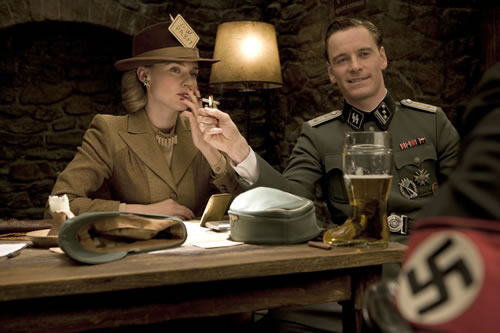
That the story strands are presented unbroken does, however, show off Tarantino’s skill as a writer. The best example comes in a scene set in the basement of a tavern, where von Hammersmark is ostensibly celebrating with friends but covertly conducting a rendezvous with her co-conspirators. The majority of the scene comprises a light-hearted card-game, the dialogue on the surface natural yet beneath the facade lurks a tension rooted in the fear of discovery. Much like the opening scene, the tension is expertly crescendoed until released with predictable violence. And yet, and it may seem absurd to level this as a criticism, there are too many of such scenes, most frequently meandering and not advancing the plot sufficiently. It smacks of a writer/director unwilling to sacrifice parts of the script best left out for the good of the film.

The wordiness, whilst something of a flaw, is also a point of interest. For a director whose signature trademark is his use of dialogue, whether expositionary or entirely incongruous, it is noteworthy that this is a film less about dialogue and more about language itself. Though plans are hatched around him, the one character who is shown to be most in control is Col. Landa, and much of this power derives from his mastery of different tongues: to comic effect in a later scene with his grasp of Italian, but also to tragic effect in the early scene where he switches between French and English to devastating effect. The Basterds are all-powerful when having use of a German translator, but later helpless when floundering without. Note also the sly nod to Gordon Jackson’s linguistic-based demise at the end of The Great Escape (1963) – in war, language can very seriously mean the difference between life and death.

As well as being mostly monolingual, the film’s other characters are painted with such broad strokes as to make Christoph Waltz’s Landa the closest thing the film has to a three-dimensional figure, and it is his performance which clearly stands out above the other thanklessly undemanding roles assigned to the cast. Whilst on the one hand ruthless and cunning, Col. Landa also possesses a charm and likeability which, if he were in a situation other than the one he is in here, might see him presented as a hero, lionized in much the same way as Zoller is by the German military establishment. He is presented as the least shallow in terms of his motivations: where others are driven by bloodlust or revenge, his is a more inquisitive drive, and as such is the most intriguing character, and is what saves the film from constituting a mere mass of caricatures.

The game of reference-spotting is of little interest to me, and the more overt mentions of Pabst, Clouzot, Emil Jannings and David O. Selznick, to name but a few, become like a tiresome reading of a checklist of names from 1940s cinema. But the film-within-a-film and the positioning of its screening as the central event which everything is building up to presents a reflexivity I don’t feel like we have seen in Tarantino’s work previously, and points to something approaching a mature understanding of the social, rather than aesthetic, functioning of the cinematic artform. As Stolz der Nation plays to the assemblage of both its own cast and the cast of Tarantino’s film, and as Zoller shakes his head at the inaccurate inadequacy of his how his story has been presented, one feels this dual-layered artifice hits upon a truth – that cinema of any kind is a falsification, and as such is inherently a manipulation of the viewer by the filmmaker. And, reductio ad absurdum, if there is no obligation for film to tell the truth then why not use it to blow Hitler up inside a cinema?


L’instinct de mort [Mesrine: Killer Instinct] (Jean-François Richet, 2008, France/Canada/Italy)

Here’s a film where the viewer is clearly drawn into complicity with a character’s on-screen misdemeanours; the first in a two-part biopic about notorious French criminal Jacques Mesrine, the relentless lightning-fast pace of Killer Instinct is only lightly abated by moments of quiet and stability, and when they do come so too quickly comes the desire to see the film return to action and violence, regardless of who is on the receiving end of it. This is a film based on real events, those shown being killed likely to be analogous to real people, and its central character, while certainly charismatic, is ultimately shown to be shallow and dislikeable – but within the confines of this thrill-ride of a film his criminal exploits make for compelling viewing.

Celebrated by some as a loveable anti-establishment rogue, the life of Jacques Mesrine points to a rather different story: a career criminal with a history of murder and armed robbery, a series of high-profile kidnappings and audacious prison breakouts saw him come to be labelled French ‘public enemy number one’. Like John Dillinger before him, with this label came an aura of outlaw-chic, and this along with a certain amount of self-aggrandizing publicity saw him achieve fame in his country’s popular presses as a kind of Robin Hood-like figure. The legend, though, bore little real resemblance to the cold-blooded reality; his mythmaking was rooted in the same kind of rose-tinted romanticism which deified common thugs like the Krays as underworld gods.

Mesrine’s martyrdom was assured when he was eventually ambushed and machine-gunned down by the police in what was widely viewed as a state-sponsored assassination, and it is this bloody demise which is the starting point of this first instalment. From the kitsch Bullitt (1968)-style split-screen presentation of these opening scenes one might be forgiven for thinking that what is about to follow is going to veer into hagiography, slavishly feeding into all of the mythology surrounding his name. What could be a more classically cinematic scene than the gun-toting icon stepping into a sports car with a glamourous girl by his side, only to be stopped in his tracks in a hail of gunfire, every bit the tragic hero?

Following this opening scene, Richet’s film then goes on breathlessly to recount episodes culled from Mesrine’s self-penned book Killer Instinct. We first have a glimpse of his formative years in the French Army in Algeria where he is drawn into torturing and killing prisoners, a hellish world far removed from his well-to-do suburban upbringing. Back in Paris sometime later, he is introduced to Guido, a gangster figure much more paternal to him than his biological father, and he begins to be drawn in to the underworld, committing ever-increasingly violent but lucrative endeavours. From here we are then catapulted into a cycle of crimes and incarcerations on both sides of the Atlantic.

The most immediate net reaction to the film is one of exhilaration; Mesrine’s life story makes for thrillingly cinematic viewing, and Richet’s direction guides us through it with the freewheeling storytelling ease of a Goodfellas (1990) and the gritty visual dizziness of a The French Connection (1971), quite the potent combination. Vincent Cassel, in the lead role and the one constant presence in the story, is given the task of anchoring the film and does so with effortless aplomb; his Mesrine alternately wriggles, snarls and charms his way through whatever he encounters, and though he bears little resemblance to his real-life counterpart this is quickly forgotten. His ability to turn on a sixpence from suave ladies man to bulging-eyed monster prevents the speed of the narrative leading to incoherence.

The main question outside of the film’s aesthetic pleasures, though, is just what does the film want to tell us about such an emblematic but problematic enigma? Lives of crime have, of course, long been brought to the screen from the pre-Hays Code gangster classics like The Public Enemy (1931) and Scarface (1932) onwards, and along with them have always come accusations of varying rabidity suggesting that said films glamourize such lifestyles to the point of making them morally justifiable and eminently desirable to the audience. It is an old argument which has a habit of resurfacing periodically, and one which has coloured a certain amount of the critical reception to Richet’s pair of films.

Yet with such a narratively straightforward film this becomes something of a complex question; there is an emotional obliqueness to the Mesrine of Killer Instinct; the narrative seldom slows up for long enough to dwell on either his material status or the consequences of his violent lifestyle before hurtling into another action-packed incident. Strangely, I was reminded of Steven Soderbergh’s Che (2008) biopics, tonally very different pieces of work, but both notably unwilling to offer anything in the way of inner psychological insight into their subjects. I am not suggesting that Richet has anywhere like the reverence for Mesrine as Soderbergh has for Guevara, but both seem to be more interested in outside perceptions of their biographees rather than trying to hit on any internal truths. The other consequence, though, is that if the story doesn’t pause long enough to illustrate any great emotional depth, then neither does it have time to dwell on the very real moral and physical consequences of his lifestyle.

Along the way of his remarkable story, there are shown the familiar items of glamourous criminal iconography in Mesrine’s lifestyle: a globe-trotting itinerary, guns, fast cars and of course women. At the same time these are shown to be always transitory elements in what time he spends outside of the series of ever-increasingly oppressive prisons he comes to occupy. Women come and go: a prostitute he has been conducting an affair with meets with inevitably violent consequences, a Spanish wife finds herself unable to live with his criminal lifestyle and falls victim to his violent behaviour. Eventually comes along Jeanne, a woman with an equal taste for the seditious life, Bonnie to his Clyde, but even their relationship is tinged with fatalism. Nor do the financial rewards seem great: Mesrine is hardly shown to be enjoying anywhere near the likes of Tony Montana’s material wealth.

The film, then, is neither a straight hagiography nor an outright condemnation. Though only lightly touched upon, the filmmakers have chosen to show how Mesrine was to a certain extent shaped by the wider politics of mid-twentieth century France: his early exposure to nihilistic violence in Algeria, the influence of Charles De Gaulle’s troubled premierships and Mesrine’s subsequent dalliances with the extreme right wing OAS group, and then his apparent politicization as a result of the barbaric prison regimes he suffered under. As the story progresses we do at times see him attempting to forge a life for himself outside of crime, only for economic or political circumstances to tempt him back in: while this is shown to be more than partially a personal choice of his, nevertheless he is also shown to be significantly straightjacketed.

Killer Instinct pays homage to Scorsese both visually and narratively, but so too in terms of its central subject matter: a dislikeable sociopathic misfit who achieves popular fame through violent means. There is a touch of Travis Bickle, Jake LaMotta or Henry Hill to Jacques Mesrine, but most tellingly there is also something of Rupert Pupkin from The King of Comedy (1983), Scorsese’s ever-prescient satire of the nature of modern celebrity. In presenting only what seem like cold facts about Mesrine’s life, Richet’s film allows the audience to confer him an heroic status. This, I think, is why I think the film is so effortlessly entertaining: watching Mesrine’s amoral exploits goes to the heart of the perversity at the core of our voyeuristic, vicarious love for crime and criminals: a love divorced from bloody reality and instead steeped in detached spectacle.

Orphan (Jaume Collet-Serra, 2009, USA /Canada/Germany/France)

The second film within two weeks to take the death of a child as its starting point, although Orphan would seem to have little in common with Von Trier’s Antichrist (2009). Or does it? The latter merged the uneasy bedfellows of Strindbergian chamber drama and occult horror to produce a fascinatingly obtuse whole, and Orphan appears to be trying to do something similar in its melding of family melodrama, thriller and recognisable bad-kid horror genre tropes. Yet the intriguing premises and a well-paced first act slowly dissolves into a jumbled mess in the hands of director Jaume Collet-Serra, though admittedly at times something of an enjoyably silly mess, and one whose merits make the film an oddly rewarding, if severely flawed, watch.


Kate and John Coleman are a well-to-do couple living in what seems to be a wintry suburban idyll with their two children, daughter Max and son Daniel. A pleasantly surprising wealth of characterisation in the film’s first act firmly establishes their individual personalities and the dynamic between them. Kate is a caring mother but with certain foibles, most notably a history of alcoholism and lingering emotional scars from a recent stillbirth (a creepy opening nightmare sequence makes this abundantly clear) while John has a history of philandering; their all-too-human flaws understandably result in a residual undercurrent of mutual mistrust between the two. Though close to Max, they are a little distant from the adolescent Daniel, who is just beginning to assert his own separate personality.


Presumably to help them with their grief, as well as overcome their marital difficulties, the couple have decided to adopt a child from the local orphanage, and on visiting are drawn to a bright, precocious, if eccentrically attired Russian girl named Esther. They immediately decide to take her into their family, but their new addition has some difficulty settling in: picked on by her new schoolmates for her strange clothes and withdrawn personality, and viewed with suspicion by Daniel who is perhaps jealous of the attention being foisted on the new arrival. Then, of course, strange happenings begin to occur: Esther exhibits a variety of odd behaviours, has a habit of being around when others are involved in ‘accidents’, and so too repeatedly shows up to interrupt her adoptive parents’ primal scene.


All of this is surprisingly well-handled by director Collet-Serra, whose ignoble oeuvre has so far consisted of previous duds House of Wax (2005) and Goal 2: Living the Dream (2007). Yes, there are problems: the glossiness of the visuals do at times make the film resemble more closely an advert for a high-spec saloon car, and at times the scare scenes are so clichéd and badly handled that they come across as being more for camp value rather than tone. But in building suspense through character, with some well-observed performances from the Coleman family members, and by marshalling a stately pace, he allows the film’s first half to build to a satisfying crescendo of tension.


Here, though, is where the problems begin to stack up. Having done most of the hard work in setting up believably flawed characters and a mysterious ambiguity around Esther, the film suddenly dives into exploitation, with the little monster scurrying around doing all sorts with bricks, hammers, vices and guns. While this does make for entertainingly schlocky viewing, it also has the effect of disjointing the narrative and the pacing, and from its intriguing, promising start the film slowly descends into well-trodden formulaic nonsense, with plot points carelessly thrown against the wall in the hope that some stick, and a rush to a helpfully expositionary phone call to Russia to explain things away before Esther’s big reveal. The sub-par slasher film denouement ultimately leaves the viewer feeling heavily short changed, and adds to the feeling of cheapness that a 123 minute film can ill afford.


What a shame, though, that the film ends up such a horrible mess, since there is much to recommend of it. The two adult leads, Vera Farmiga and Peter Sarsgaard, make for a believably dysfunctional couple, and their young children are also both fleshed out in terms of personality much more than one would expect for such a genre piece. Stealing the show, inevitably, is young Isabelle Fuhrman in the title role, whose initial radiance morphs into a beguilingly stony-faced monster who can well be believed to be either angelic victim or murderous manipulator. Director Collet-Serra clearly has ambitions higher than his previous studio vehicle output might suggest, and this goes some of the way to suggesting that there is an intelligence behind his camera, but Orphan‘s manifold flaws show that there is still much work to be done.

Antichrist (Lars von Trier, 2009, Denmark/Germany/France/Sweden/Italy/Poland)

I know of more than a few people who are able to watch Nicolas Roeg’s majestically unsettling Don’t Look Now (1973) and not be moved by it. Worse still, aside from the happenings in its oft-criticized denouement, the film’s lack of conventional scares lead some to consider it not to be a ‘horror’ film at all. This, of course, depends on one’s expectations of the genre, and those who go into Roeg’s film wanting to see a thrill ride more akin to Halloween (1978) will be blinded to its powerful psychological message: that in the wake of the loss of their child, the central grieving couple are not only thrown into a sorrowful mourning, but what also becomes manifest, in the husband in particular, is an overwhelming feeling of powerlessness in the face of fate’s arbitrariness, allowing a previously unerring belief in rationality and order to be shaken to its very core.

I take time to mention this in relation to Antichrist for a number of reasons. Firstly, it shares the same jumping-off point and covers similar psychological terrain as Don’t Look Now: a grieving couple trying to come to terms with their loss but in radically different ways from each other. Secondly, like its illustrious British predecessor, it is an unconventional film whose combination of familiar horror tropes with arthouse leanings inevitably harkens back to the earlier era of auteurist horror films made in the wake of Rosemary’s Baby (1968), the period from which contemporary horror gained its hard-won critical reputation. And like Roeg, director Lars von Trier is an experimentalist, interested in playfully deconstructing cinema and reconstructing it in his own image rather than aping what has come before.

However, a word of caution. For all of his talents, of which even his greatest detractors cannot deny, there is always an element of mischief surrounding von Trier’s work, a sneering cynicism typical of many postmodern pranksters which leads to a widespread suspicion among critics as to how honest his artistic intentions are. Is he an enfant terrible whose films are Nabokovian chess puzzles intended to stimulate debate, or merely a disaffected self-publicist, a directorial equivalent of Dennis the Menace?

Ever since its début at Cannes earlier in the year, Antichrist has been variously labelled offensive, misogynistic, pornographic and sadistic, and, as is their wont at Cannes, was met with boos and laughter from the gathered audience of festival attendees. Since then, the more reactionary elements of the media have been predictably up in arms about its content, creating the storm in a teacup of controversy which the director presumably intended. As such, not only is it impossible now to approach the film without the shackles of preconceived genre conventions, but also without prior knowledge of the film’s more graphic content, and hence losing some of the shock value. As blogger Matt Singer put it, “it’s the difference between walking into an ambush and walking to the gallows”.

The story, should we forget to mention it, goes as follows. A couple, who for the duration remain unnamed, are making love in the shower when their young son in another room manages to climb out of a window and fall to his death. The He, in his capacity as a practicing psychologist, somewhat unwisely elects to treat the She using exposure therapy, trying to isolate and contain her irrational fears. After prolonged examination, it emerges that these relate strongly to nature, and specifically to Eden, the couple’s cottage set in remote forestland, and where they proceed to travel to as a final stage of her treatment. It is here, though, that things begin to go awry, certain sinister things are discovered and the film veers from psychological realism into the realms of the supernatural.

As with the director’s Dogville (2003), the fact that Antichrist is explicitly divided into chapters immediately admits the artificiality of its construction. As Chapters One and Two, entitled “Grief” and “Pain”, could easily be seen as a cross between Don’t Look Now and a sombre Bergman chamber film, the structure clearly delineates between these early scenes and the later more surreal and violent final two chapters, “Despair” and “The Three Beggars”. A very poorly written article in the Daily Mail argued that the film’s tonal shifts meant it would fail to satisfy horror fans and the arthouse crowd alike, as if these two were mutually exclusive – presumably the writer has not seen a horror film since Repulsion (1965). This is, though, symptomatic of why the film which fool a good number of film-goers into thinking it is something it is not; essentially what we have here is an old-fashioned occult horror film, shrouded in rather messy Christian symbolism, and made to look like something more austere; not so much a wolf in sheep’s clothing as a talking fox so attired.

Antichrist may well be better defined in terms of what it is not rather than what it is. The film’s violent content is not gratuitous, contrary to what may have been said elsewhere. Yes, it would be if in isolation, or if framed within the film differently, but by the time it arrives we have gone so deep into Biblical symbolism that it cannot be taken literally – except perhaps by those Biblical Literalists who also believe in such things as 7-day Creation and a Noah’s Ark with animals going two-by-two. The film’s famous scene of self-mutilation, whilst graphic, on reflection serves as a logical peak for the crescendoing horror, and brings a bizarre form of catharsis in the viewer. Michael Haneke’s more clearly sado-masochistic The Piano Teacher (2001) had more of a case to answer in this respect. If I have an issue, it is with the very early insertion of a shot of hardcore sex in the film’s prologue, which seems to add little to what is already a beautifully intimate scene.

Is it in fact a trap to take the film seriously at all? So much of modern film theory, particularly with regard to horror cinema, is informed by psychoanalysis, in particular Freud and Lacan, yet it is clear from the stilted, emotionally repressed character of the film’s He the contempt von Trier has for such methods. Is this poking fun at a predicted critical application of the likes of Barbara Creed’s concept of the monstrous-feminine, or Laura Mulvey’s ideas about sadistic-voyeurism? The very explicitness of the script’s discussion of the supposed alignment of the female and ‘Evil’ is so over-the-top as to render the accusations of misogyny as laughable – films that are genuinely misogynistic are never so obvious as to contain conversations about it.

I can see why some critics see the film as a trap, but I think it is more of a playful game between the director and his audience. The closing dedication to Andrei Tarkovsky was laughed at at Cannes and seen as like the bad punchline to a terrible and long joke. Anthony Dod Mantle’s breathtaking camerawork, from the hyper-stylised super-slow motion monochrome prologue through to the eerie Lynchian abstractions in Eden at times betray a clear visual debt to the Russian auteur, but the real debt is in terms of pacing and structure, and the sometimes dream-like illogic into which the film drifts repeatedly made me think of Mirror (1975). Yet for Tarkovsky, nature equalled serenity whereas here for von Trier it appears to represent ‘Satan’s church’, surely a more Herzogian view. Maybe the joke is on me too.

Antichrist is so deliberately contrary a film that analysing it in traditional cinematic terms seems foolhardy. Yes, the acting is great, the cinematography stunning, the story gripping and resolved in terms of its own admittedly twisted internal logic. At the same time, it is confusing in terms of what message, if any, it is trying to communicate, and the feeling of directorial disingenuity is sometimes hard to escape. It is hardly a film I could easily recommend anyone to watch. Yet all I can say is that after the film I left the cinema both with my stomach in knots and my imagination fired, and that this is something which happens all too seldom.

Looking beyond the canon

One of the great difficulties when writing about film history, as with doing any other type of history, is the need to strike a balance between on the one hand positioning the film(s) in question within the broader framework of a coherent historical narrative, whilst on the other hand making sure one is not falling into the trap of applying too reductionist a view of the context in which one is placing said texts. The most difficult aspect of this to overcome is the idea that there exists such a thing as ‘the canon’, that unspecified number of films which are considered as both artistically significant in isolation, and as important to the development of film as an art-form worthy of serious consideration.

As an illustration, consider the recent poll of the ‘Greatest Films’ undertaken by Iain Stott over at The One-Line Review blog. Unlike the decennial Sight and Sound poll which asks for contributors’ top ten films, this poll expanded the number to fifty in the hope of spreading the net wider to include personal favourites alongside the usual canonical suspects. As the S&S poll has done since 1961, the survey was inevitably topped by Orson Welles’ Citizen Kane, that perennial favourite perceived as only being enjoyed by the critical elite rather than the wider public. Elsewhere, the rest of the top fifty predictably consists of recognizably canonical films, and only one made after 1990 (Pulp Fiction), another symptom of the tenedency for older films to domniate such lists, a phenomenol which Adrian Martin refers to as ‘the Citizen Kane canon’.

Yet beneath this apparent tacit agreement with traditional view of film history, the real devil is in the details: of the 3037 films suggested, over half of them were suggested by only one of the 187 participants. Whilst weight of numbers favours the ‘great’ films, there is an underlying diversity of opinion which is under-represented in the collation, but can be seen to exist outside of traditional top ten polls. Stott’s next project is entitled ‘Beyond the Canon’, and seeks aims to look beyond the paradigmatic view of the story of cinema and highlight these less well known but important films. After all, regardless of their critical stature, are not the most important films those which we have the greatest personal connection to?

For more information, and details on how to submit suggestions, see here: http://beyondthecanon.blogspot.com/