Decisions decisions…

It’s easy to tell that awards season is upon us, as a host of great films have crept their way into cinemas nationwide over the last few weeks. But this has the unfortunate effect of creating a certain degree of cinema fatigue amongst film-lovers this time of year. No better example of this than yesterday, dubbed ‘Super Friday’ by The Guardian’s Peter Bradshaw, who awarded 5-star reviews for three new releases – Juno, The Diving Bell and the Butterfly and There Will Be Blood.

Though all very different films, there is some major crossover in the potential audience for these three films (i.e. me). So will they all suffer from having to compete against each other? I hope not, as they all look remarkable pieces of work, unfortunately by dint of some poor organization being released on the same day here in the UK. Their US release dates were:

The Diving Bell and the Butterfly: 30th November 2007
Juno: 25th December 2007
There Will Be Blood: 11 January 2008

i.e. nicely spaced out, so as to avoid any overlap for the arthouse audience. They do this with the summer blockbusters, too, so they do not clash with each others box-office returns. So come February next year, can someone please sort it out so that we poor cinema-going folks don’t have to go to the pictures three times in one weekend just to keep up with the good stuff?

Great Films: Offret [The Sacrifice] (Andrei Tarkovsky, 1986, Sweden / UK / France)

Andrei Tarkovsky’s rather intimidating critical reputation rests on just seven feature films, of which The Sacrifice is chronologically the last, completed and released shortly before his untimely death in 1986. And in many ways this swansong can be considered his crowning glory, a bold, striking work rich in ideas, artistry and humanity, and one which is very distinctly ‘Tarkovskian’ in style.

To try to make out a clear conventional narrative thread through a Tarkovsky film is like trying to look for belly laughs in Schindler’s List; you ain’t going to find a lot. But The Sacrifice is his most straighforward of stories; the film is set in an unnamed Swedish coastal village, much like the island of Faro, where filmmaker Ingmar Bergman chose to retreat to in his later years. Alexander, an ageing atheist who lives on the island, is telling his young son a Zen-like parable about the planting and nurturing of a tree. The local postman (and doctor) cycles by, and offers up a discussion of Nietzche’s idea of eternal recurrence, which seems to chime with Alexander’s story. Visually, we are awash with tranquil seascapes and lush greenery.

It is Alexander’s birthday, and a small group of friends and family gather at his house. Discussion turns to his acting past, which then leads to a strange story about a lady who loses her son in a war, only to find him appearing in a photograph some twenty years later. Inside the house, the screen begins to asssume more desaturated, darker tones, which foretell what is to come; uncontrollable shaking in the room signals jets flying overhead, and in a nightmare-like sequence, we hear the official announcement that this is because some kind of nuclear armageddon has been initiated. As a mixture of hysteria and resignation overcomes those present, Alexander begins to question the nature of his lack of faith, but appears to be shown a possible way-out, the sacrifice of the title.

Loaded with religious symbolism, the film tries to show how man reacts when faced not merely with a spiritual crisis, but one brought on by the seemingly arbitrary annihilation of everything and everyone he loves. There are references to other Christian-inspired pieces of art, notably Leonardo’s The Adoration of the Magi and Bach’s St. Matthew’s Passion, and this is clearly Tarkovsky’s own attempt to find religious expression through his chosen medium. It is perhaps ladelled on a bit too heavily at times; his visit to ‘Maria’, the supposed source of his possible redemption, teeters over the edge of subtlety, though it the scene is thankfully visually spare.

That the film is set on a Faro-like island is of great significance, as the spirit of Ingmar Bergman is ever-present, in part also to the presence of legendary Swedish cinematographer and long-time Bergman collaborator Sven Nykvist. The dialogue, in particular towards the start, has the air of the great master director’s work, in particular the films of his ‘Faith Trilogy’ of the early 1960s. The collaboration with Nykvist, who was DP on those three films, produces an interesting mixing of styles; the Swede’s trademark naturalistic lighting adding a mysterious air to Tarkvosky’s almost balletic, rhythmic long takes. The Sacrifice is famous for having one of the longest Average Shot Lengths in cinema history, some 72 seconds, one of the opening shots alone lasting nine and a half minutes.

Critics of the film may suggest that it is in fact overly stylised, and too Bergman-like in places. The symbolism, as mentioned above, is very heavy at times, but there are also moments of extreme painterly beauty, shots worthy of a Vermeer or Rembrandt painting. The transition from the lush, rich-hued palette at the start of the film, to the dark, menacing tones through the bulk of the middle apocalypse section is one of the most successful stylistic contrasts in cinema history. In one scene, Alexander tells a story about how he tried to tidy his dying mother’s overgrown garden for her, but once he had finished, he found the ‘order’ he had created to be ugly; this story, and the film as a whole, underlines Tarkovsky’s love of the natural world, the divine order which seems at times in contradiction to man’s destructive wills.

Andrei Rublev and Solyaris are generally regarded as Tarkovsky’s masterpieces, with The Sacrifice seen as being too difficult a watch, and possibly too flawed. But the film’s end dedication is the clue to its mysteries, and its contradictions: to his son, Andrejusja, “with hope and confidence”. Tarkovsky knew he was dying when he was making the film; perhaps it is best read as a message to his son, the culmination of a lifetime’s experiences, joys and sadnesses, with the wish that he would be always able to learn from it.

Peter Bradshaw has definitely been smoking something…

..judging from his Guardian review of ‘Aliens Versus Predator: Resurrection’:

“But perhaps it is time to extend this face-off principle to other kinds of cinema. We could have an action-horror with Keira Knightley from Atonement battling Helena Bonham Carter from A Room With a View, the delicate porcelain of their English complexions flecked with spittle and blood as their jaws extend into slavering mandibles, from which lesser rows of teeth would extend as they rampaged around the Tuscan countryside fanatically trying to kill each other.”

Quite the image.

Before the Devil Knows You’re Dead (Sidney Lumet, 2007, USA)

Sidney Lumet is the very definition of a ‘veteran director’, having been making films since 1957’s Twelve Angry Men, more than half of the duration of cinema’s relatively short history. Along the way, he has given us the likes of Serpico, Dog Day Afternoon, The Hill and Network to name but a few. However, the latter, the last of his great films, came in 1976, and has been off the boil for quite a significant time; the dire likes of A Stranger Among Us, in which Melanie Griffith has to solve a crime by going undercover in the Hassidic Jewish community, seem almost too ridiculous to be true. So it is with a degree of relief to report that Lumet’s new film, Before the Devil Knows You’re Dead is a perfectly watchable thriller, intruiging in design, and a set of strong performances from its leads. But, contrary to some opinions, it is no masterpiece.

Familial ties never looked so close, or as strained, as they do here; Andy and Hank, Philip Seymour Hoffman and Ethan Hawke respectively, are brothers who are both in dire need of money: Andy to feed his out of control spending on his drug habits, Hank to pay his estranged wife and daughter. Andy has a seemingly simple plan: to rob a ‘mom and pop’-run jewellery store when the owners are out and a half-blind old lady is looking after the place; the insurance cover would make the crime essentially a victimless one, he adds unconvincingly. There is, however, one problem: it is their parents’ store. Things inevitably go horribly wrong, and the brothers find themselves in more than a spot of bother.

The film is contructed in an unusually non-linear way; we begin with the robbery, but time jumps backwards and forwards through the course of the film, revealing new details about the relationships between the brothers, their parents and various third parties, most significantly Andy’s wife, played by an almost perpetually topless Marisa Tomei. While initially this seems an interesting device, coherently guiding us through the narrative, it eventually runs out of steam, jarring past the first half of the duration.

Philip Seymour Hoffman is undeniably the greatest character actor working in Hollywood today, and here again he delivers a new, unique, fully-fleshed-out character from his seemingly bottomless stock of personalities. The relationship between himself and Ethan Hawke’s Hank is suitably tense, with the believable air of a slightly frosty fraternal bond, despite the complete lack of mutual physical resemblance. Albert Finney as their father is solid as ever, though his role is slightly thankless, as is Marisa Tomei’s.

Some reviews have gushed about the film, raving about its tight construction, moral unsettlingness and its suspenseful air of tension. Some of these have overstepped the mark somewhat; Before the Devil Knows You’re Dead is an impressive piece of work, especially for an 80-plus year-old director whose recent form has been so poor, but it is also strangely unsatisfying, not sufficiently fleshed out in parts, and thinks itself a little too clever for its own good.

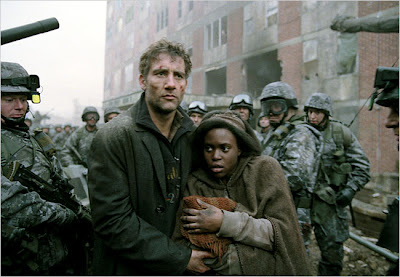
Great Films: Children of Men (Alfonso Cuarón, 2006, Japan / UK / USA)

“What happens to the world without the sound of children’s voices?”

So asks one character, a former midwife, now living in a sterile world where women are unable to bear children, in this, Alfonso Cuarón’s superb imagining of P.D. James’ novel. The film takes this central premise of the book and runs with it, in doing so asking many questions about the nature of existence: what happens if man is denied a future? Are religions, political ideologies and dogmas strengthened or weakened by this? And if there is hope, how do we react to its possibility?

The film posits this premise from shot one: our protagonist Theo walks into a cafe and is surrounded by people transfixed by a television news report, which is stating that the ‘youngest human’, the last to be born before the entire world went infertile some eighteen years ago, has died. This device neatly presents us with a wealth of information about the dystopia we are entering. Similarly, the London street that Theo walks onto afterwards informs us about this future world, one not too dissimilar to the present. The year is 2027, and while technology has advanced somewhat, this is closer to the present than the likes of Blade Runner.

Ridley Scott’s future noir is an interesting reference point, as there are echoes of the jaded, washed-up blade-runner Deckard in Clive Owen’s Theo; he seems to a large extent to have given up on life and happiness, and is now just a rather aimless alcoholic, overly cynical and sarcastic. A politically active past is alluded to, in particular when he goes to visit his friend Jasper, an ageing pot-smoking hippy now retired in the countryside, but he now seems to have abandoned that for a boring pen-pushing desk job. Even nearly being caught up in a terrorist bomb blast seems not to traumatise him overly. Has this childless world brought this nihilistic state of being upon him?

Although the source P.D. James novel was written in the early 1990s, this is very clearly a post-9/11, post-Iraq film in much the same way as Juan Carlos Fresnadillo’s 28 Weeks Later was; after a mass influx of refugees, Britain has now become a police state, with the powers-that-be now systematically rounding-up and deporting all immigrants. Bexhill, in reality a quaint seaside resort on the south coast, has now been tranformed into a nightmarish refugee camp, quarantined off from the rest of the country. Echoes of the Holocaust and Guantanemo Bay are all pervasive, and there is one haunting shot which is a clear visual reference to the US Abu Ghraib prison in Baghdad.

The bomb blast which Theo narrowly avoids is officially attributed to a terrorist group named ‘the Fishes’, which is opposed to this policy of explusion. Theo is soon contacted by this group, who it turns out are led by his estranged wife Julian, who want him to use his position to procure a travel permit for a young refugee. It soon transpires why this refugee is so important: she is pregnant, and the group want to transport her to ‘the Human Project’, an anonymous offshore group of scientists who are apparently working on curing the infertility problem. The film then essentially becomes a road movie cum chase movie, with Theo quickly realising that no-one else can be trusted with this precious cargo, and must attempt to safely escort the refugee Kee to their mysterious destination.

Director Cuarón has frequently stated that he considers this a sister piece to his earlier breakthough hit Y tu mamá también (2001). On a superficial level, this almost seems absurd: what can a low-key road movie about two young friends travelling across Mexico and discovering their sexuality possibly have in common with this futuristic dystopian fantasy? But look beyond the genre stereotypes, and the commonality is surprising. Both films show intially jaded protagonists embark on journeys of self-discovery, against backdrops of social upheaval, ultimately ending in a combination of tragedy and hope, however small. The journeys themselves are what is important, not the rather open-ended denouements.

While the London of 2027 is perhaps not much of a fully-realised world as compared with other celluloid imaginings of the future, this is utimately because it doesn’t need to be; there is none of the hollow flashiness of the likes of A.I. or I, Robot because the focus of the film is the human drama at its centre, not necessarily the context, giving the film more of a feel of universality. Where context is more obvious, it is when its post-9/11 commentary is more explicitly being made, and here the viewer will decide either to go with its politics or be alienated from it. Personally, I was happy with the anti-anti-immigration message, but it will be troublesome for some.

Three of the central characters, Julian, Theo and Jasper, appear to be three variants of the same personality. The former husband-and-wife pairing Julian and Theo share a common past, and at one stage shared political ideals – Jasper explains they met at a demonstration – but their lives at one unnamed point diverged, Julian’s to underground activism, Theo’s to resigned acquiescence and passivity. Jasper too was politically aware, a product of the heady revolutionary days of 1968; but just as that near-revolution was defeated and eventually fizzled out, deprived of hope, so too was the revolutionary instinct in Theo. The students of ’68 wanted to change the world, but that impulse is ultimately dependent on there being a future, creating a better world for a following generation. Remove this hope, and what is the point of political idealism?

If politics is rendered neutered, then so too is history, if history is the prism through which looking at the past allows us to envision and, to an extent, shape our future. One scene in particular neatly expresses this idea. When Theo attempts to procure transit papers for Kee, he goes to visit his cousin Nigel, in his ivory tower at Battersea power station. There we see he has procured some of mankinds greatest artworks: Michelangelo’s David adorns the entrance, while on one huge wall of the dining room hangs Picasso’s Guernica. But deprived of a context, and denied a future, these great works are rendered meaningless – one, a marvel at human beauty, and the other a howl against human brutality, will be nothing without anyone to observe them.

There are many, many possible readings of this film; i have not even mentioned the possible religious interpretations and symbols. But ultimately one takes from the film what one brings to it, and whether one sees it as a pessimistic view of the natural decline of human values when faced with utter despair, or as showing the triumph of hope in the face of almost inevitable doom, will depend on ones own personal outlook on life. But what a remarkable piece of mainstream filmmaking, how rare that a piece of cinema this bold, intelligent and rich can come successfully to fruition.